
Squeeze Kernel Covariance Estimator




A streaming covariance estimator for panels of financial returns that learns fastest on the days that matter. One O(n²) update per period, positive semi-definite by construction at every step, missing values handled natively, and defaults that require no tuning. Only dependency: NumPy.
References: "The Squeeze Kernel Covariance Estimator: Dual-Timescale Tracking with Adaptive Shrinkage" (Kende, 2026) — SSRN abstract 6455918 — and its companion "Cluster-Respecting Shrinkage for Streaming Covariance Estimation" (Kende, 2026).
Why
Every standard covariance estimator treats all trading days as equally informative. Markets don't work that way: correlations reveal themselves when markets move; calm days are mostly noise. The Squeeze Kernel weighs each day by the information it actually carries — quiet days barely count, dispersion shocks pass through in full — and runs volatility and correlation on separate clocks, so vol spikes never contaminate the correlation estimate. The result is a single streaming recursion that:
- is PSD at every step, structurally — never needs eigenvalue clipping, nearest-PSD projection, or a solver;
- adapts fastest exactly when it matters — a Fisher-information kernel up-weights high-dispersion (stress) days, when correlation regimes actually move;
- regularises itself — an adaptive equicorrelation shrinkage activates automatically as the asset count approaches the effective sample size, with a provable condition-number bound;
- ingests missing values natively — listings, delistings, and halts enter as
NaN; no imputation or complete-case subsetting; - is fast — a full 30-year daily pass takes ~0.75 s at n=100 and ~3.4 s at n=300 (single-threaded), 30–40× faster than rolling-window baselines at scale.
The scoreboard. On a 30-year S&P 500 panel (~7,600 out-of-sample days) the default single-scale estimator beats EWMA, Ledoit–Wolf, OAS, nonlinear shrinkage, RMT denoising, and the Gerber statistic on one-step density forecasts, and statistically ties DCC — the only two methods in the 90% model confidence set. The headline configuration (multi-scale correlation memory, corr_half_lives=(43, 173, 693)) goes further: it leads every tested method at every universe size and the 90% model confidence set collapses to it alone, with the margin confirmed out-of-time on an external industry panel. For large equity universes, the cluster shrinkage target (shrinkage_target="cluster") adds a further large gain exactly where shrinkage binds: 25 NLL points at n=300.
Against the alternatives:
- RiskMetrics / EWMA — same one-recursion simplicity, but two clocks and information weighting: better forecasts at zero extra operational cost.
- Ledoit–Wolf, nonlinear shrinkage, RMT denoising — static snapshots refit from scratch on a rolling window each day; the Squeeze Kernel is genuinely dynamic, more accurate on the benchmark, and 30–40× faster at scale.
- DCC-GARCH — matched (single-scale) or beaten (multi-scale) without multi-stage likelihood fitting or the fragile news-impact coefficient; at n=300 DCC needs a multi-year warm-up before its forecasts stabilise and still trails by ~25 NLL.
- Gerber statistic — the Squeeze Kernel is a PSD-by-construction generalization of the same robust-comovement idea: no nearest-PSD repair step, and it wins the head-to-head.
See the difference
Take a passive strategy any allocator would recognize: a long-only minimum-variance portfolio of 300 liquid US stocks, scaled to a 15% volatility target, rebalanced once a month, with 5 bps trading costs. Run it twice on identical data. The only thing that changes between the two runs is the covariance matrix that picks the weights and sets the exposure.
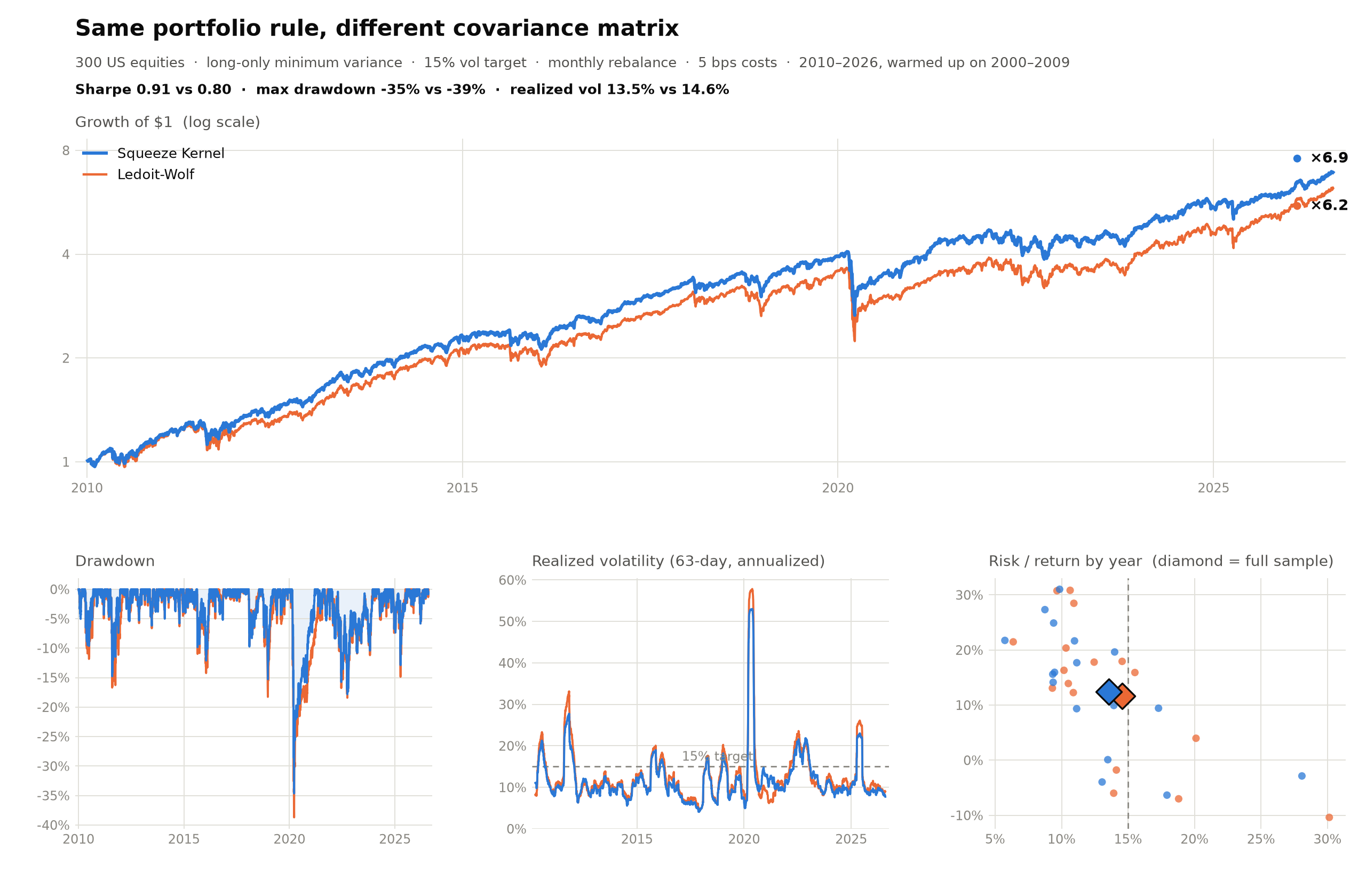
| Method | CAGR | Vol | Sharpe | MaxDD | Calmar | Vol-target RMSE |
|---|---|---|---|---|---|---|
| Squeeze Kernel | 13.1% | 13.0% | 1.00 | -31.2% | 0.42 | 6.47% |
| Ledoit-Wolf (252d) | 11.7% | 14.6% | 0.80 | -38.7% | 0.30 | 7.51% |
You can regenerate this example from the repo alone. The returns panel ships as a parquet (daily returns for 300 US stocks, sourced from Yahoo Finance), and the script prints the table and redraws the figure:
pip install squeeze-kernel pandas pyarrow scikit-learn matplotlib
python examples/vol_targeted_portfolio.py    # ~2 minutes
The full protocol and data notes live in examples/vol_targeted_portfolio.py and examples/data/build_equity_panel.py.
Installation
pip install squeeze-kernel          # NumPy only
pip install "squeeze-kernel[full]"  # + SciPy (kappa calibration, chi² kernel)
Quickstart
import numpy as np
from squeeze_kernel import SqueezeKernelEstimator

# daily_returns: array of shape (T, n) — may contain NaN for missing assets
est = SqueezeKernelEstimator(n_assets=daily_returns.shape[1])

for r_t in daily_returns:          # stream one day at a time
    est.update(r_t)

cov  = est.get_cov()               # (n, n) covariance, PSD by construction
corr = est.get_corr()              # (n, n) correlation
That is the whole API for most uses. The defaults (lambda_vol=0.98, lambda_corr=0.996, kappa=0.25) are the paper-recommended settings for daily returns, selected by time-series cross-validation and robust across a 50× parameter sweep — deploy them as-is.
Batch mode, if you prefer the full path in one call:
from squeeze_kernel import estimate_squeeze_cov

cov_path, corr_path, weights = estimate_squeeze_cov(daily_returns, with_weights=True)
# cov_path: (T, n, n) — the estimate after each day
A complete runnable walkthrough (streaming, missing data, batch) is in examples/quickstart.py.
Missing values
Pass NaN for any asset not observed on a given day — nothing else to do:
r_t = np.array([0.004, np.nan, -0.011])   # asset 2 not trading today
est.update(r_t)                            # PSD preserved, no imputation
Parameters
| Parameter | Default | Meaning |
|---|---|---|
lambda_vol |
0.98 |
volatility EWMA decay (half-life ≈ 34 days) |
lambda_corr |
0.996 |
correlation EWMA decay (half-life ≈ 173 days, T_eff ≈ 250) |
kappa |
0.25 |
Fisher kernel saturation; higher = stronger calm-day filtering |
shrinkage |
"auto" |
adaptive equicorrelation shrinkage ("none" or a float to override) |
shrinkage_delta |
0.10 |
concentration threshold at which shrinkage activates |
Useful read-only state after each update(): est.weight (last kernel weight), est.effective_sample_size (kernel-weighted T_eff), est.shrinkage_intensity (current α).
To recalibrate kappa for a different asset class (requires the full extra):
kappa = SqueezeKernelEstimator.calibrate_kappa(burn_in_returns, target_weight=0.6)
Advanced options
All options are off by default; the defaults reproduce the published estimator exactly. Full derivations and benchmark tables are in the papers.
Multi-scale correlation memory (corr_half_lives=(43, 173, 693)): replaces the single correlation timescale with a ladder of EWMAs whose blend a sequential surprise detector tilts toward fast or slow memory as the evidence demands. This is the papers' headline configuration: it leads every tested method at every universe size, and the blend stays convex so PSD still holds by construction.
Cluster shrinkage target (shrinkage_target="cluster"): shrinks toward a target that respects the correlation matrix's own block structure instead of a single equicorrelation, with no clustering algorithm and zero added parameters. The best choice for large equity universes: worth 4 held-out NLL points at n=200 and 25 at n=300 on the benchmark.
# recommended setup for a large equity universe:
est = SqueezeKernelEstimator(n_assets=300, corr_half_lives=(43, 173, 693),
                             shrinkage_target="cluster")
OU volatility anchor (vol_anchor_phi=0.995): mean-reverts each asset's variance forecast toward a slow per-asset anchor, giving a two-timescale volatility structure with a single parameter (deviation half-life ≈ ln 2/(1−φ) days). Worth 3–5 NLL points on the benchmark.
Score-exact weighting (weight_statistic="mahalanobis", use with kappa=1.0): drives the kernel with the Mahalanobis surprise against the estimator's own correlation. Use it only in the moderate-concentration regime (n / T_eff ≲ 0.5).
Score-driven memory (lambda_corr_fast=0.99): lets stress days also shorten the correlation memory. Do not combine with the Mahalanobis option.
New-listing usability gate (min_obs=60): exposes a usable_mask property marking assets with at least min_obs observations, so deployments can exclude cold starts from scoring and optimization; the estimates themselves are unchanged.
Alternative kernels: pass kernel_fn=kernel_exponential or kernel_chi2_cdf, or any callable mapping to [0, 1); the PSD guarantee holds for any such kernel.
How it works
Three mechanisms in one recursion:
- Dual-timescale EWMA — fast per-asset volatility (
lambda_vol) is separated from slow correlation dynamics (lambda_corr), so variance shocks don't contaminate the correlation estimate. - Fisher kernel weighting — each day's standardized outer product enters with weight
w = d²/(d² + kappa), whered²is the mean squared standardized return: calm days contribute little, dispersion shocks contribute fully. - Adaptive equicorrelation shrinkage —
alpha = min(1, max(0, n/(2·S) − delta))blends toward an equicorrelation target using the estimator's own kernel-weighted sample sizeS; it is a no-op at low dimension and provides provably bounded conditioning at high dimension.
The complete update is a natural-gradient step on the Gaussian log-likelihood, with the kernel weight acting as an adaptive Riemannian learning rate (paper, Appendix B).
Development
uv sync --extra full --extra dev
uv run python -m pytest        # test suite
uv run python -m ruff check .  # lint
uv run mypy                      # strict type check (src/squeeze_kernel)
uv build                       # build sdist + wheel
Citation
@article{kende2026squeeze,
  title  = {The Squeeze Kernel Covariance Estimator: Dual-Timescale Tracking with Adaptive Shrinkage},
  author = {Kende, Robert},
  year   = {2026},
  note   = {Available at SSRN: \url{https://ssrn.com/abstract=6455918}}
}
See also CITATION.cff.
License
MIT
1 maintainer

Release files for squeeze-kernel 0.7.1
For a detailed explanation of source distributions (sdists) and built distributions (wheels), please see the package formats documentation.
Source distribution (sdist)
| File | Size | Uploaded | |
|---|---|---|---|
| squeeze_kernel-0.7.1.tar.gz | 20.3 kB | Details |
Built distribution (wheel)
| File | Interpreter | ABI | Platform | Reset |
|---|---|---|---|---|
| squeeze_kernel-0.7.1-py3-none-any.whl | Python 3 | none | any | Details |
Total release size: 42.7 kB
Release files / squeeze_kernel-0.7.1.tar.gz
| Download URL | squeeze_kernel-0.7.1.tar.gz |
|---|---|
| Size | 20.3 kB |
| Tags | Source |
|
SHA-256 checksum How to use checksums |
bb956fa93a5f775707d680c8e5cf11c16646ea1ae6d47f6eafc96eb44f0e5fc9
|
|
BLAKE2b-256 checksum How to use checksums |
a5f3e1a50467d8170ff2276f1be8d1daa5101a1af1c902921892fdad417e3cff
|
| Upload date | |
|
Uploaded using Trusted Publishing? What is trusted publishing? |
Yes |
| Uploaded via |
twine/7.0.0 CPython/3.13.14
|
Provenance
Provenance describes where a file came from. On PyPI, provenance is shared via attestations, which provide a verifiable record of the build or publishing details. View details, limitations and caveats.


PyPI Publish Attestation
PyPI verified that this artifact, at this checksum, originated from the publisher listed below.
Signed by GitHub Actions, verified by PyPI on Aug 21, 2026.
Transparency logRelease files / squeeze_kernel-0.7.1-py3-none-any.whl
| Download URL | squeeze_kernel-0.7.1-py3-none-any.whl |
|---|---|
| Size | 22.4 kB |
| Tags | Python 3 |
|
SHA-256 checksum How to use checksums |
31dc4ec8cd10e67bb007e0ca17fe30e6388ec0e668d57a5117f62ca9814c1618
|
|
BLAKE2b-256 checksum How to use checksums |
3751650f2611624f6649c5a105c7ab9ed6c0bf2fc9445396b77de10d81d92620
|
| Upload date | |
|
Uploaded using Trusted Publishing? What is trusted publishing? |
Yes |
| Uploaded via |
twine/7.0.0 CPython/3.13.14
|
Provenance
Provenance describes where a file came from. On PyPI, provenance is shared via attestations, which provide a verifiable record of the build or publishing details. View details, limitations and caveats.
PyPI Publish Attestation
PyPI verified that this artifact, at this checksum, originated from the publisher listed below.
Signed by GitHub Actions, verified by PyPI on Aug 21, 2026.
Transparency log













