stac-optimizer


Korean README | Optimizer docs | Korean docs | Benchmark JSON
STAC means "SignSGD Trunk, AdamW Cap". It keeps the sign trunk state-free, uses AdamW only on the final trainable-module tail, and is tuned to reduce optimizer-state VRAM without giving up tail stability.
| Item | Value |
|---|---|
| Python | >=3.13 |
| PyTorch | >=2.10 |
| Default split | last_n_ratio=0.125 |
| Explicit override | last_n_modules |
| Default sign decay in hybrid mode | 0.5 * weight_decay |
| Default no-decay policy | bias + 1-D parameters |
| Preferred public ratio arg | last_n_ratio (adamw_ratio remains supported) |
Flow
flowchart LR
    A["Trainable modules<br/>registration order"]
    B["Resolve AdamW cap<br/>`last_n_modules` or<br/>default `last_n_ratio=12.5%`"]

    subgraph S["State-free sign trunk"]
        C["Earlier modules"]
        D["Decoupled weight decay on weight tensors<br/>bias + 1-D params skip decay by default<br/>parameter -= lr * sign(grad)<br/>no momentum, no sign-side state"]
    end

    subgraph T["AdamW cap"]
        E["Final tail modules"]
        F["Standard AdamW on the tail<br/>bias + 1-D params skip decay by default<br/>exp_avg + exp_avg_sq"]
    end

    A --> B
    B --> C
    B --> E
    C --> D
    E --> F

    classDef neutral fill:#f8fafc,stroke:#475569,color:#0f172a,stroke-width:1px;
    classDef sign fill:#d7f0e8,stroke:#0f766e,color:#134e4a,stroke-width:1.5px;
    classDef adam fill:#dbeafe,stroke:#2563eb,color:#1d4ed8,stroke-width:1.5px;

    class A,B neutral;
    class C,D sign;
    class E,F adam;
Install
python -m pip install stac-optimizer
For local development and benchmark generation:
python -m pip install -e ".[dev]"
Quickstart
import torch
from torch import nn

from stac_optimizer import STAC


model = nn.Sequential(
    nn.Linear(128, 64),
    nn.ReLU(),
    nn.Linear(64, 32),
    nn.ReLU(),
    nn.Linear(32, 10),
)

optimizer = STAC(
    model,
    lr=1e-3,
    last_n_ratio=0.125,
    weight_decay=1e-2,
    error_if_nonfinite=True,
)

loss = torch.nn.functional.mse_loss(
    model(torch.randn(8, 128)),
    torch.randn(8, 10),
)
loss.backward()
optimizer.step()
optimizer.zero_grad(set_to_none=True)
last_n_ratio counts only modules that directly own trainable parameters.
Pure containers such as nn.Sequential are skipped unless they own parameters
themselves. Use last_n_modules when you want an explicit cap size instead.
Bias tensors and 1-D parameters such as LayerNorm scales skip decoupled weight
decay by default in both sections.
CUDA Research Snapshot
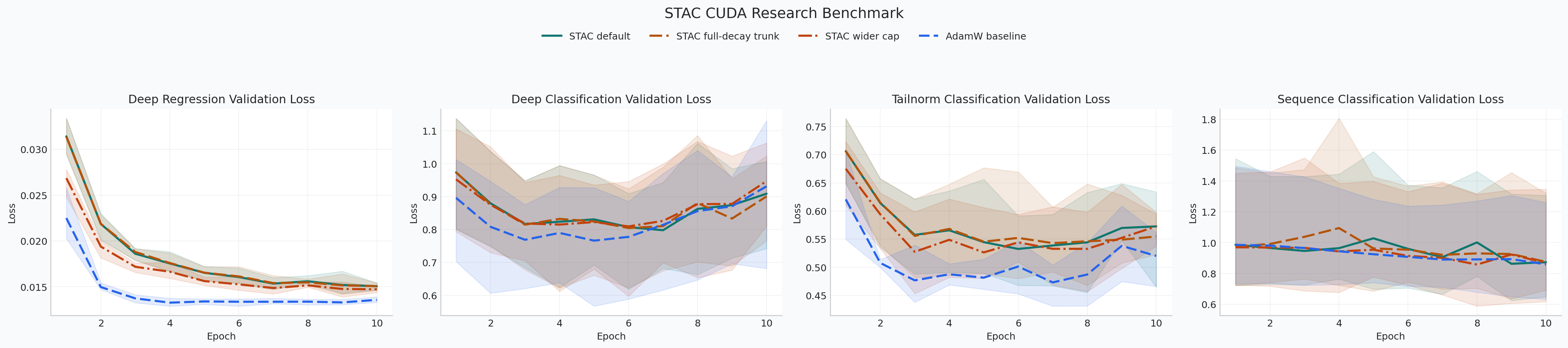
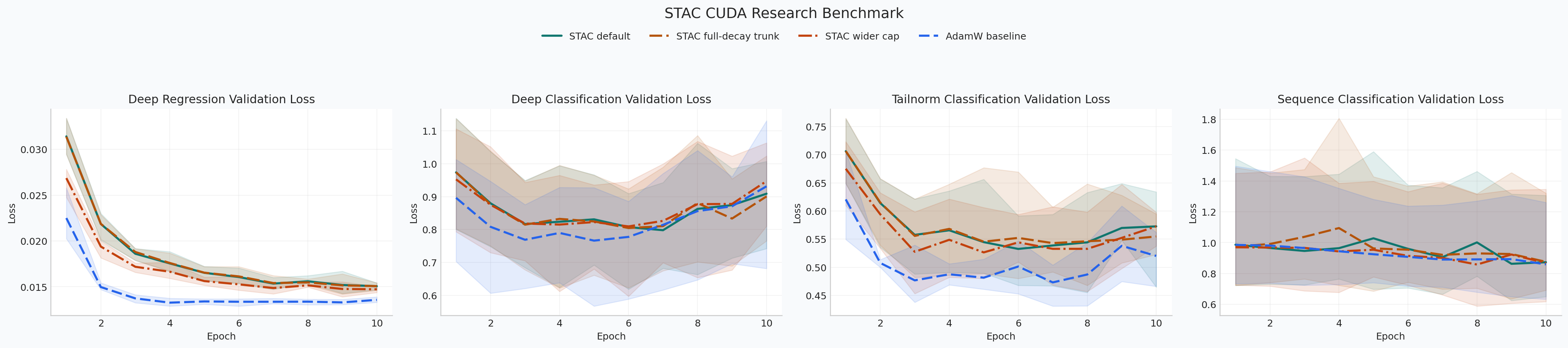
The repository benchmark is CUDA-only and uses held-out validation splits,
5 paired seeds, seeded teachers, seeded student initialization, fixed batch
schedules per seed, deep residual models, a transformer-like sequence task
with embeddings and LayerNorm, BF16 autocast when supported, epoch-by-epoch
validation loss curves, and a first-step optimizer-memory probe.
The AdamW baseline uses the same bias/1-D no-decay grouping so the comparison
does not hinge on a different weight-decay policy.
Snapshot from 2026-03-19 on torch 2.10.0+cu126 and
NVIDIA GeForce RTX 3070:
| Config | Setup | Deep regression val loss | Deep classification val acc | TailNorm val acc | Sequence val acc | Optimizer state MB | Peak step delta MB |
|---|---|---|---|---|---|---|---|
STAC default |
last_n_ratio=0.125, hybrid default sign decay, bias/1-D no-decay |
0.015066 |
0.7006 |
0.7984 |
0.6909 |
8.133 |
16.125 |
STAC full-decay trunk |
last_n_ratio=0.125, sign_weight_decay=weight_decay, bias/1-D no-decay |
0.015075 |
0.6994 |
0.8064 |
0.7089 |
8.133 |
16.125 |
STAC wider cap |
last_n_ratio=0.25, bias/1-D no-decay |
0.014726 |
0.6943 |
0.7996 |
0.6909 |
24.149 |
36.125 |
AdamW baseline |
full AdamW with the same no-decay policy in practice | 0.013574 |
0.7129 |
0.8268 |
0.7190 |
98.227 |
147.188 |
Repository takeaway: the default preset cuts optimizer state from
98.227 MB to 8.133 MB, the full-decay variant keeps the same memory profile
while helping the norm-heavy and sequence tasks a bit, and the wider cap spends
more AdamW state to improve regression. Those are repository-local measurements,
not universal guarantees.
Verify
python -m pytest -q
python examples/research_benchmark.py --device cuda
rm -rf build dist
python -m build
python -m twine check dist/*
1 maintainer

Metadata
1 maintainer
Release files for stac-optimizer 0.3.0
For a detailed explanation of source distributions (sdists) and built distributions (wheels), please see the package formats documentation.
Source distribution (sdist)
| File | Size | Uploaded | |
|---|---|---|---|
| stac_optimizer-0.3.0.tar.gz | 520.7 kB | Details |
Built distribution (wheel)
| File | Interpreter | ABI | Platform | Reset |
|---|---|---|---|---|
| stac_optimizer-0.3.0-py3-none-any.whl | Python 3 | none | any | Details |
Total release size: 534.0 kB
Release files / stac_optimizer-0.3.0.tar.gz
| Download URL | stac_optimizer-0.3.0.tar.gz |
|---|---|
| Size | 520.7 kB |
| Tags | Source |
|
SHA-256 checksum How to use checksums |
b2b4c69afe9ea911c2ad2675ef414aafd33f0191e14a2a55e054bf116ae20766
|
|
BLAKE2b-256 checksum How to use checksums |
1c1f122276e3af12dca146f1e6c06e164be61f8ff4deff16069e79201316cdac
|
| Upload date | |
|
Uploaded using Trusted Publishing? What is trusted publishing? |
Yes |
| Uploaded via |
twine/6.1.0 CPython/3.13.7
|
Provenance
Provenance describes where a file came from. On PyPI, provenance is shared via attestations, which provide a verifiable record of the build or publishing details. View details, limitations and caveats.


PyPI Publish Attestation
PyPI verified that this artifact, at this checksum, originated from the publisher listed below.
Signed by GitHub Actions, verified by PyPI on Mar 19, 2026.
Transparency logRelease files / stac_optimizer-0.3.0-py3-none-any.whl
| Download URL | stac_optimizer-0.3.0-py3-none-any.whl |
|---|---|
| Size | 13.3 kB |
| Tags | Python 3 |
|
SHA-256 checksum How to use checksums |
3c0517270c1d7bd56339cd98c324bb103e38dc98c53e550674dd0ae059779593
|
|
BLAKE2b-256 checksum How to use checksums |
87008287531d2840b50ae614ef3f7624b185b3ef01cfacf9ecfc959d222d3257
|
| Upload date | |
|
Uploaded using Trusted Publishing? What is trusted publishing? |
Yes |
| Uploaded via |
twine/6.1.0 CPython/3.13.7
|
Provenance
Provenance describes where a file came from. On PyPI, provenance is shared via attestations, which provide a verifiable record of the build or publishing details. View details, limitations and caveats.
PyPI Publish Attestation
PyPI verified that this artifact, at this checksum, originated from the publisher listed below.
Signed by GitHub Actions, verified by PyPI on Mar 19, 2026.
Transparency log