
The repository or configuration that created this release differ from a previous release. View details.
Startup Factory
Your AI agents can write code. Startup Factory turns them into a delivery team.
From product intent to reviewed, tested, production-ready software — coordinated through the project board you already use.
Open source · MIT licensed · Multi-model · Tracker-native · Cloud-agnostic · Fail-closed
AI made implementation faster. It did not make product delivery automatic.
I'm Alex Ischenko, an AI-first CTO and product builder. For more than 20 years, I have built and scaled software across Fintech, Insurance, SaaS, E-commerce, Healthcare, Gaming, and AI. I have led engineering organizations of up to 150 people and helped build products serving 20M+ daily users and platforms handling billions of clicks each month.
When I started building ExecMatchAI with more than 30 AI agents and supporting AI-native startups as a fractional CTO, I found a new bottleneck. The agents could produce code quickly. I was still acting as the message bus — clarifying scope, routing work, reconciling branches, checking reviews, updating the board, recovering failed runs, and deciding what was safe to ship.
Startup Factory is my answer. It turns your product board into the operating system for an AI engineering team. A Product Manager turns intent into executable work. A Principal Architect designs the solution. A Sceptical Principal Architect tries to break it. Builders implement isolated slices. Independent reviewers judge exact packages. A deterministic integrator verifies and merges. Production delivery stays behind explicit policy, current evidence, and human approval.
And you are not locked into one AI model. Mix Claude, Codex, Gemini, DeepSeek, or other agents across different roles — using different models to challenge each other, reduce correlated bias, and bring different perspectives to the same problem.
This is the system I use for real startup delivery. I am sharing it as open source because builders should not have to choose between AI speed and engineering discipline.
The unit of progress is not a prompt, a diff, or a line of code. It is a verified product outcome.
Startup Factory does not replace your coding agent, repository, project-management tool, CI/CD system, cloud, or engineering stack. It coordinates them.
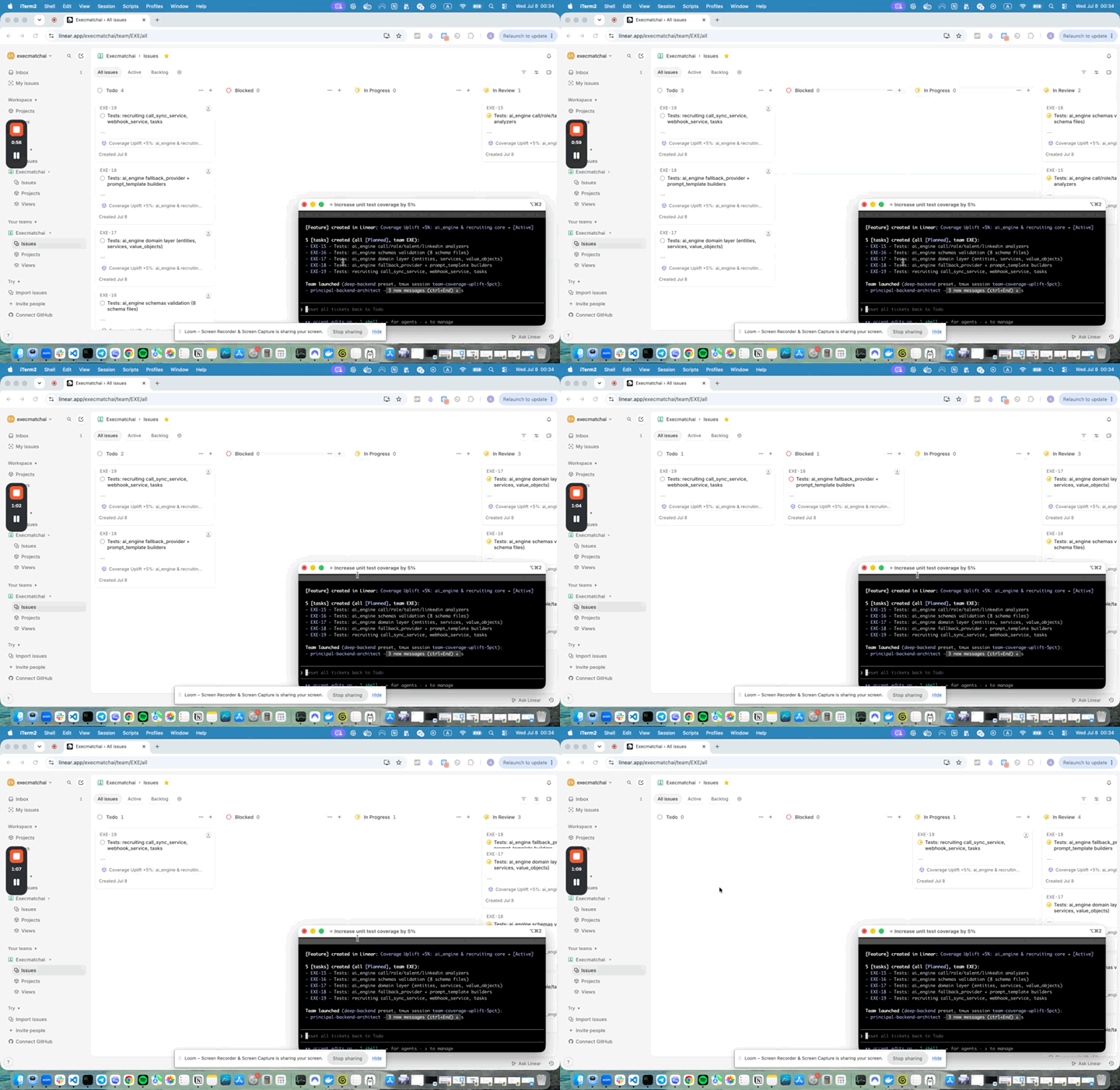
Table of contents
- Who it is for
- Quick start (local Markdown, no tracker account)
- Ten easy prompts for startup delivery
- See the factory work
- This is not another coding copilot
- The delivery loop
- Meet the team
- Six team presets
- Bring your own agents, tracker, and stack
- Choose how much autonomy you want
- Safety is part of the architecture
- What's new
- Documentation
- Project status
- Contributing
- License
Who it is for
| You are | Startup Factory helps you |
|---|---|
| A founder or CTO who still ships | Turn product intent into structured execution without becoming the dispatcher for every AI coding session. |
| A solo builder who wants a team, not a blank prompt | Add product, architecture, implementation, QA, security, and review roles around the agent you already use. |
| A technical lead adopting coding agents | Separate design, implementation, review, integration, and release authority instead of trusting one long agent loop. |
| An AI-first engineering team | Mix Claude, Codex, Gemini, Aider, DeepSeek Harness, or another file-reading CLI by role while keeping one shared workflow. |
| A team already living in a product board | Keep scope, progress, findings, approvals, blockers, and delivery state where product decisions already happen. |
Use your coding agent directly for a one-line fix. Startup Factory earns its keep when work crosses roles, branches, reviews, trackers, or production. See Meet the team for the roles it adds.
Quick start (local Markdown, no tracker account)
Start with one agent and the local Markdown tracker. From your project root:
uvx startup-factory@latest install --agent codex
uvx startup-factory@latest init --agent codex --mode solo \
  --product-management-tool Markdown --apply
Use --agent claude-code for Claude Code. Then ask your agent:
Plan a feature: add CSV export to the reports page.
Continue with Start task 1, Send task 1 to review, and Finalize task 1.
That exercises the smallest useful loop: plan → build → review → verify.
For a governed team delivery, guided integration-pack setup, prerequisites, and
the explicit non-production boundary, follow the
governed delivery benchmark path. A reproducible
example is in
reference/governed-delivery-example.md.
Safe updates
Preview, apply, and verify an update with the same release CLI:
uvx startup-factory@latest update --agent codex --dry-run
uvx startup-factory@latest update --agent codex
uvx startup-factory@latest verify --agent codex
Updates are staged, locked, verified, and rollback-capable. Existing project
configuration and project-owned extensions are preserved by default; conflicts
fail before mutation. Replacing preserved configuration requires the explicit
--overwrite-config flag. Both supported updaters report preserved 0.1.x
authority settings that need migration in dry-run and applied output. The
release CLI also returns them as structured migrationDiagnostics; it never
rewrites the preserved settings. Reprovision a legacy operator-owned sandbox
runner under a canonical root-owned, non-executor-writable system path, and set
the protected lifecycle root explicitly before restarting governed services.
See SKILL.md for the
release-managed and legacy/source-managed procedures and
reference/troubleshooting.md for fail-closed
recovery guidance.
Ten easy prompts for startup delivery
Replace the brackets and paste. Each prompt assumes the same rules: use the installed Startup Factory skill, keep agents inside their assigned roles, require current tests and independent review, deploy only through the protected release executor, and stop visibly when a gate or approval is missing.
The Senior Security Engineer already exists and reviews independently; an implementation engineer writes the fix. For continuous work, use bounded
pm-agent.pypasses — not one endless LLM session.
1. Ship a product feature
Deliver [FEATURE] from [TRACKER] to production with Startup Factory. Launch the
full-stack team, define measurable acceptance criteria, build and test isolated
slices, review independently, deploy the approved commit, and verify [OUTCOME].
2. Clear the Linear bug queue
In Linear [TEAM/PROJECT], process queued tickets labelled "Bug". Choose the right
team per ticket, require security review, reproduce each bug with a failing test,
fix it, run regressions, deploy safely, and report the result.
3. Fix cloud infrastructure and backups
Audit [CLOUD/ENVIRONMENT] with the deep-infra team. Fix drift through IaC, review
IAM, networking, monitoring, cost, backups, and restore readiness; validate the
plan and rollback, obtain production approval, then verify the service.
4. Harden product security
Harden [SERVICE/FEATURE] with the deep-security team. Threat-model it, implement
the highest-risk fixes, run authorized abuse tests, require independent security
approval, deploy the verified commit, and monitor for regressions.
5. Build a regression safety net
Create a regression suite for [PRODUCT]. Launch the appropriate engineering team
with QA review, cover critical journeys and past incidents with reliable
unit/API/E2E tests, remove flakiness, run them in CI, and publish release criteria.
6. Turn customer feedback into a roadmap
Analyze [FEEDBACK SOURCE] with Startup Factory. Group evidence-backed themes,
rank them by impact, confidence, and effort, create scoped tracker features, and
deliver the approved top priority with measurable acceptance criteria.
7. Improve onboarding conversion
Improve [ONBOARDING STEP] from [BASELINE] to [TARGET]. Launch the full-stack
team, instrument the funnel, define experiment guardrails, ship the change,
verify real analytics, and recommend keep, iterate, or rollback.
8. Prevent a production incident from recurring
Investigate [INCIDENT] with the appropriate backend or infra team. Build an
evidence-based timeline, fix the root cause, add tests, alerts, and a runbook,
rehearse recovery safely, then verify the production signals.
9. Run a safe data migration
Migrate [DATA/SYSTEM] with the deep-backend team. Use a backward-compatible
expand/contract plan, rehearse on representative non-production data, verify
integrity and rollback, obtain production approval, then monitor completion.
10. Ship an AI feature responsibly
Deliver [AI FEATURE] with the deep-llm team. Define quality, safety, latency,
and cost thresholds; secure prompts, tools, and data; run reproducible evals,
release gradually, and monitor drift, failures, and spend.
See the factory work
Here is the shape of a typical governed feature:
You
  "Deliver organization invitations with roles and audit logging."

Product Manager
  Creates one [feature], measurable acceptance criteria, and a dependency-aware
  set of [tasks].

Principal Architect
  Designs the data model, API, authorization boundaries, rollout, and tests.

Sceptical Principal Architect
  Challenges tenant isolation, replay behavior, migration safety, and rollback.
  The design does not proceed until material objections are resolved.

Builders
  Implement backend, frontend, infrastructure, or LLM slices in isolated task
  branches and worktrees.

Independent review board
  Reviews one exact package. Findings return the [task] to a fresh, traceable
  attempt instead of silently approving changed code.

Integrator
  Runs the configured build, test, lint, and format checks, then merges only the
  approved package.

Protected release (optional)
  Deploys only the approved commit with current CI, policy, and human-approval
  evidence, then verifies the target.

Project board
  Keeps the scope, owners, decisions, progress, blockers, findings, approvals,
  and delivery state visible throughout the run.
One board. Different roles. No agent grades its own homework.
This is not another coding copilot
Startup Factory is the coordination and governance layer around the coding agents you already use.
| A typical agent loop | Startup Factory |
|---|---|
| One chat contains the plan and state | The project board and durable task records remain the source of truth |
| The same agent plans, builds, and reviews | Product, architecture, implementation, review, integration, and release authority are separated |
| One model does every job | Different models and CLIs can be assigned by role and task profile |
| Agents edit one shared checkout | Each implementation attempt gets its own task branch and worktree |
| Review can become stale while the code keeps changing | Reviewers judge an exact, digest-bound package |
| Failure means restarting or guessing | Events, checkpoints, attempts, and outboxes make interrupted work recoverable |
| Success is claimed in prose | Status changes, checks, evidence, and approvals are written and verified |
| The coding session can reach production | Production credentials stay with a separate, policy-gated release executor |
No single agent is asked to be the product manager, architect, implementer, reviewer, integrator, and release authority for its own work.
The delivery loop
Startup Factory is a process, not a bag of prompts:
Plan -> Design -> Challenge -> Build -> Review -> Integrate -> Release -> Verify -> Learn
flowchart LR
    A[Product intent] --> B[Product plan]
    B --> C[Architecture]
    C --> D[Adversarial challenge]
    D --> E[Task workers in isolated worktrees]
    E --> F[Independent review board]
    F -->|findings| E2[Fresh traceable attempt]
    E2 --> F
    F -->|approved exact package| G[Deterministic integration]
    G --> H[Ready to deploy]
    H --> I[Protected release]
    I --> J[Production verification]
    J --> K[Retrospective and reusable learnings]
Every stage has an owner, an allowed set of actions, and a visible handoff. The complete lifecycle is documented in reference/lifecycle.md, and the multi-agent protocol lives in reference/orchestration.md.
Meet the team
| Role | Responsibility | What it does not do |
|---|---|---|
| Product Manager | Turns product intent into acceptance criteria, tasks, dependencies, and measurable outcomes | Does not write code or waive architecture and review gates |
| Team Lead | Owns dispatch, coordination, process integrity, and independent quality review | Does not write implementation code or override another mandatory gate |
| Principal Architect | Proposes the architecture, contracts, risks, migration path, and validation strategy | Does not implement and then approve its own design |
| Sceptical Principal Architect | Tries to disprove the design, expose hidden assumptions, and force safer alternatives | Does not become a second implementer |
| Builders | Implement bounded backend, frontend, infrastructure, security, data, or LLM tasks | Do not merge or declare themselves production-ready |
| QA and Security reviewers | Add independent evidence for the gates required by the task or team | Do not rewrite the reviewed package while approving it |
| Integrator | Verifies the approved package with deterministic repository checks and performs serialized integration | Does not redesign or silently repair rejected work |
| Release Executor | Applies an approved production plan using isolated credentials and verifies the result | Is not an LLM and does not infer missing approval |
Every preset team includes three distinct core review-board roles — Team Lead, Principal Architect, and Sceptical Principal Architect — plus a dedicated integrator. The presets are listed in Six team presets.
Six team presets
| Preset | Use it for |
|---|---|
full-stack |
Product features spanning schema, API, and UI |
deep-backend |
Domain logic, data models, APIs, migrations, and performance |
deep-frontend |
UI architecture, complex client state, and design-system work |
deep-security |
Threat-model-driven security work and hardening of your own codebase |
deep-infra |
Cloud infrastructure, CI/CD, reliability, observability, and operations |
deep-llm |
LLM products, RAG, evaluation, serving, safety, latency, and cost |
Each team uses the same delivery loop and authority model. Only the specialist roster changes. See teams/README.md for launch and extension details.
Bring your own agents, tracker, and stack
Coding agents and models
The package installer has first-class targets for:
| Agent | Installer value |
|---|---|
| Claude Code | --agent claude-code |
| OpenAI Codex CLI | --agent codex |
| Aider | --agent aider |
| DeepSeek Harness | --agent deepseek-harness |
Team roles are configured through command templates, so you can mix runtimes. For example, use Claude for the Team Lead and Principal Architect, Codex for the Sceptical Principal Architect and security review, Gemini for review diversity, and DeepSeek Harness or Aider for selected implementation tasks.
config/team.config.md is the entire LLM coupling: one line per role giving the shell command that runs it. The launcher composes each agent's startup prompt into a file and substitutes its path for {prompt_file}:
TEAM_LEAD_CMD="claude -p \"$(cat '{prompt_file}')\" --permission-mode acceptEdits"
PRINCIPAL_ARCHITECT_CMD="claude -p \"$(cat '{prompt_file}')\" --permission-mode acceptEdits"
SCEPTICAL_ARCHITECT_CMD="codex exec --approve-for-me \"$(cat '{prompt_file}')\""
BACKEND_CMD="codex exec --approve-for-me \"$(cat '{prompt_file}')\""
REVIEWER_CMD="gemini --yolo \"$(cat '{prompt_file}')\""
TEAM_DEFAULT_CMD="claude -p \"$(cat '{prompt_file}')\" --permission-mode acceptEdits"
Command templates for common CLIs:
| LLM / CLI | Command template |
|---|---|
| Claude Code | claude -p "$(cat '{prompt_file}')" --permission-mode acceptEdits |
| Codex CLI | codex exec --approve-for-me "$(cat '{prompt_file}')" |
| Gemini CLI | gemini --yolo "$(cat '{prompt_file}')" |
| DeepSeek Harness | dsh --profile headless "$(cat '{prompt_file}')" |
| Any file-reading CLI | yourcli --prompt-file {prompt_file} |
Command resolution per role: an explicit <ROLE>_CMD value is used; <ROLE>_CMD=null disables the role; an absent key falls back to TEAM_DEFAULT_CMD. That fallback is why the many specialist preset roles need no per-role keys — set TEAM_DEFAULT_CMD once and override only the roles you want on a different model. The three core review-board roles are the exception: a launch fails before any agent starts if one of their commands is null or unresolved.
⚠️ Safety: these templates use unattended execution modes (
acceptEdits,--approve-for-me,--yolo). Codex keeps its workspace-write sandbox and routes approval requests through automatic review. Workers may commit untrusted checkpoints only to task branches; only the integrator writes the feature branch. Every implementer is isolated in its own git worktree — but still run teams on a branch you can throw away, and review the tracker before merging to your main branch.
The contract is intentionally thin: provide the prompt, let the agent read and edit files within its assigned boundary, capture the result, and trust the exit status. Adding another compatible CLI should not require rewriting the orchestration core.
Project-management tools
| Tracker | Best for | Adapter |
|---|---|---|
| Markdown | Local evaluation, offline work, and zero-account setup | adapters/Markdown.md |
| Linear | Product-led startup and scale-up teams | adapters/Linear.md |
| Jira | Established engineering and enterprise workflows | adapters/Jira.md |
| GitHub Issues | Teams that keep planning close to the repository | adapters/GitHubIssues.md |
| Your own tool | Internal systems or another project-management platform | adapters/_TEMPLATE.md |
The workflow speaks one generic vocabulary — [feature], [task], [subtask], and configured statuses — while each adapter translates it into the selected tool.
Credentials live in environment variables, never in the config files, and a hosted tracker needs its access wired once. See reference/tracker-access.md for the exact key, scope, and env-var setup per tool.
Validated integration packs provide a guided validate → preview → apply → doctor
path for the shipped trackers, exact-commit GitHub Actions evidence, and inactive
Docker Compose or Kubernetes deployment boundaries. Packs are data-only, plans
are digest-bound, and doctor checks names/presence without reading credential
values or authenticating a provider. See
extensions/integration-packs/README.md.
Engineering stack
Startup Factory is language-, framework-, cloud-, and CI-provider-agnostic. Your repository defines the real build, test, lint, format, deployment, rollback, and verification commands.
Choose how much autonomy you want
Start small and add authority only when the environment is ready.
| Mode | What runs | Best use |
|---|---|---|
| Solo | One installed agent follows the lifecycle; self-review is labelled as self-review and cannot impersonate independent approval | Learning the workflow and shipping small features |
| Team | Specialist agents work through separate roles, packages, worktrees, and mandatory review gates | Normal multi-agent delivery after protected runtime setup |
| Autonomous | A deterministic supervisor scans the board, restores in-flight state, and launches only eligible bounded work | Carefully controlled unattended queues |
| Release | A separate executor applies an exact, approved production plan and verifies the target | Governed production delivery |
init --apply configures the safe solo and team starting modes; the full flag list is in Safe updates. Autonomous board processing and production release are intentionally off by default and require external configuration, identities, sandboxes, hooks, and readiness checks. Read Safety is part of the architecture before turning either on.
Team initialization alone does not grant authenticated publication authority. That requires the separately provisioned external sandbox runner, broker-only tracker writes, lifecycle authority, and successful doctor probes documented in the governed delivery benchmark path. Without that boundary, team processes are manually supervised and cannot publish governed review, integration, or release evidence.
Safety is part of the architecture
Autonomous agents are useful only when their authority is bounded.
Startup Factory provides:
- A code-owned DENY / REQUIRE HUMAN APPROVAL / ALLOW policy contract.
- Exact package, commit, artifact, environment, expiry, and approval binding.
- Independent roles that cannot approve work outside their authority.
- Serialized integration and verified status transitions.
- Durable denial, blocker, attempt, and delivery records.
- Automation and production delivery that remain disabled until explicitly configured.
- A credential-separated release executor. Ordinary coding agents do not receive production credentials.
- Fail-closed behavior when evidence is missing, stale, malformed, or inconsistent.
Startup Factory is not an operating-system sandbox. Run agents with real filesystem, process, network, and identity isolation appropriate to your environment. Repository-level policy is an additional boundary, not a replacement for host security.
Read the full contracts before enabling unattended or production operation:
What's new in 0.2.0
This release candidate introduces three improvements:
- Risk-based delivery:
microcovers small, declared documentation changes;standardcovers ordinary code and tests;high-riskcovers unknown scope, security, control-plane, and release work. A requested profile cannot lower inferred risk; the exact committed diff is checked again before review and can add gates. High-risk work uses a strong-model floor, exclusive implementation, and QA and Security gates. The core review board, exact package evidence, immutable deny rules, integration authority, and production authority do not change. Common fused auth, role, and key/token-rotation filenames are treated as high risk. Seereference/delivery-profiles.md. - Guided integration packs:
validate → preview → apply → doctorcovers the shipped Markdown, GitHub Issues, Jira, and Linear trackers, plus inactive boundary descriptors for GitHub Actions exact-commit verification, Docker Compose, and Kubernetes. Packs are validated data, saved plans bind their source and target, and credentials stay outside repository config. Malformed pack JSON fails validation; apply never executes commands or activates CI or deployment. Doctor reports local setup without authenticating a provider. Seeextensions/integration-packs/README.md. - Objective beta readiness:
SECURITY.mddefines disclosure; a shorter quickstart, compatibility boundaries, a reproducible walkthrough, and benchmark and usage methodology make evaluation repeatable. Native Windows is unsupported and WSL remains experimental and untested. The exact-release-set checker reports not ready until fresh protected validation, package, review, disclosure, compatibility, walkthrough, benchmark, and usage evidence is supplied. The under-15-minute delivery target is not yet a measured result.
Release is manual and fail-closed: merging to main does not publish. The
workflow binds the exact current-main and protected evidence-branch commits,
serializes release runs, and checks live release and pypi environments for
required reviewers, self-review prevention, and disabled administrator bypass.
The separate PyPI approval and exact bundle, wheel, and sdist checks remain
mandatory. These safeguards do not themselves authorize a production release.
0.1.x upgrade action: project configuration is preserved during updates.
Before restarting autonomous or release services, update the protected
installed config/team.config.md: set BROKER_LIFECYCLE_ROOT to the exact
canonical external lifecycle path and, when AGENT_SANDBOX_ENFORCED=true,
replace a missing, null, or legacy operator-owned AGENT_SANDBOX_RUNNER with a
canonical external executable whose file and complete ancestor chain are
root-owned and not writable by the executor, group, or world. The scheduler's
STARTUP_FACTORY_LIFECYCLE_STATE_ROOT may only repeat that value; it no longer
substitutes for a null or missing config assignment. Follow the bounded
migration procedure.
What's new in 0.1.23
Updating an installation could quietly undo work, in three different ways.
A local edit to a shipped file was replaced without a word. The updater already
records the hash of every file it installs, but only consulted it when deciding
whether a retired file was safe to delete — never for files the incoming
version overwrites. It now names them: WARNING: 2 upstream file(s) were modified locally since they were installed, in both the dry run and the applied
update, so a local fix is either re-applied deliberately or upstreamed.
update also had no notion of version order and would write an older bundle over
a newer installation. A published index is not always ahead of what is installed
— a release can be mid-flight, or half-published when post-publish verification
fails — so @latest legitimately resolves to the previous version, and
installing it reverted whatever the newer one fixed. Downgrades are now refused
unless --allow-downgrade says otherwise.
Finally, bin/update-installed-skill.sh already refuses release-managed
installations because it cannot carry their bundle provenance, but the mirror
image was open: the release CLI would convert a source-managed installation
without comment, which is how the previous two problems combined into a silent
revert. update now refuses it and names the updater that preserves source
provenance.
What's new in 0.1.22
Two defects could stop a board permanently, and the contract behind one of them was documented nowhere.
A published artifact carries a delivery-id: trailer appended after the role
signature, so resolving the signing role from the end of the body returned the
delivery id instead of a role. Every gate then looked foreign to the planner: on
a [task] with a declared supporting review gate the core-approval branch was
never entered, the merge queue was unreachable, and the same reviewer was
relaunched every pass while the board reported itself idle. Signature resolution
now skips that trailer.
The integration authorizer also accepted only a Files: line split on commas,
while reviewers publish the same evidence under prose labels. Both authorizer
sites now share one fail-closed parser: it accepts the prose labels and a single
consistent comma, middot, or bullet separator, while rejecting duplicate
declarations or paths, mixed separators, empty declarations, and unquoted
whitespace-only lists. Set-equality against the reviewed Git diff is unchanged.
That contract is now specified in
reference/orchestration.md and in every role brief
that publishes a file list, and a set mismatch names which paths differ in each
direction.
What's new in 0.1.21
This release documents what the README rewrite would otherwise have dropped.
Troubleshooting and tracker access were reachable only from the old README, so
replacing it would have removed them from the project entirely. They now live in
reference/troubleshooting.md and
reference/tracker-access.md, and the README
links to both.
What's new in 0.1.20
This release makes an idle dispatch pass affordable and a stalled board visible, and stops a relaunch destroying verdicts the previous boot had enqueued.
A pass now asks the adapter for a cheap change token and reuses the cached
[feature] export when nothing moved, so an idle pass costs a couple of requests
instead of hundreds — a watch loop at the default cadence could otherwise
exhaust an hourly hosted-tracker budget with no work having changed. Reuse is
bounded on every side: a full export runs at least every
EXPORT_MAX_REUSE_SECONDS, the token is recorded only after a successful
export, and an adapter that cannot promise the token moves whenever the export
would simply omits it.
launch-team.sh health adds a board-level line per team, because every role
reaching exited is the normal end of a pass and per-role output cannot
separate a board that finished from one nobody is driving.
Workers no longer receive an outbox signing secret. For sandbox-enforced launches, the launcher keeps each secret in a generation-bound publication supervisor and gives the worker only a non-secret Unix-socket locator; unenforced/manual launches receive no authenticated publication transport. Task relaunches share one logical task lane and gate relaunches one role lane, so a successor immediately fences its predecessor from signing anything new. Signing also creates a protected, durable receipt for that exact entry and body under the same authority lock used by mint, revoke, holds, and tracker effects. This lets a final package already admitted before a normal worker exit drain safely after the supervisor's exact-id revocation, without letting a stale generation publish a different package.
What's new in 0.1.19
This release rewrites the README as a landing page. It leads with what Startup
Factory is, who it is for, and a short local quick start, then hands off to
SKILL.md and reference/ for operational detail.
Navigation is new: a table of contents, section anchors, and cross-links between
related sections. The role-to-command mapping from
config/team.config.md is documented alongside the
unattended-execution safety note, and ### Safe updates keeps the update,
verify, and preserved-configuration contract in the README.
No runtime, adapter, or packaging behavior changes in this release.
What's new in 0.1.18
This release fixes the public installation check that gates a release. The step
retries while a freshly published version propagates, but the version comparison
ran inside the if body, so the first not-yet-propagated answer aborted the step
instead of retrying — and because the GitHub release job depends on that check,
a transient lag could leave a version published to PyPI while the tag and GitHub
release were skipped entirely.
The comparison is now part of the retry condition, so propagation lag is retried as intended while a genuinely wrong published version still fails the release after the retry budget is exhausted.
What's new in 0.1.17
This release keeps an exhaustive tracker read inside a hosted tracker's request
budget, so a dispatch pass can complete on a [feature] with hundreds of
[task] items.
Previously the Linear project export hydrated comments, labels, and relations
with one request per connection per issue, and the Jira export and board scan
read comments once per [task]. On a large [feature], a single pass could
exceed an hourly request budget before finishing, so it never persisted its
projection and the next pass repeated the same work. Both adapters now hydrate
from the paginated read they already perform, and any connection reporting a
further page still falls back to the exhaustive per-item read — a truncated or
malformed response is never treated as complete.
Two projection defects are fixed alongside it. Managed [feature] projections
are now tracker comments rather than project fields, because a short description
is length-capped and a content document is reformatted by the tracker, so
neither could hold a projection verifiable as stored; a block left in either
field by an earlier version is retired on the next upsert. The [task]
projection also no longer back-fills completed history it never tracked, and it
skips archived items instead of failing the pass that encounters one.
What's new in 0.1.16
This release adds project-scoped agent health monitoring. Teams can use
launch-team.sh health [--json] [--watch] to see typed agent status across the
current Git project, including linked worktrees, without exposing agents from
other projects. Fresh, self-reported implementation percentages are shown when
available; otherwise the view reports trusted elapsed time.
Watch mode observes immediately and then every five minutes without waking an
LLM. For unattended operation, pm-agent.py --healthcheck atomically publishes
the same presentation-only snapshot, while its health clock remains independent
of portfolio scanning. Health data never controls lifecycle, scheduling,
reviews, integration, or releases.
Documentation
| Start here | What it covers |
|---|---|
reference/quickstart.md |
External-runner prerequisites and the unproven benchmark path for a governed, non-production team delivery |
SKILL.md |
The operational front door and supported user requests |
reference/lifecycle.md |
Planning, starting, reviewing, finalizing, blocking, automation, and release scenarios |
reference/orchestration.md |
Task packets, worktrees, mailboxes, dispatch, gates, attempts, and integration |
reference/delivery-profiles.md |
Monotonic micro, standard, and high-risk routing and invariant authority boundaries |
extensions/integration-packs/README.md |
Pack schema, two-root setup model, preview/apply/doctor flow, and extension contract |
teams/README.md |
Team presets, roles, launch modes, and extension rules |
reference/vocabulary.md |
Tool-neutral entities, statuses, mappings, and naming rules |
reference/automation.md |
Deterministic board monitoring and bounded task dispatch |
reference/guardrails.md |
Denied actions, exact human approvals, and allowed operations |
reference/deployment.md |
Provider-neutral, recoverable production delivery |
reference/evidence-providers.md |
Commit-bound external evidence and provider contracts |
reference/compatibility.md |
Tested, declared, untested, and unsupported platform/runtime positions |
reference/governed-delivery-example.md |
Reproducible first-delivery and exact package-build walkthrough |
reference/benchmarks.md |
Honest latency, usage, and cost measurement methodology |
reference/beta-readiness.md |
Objective beta criteria and exact evidence schema |
SECURITY.md |
Private vulnerability reporting and coordinated disclosure process |
reference/tracker-access.md |
Wiring a tracker: access mechanisms, scopes, and credential env vars |
reference/troubleshooting.md |
Symptoms an operator hits, and what each fail-closed stop means |
config/ |
Tracker, planning, team, automation, guardrail, and deployment configuration |
adapters/ |
Shipped project-management adapters and the custom adapter template |
| GitHub Releases | Version history and release notes |
Claude Code users can optionally connect obra/superpowers for planning intake. Startup Factory still owns task execution, worktrees, dispatch, review, integration, and release. See reference/superpowers-planning.md.
Project status
Startup Factory is early-stage open-source software under active development. Start with Markdown and solo or team mode. Pin a reviewed package version in controlled environments and upgrade through Safe updates. Native Windows is unsupported and WSL is currently untested; see the compatibility matrix. Do not enable autonomous or production operation until the documented readiness checks pass.
The framework is deliberately explicit. It would rather stop visibly than invent state, skip a gate, or pretend that work shipped.
Contributing
Startup Factory is designed to be extended:
- Add a project-management adapter.
- Add a coding-agent runtime.
- Add a specialist role or team preset.
- Improve a lifecycle, security, or release control.
- Share a reproducible delivery case study.
Issues and pull requests are welcome. Please keep changes compatible with the tool-neutral workflow and the fail-closed authority model.
License
MIT. Use it, fork it, improve it, and make it yours.
Built for builders who want AI speed without giving up engineering discipline.
1 maintainer

Metadata
1 maintainer
Release files for startup-factory 0.2.0
For a detailed explanation of source distributions (sdists) and built distributions (wheels), please see the package formats documentation.
Change of provenance
The repository or configuration that created these release files differ from that of a previous release.
We recommend inspecting the repository and configuration before proceeding. View details.
Source distribution (sdist)
| File | Size | Uploaded | Provenance | Actions |
|---|---|---|---|---|
| startup_factory-0.2.0.tar.gz | 1.2 MB | With provenance | Details for startup_factory-0.2.0.tar.gz |
Built distribution (wheel)
| File | Interpreter | ABI | Platform | Actions Reset |
|---|---|---|---|---|
| startup_factory-0.2.0-py3-none-any.whl | Python 3 | none | any | Details for startup_factory-0.2.0-py3-none-any.whl |
Total release size: 2.3 MB
Release files / startup_factory-0.2.0.tar.gz
Change of provenance
This file belongs to a release with changed provenance: the repository or configuration that created the release files differ from that of a previous release.
We recommend inspecting the repository and configuration before proceeding. View details.
| Download URL | startup_factory-0.2.0.tar.gz |
|---|---|
| Size | 1.2 MB |
| Tags | Source |
|
SHA-256 checksum How to use checksums |
f88b2a068b47f92ad3438ed09dcaa82d85930cde3ddc5789efd9c4be7f74dfad
|
|
BLAKE2b-256 checksum How to use checksums |
64c4db32d62157cf2e184a8494197c4b0eae7fd8ad63b9c5a57894f244b593f4
|
| Upload date | |
|
Uploaded using Trusted Publishing? What is trusted publishing? |
Yes |
| Uploaded via |
twine/6.1.0 CPython/3.13.13
|
Provenance
Provenance describes where a file came from. On PyPI, provenance is shared via attestations, which provide a verifiable record of the build or publishing details. View details, limitations and caveats.


PyPI Publish Attestation
PyPI verified that this artifact, at this checksum, originated from the publisher listed below.
Signed by GitHub Actions, verified by PyPI on Oct 3, 2026.
Transparency logRelease files / startup_factory-0.2.0-py3-none-any.whl
Change of provenance
This file belongs to a release with changed provenance: the repository or configuration that created the release files differ from that of a previous release.
We recommend inspecting the repository and configuration before proceeding. View details.
| Download URL | startup_factory-0.2.0-py3-none-any.whl |
|---|---|
| Size | 1.2 MB |
| Tags | Python 3 |
|
SHA-256 checksum How to use checksums |
012b99123bed72dfdf2ca341899ad12fe78372396bdd0b4bdc8ae9d9ea71a205
|
|
BLAKE2b-256 checksum How to use checksums |
c3e8ab31be611ff06699545a87978bb95c3e7a3b30d66e317ad69dd8606bd3e6
|
| Upload date | |
|
Uploaded using Trusted Publishing? What is trusted publishing? |
Yes |
| Uploaded via |
twine/6.1.0 CPython/3.13.13
|
Provenance
Provenance describes where a file came from. On PyPI, provenance is shared via attestations, which provide a verifiable record of the build or publishing details. View details, limitations and caveats.
PyPI Publish Attestation
PyPI verified that this artifact, at this checksum, originated from the publisher listed below.
Signed by GitHub Actions, verified by PyPI on Oct 3, 2026.
Transparency logSecurity for startup-factory 0.2.0
Provenance
Provenance describes where a file came from. On PyPI, provenance is shared via attestations, which provide a verifiable record of the build or publishing details. View details, limitations and caveats.
Change of provenance
The configuration that created this release differs from a previous release.
While this could reflect a routine change by the project maintainers, it may also indicate that the release files have been compromised.
Attestation for startup_factory-0.2.0.tar.gz
PyPI Publish Attestation
PyPI verified that this artifact, at this checksum, originated from the publisher listed below.
Signed by GitHub Actions, verified by PyPI on Oct 3, 2026.
Transparency logA note on package security
PyPI is a repository for distributing packages, not a service for auditing them. While third-party security researchers and our staff do their best to detect and remove malicious packages, PyPI cannot guarantee the quality, security or suitability of any given package.
To learn more about protecting yourself from malicious actors, visit our package security documentation.














