

statescale - Snapshot-driven state upscaling






statescale is a Python package for snapshot-driven upscaling of high-dimensional
simulation states along arbitrary parameter or signal paths.
✨ Overview
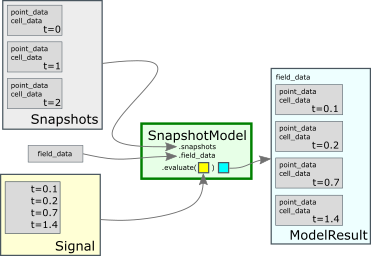
statescale provides a lightweight API to manage time-dependent point- and cell-data
and time-independent field-data across snapshots and to interpolate that data on new
signals. The central class is
SnapshotModel.
Highlights
- ✅ Snapshot-driven state upscaling
- ✅ Upscale simulation data to continuous signals from sparse snapshots
- ✅ Efficient handling of high-dimensional data
- ✅ Easy-to-use API
📦 Installation
Install from PyPI:
pip install statescale
Development install (from source):
- Clone the repository:
git clone https://github.com/adtzlr/statescale.git
cd statescale
- Install in editable mode:
pip install --editable .
Dependencies: numpy and scipy (and pytest for running tests).
🚀 Quickstart
A minimal example. Snapshots must have shapes (n_snapshots, n_dim), point- and cell-
data (n_snapshots, ...) and the dimension of the signal must be compatible with
snapshots, i.e. (n_steps, n_dim). The second dimension of snapshots and the signal
are optional, 1d-arrays are also supported. The model result will be of shape
(n_steps, ...).
Array-based input data
import numpy as np
import statescale

snapshots = np.linspace(0, 1, num=3).reshape(-1, 1)  # 3 snapshots, 1 parameter
point_data = {"displacement": np.random.rand(3, 9, 3)}  # 3 snapshots, 9 points, 3 dim
cell_data = {"strain": np.random.rand(3, 4, 6)}  # 3 snapshots, 4 cells, 6 dim
field_data = {"id": 1001}  # time-independent data

model = statescale.SnapshotModel(
    snapshots=snapshots,
    point_data=point_data,
    cell_data=cell_data,
    field_data=field_data,
    # kernel="surrogate",  # use a POD "surrogate" model or simple "griddata"
    # modes=(2, 10),  # min- and max no. of modes for surrogate model
)

signal = np.linspace(0, 1, num=20).reshape(-1, 1)  # 20 items, 1 parameter

# a `ModelResult` object with `point_data`, `cell_data` and `field_data`.
res = model.evaluate(signal, method="griddata")  # method "griddata" or "rbf"
List-based input data
If the data is list-based, the model can also import lists of dicts, with per-snapshot list items. Model results also support indexing and a conversion to lists of dicts.
import numpy as np
import statescale

point_data = [
    {"displacement": np.random.rand(6, 2)},  # 1. snapshot, 6 points, 2 dim
    {"displacement": np.random.rand(6, 2)},  # 2. snapshot, 6 points, 2 dim
    {"displacement": np.random.rand(6, 2)},  # 3. snapshot, 6 points, 2 dim
]
cell_data = [
    {"strain": np.random.rand(4, 2, 2)},  # 1. snapshot, 4 cells, (2, 2) dim
    {"strain": np.random.rand(4, 2, 2)},  # 2. snapshot, 4 cells, (2, 2) dim
    {"strain": np.random.rand(4, 2, 2)},  # 3. snapshot, 4 cells, (2, 2) dim
]

model = statescale.SnapshotModel(
    snapshots=snapshots,
    point_data=point_data,
    cell_data=cell_data,
    field_data=field_data,
)

# `point_data`, `cell_data` and `field_data` for step 5 of the signal.
res_5 = model.evaluate(signal)[5]
Any NumPy-function may be applied to the model result data on all time-dependent arrays. E.g., the mean over all cells (here, the first axis) of the cell-data is evaluated by:
res_5_mean = res_5.apply(np.mean, on_point_data=False, on_cell_data=True)(axis=0)
More details can be found in the documentation.
🛠️ Tests
The tests are located in tests. Run them locally with:
tox
➕ Contributing
Bug reports and pull requests are welcome. Please open an issue or PR in the repository. The package is in early development, expect breaking API changes until version 1.0.0.
📄 Changelog
All notable changes to this project will be documented in this file. The format is based on Keep a Changelog, and this project adheres to Semantic Versioning.
🔓 License
See the LICENSE file.
1 maintainer

Metadata
1 maintainer
Release files for statescale 0.3.0
For a detailed explanation of source distributions (sdists) and built distributions (wheels), please see the package formats documentation.
Source distribution (sdist)
| File | Size | Uploaded | |
|---|---|---|---|
| statescale-0.3.0.tar.gz | 15.4 kB | Details |
Built distribution (wheel)
| File | Interpreter | ABI | Platform | Reset |
|---|---|---|---|---|
| statescale-0.3.0-py3-none-any.whl | Python 3 | none | any | Details |
Total release size: 29.9 kB
Release files / statescale-0.3.0.tar.gz
| Download URL | statescale-0.3.0.tar.gz |
|---|---|
| Size | 15.4 kB |
| Tags | Source |
|
SHA-256 checksum How to use checksums |
c3d1f6f49ae0d28550f0355ae58020ff60dfd267f16b33ed39917747683ebd90
|
|
BLAKE2b-256 checksum How to use checksums |
c05906e1fe09d56f271f83ef99578a5a1d35b3c39fbbd40cf77710c599164508
|
| Upload date | |
|
Uploaded using Trusted Publishing? What is trusted publishing? |
No |
| Uploaded via |
twine/6.1.0 CPython/3.13.7
|
Release files / statescale-0.3.0-py3-none-any.whl
| Download URL | statescale-0.3.0-py3-none-any.whl |
|---|---|
| Size | 14.5 kB |
| Tags | Python 3 |
|
SHA-256 checksum How to use checksums |
280554c8cd1b2d9c092b61293e481fb8b26ecda52474950dd539692272281493
|
|
BLAKE2b-256 checksum How to use checksums |
b088efff68d6c71a0423fb786ce295b65e3f31986563f7453f7bf5a120464f2e
|
| Upload date | |
|
Uploaded using Trusted Publishing? What is trusted publishing? |
No |
| Uploaded via |
twine/6.1.0 CPython/3.13.7
|














