
snapshot-driven state upscaling

Project description

statescale - Snapshot-driven state upscaling






statescale is a Python package for snapshot-driven upscaling of high-dimensional
simulation states along arbitrary parameter or signal paths.
✨ Overview
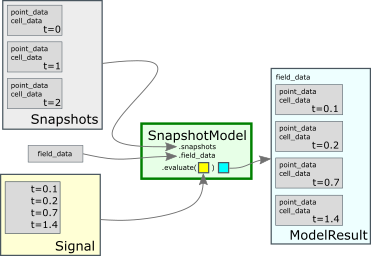
statescale provides a lightweight API to manage time-dependent point- and cell-data
and time-independent field-data across snapshots and to interpolate that data on new
signals. The central class is
SnapshotModel.
Highlights
- ✅ Snapshot-driven state upscaling
- ✅ Upscale simulation data to continuous signals from sparse snapshots
- ✅ Efficient handling of high-dimensional data
- ✅ Easy-to-use API
📦 Installation
Install from PyPI:
pip install statescale
Development install (from source):
- Clone the repository:
git clone https://github.com/adtzlr/statescale.git
cd statescale
- Install in editable mode:
pip install --editable .
Dependencies: numpy and scipy (and pytest for running tests).
🚀 Quickstart
A minimal example. Snapshots must have shapes (n_snapshots, n_dim), point- and cell-
data (n_snapshots, ...) and the dimension of the signal must be compatible with
snapshots, i.e. (n_steps, n_dim). The second dimension of snapshots and the signal
are optional, 1d-arrays are also supported. The model result will be of shape
(n_steps, ...).
Array-based input data
import numpy as np
import statescale

snapshots = np.linspace(0, 1, num=3).reshape(-1, 1)  # 3 snapshots, 1 parameter
point_data = {"displacement": np.random.rand(3, 9, 3)}  # 3 snapshots, 9 points, 3 dim
cell_data = {"strain": np.random.rand(3, 4, 6)}  # 3 snapshots, 4 cells, 6 dim
field_data = {"id": 1001}  # time-independent data

model = statescale.SnapshotModel(
    snapshots=snapshots,
    point_data=point_data,
    cell_data=cell_data,
    field_data=field_data,
    # use_surrogate=False,  # use a POD surrogate model
    # modes=(2, 10),  # min- and max no. of modes for surrogate model
)

signal = np.linspace(0, 1, num=20).reshape(-1, 1)  # 20 items, 1 parameter

# a `ModelResult` object with `point_data`, `cell_data` and `field_data`.
res = model.evaluate(signal)
List-based input data
If the data is list-based, the model can also import lists of dicts, with per-snapshot list items. Model results also support indexing and a conversion to lists of dicts.
import numpy as np
import statescale

point_data = [
    {"displacement": np.random.rand(6, 2)},  # 1. snapshot, 6 points, 2 dim
    {"displacement": np.random.rand(6, 2)},  # 2. snapshot, 6 points, 2 dim
    {"displacement": np.random.rand(6, 2)},  # 3. snapshot, 6 points, 2 dim
]
cell_data = [
    {"strain": np.random.rand(4, 2, 2)},  # 1. snapshot, 4 cells, (2, 2) dim
    {"strain": np.random.rand(4, 2, 2)},  # 2. snapshot, 4 cells, (2, 2) dim
    {"strain": np.random.rand(4, 2, 2)},  # 3. snapshot, 4 cells, (2, 2) dim
]

model = statescale.SnapshotModel(
    snapshots=snapshots,
    point_data=point_data,
    cell_data=cell_data,
    field_data=field_data,
)

# `point_data`, `cell_data` and `field_data` for step 5 of the signal.
res_5 = model.evaluate(signal)[5]
Any NumPy-function may be applied to the model result data on all time-dependent arrays. E.g., the mean over all cells (here, the first axis) of the cell-data is evaluated by:
res_5_mean = res_5.apply(np.mean, on_point_data=False, on_cell_data=True)(axis=0)
More details can be found in the documentation.
🛠️ Tests
The tests are located in tests. Run them locally with:
tox
➕ Contributing
Bug reports and pull requests are welcome. Please open an issue or PR in the repository. The package is in early development, expect breaking API changes until version 1.0.0.
📄 Changelog
All notable changes to this project will be documented in this file. The format is based on Keep a Changelog, and this project adheres to Semantic Versioning.
🔓 License
See the LICENSE file.
Release history Release notifications | RSS feed


Download files
Download the file for your platform. If you're not sure which to choose, learn more about installing packages.
Source Distribution
Built Distribution
Filter files by name, interpreter, ABI, and platform.
If you're not sure about the file name format, learn more about wheel file names.
Copy a direct link to the current filters
File details
Details for the file statescale-0.2.2.tar.gz.
File metadata
- Download URL: statescale-0.2.2.tar.gz
- Upload date:
- Size: 13.7 kB
- Tags: Source
- Uploaded using Trusted Publishing? No
- Uploaded via: twine/6.1.0 CPython/3.13.7
File hashes
| Algorithm | Hash digest | |
|---|---|---|
| SHA256 |
9cc6cc044127da6106624d3fca6acefa1834af25d3e0ba3fb72e396f07f41ba3
|
|
| MD5 |
14e3013d2a8a156d14e0334e555ac13f
|
|
| BLAKE2b-256 |
cf1dd18ce197ace04544c95af42da6504191534fbccc362380dcf7c93c24cc54
|
File details
Details for the file statescale-0.2.2-py3-none-any.whl.
File metadata
- Download URL: statescale-0.2.2-py3-none-any.whl
- Upload date:
- Size: 13.0 kB
- Tags: Python 3
- Uploaded using Trusted Publishing? No
- Uploaded via: twine/6.1.0 CPython/3.13.7
File hashes
| Algorithm | Hash digest | |
|---|---|---|
| SHA256 |
ff32eefb115fe839f5d3a90d152c7f2166105f78fe92a85c821ed56367e3db4a
|
|
| MD5 |
1793a6ebc434ff058148f462e06c2be3
|
|
| BLAKE2b-256 |
4c9f6e5b06ed3f859ff6d7c3297cb420bd878a67e5ffa95bbe031883988a0ab4
|






