
Steamboat



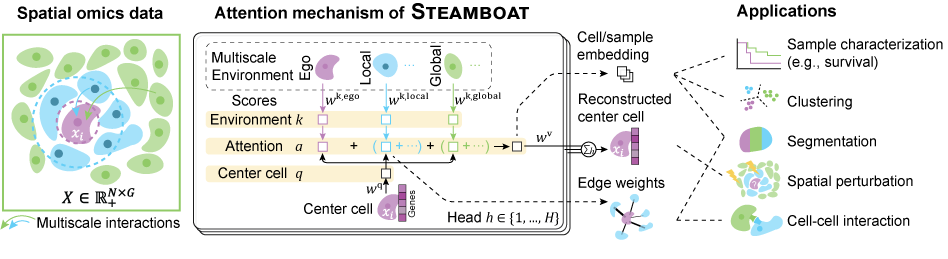
Steamboat is an interpretable machine learning framework leveraging a self-supervised, multi-head attention model that uniquely decomposes the gene expression of a cell into multiple key factors:
- intrinsic cell programs,
- neighboring cell communication, and
- long-range interactions.
These pieces of information are used to generate cell embedding, cell network, and reconstructed gene expression.
System requirements
Hardware
Steamboat can run on a laptop, desktop, or server. The experiments were done on a desktop computer with an RTX 3080 GPU (10GB VRAM). A GPU can significantly reduce the time needed to train the models (more than 5x on the most demanding examples).
Operating system
Steamboat is python-based and run on all mainsteam operating systems. It has been tested on Windows 10 and Springdale Linux.
Software dependencies
Lastest tested working dependency combination
| Package | Tested in 06/2025 | Tested in 12/2025 |
|---|---|---|
| Python | 3.11.5 | 3.19.9 |
| Torch | 2.1.2 (w/ cuda 12.1) | 2.9.1 (w/ cuda 13.0) |
| Scanpy | 1.9.6 | 1.11.5 |
| Squidpy | 1.5.0 | 1.6.6 |
| Scipy | 1.11.4 | 1.16.3 |
| Numpy | 1.26.2 | 2.3.1 |
| Networkx | 3.1 | 3.5 |
| Matplotlib | 3.8.0 | 3.10.6 |
| Seaborn | 0.13.2 | 0.13.2 |
| Scikit-learn | 1.2.2 | 1.7.2 |
Installation
We recommend using Miniconda to create a virtual environment.
conda create -n steamboat python=3.13
conda activate steamboat
pip install steamboat-bio
Installation usually takes about 2 minutes, but can vary depending on computer and network conditions.
Tips for GPU support
Before running pip install steamboat-bio, follow the official guide to install the appropriate Pytorch version for your system and hardware.
The exact commands will depend on your hardware and system. In general, they look like this.
conda create -n steamboat python=3.13
conda activate steamboat
pip install torch torchvision --index-url https://download.pytorch.org/whl/cu130 # DO NOT RUN. ADJUST IT FOR YOUR SYSTEM.
pip install steamboat-bio
Run without installation
If you are interested in modifying the package, or just don't feel like installing it, Steamboat can be imported directly after adding its directory to the path.
git clone https://github.com/ma-compbio/Steamboat
import sys
sys.path.append("/path/of/the/cloned/repository")
You may need to install the dependencies listed in requirements.txt manually.
Basic workflow
import steamboat as sf # "sf" = "Steamboat Factorization"
import steamboat.tools
Data preparation and training
First, make a list (adatas) of one or more AnnData objects, and preprocess them.
adatas = sf.prep_adatas(adatas, log_norm=True)
dataset = sf.make_dataset(adatas)
Create a Steamboat model and fit it to the data.
Refer to the tutorial about selecting the optimal n_heads.
model = sf.Steamboat(short_features, n_heads=10, n_scales=3)
model = model.to("cuda") # if GPU acceleration is supported.
model.fit(dataset)
After training, you can check the trained metagenes.
sf.tools.plot_all_transforms(model, top=1)
Tissue architecture definition (clustering and segmentation)
For clustering and segmentation, run the following lines. Change the resolution to your liking.
sf.tools.neighbors(adata)
sf.tools.leiden(adata, resolution=0.1)
sf.tools.segment(adata, resolution=0.5)
Mechanistic discovery (ligand–receptor screening)
lrp_dfs = sf.tools.score_lrs(adata, model, None, gene_names='index')
for i in range(model.spatial_gather.n_heads):
    display(lrp_dfs[i])
For visualization of the results, please refer to the tutorial.
Hypothesis testing (spatial perturbation)
This is a more involved process. Please refer to the relevant demos below.
If you want to try Steamboat with a relatively small dataset, please try human tonsil (Slide-tags).
Demos
A few examples in Jupyter notebook are included in the examples folder:
- Illustration (simulated)
- Ovarian cancer data (CosMX)
- Mouse brain (MERFISH)
- Colorectal cancer data (CODEX)
- Xenograft melanoma (Perturb-FISH)
- Human tonsil (Slide-tags)
- Breast cancer (Visium)
The simulation demo takes about five minutes to run. The mouse brain data takes one hour to train. Other demos take about ten minutes each.
While the demos only cover selected results that are quick to go through, all results can be generated by code in reproducibility directory.
Data used in these examples are available in Google Drive. Trained models are also uploaded.
Documentation
For the full API and real data examples, please visit our documentation.
1 maintainer

Release files for steamboat-bio 0.1.6
For a detailed explanation of source distributions (sdists) and built distributions (wheels), please see the package formats documentation.
Source distribution (sdist)
| File | Size | Uploaded | |
|---|---|---|---|
| steamboat_bio-0.1.6.tar.gz | 26.9 kB | Details |
Built distribution (wheel)
| File | Interpreter | ABI | Platform | Reset |
|---|---|---|---|---|
| steamboat_bio-0.1.6-py3-none-any.whl | Python 3 | none | any | Details |
Total release size: 52.2 kB
Release files / steamboat_bio-0.1.6.tar.gz
| Download URL | steamboat_bio-0.1.6.tar.gz |
|---|---|
| Size | 26.9 kB |
| Tags | Source |
|
SHA-256 checksum How to use checksums |
3001dcfd314165ec81f6afbfbd9e7651c320882da51cbad589760b20ffc3e9f0
|
|
BLAKE2b-256 checksum How to use checksums |
14eeedadd1e520d9b158ae616002c21cf98cf40528d0acf365b482068a2e6ece
|
| Upload date | |
|
Uploaded using Trusted Publishing? What is trusted publishing? |
Yes |
| Uploaded via |
twine/6.1.0 CPython/3.13.12
|
Provenance
Provenance describes where a file came from. On PyPI, provenance is shared via attestations, which provide a verifiable record of the build or publishing details. View details, limitations and caveats.


PyPI Publish Attestation
PyPI verified that this artifact, at this checksum, originated from the publisher listed below.
Signed by GitHub Actions, verified by PyPI on Jul 2, 2026.
Transparency logRelease files / steamboat_bio-0.1.6-py3-none-any.whl
| Download URL | steamboat_bio-0.1.6-py3-none-any.whl |
|---|---|
| Size | 25.3 kB |
| Tags | Python 3 |
|
SHA-256 checksum How to use checksums |
a69bcb1d8d01dae64a32c52252115989befedd495c3bf9172b678d04f2343d5c
|
|
BLAKE2b-256 checksum How to use checksums |
ea1e994554d79cc8072ba17f3547ddcd2af1649fb7bfcd3d6c64909243568091
|
| Upload date | |
|
Uploaded using Trusted Publishing? What is trusted publishing? |
Yes |
| Uploaded via |
twine/6.1.0 CPython/3.13.12
|
Provenance
Provenance describes where a file came from. On PyPI, provenance is shared via attestations, which provide a verifiable record of the build or publishing details. View details, limitations and caveats.
PyPI Publish Attestation
PyPI verified that this artifact, at this checksum, originated from the publisher listed below.
Signed by GitHub Actions, verified by PyPI on Jul 2, 2026.
Transparency log













