



Stellarmesh is a meshing library for nuclear workflows. Principally, it supports the creation of DAGMC geometry from CAD models.
Features:
✅ Surface and volume meshing
✅ Gmsh and OpenCASCADE meshing backends
✅ Linear and angular mesh tolerances
✅ Surface boundary conditions
✅ Imprinting and merging of conformal geometry
✅ Mesh refinement
✅ Mesh merging
✅ Programmatic manipulation of .h5m tags
✅ Automated testing and integration
Getting Started
Example
import build123d as bd
import stellarmesh as sm

solids = [bd.Solid.make_torus(1000, 100)]
for _ in range(3):
    solids.append(bd.Solid.thicken(solids[-1].faces()[0], 100))
solids = solids[1:]

geometry = sm.Geometry(solids[::-1], material_names=["a", "a", "c"])
mesh = sm.SurfaceMesh.from_geometry(
    geometry, sm.GmshSurfaceOptions(min_mesh_size=50, max_mesh_size=200)
)
mesh.write("test.msh")
mesh.render("docs/torus-mesh-reversed.png", rotation_xyz=(90, 0, -90), normals=15)

h5m = sm.DAGMCModel.from_mesh(mesh)
h5m.write("dagmc.h5m")
h5m.write("dagmc.vtk")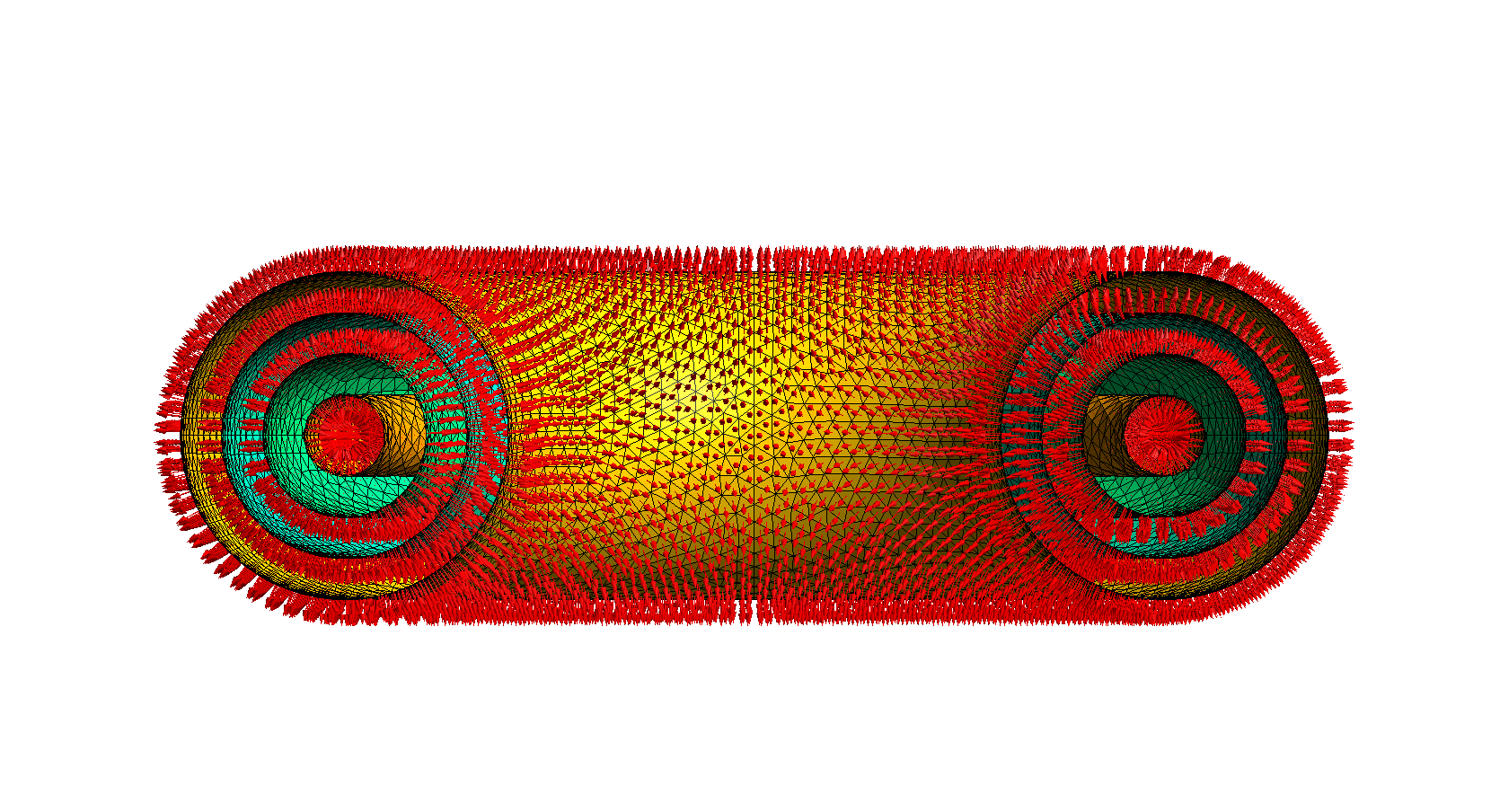
Citing
If you use Stellarmesh in your research, please cite it. Citation metadata is available in the CITATION.cff file, and GitHub can generate APA or BibTeX entries from the “Cite this repository” button on the repository page.
Contributing
Contributions are welcome — bug reports, feature requests, documentation fixes and pull requests.
Questions and usage help: start a thread in GitHub Discussions.
Bugs and feature requests: open an issue from one of the templates. Where applicable, please attach code to reproduce your issue.
Pull requests: for anything larger than a small fix, open an issue first so we can agree on the approach before you write code.
Stellarmesh uses pixi to manage its development environments, and stores binary data in Git LFS. To set up:
git lfs install
git clone https://github.com/stellarmesh/stellarmesh.git
cd stellarmesh
pixi run -e test test-unit
Acknowledgements
Stellarmesh is originally a project of Thea Energy, who are building the world’s first planar coil stellarator.

1 maintainer

Metadata
1 maintainer
Release files for stellarmesh 2.1.0
For a detailed explanation of source distributions (sdists) and built distributions (wheels), please see the package formats documentation.
Source distribution (sdist)
| File | Size | Uploaded | Provenance | Actions |
|---|---|---|---|---|
| stellarmesh-2.1.0.tar.gz | 25.1 kB | With provenance | Details for stellarmesh-2.1.0.tar.gz |
Built distribution (wheel)
| File | Interpreter | ABI | Platform | Actions Reset |
|---|---|---|---|---|
| stellarmesh-2.1.0-py3-none-any.whl | Python 3 | none | any | Details for stellarmesh-2.1.0-py3-none-any.whl |
Total release size: 49.8 kB
Release files / stellarmesh-2.1.0.tar.gz
| Download URL | stellarmesh-2.1.0.tar.gz |
|---|---|
| Size | 25.1 kB |
| Tags | Source |
|
SHA-256 checksum How to use checksums |
8d999e1ef022850ed3e4f73f8f65c4682103c5abaf2ac05d4519066084a560ad
|
|
BLAKE2b-256 checksum How to use checksums |
62eed127c6aaf23c3125565f79a0c7efc6ac6051fb887afbdd4fce15fad68a53
|
| Upload date | |
|
Uploaded using Trusted Publishing? What is trusted publishing? |
Yes |
| Uploaded via |
twine/7.0.0 CPython/3.13.16
|
Provenance
Provenance describes where a file came from. On PyPI, provenance is shared via attestations, which provide a verifiable record of the build or publishing details. View details, limitations and caveats.


PyPI Publish Attestation
PyPI verified that this artifact, at this checksum, originated from the publisher listed below.
Signed by GitHub Actions, verified by PyPI on Nov 20, 2026.
Transparency logRelease files / stellarmesh-2.1.0-py3-none-any.whl
| Download URL | stellarmesh-2.1.0-py3-none-any.whl |
|---|---|
| Size | 24.7 kB |
| Tags | Python 3 |
|
SHA-256 checksum How to use checksums |
3752b211d1d4e1bc49a4629b114b48f4a184f902c09f43aaf4c75977831abf09
|
|
BLAKE2b-256 checksum How to use checksums |
b591316f781fef277da088873549e7e3c68d12984c9c134d53a5b90091498cf1
|
| Upload date | |
|
Uploaded using Trusted Publishing? What is trusted publishing? |
Yes |
| Uploaded via |
twine/7.0.0 CPython/3.13.16
|
Provenance
Provenance describes where a file came from. On PyPI, provenance is shared via attestations, which provide a verifiable record of the build or publishing details. View details, limitations and caveats.
PyPI Publish Attestation
PyPI verified that this artifact, at this checksum, originated from the publisher listed below.
Signed by GitHub Actions, verified by PyPI on Nov 20, 2026.
Transparency logSecurity for stellarmesh 2.1.0
Provenance
Provenance describes where a file came from. On PyPI, provenance is shared via attestations, which provide a verifiable record of the build or publishing details. View details, limitations and caveats.
Full provenance
Both files in this release have been uploaded with provenance metadata.
Attestation for stellarmesh-2.1.0.tar.gz
PyPI Publish Attestation
PyPI verified that this artifact, at this checksum, originated from the publisher listed below.
Signed by GitHub Actions, verified by PyPI on Nov 20, 2026.
Transparency logA note on package security
PyPI is a repository for distributing packages, not a service for auditing them. While third-party security researchers and our staff do their best to detect and remove malicious packages, PyPI cannot guarantee the quality, security or suitability of any given package.
To learn more about protecting yourself from malicious actors, visit our package security documentation.














