
Stellenpilot
Your local AI job assistant. Open source, private, and on autopilot.




Stellenpilot is an AI agent for your job search that runs on your own computer. Every morning it finds new jobs, an AI reads each one against your CV, tells you honestly how well it fits, and writes a tailored CV and cover letter for the best matches. When you open the dashboard, the work is done: you read, decide and send.
It comes with its own free built-in AI, so you need no account, no API key and no cloud. Your CV never leaves your computer. Built for the job market in Germany, and it works in other countries too.
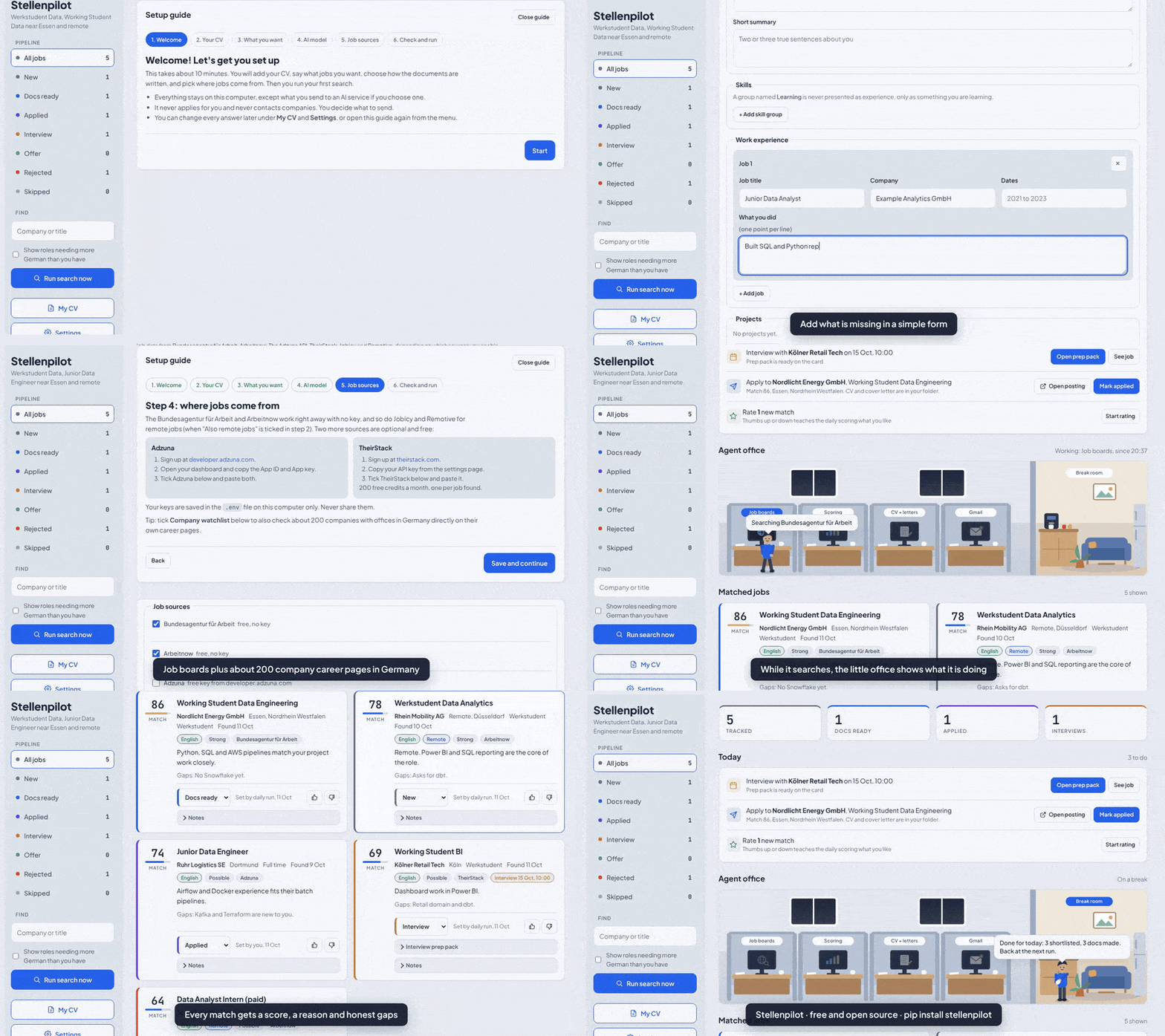
All names, companies and jobs in this demo are fictional.
pip install stellenpilot
stellenpilot serve
Open http://127.0.0.1:8765. Setup takes a few minutes, plus the one time AI download: drop your CV, say what you are looking for, press Download for the built-in AI, and switch on the daily search. Windows, macOS and Linux, Python 3.11 or newer.
How it works
flowchart LR
    A["🔎 Collect<br/>6 job sources<br/>+ 200 company sites"] --> B["🧠 AI scores<br/>each job 0 to 100<br/>with reasons and gaps"]
    B --> C["✍️ AI writes<br/>tailored CV and<br/>cover letter"]
    C --> D["📬 Gmail tracks<br/>replies and moves<br/>statuses forward"]
    D --> E["✅ You decide<br/>read, edit, send"]
Every day, by itself:
- Collect. Stellenpilot searches the Bundesagentur für Arbeit, Arbeitnow, Adzuna, TheirStack, Jobicy and Remotive, plus the career pages of about 200 companies with offices in Germany. Duplicates are removed.
- Score. The AI reads each ad against your CV and gives a match from 0 to 100, a short reason, and the honest gaps. It reads which German level the ad really asks for and skips ads far above yours.
- Write. For the best matches it writes a CV and a cover letter tailored to that job, using only facts from your CV, as Word files and PDF.
- Track. With Gmail connected, confirmations, interview invitations and rejections move each application forward on their own. Interviews get a prep pack.
- Report. The dashboard (and, if you like, a Telegram or email digest) shows what is ready to send today.
It never applies for you and never contacts a company. The agent prepares; you stay in control of every application.
The AI
What the AI does for you
- Reads your CV. Drop a PDF or Word file and the AI turns it into a structured profile. Every bullet is checked against your original, and anything left out or made up is flagged.
- Scores every job from 0 to 100 with a one line reason and the honest gaps (for example "asks for dbt, which you are still learning").
- Understands German job ads. It finds the German level an ad really needs (A1 to C2, from phrases like "verhandlungssicher" or "gute Deutschkenntnisse"), compares it with yours, and writes an English summary of every German ad.
- Tailors your CV. It picks and orders the experience, projects and skills from your profile that matter most for this job, and chooses the best fitting headline.
- Writes the cover letter in natural language for that company and role, plus a short report: what the ad asks for, what you cover, and which gaps to be honest about. German letters only if your German is B2 or better.
- Prepares interviews with likely questions and questions to ask them.
- Learns your taste. Mark jobs as a good match or not for you, and the next search leans toward what you liked.
Truthful by design
A job assistant that invents experience gets people into trouble. Stellenpilot has a truth guard: any generated sentence that mentions a number, a tool or a language level your profile does not back up is rejected and replaced with safe text. Skills in a group called "Learning" are never presented as experience. The AI rephrases and selects; it never adds facts.
Choose your AI
| Built-in AI | Ollama, LM Studio, llama.cpp | Claude or OpenAI | No AI | |
|---|---|---|---|---|
| Setup | one Download button | install the app, pull a model | paste an API key | nothing |
| Cost | free | free | a few cents a day | free |
| Privacy | stays on your computer | stays on your computer | CV and ads go to the provider | stays on your computer |
| Writing | good | depends on the model | best | templates |
| Speed | slower (see below) | depends on your computer | fast | instant |
Built-in AI is the default for new users. Pick it in setup or in Settings, AI model and press Download. Stellenpilot downloads the llama.cpp engine and an open Qwen3.5 model (Apache 2.0) once, into ~/.stellenpilot/ai. It starts by itself when a search needs it and stops when the search is done.
| model | download | memory | writing |
|---|---|---|---|
| Standard: Qwen3.5 4B (default) | 2.7 GB | about 6 GB free | better |
| Light: Qwen3.5 2B | 1.3 GB | runs with 8 GB in total | simpler, about twice as fast |
How fast is it? It runs on your processor, so it is slower than Claude, but free and private:
- Standard on a typical laptop: about 20 to 40 seconds to score one job, and 1 to 2 minutes for a CV with its cover letter. Light is about twice as fast.
- To keep searches short, an AI on your own computer reads the 20 most promising new jobs of each search (picked by keywords); the others keep a keyword score. Change it with
max_ai_jobsunder[llm]. - A daily search with the AI takes about 10 to 20 minutes with Standard, or 5 to 10 with Light, in the background. Without AI it takes a minute or two.
- Measured on our small test server with only 2 processor cores: Standard needed 67 seconds per job and 2 minutes per CV and letter; Light 32 seconds and about 1 minute. Older laptops can be that slow; newer ones and Macs with Apple chips are faster.
- After the download, Test speed in Settings measures your own computer.
The laptop figures are estimates from published CPU benchmarks for these model sizes, not measured on every computer.
Using your own local model or a cloud API
Set [llm] in config.toml, or choose it in Settings, AI model:
| provider | what you need | notes |
|---|---|---|
builtin |
press Download once in Settings | Local and free, set up by Stellenpilot. model = "standard" or "light". |
ollama |
Ollama running, a pulled model | Local and free. |
lmstudio |
LM Studio with its server started | Local and free. |
llamacpp, vllm, local |
a running server | Any OpenAI compatible local server. |
anthropic |
ANTHROPIC_API_KEY in .env |
Claude through the Anthropic API. |
openai |
OPENAI_API_KEY in .env |
OpenAI API. |
none |
nothing | Keyword scoring and template letters. |
Which local model for Ollama or LM Studio? Pick an instruction tuned version, because the tool asks for JSON answers.
| your computer | try | download |
|---|---|---|
| 8 GB RAM, no GPU | ministral-3:3b or qwen3.5:2b. Expect rougher scores and shorter letters. |
about 3 GB |
| 16 GB RAM, or a GPU with 8 GB | qwen3.5:4b (default pick), or ministral-3:8b if many of your ads are in German |
4 to 6 GB |
| GPU with 16 GB or more | qwen3.5:9b or gemma4:12b |
7 to 9 GB |
Why these (checked on their model cards, October 2026): all are Apache 2.0, run in Ollama, and handle JSON well. Qwen3.5 covers 201 languages; Ministral 3 lists German among its main languages and is built for JSON output; Gemma 4 is Google's newest small family. Qwen3.5 and Gemma 4 can "think" before answering, which makes them slow; Stellenpilot switches that off for Ollama (set think = true under [llm] to turn it back on).
What we saw in testing with a very small model (Qwen2.5 1.5B on 2 CPU cores): the pipeline worked end to end, the German check and the truth guard did their job, and the cover letter stayed truthful. But the model gave every job the same score and wrote a two sentence letter, and each answer took about a minute. Small models are fine for trying the setup, not for real use.
Full setup for Ollama, LM Studio, llama.cpp, vLLM and Docker, plus speed tips and troubleshooting: docs/local-llm.md. Run stellenpilot doctor to check that your model server is reachable and the model is installed.
Automation
- Daily autopilot. Switch on Automatic search in Settings and pick a time. Stellenpilot sets up Task Scheduler on Windows or cron on macOS and Linux for you. The dashboard does not need to be open. A search missed because the computer was off runs when you log in or open Stellenpilot. Doing it by hand: docs/scheduling.md.
- Company watchlist. Switch on the ready made list of about 200 companies with offices in Germany, or add your dream companies that use Greenhouse, Lever, Ashby, Personio or SmartRecruiters. Their new roles often appear here before they reach the job boards.
- Gmail sync. Read only. Connect it in Settings, Gmail in three steps, and statuses move forward as replies arrive. It never sends, deletes or labels mail. Details: docs/gmail.md.
- Daily digest to Telegram or email: top new matches, documents ready to send, interviews. See docs/digest.md.
- Jobs you found yourself. Paste a link or the ad text from LinkedIn, a friend or anywhere, and the AI scores and tailors it like the rest.
The dashboard
Five calm pages, in your browser, on your computer:
- Home: what is ready to apply, interviews coming up, the newest matches, and a small 3D office where you can watch the agent work.
- Jobs: every job with its score, why it fits, honest gaps, your documents, notes and interview prep.
- Applications: a board you drag cards across (Applied, Interview, Offer, Rejected), with reply rates by source, the skill gaps employers mention most, and a weekly summary.
- My CV: your profile, with tips to improve your matches.
- Settings: job sources, the AI, the daily search and Gmail, with step by step help for every key.
Install
New to Python or the terminal? Follow INSTALL.md: step by step for Windows, macOS, Linux and Docker, from installing Python to your first search.
pip install stellenpilot
mkdir my-hunt
cd my-hunt
stellenpilot serve      # open http://127.0.0.1:8765, setup opens by itself
"stellenpilot is not recognized"? pip put the command in a folder that is not on your PATH. Use python -m stellenpilot serve instead (python3 on macOS and Linux). That always works.
Update with pip install -U stellenpilot. Your files in my-hunt are never touched by an update.
From source, or with Docker
From the source code instead: you need Python 3.11 or newer (or Docker, see below). Works on Windows, macOS and Linux. On Debian or Ubuntu also install python3-venv. On Windows use python where the commands below say python; on macOS and Linux it may be python3.
git clone https://github.com/srvskr1/stellenpilot.git
cd stellenpilot
python -m venv .venv
# Windows: .venv\Scripts\activate    macOS or Linux: source .venv/bin/activate
pip install -e .

mkdir my-hunt
cd my-hunt
stellenpilot init      # creates config.toml, profile.toml and .env
stellenpilot demo      # optional: fictional sample jobs, to look around first
stellenpilot serve     # open http://127.0.0.1:8765
Prefer Docker? No Python needed:
mkdir data
docker compose build
docker compose run --rm stellenpilot init
docker compose up -d      # http://127.0.0.1:8765
See docs/docker.md for daily runs and details.
Prefer files to the dashboard? Everything also lives in profile.toml, config.toml and .env, stellenpilot run searches from the terminal, and stellenpilot doctor checks the setup.
Job sources
| source | key | cost and limits | terms you should know |
|---|---|---|---|
| Bundesagentur für Arbeit | none | free | Community documented endpoint (jobsuche.api.bund.dev). No published limits, so requests are kept small. |
| Arbeitnow | none | free | Their terms require a link back to arbeitnow.com. The dashboard shows it. |
| Adzuna | free, from developer.adzuna.com | default 250 calls a day | Allowed for personal research. Adzuna must be credited; every Adzuna job links to Adzuna. Returns short snippets, not full ads. |
| TheirStack | free, from theirstack.com | 200 credits a month, 1 credit per job | Keys may not be shared. Each user needs their own. |
| Jobicy | none | free, one pass an hour at most | Remote jobs only. Credit Jobicy with a link to the listing; the dashboard does this. |
| Remotive | none | free, about 4 calls a day at most | Remote jobs only, one call per run. Small feed, delayed by a day. Credit and link back to Remotive; the dashboard does this. |
There is no LinkedIn, StepStone or Indeed scraper on purpose. LinkedIn's and StepStone's terms forbid scraping, and Indeed has no public job search API. See docs/sources.md for the details and links.
Other countries: set country in config.toml. Adzuna covers 19 countries, Jobicy and Remotive cover remote roles open to your country, TheirStack and the company watchlist cover any country, and the Bundesagentur and Arbeitnow cover Germany only.
Privacy and safety
- Local first. Everything is stored in
jobhunt.dband theoutputfolder next to your config, on your computer. With the built-in AI or another local model, nothing about you leaves it. - With Claude or OpenAI, your profile and the job ads are sent to that provider.
- The dashboard listens on 127.0.0.1 only, and write requests need a custom header, so other websites cannot change your data through your browser.
- Read every document before you send it. The truth guard checks digits and the tools it knows (see
VOCABinstellenpilot/score.py). It cannot judge spelled out numbers or vague claims, so you are the final check.
Commands
| command | does |
|---|---|
stellenpilot init |
create config, profile and .env from the examples |
stellenpilot doctor |
check the setup and keys |
stellenpilot run |
search, score, tailor, and sync Gmail if enabled |
stellenpilot run --no-tailor |
search and score only |
stellenpilot serve |
start the dashboard on 127.0.0.1:8765 |
stellenpilot gmail |
sync statuses from Gmail once |
stellenpilot demo |
load fictional sample jobs |
stellenpilot import cv.pdf |
turn your CV into profile.imported.toml to review |
stellenpilot add LINK |
add a job from a careers page link |
stellenpilot add --text ad.txt --title "..." --company "..." --tailor |
add a pasted ad and tailor it now |
stellenpilot watch LINK |
find the watchlist entry for a company |
stellenpilot notify-test |
send a test digest |
stellenpilot telegram-id |
show your Telegram chat id |
Use --home PATH to keep your files in another folder.
Use --home PATH to keep your files in another folder.
Project layout
stellenpilot/
  sources/      one module per job API
  pipeline.py   the daily run: collect, score, tailor, Gmail
  score.py      LLM or keyword scoring, taste from your ratings
  tailor.py     truthful CV plan, DOCX, cover letter, report, PDF
  server.py     local dashboard API
  web/          dashboard page
  examples/     example config and profile
tests/          offline tests: python -m unittest discover -s tests
Uninstall completely
Do these steps in order. Steps 1 and 2 matter most: they stop the daily search before the program is gone.
1. Stop the dashboard. Press Ctrl+C in the terminal where stellenpilot serve runs (Docker: docker compose down).
2. Remove the automatic daily search, if you switched it on. Easiest: in the dashboard open Settings, switch off Search every day under Automatic search and press Save changes. If the dashboard is already gone:
- Windows (PowerShell):
schtasks /Delete /TN "Stellenpilot daily search" /F - macOS and Linux: run
crontab -eand delete the line that ends with# jobhunt-daily
3. Remove the program.
- Installed with pip: activate the environment you installed it in, then
pip uninstall stellenpilot. Delete that environment folder too if you made one just for it (for examplestellenpilot-envor.venv). - Installed from source: delete the
stellenpilotfolder you cloned or unzipped (the environment.venvis inside it). - Docker: in the project folder run
docker compose down, thendocker rmi ghcr.io/srvskr1/stellenpilot(anddocker image pruneto free the space of any self built image).
4. Delete your data. Your workspace folder (my-hunt, or data for Docker) holds everything personal: your CV profile, .env with your API keys, the job database, the generated CVs and cover letters, run.log, backups and the Gmail token.json. Delete the whole folder. The only other place is the Built-in AI folder .stellenpilot in your home folder, if you downloaded it (see step 5).
5. Close your accounts and keys (optional, but good practice):
- API keys you created for it: delete them at Adzuna, TheirStack, Anthropic or OpenAI.
- Gmail sync: remove access at https://myaccount.google.com/permissions and delete the Google Cloud project you made for it.
- Telegram digest: send
/deletebotto @BotFather. - Built-in AI: press Remove the AI files in Settings, or delete the folder
.stellenpilotin your home folder (C:\Users\<you>\.stellenpiloton Windows). It holds the engine and the model, about 1.5 to 4 GB. - Ollama model:
ollama rm qwen3.5:4b(or the model you pulled), and uninstall Ollama or LM Studio if you only used them for this.
LibreOffice and Python stay installed; remove them like any other app if you no longer need them.
Contributing
Issues and pull requests are welcome. New sources should use an official or clearly permitted API, follow the shape in stellenpilot/sources/__init__.py, and come with an offline test.
Credits and license
MIT, see LICENSE. Credits for ideas and data are in NOTICE.md. The built-in AI uses llama.cpp (MIT) and Qwen3.5 models (Apache 2.0), downloaded from their official sources.
1 maintainer

Metadata
1 maintainer
Release files for stellenpilot 0.5.2
For a detailed explanation of source distributions (sdists) and built distributions (wheels), please see the package formats documentation.
Source distribution (sdist)
| File | Size | Uploaded | |
|---|---|---|---|
| stellenpilot-0.5.2.tar.gz | 151.4 kB | Details |
Built distribution (wheel)
| File | Interpreter | ABI | Platform | Reset |
|---|---|---|---|---|
| stellenpilot-0.5.2-py3-none-any.whl | Python 3 | none | any | Details |
Total release size: 292.6 kB
Release files / stellenpilot-0.5.2.tar.gz
| Download URL | stellenpilot-0.5.2.tar.gz |
|---|---|
| Size | 151.4 kB |
| Tags | Source |
|
SHA-256 checksum How to use checksums |
33dd1f58bbeda1dd8119da8c9a4852d350e2c4e6f7cb01768b6a391152127135
|
|
BLAKE2b-256 checksum How to use checksums |
fcaf66487ee13bfe630d3e99e4b0aa5fcb39650020922fc96e131b08e3f1936f
|
| Upload date | |
|
Uploaded using Trusted Publishing? What is trusted publishing? |
Yes |
| Uploaded via |
twine/7.0.0 CPython/3.13.14
|
Provenance
Provenance describes where a file came from. On PyPI, provenance is shared via attestations, which provide a verifiable record of the build or publishing details. View details, limitations and caveats.


PyPI Publish Attestation
PyPI verified that this artifact, at this checksum, originated from the publisher listed below.
Signed by GitHub Actions, verified by PyPI on Oct 13, 2026.
Transparency logRelease files / stellenpilot-0.5.2-py3-none-any.whl
| Download URL | stellenpilot-0.5.2-py3-none-any.whl |
|---|---|
| Size | 141.1 kB |
| Tags | Python 3 |
|
SHA-256 checksum How to use checksums |
5871a1157ccd0cdaaa4de59ddbaddf60cf28fc57e1543d04fdfce706de685f2a
|
|
BLAKE2b-256 checksum How to use checksums |
6f5ed3a310030feb44cec44e71e636143453a4eb43f5ee040a82aaa58729e629
|
| Upload date | |
|
Uploaded using Trusted Publishing? What is trusted publishing? |
Yes |
| Uploaded via |
twine/7.0.0 CPython/3.13.14
|
Provenance
Provenance describes where a file came from. On PyPI, provenance is shared via attestations, which provide a verifiable record of the build or publishing details. View details, limitations and caveats.
PyPI Publish Attestation
PyPI verified that this artifact, at this checksum, originated from the publisher listed below.
Signed by GitHub Actions, verified by PyPI on Oct 13, 2026.
Transparency log













