
A Tool for Automated Stratigraphic Log Visualisation
A Python-based framework for automated visualisation of creating standardised, reproducible, and digitally integrated stratigraphic logs.







Key Features
-
Simple Input Format: Use CSV, Excel or similar files to structure your data with a range of supported column types (lithology, grain size, features, lenses, contacts, etc.) and let stratapy handle the visualisation
-
Vast Customisation: Tailor every aspect of your logs, from layout and styling to colours and symbology, with a simple parameter-based interface
-
Standardised Symbology: Access a curated library of geological symbols and patterns, including USGS standard lithology patterns
-
Multi-Figure Functionality: Create complex, multi-panel figures with ease, enabling comprehensive visualisation of stratigraphic data
-
Publication-Quality Output: Generate high-resolution figures suitable for academic publication and professional presentations
-
Accessible for Non-Programmers: Designed with user-friendliness in mind, enabling geoscientists of all programming skill levels to create stunning visualisations
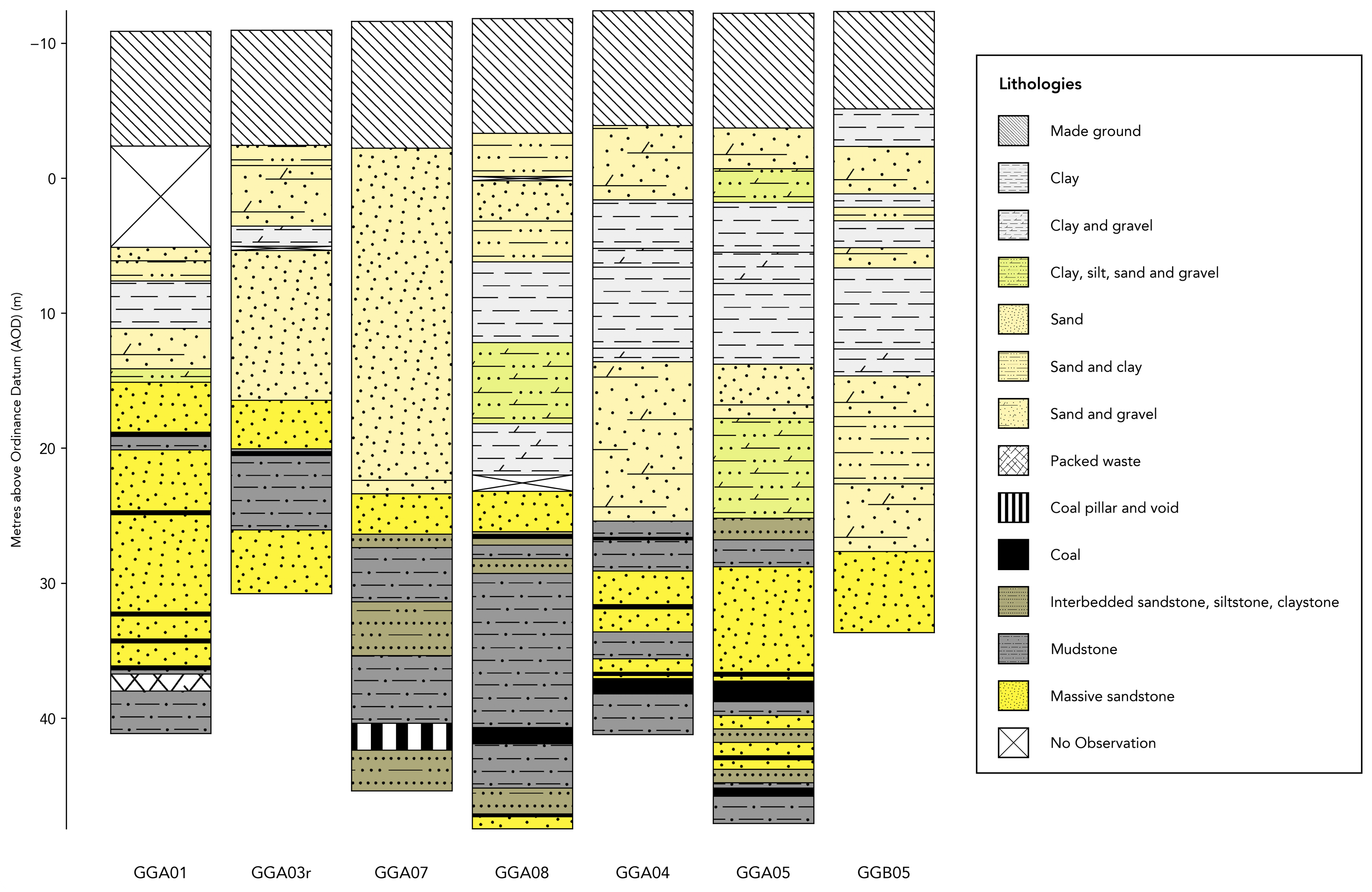
For more examples, see the documentation or try it out online with this Google Colab tutorial notebook.
Quick Start
Installation
pip install stratapy
Basic Usage
import stratapy as sp

# Load and plot a log
log = sp.load_log('path/to/file.csv')
log.plot()
log.save('output.png')
Multi-Panel Figures
import stratapy as sp

# Automatically plot multiple logs in a single figure
files = ['log1.csv', 'log2.csv', 'log3.csv']
panel = sp.multi_fig(files)
panel.save('output.png')
Use Online - No Installation Required
Try out stratapy immediately without any installation using this Google Colab tutorial notebook.
See the Online Platforms section of the documentation for more details.
Documentation
For full API reference and tutorials, visit our ReadTheDocs page.
Citation
If you use this software in your research or otherwise, please cite its associated publication:
Smith, J. L., Antoniou, C., & Alexander, R. (2026). Stratapy: a tool for automated stratigraphic log visualisation. Scientific Reports 16 1 https://doi.org/10.1038/s41598-026-58501-2
For detailed citation metadata, see CITATION.cff or use the following BibTeX entry:
@software{smith_stratapy_2026,
  author       = {Smith, Jack Lee and Antoniou, Christina and Alexander, Ruaridh},
  title        = {Stratapy: a tool for automated stratigraphic log visualisation},
  journal      = {Scientific Reports},
  volume       = {},
  number       = {},
  month        = june,
  year         = 2026,
  doi          = {10.1038/s41598-026-58501-2},
  url          = {https://doi.org/10.1038/s41598-026-58501-2},
}
License
Distributed under the BSD 3-Clause License. See LICENSE.txt for more information.
Compatibility
stratapy is compatible with Python 3.9 and above, and supports a wide range of versions for key dependencies (NumPy, Pandas, Matplotlib).
| Python Version | NumPy Range | Pandas Range | Matplotlib Range | Status | Notes |
|---|---|---|---|---|---|
| 3.11 | >=1.22 | >=1.4 | >=3.0 | ✔️ | Recommended Environment (Full support across all versions) |
| 3.12 / 3.13 | >=1.24 | >=2.0 | >=3.8 | ✔️ | Fully Supported (Legacy stacks are not compatible) |
| 3.14 | >=2.0 | >=2.2 | >=3.9 | ✔️ | Bleeding-Edge (Support for latest Python and dependencies; may have some issues with older versions) |
| 3.9 / 3.10 | <2.1 | <3.0 | <3.10 | ✔️ | Supported for stable/legacy stacks; excludes bleeding-edge |
| <=3.8 | — | — | — | ❌ | Unsupported |
1 maintainer

Metadata
1 maintainer
Release files for stratapy 1.0.1
For a detailed explanation of source distributions (sdists) and built distributions (wheels), please see the package formats documentation.
Source distribution (sdist)
| File | Size | Uploaded | Provenance | Actions |
|---|---|---|---|---|
| stratapy-1.0.1.tar.gz | 17.6 MB | Without provenance | Details for stratapy-1.0.1.tar.gz |
Built distribution (wheel)
| File | Interpreter | ABI | Platform | Actions Reset |
|---|---|---|---|---|
| stratapy-1.0.1-py3-none-any.whl | Python 3 | none | any | Details for stratapy-1.0.1-py3-none-any.whl |
Total release size: 35.2 MB
Release files / stratapy-1.0.1.tar.gz
| Download URL | stratapy-1.0.1.tar.gz |
|---|---|
| Size | 17.6 MB |
| Tags | Source |
|
SHA-256 checksum How to use checksums |
1549c78352ca3f5d7bb0e14c259e7bcc707bad8152f30f8a36eed69af3f7e881
|
|
BLAKE2b-256 checksum How to use checksums |
124285cd763c6ab7f329211bd97a3a8c4d3f0457f4bee4c689e9f84d936c9efa
|
| Upload date | |
|
Uploaded using Trusted Publishing? What is trusted publishing? |
No |
| Uploaded via |
twine/6.2.0 CPython/3.13.11
|
Release files / stratapy-1.0.1-py3-none-any.whl
| Download URL | stratapy-1.0.1-py3-none-any.whl |
|---|---|
| Size | 17.6 MB |
| Tags | Python 3 |
|
SHA-256 checksum How to use checksums |
116434fd679e5e1c22f264578e5a3a8693298786c83091a90770ca7844a66c3d
|
|
BLAKE2b-256 checksum How to use checksums |
62ee8c61ae5cb97904d6d0e6b6a42cde819a00515c5b34b354f81c72435c4309
|
| Upload date | |
|
Uploaded using Trusted Publishing? What is trusted publishing? |
No |
| Uploaded via |
twine/6.2.0 CPython/3.13.11
|
Security for stratapy 1.0.1
Provenance
Provenance describes where a file came from. On PyPI, provenance is shared via attestations, which provide a verifiable record of the build or publishing details. View details, limitations and caveats.
No provenance found
None of the files in this release were uploaded with provenance metadata.
A note on package security
PyPI is a repository for distributing packages, not a service for auditing them. While third-party security researchers and our staff do their best to detect and remove malicious packages, PyPI cannot guarantee the quality, security or suitability of any given package.
To learn more about protecting yourself from malicious actors, visit our package security documentation.














