
subgraphsearch




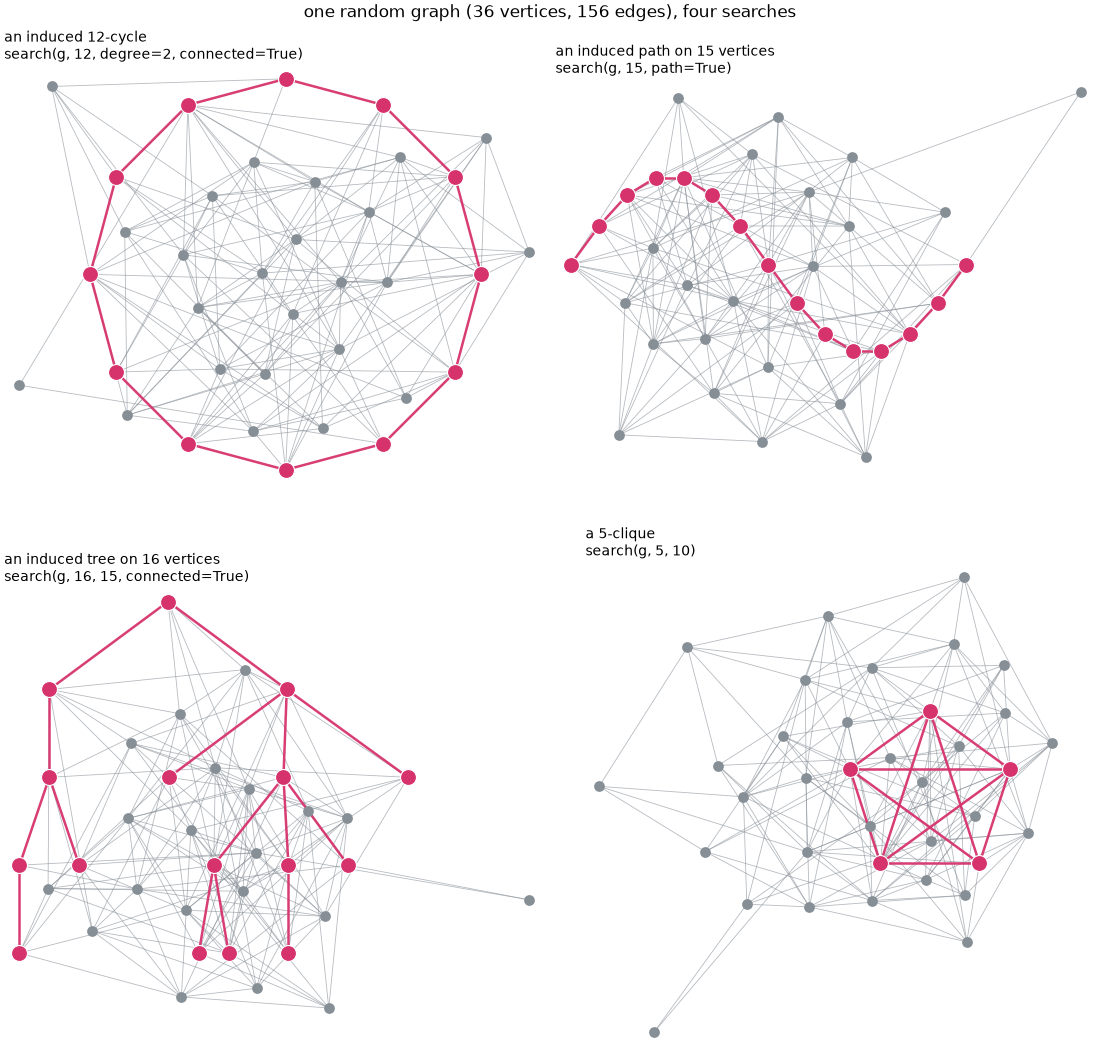
Find induced subgraphs of a given size that hit a prescribed target, in milliseconds where general solvers take seconds or give out. It is a family of searches, one for each kind of target:
- A number of edges:
kvertices spanning exactlymedges, including cliques (all edges), independent sets (none) and trees. - A degree for every vertex: regular subgraphs, such as induced cycles (every vertex of degree 2), and induced paths.
- A total weight, in a weighted graph. The heaviest
kvertices solve the maximum diversity problem: choosingkofnitems as different from each other as possible, such as a diverse portfolio or far-apart facility sites. Here it matches the best published values for up to 500 items in under a second.
Where a specialized solver exists, such as for cliques, that solver usually wins at scale (How it compares). Searches can pass through given vertices, are reproducible from a seed, report near misses alongside exact solutions, and come with diagnostics for tuning; many graph formats are supported.
Start with the quickstart notebook, a hands-on tour of every kind of search.
Install
subgraphsearch is on PyPI and requires Python 3.10 or later and NumPy 1.24 or later. With uv:
uv add subgraphsearch                # add the package to your project
uv add "subgraphsearch[all]"         # also plotting and conversions to networkx, igraph and SciPy
uv tool install subgraphsearch       # just the `subgraphsearch` command, on your PATH
uvx subgraphsearch info g.g6         # or run the command without installing it
With pip:
pip install subgraphsearch           # the package and the `subgraphsearch` command
pip install "subgraphsearch[all]"    # also plotting and conversions to networkx, igraph and SciPy
pipx install subgraphsearch          # just the command, in its own environment
pipx run subgraphsearch info g.g6    # or run the command without installing it
Prebuilt wheels need no compiler, and each one serves every Python from 3.10 on:
| Platform | Architectures | Requires |
|---|---|---|
| Linux with glibc (most distributions) | x86-64, ARM64 | glibc 2.17 or later |
| Linux with musl (Alpine, slim Docker images) | x86-64, ARM64 | musl 1.2 or later |
| macOS | Intel, Apple silicon | macOS 10.12 (Intel) or 11 (Apple silicon) or later |
| Windows | x64, ARM64 | — |
The x86-64 wheels need an x86-64 processor from about 2009 on (the x86-64-v2 level, with the POPCNT instruction). On older processors and on other platforms, pip builds the package from source, which needs a Rust toolchain, 1.87 or later.
To copy the quickstart notebook into the current directory and open it in JupyterLab:
uv run --with "subgraphsearch[all]" --with jupyterlab python -m subgraphsearch quickstart   # with uv
pip install "subgraphsearch[all]" jupyterlab && python -m subgraphsearch quickstart       # with pip
Documentation
| Document | What it covers |
|---|---|
| Quickstart notebook | A hands-on tour of every kind of search and its applications |
| BENCHMARKS.md | How subgraphsearch compares with other methods on standard benchmarks |
| ALGORITHM.md | How the search works: moves, perturbations, variants, data structures |
| TUNING.md | Which search to use for a goal, and how to set its parameters |
| GRAPHS.md | Random graphs, operations, graphs from vectors and designs, file formats |
| ARCHITECTURE.md | How the Rust core, the command line and the Python package fit together |
| PORTING.md | The original C programs, and how to reproduce their runs exactly |
| DEVELOPMENT.md | Building, testing and releasing |
Python
import numpy as np
import subgraphsearch as ss
from subgraphsearch import viz

# choose 50 of 500 items as different from each other as possible
items = np.random.default_rng(0).random((500, 8))             # 500 items, 8 features each
dist = np.linalg.norm(items[:, None] - items[None], axis=-1)  # the distance between every two
w, factor = ss.WeightedGraph.from_scores(dist)                # items as vertices, distances as weights
best = ss.densest(w, 50)                                      # 50 items as far apart as possible:
best.vertices, best.score                                     # which, and their total distance

g = ss.generate("exponential", 100, 0.6, seed=1)   # a random graph: 100 vertices, density 0.6

r = ss.search(g, size=11, edges=55)    # 11-cliques
r = ss.search(g, size=30, edges=340)   # 30 vertices spanning exactly 340 edges
r = ss.search(g, size=10, degree=4)    # 4-regular induced subgraphs
big = ss.largest(g, "clique")          # the largest clique the search can find
dense = ss.densest(g, 30)              # the 30 vertices spanning the most edges

print(r.summary())
r.solutions()                                  # the distinct vertex sets found
viz.plot_graph(g, highlight=r.best.vertices)   # draw one
viz.plot_search_summary(r)                     # how the search went
viz.save_html("result.html", r)                # an interactive viewer; viz.show(r) in Jupyter
In Jupyter, graphs and results display as summaries with small charts.
- Searches: a number of edges (
edges=), a regular subgraph (degree=), an induced path (path=True, between two given vertices withendpoints=), a total weight in a weighted graph; any of them connected (connected=True) or through given vertices (fixed=), with near misses alongside exact solutions.ss.largestfinds the largest induced path, cycle or tree, clique or independent set the search can reach. - Graphs: from edges, files, other libraries (networkx, igraph, SciPy, NumPy), random models,
hypercubes and grids, incidence structures such as block designs, and sets of vectors or binary
words joined by their inner products or Hamming distances (
ss.Graph.from_vectors,ss.Graph.from_words), and weighted graphs from real-valued scores (ss.WeightedGraph.from_scores); complements, induced subgraphs, Seidel switching, and products of graphs (Cartesian, tensor, strong, lexicographic, replacement and zig-zag). - Seeing what happened: drawings of graphs and the subgraphs found, diagnostics of a search, spectra, and parameter sweeps for tuning.
The quickstart notebook goes through all of these.
How it compares
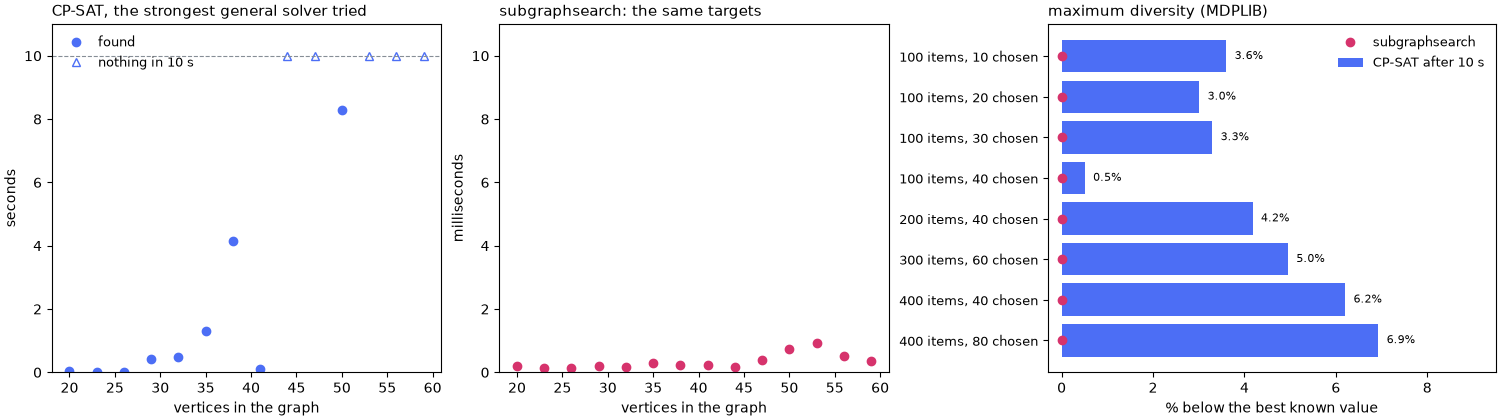
- Maximum diversity: the best published MDPLIB values up to 500 items in under a second, where
CP-SAT ends up to 10% short and the MIP solvers up to 36%. At 2000 items, in the 20 s per run of
a heuristic made for the problem, which reaches the best known value in 22 of 30 runs,
subgraphsearch reaches it in 7 with default settings and in 27 with
aspiration="full". - Exact edge counts: milliseconds, where CP-SAT and the MIP solvers SCIP, HiGHS and CBC need seconds at a few dozen vertices and mostly find nothing within 10 seconds past 40.
- Maximum cliques: far faster than an exact search, but a dedicated clique solver is faster still and solves graphs built to trap local search.
- Steiner triple systems: found on up to 81 points, but a hill-climbing method made for these designs is thousands of times faster and reaches far larger ones.
- Snake-in-the-box: the records up to the 8-cube, and within 3 vertices of the 9-cube's.
BENCHMARKS.md has the tables, settings and sources.
Applications
Many combinatorial objects are induced subgraphs of the right graph, so one search finds them all.
- Choosing diverse items. Picking
kofnitems so that the total distance between the chosen ones is as large as possible, such as a diverse portfolio, facility sites that should be far apart, or a varied set of compounds to test, is the maximum diversity problem. It is a weighted search: the items are vertices and the distances edge weights (ss.WeightedGraph.from_scoresturns a distance matrix into one). The quickstart notebook works through benchmark instances, and BENCHMARKS.md compares the results with other methods. - Error-correcting codes. A binary code of minimum distance
dis a clique in the graph of words joined when they differ in at leastdplaces. examples/codes.py finds codes of the largest possible size for lengths 9 to 12, among them the 72-word code of length 11 and distance 4 in about a second. - Steiner triple systems. Triples of points containing every pair exactly once are an independent set in the graph of triples joined when they share a pair. examples/steiner.py finds them on up to 81 points, 1,080 triples among 85,320, with a short tabu tenure; a hill-climbing method made for these designs is thousands of times faster (BENCHMARKS.md).
- Strongly regular graphs. Switching a strongly regular graph with respect to a regular
subgraph the search finds can give a new one with the same parameters: the Shrikhande graph from
the 4×4 rook's graph, and the three Chang graphs from the triangular graph
T(8). - Spectral bounds. Eigenvalues bound how large an independent set (Hoffman) or a clique
(Delsarte) can be, and more generally how many edges any
kvertices can span: the expander mixing lemma, and Cheeger's inequality on expansion. The search finds sets that meet these bounds in the rook's graph, the triangular graphs and the hypercubes, so the bounds are sharp there; finds the sparse cuts a small spectral gap promises in a poor expander; and in good expanders, random regular and Paley graphs, shows how close to random every set must be. - Hadamard matrices. The rows of a Hadamard matrix are pairwise orthogonal ±1 vectors, so it is a clique in the graph of such vectors joined when orthogonal. examples/hadamard.py finds matrices of orders 8 to 20 this way, the order-20 graph having 31,752 vertices and 169 million edges.
- Snakes and coils in hypercubes. The longest induced paths and cycles in the
n-cube are the snake-in-the-box and coil-in-the-box problems (BENCHMARKS.md, examples/snake_9cube.py). - Equiangular lines. Lines whose vectors have inner products ±c form a clique; the search finds the 16 equiangular lines in 6 dimensions, the most there can be.
The quickstart notebook works through each of these.
How the search works
subgraphsearch is a randomized tabu search with perturbations, in two forms: a counting search that aims at a number of edges or a total weight (exact counts, cliques, independent sets, trees, the densest subgraphs) and a degree search that aims at every vertex's number of neighbors in the subgraph (regular subgraphs, cycles, paths). Each move swaps one subgraph vertex for one outside vertex, chosen among the swaps that bring the subgraph closest to the target. Vertices just swapped stay tabu for a few moves, longer for larger subgraphs of larger graphs, so the search does not circle back; and every few hundred moves a perturbation, random moves or a region kick that rebuilds the part of the subgraph nearest a random vertex, moves it out of local minima. Experiments run in parallel, and results depend only on the seed. Memory is the only limit on graph size, mostly one bit per pair of vertices, about 1.25 GB at 100,000 vertices (details). ALGORITHM.md describes the method in full, and TUNING.md how to choose a search and its settings.
Command line
The subgraphsearch command comes with the Python package (see Install); with a Rust
toolchain, cargo install subgraphsearch builds the same command from
crates.io.
# make a graph
subgraphsearch generate exponential -n 100 -d 0.6 -s 1 -o g.g6    # random: 100 vertices, density 0.6
subgraphsearch generate hypercube --dimension 7 -o q7.g6           # or a standard one: the 7-cube

# search it
subgraphsearch search g.g6 -k 11 -m 55                            # 11-cliques
subgraphsearch search g.g6 -k 30 -m 340 --max-conflict 2          # 30 vertices, 340 edges; near misses too
subgraphsearch search g.g6 -k 30 --densest                        # the 30 vertices spanning the most edges
subgraphsearch search g.g6 -k 10 --degree 4                       # 4-regular subgraphs
subgraphsearch search q7.g6 -k 36 --degree 2 --connected          # induced 36-cycles
subgraphsearch search q7.g6 -k 40 --path --endpoints 0,127        # induced 40-vertex paths from 0 to 127
subgraphsearch largest q7.g6 --shape path                         # the longest induced path: 51, the record

# look at the results
subgraphsearch search g.g6 -k 11 -m 55 --json result.json         # save them
python -m subgraphsearch explore g.g6 --result result.json        # explore them in an interactive page
subgraphsearch convert g.g6 g.dot --highlight 3,17,42             # draw a subgraph with Graphviz
Other subcommands print statistics (info), apply operations such as complements, induced
subgraphs, switching and products (op), and build graphs from block designs (incidence);
search --weighted searches for a total weight, and search --all every graph in a file.
subgraphsearch --help lists everything.
subgraphsearch search exits with status 2 when nothing is found.
| Option | Meaning | Default |
|---|---|---|
-k, --vertices |
subgraph vertices | required |
-m, --edges |
subgraph edges (total weight, with --weighted) |
required, unless --densest, --sparsest, --degree or --path |
--densest, --sparsest |
instead, the subgraph with the most (fewest) edges, or total weight | |
-d, --degree |
instead, a subgraph regular of this degree | |
--path |
instead, an induced path | |
--endpoints |
with --path, the two vertices the path runs between, e.g. 0,7 |
none |
--connected |
require a connected subgraph | off |
--fixed |
vertices the subgraph must contain | none |
-n, --experiments |
independent restarts | 40 |
--moves |
maximum moves per experiment | 250 |
--div-freq, --div-dur |
make div-dur random moves at the start of every div-freq moves |
250, 4 |
--kick-size, --kick-ban |
region kicks in place of the random moves of every cycle after the first: vertices rebuilt per kick, and moves they stay out (0 turns kicks off) | 4, 20 (no kicks with --degree, --path, --rng legacy) |
--tabu-tenure |
moves a vertex just swapped stays tabu (0 = automatic) | min(k/10, (n-k)/80, 20), at least 1 (1 with --degree, --path, --rng legacy) |
--aspiration[=full] |
take a tabu swap that beats the best value so far: the two vertices just swapped, or with =full every swap the tenure forbids (for long tenures) |
off |
-s, --seed |
random seed | 1 |
--weighted |
read edge weights; -m is then a total weight |
off |
--scores |
read real-valued scores, such as distances, as weights scaled to 1–255, and report exact totals; implies --weighted |
off |
Rust
The search, generators and formats are also a Rust library,
subgraphsearch-core, which needs Rust 1.87 or
later. Add it with cargo add subgraphsearch-core; its API is documented on
docs.rs.
use subgraphsearch_core::{Graph, SearchParams, search};

// find induced 4-vertex paths (3 edges) in a 12-cycle
let g = Graph::from_edges(12, (0..12).map(|i| (i, (i + 1) % 12))).unwrap();
let result = search(&g, &SearchParams::new(4, 3)).unwrap();
let found = result.experiments.iter().find(|e| e.success).unwrap();
assert_eq!(g.induced_edge_count(&found.vertices), 3);
License
MIT
1 maintainer

Metadata
1 maintainer
Release files for subgraphsearch 4.4.2
For a detailed explanation of source distributions (sdists) and built distributions (wheels), please see the package formats documentation.
Source distribution (sdist)
| File | Size | Uploaded | Provenance | Actions |
|---|---|---|---|---|
| subgraphsearch-4.4.2.tar.gz | 183.8 kB | With provenance | Details for subgraphsearch-4.4.2.tar.gz |
Built distributions (wheels)
Total release size: 9.6 MB
Release files / subgraphsearch-4.4.2.tar.gz
| Download URL | subgraphsearch-4.4.2.tar.gz |
|---|---|
| Size | 183.8 kB |
| Tags | Source |
|
SHA-256 checksum How to use checksums |
28af823d7a387dd3fe8001a03ec6fab0cc89cf9dbb66135a3159c1dac6bde1a3
|
|
BLAKE2b-256 checksum How to use checksums |
bbeb2b5a7c666c472ffeedcf7a75b72955be3eed5d13df1c2fa5681700485bae
|
| Upload date | |
|
Uploaded using Trusted Publishing? What is trusted publishing? |
Yes |
| Uploaded via |
twine/7.0.0 CPython/3.13.16
|
Provenance
Provenance describes where a file came from. On PyPI, provenance is shared via attestations, which provide a verifiable record of the build or publishing details. View details, limitations and caveats.


PyPI Publish Attestation
PyPI verified that this artifact, at this checksum, originated from the publisher listed below.
Signed by GitHub Actions, verified by PyPI on Nov 17, 2026.
Transparency logRelease files / subgraphsearch-4.4.2-cp310-abi3-win_arm64.whl
| Download URL | subgraphsearch-4.4.2-cp310-abi3-win_arm64.whl |
|---|---|
| Size | 1.0 MB |
| Tags | CPython 3.10 Windows ARM64 abi3 |
|
SHA-256 checksum How to use checksums |
0ab175513fa661658507a6835557b57d1e9eab368abbf3bf0611ee5462e8589b
|
|
BLAKE2b-256 checksum How to use checksums |
88d3d80c76f4634b1a992c2d2cbcb11b9baf5491e0b0f478aac814d120bb51e8
|
| Upload date | |
|
Uploaded using Trusted Publishing? What is trusted publishing? |
Yes |
| Uploaded via |
twine/7.0.0 CPython/3.13.16
|
Provenance
Provenance describes where a file came from. On PyPI, provenance is shared via attestations, which provide a verifiable record of the build or publishing details. View details, limitations and caveats.
PyPI Publish Attestation
PyPI verified that this artifact, at this checksum, originated from the publisher listed below.
Signed by GitHub Actions, verified by PyPI on Nov 17, 2026.
Transparency logRelease files / subgraphsearch-4.4.2-cp310-abi3-win_amd64.whl
| Download URL | subgraphsearch-4.4.2-cp310-abi3-win_amd64.whl |
|---|---|
| Size | 1.1 MB |
| Tags | CPython 3.10 Windows x86-64 abi3 |
|
SHA-256 checksum How to use checksums |
866c2718ea2d0a5dd5a26c7252d9965e257867db1bc35112f459fc736a73a4b3
|
|
BLAKE2b-256 checksum How to use checksums |
ea4aaf31b7f56024c0243eafa56c6c0bc4d5aee673a067f115c2d80a90c39f9d
|
| Upload date | |
|
Uploaded using Trusted Publishing? What is trusted publishing? |
Yes |
| Uploaded via |
twine/7.0.0 CPython/3.13.16
|
Provenance
Provenance describes where a file came from. On PyPI, provenance is shared via attestations, which provide a verifiable record of the build or publishing details. View details, limitations and caveats.
PyPI Publish Attestation
PyPI verified that this artifact, at this checksum, originated from the publisher listed below.
Signed by GitHub Actions, verified by PyPI on Nov 17, 2026.
Transparency logRelease files / subgraphsearch-4.4.2-cp310-abi3-musllinux_1_2_x86_64.whl
| Download URL | subgraphsearch-4.4.2-cp310-abi3-musllinux_1_2_x86_64.whl |
|---|---|
| Size | 1.4 MB |
| Tags | CPython 3.10 Linux musl 1.2+ x86-64 abi3 |
|
SHA-256 checksum How to use checksums |
2e90af49505c10837f954dde3cd7be02fe2fe40d8f2089b9e9bf667ba14e39aa
|
|
BLAKE2b-256 checksum How to use checksums |
077759846a020cfda299a58037fb0354d6c8e8837a795b11c9b43bd1b4e7bdaf
|
| Upload date | |
|
Uploaded using Trusted Publishing? What is trusted publishing? |
Yes |
| Uploaded via |
twine/7.0.0 CPython/3.13.16
|
Provenance
Provenance describes where a file came from. On PyPI, provenance is shared via attestations, which provide a verifiable record of the build or publishing details. View details, limitations and caveats.
PyPI Publish Attestation
PyPI verified that this artifact, at this checksum, originated from the publisher listed below.
Signed by GitHub Actions, verified by PyPI on Nov 17, 2026.
Transparency logRelease files / subgraphsearch-4.4.2-cp310-abi3-musllinux_1_2_aarch64.whl
| Download URL | subgraphsearch-4.4.2-cp310-abi3-musllinux_1_2_aarch64.whl |
|---|---|
| Size | 1.3 MB |
| Tags | CPython 3.10 Linux musl 1.2+ ARM64 abi3 |
|
SHA-256 checksum How to use checksums |
a69bb180e4188987db071aa171d9ba79bbfe1125d95b0e5d9d2513d29ef7a0d5
|
|
BLAKE2b-256 checksum How to use checksums |
8b86fab5633d2651caebb43c85c432bf03331f05da75340659eaa5edf3c3b279
|
| Upload date | |
|
Uploaded using Trusted Publishing? What is trusted publishing? |
Yes |
| Uploaded via |
twine/7.0.0 CPython/3.13.16
|
Provenance
Provenance describes where a file came from. On PyPI, provenance is shared via attestations, which provide a verifiable record of the build or publishing details. View details, limitations and caveats.
PyPI Publish Attestation
PyPI verified that this artifact, at this checksum, originated from the publisher listed below.
Signed by GitHub Actions, verified by PyPI on Nov 17, 2026.
Transparency logRelease files / subgraphsearch-4.4.2-cp310-abi3-manylinux2014_x86_64.manylinux_2_17_x86_64.whl
| Download URL | subgraphsearch-4.4.2-cp310-abi3-manylinux2014_x86_64.manylinux_2_17_x86_64.whl |
|---|---|
| Size | 1.2 MB |
| Tags | CPython 3.10 Linux glibc 2.17+ x86-64 abi3 |
|
SHA-256 checksum How to use checksums |
a01dbd6cd684d20fdaf944b3ee03bde8b1831928144c4fea1b15203c5d74bf65
|
|
BLAKE2b-256 checksum How to use checksums |
820cd12caa8de96040d6057f41e7ef33bce96f978c5dfc273fcf9eccc3af9b75
|
| Upload date | |
|
Uploaded using Trusted Publishing? What is trusted publishing? |
Yes |
| Uploaded via |
twine/7.0.0 CPython/3.13.16
|
Provenance
Provenance describes where a file came from. On PyPI, provenance is shared via attestations, which provide a verifiable record of the build or publishing details. View details, limitations and caveats.
PyPI Publish Attestation
PyPI verified that this artifact, at this checksum, originated from the publisher listed below.
Signed by GitHub Actions, verified by PyPI on Nov 17, 2026.
Transparency logRelease files / subgraphsearch-4.4.2-cp310-abi3-manylinux2014_aarch64.manylinux_2_17_aarch64.whl
| Download URL | subgraphsearch-4.4.2-cp310-abi3-manylinux2014_aarch64.manylinux_2_17_aarch64.whl |
|---|---|
| Size | 1.2 MB |
| Tags | CPython 3.10 Linux glibc 2.17+ ARM64 abi3 |
|
SHA-256 checksum How to use checksums |
ca6bf362c3a350551ce5be17a21f5e7337e2cf61e257636ba4d3b9e138e83517
|
|
BLAKE2b-256 checksum How to use checksums |
d8daf279eb837670b2ae35b92c3bd6117c595b608d692173c76a641f2f3ff342
|
| Upload date | |
|
Uploaded using Trusted Publishing? What is trusted publishing? |
Yes |
| Uploaded via |
twine/7.0.0 CPython/3.13.16
|
Provenance
Provenance describes where a file came from. On PyPI, provenance is shared via attestations, which provide a verifiable record of the build or publishing details. View details, limitations and caveats.
PyPI Publish Attestation
PyPI verified that this artifact, at this checksum, originated from the publisher listed below.
Signed by GitHub Actions, verified by PyPI on Nov 17, 2026.
Transparency logRelease files / subgraphsearch-4.4.2-cp310-abi3-macosx_11_0_arm64.whl
| Download URL | subgraphsearch-4.4.2-cp310-abi3-macosx_11_0_arm64.whl |
|---|---|
| Size | 1.1 MB |
| Tags | CPython 3.10 abi3 macOS 11.0+ ARM64 |
|
SHA-256 checksum How to use checksums |
f542f2309cd142870c1c36cb17665e17fbba9f46b31ed8a1a8a1163bcd8cd688
|
|
BLAKE2b-256 checksum How to use checksums |
4b74459923518409d9c429c30fc738634460809008249a24fa8b7a8e66ba8e79
|
| Upload date | |
|
Uploaded using Trusted Publishing? What is trusted publishing? |
Yes |
| Uploaded via |
twine/7.0.0 CPython/3.13.16
|
Provenance
Provenance describes where a file came from. On PyPI, provenance is shared via attestations, which provide a verifiable record of the build or publishing details. View details, limitations and caveats.
PyPI Publish Attestation
PyPI verified that this artifact, at this checksum, originated from the publisher listed below.
Signed by GitHub Actions, verified by PyPI on Nov 17, 2026.
Transparency logRelease files / subgraphsearch-4.4.2-cp310-abi3-macosx_10_12_x86_64.whl
| Download URL | subgraphsearch-4.4.2-cp310-abi3-macosx_10_12_x86_64.whl |
|---|---|
| Size | 1.1 MB |
| Tags | CPython 3.10 abi3 macOS 10.12+ x86-64 |
|
SHA-256 checksum How to use checksums |
ceef8032bfbf80839871f4c0ddee296b6ded6ac526d2b2c1d63f62656d788960
|
|
BLAKE2b-256 checksum How to use checksums |
b0b566aa0e6984799c5acd0b5437f4afdd720bb3f32ddf6bc8efa3f639cf05ba
|
| Upload date | |
|
Uploaded using Trusted Publishing? What is trusted publishing? |
Yes |
| Uploaded via |
twine/7.0.0 CPython/3.13.16
|
Provenance
Provenance describes where a file came from. On PyPI, provenance is shared via attestations, which provide a verifiable record of the build or publishing details. View details, limitations and caveats.
PyPI Publish Attestation
PyPI verified that this artifact, at this checksum, originated from the publisher listed below.
Signed by GitHub Actions, verified by PyPI on Nov 17, 2026.
Transparency logSecurity for subgraphsearch 4.4.2
Provenance
Provenance describes where a file came from. On PyPI, provenance is shared via attestations, which provide a verifiable record of the build or publishing details. View details, limitations and caveats.
Full provenance
All 9 files in this release have been uploaded with provenance metadata.
Attestation for subgraphsearch-4.4.2.tar.gz
PyPI Publish Attestation
PyPI verified that this artifact, at this checksum, originated from the publisher listed below.
Signed by GitHub Actions, verified by PyPI on Nov 17, 2026.
Transparency logA note on package security
PyPI is a repository for distributing packages, not a service for auditing them. While third-party security researchers and our staff do their best to detect and remove malicious packages, PyPI cannot guarantee the quality, security or suitability of any given package.
To learn more about protecting yourself from malicious actors, visit our package security documentation.














