
SwarmX (forked from OpenAI's Swarm)






An extreme simple framework exploring ergonomic, lightweight multi-agent orchestration.
Highlights
- SwarmX is both Agent and Workflow
- MCP servers support
- OpenAI-compatible streaming-server
- Workflow import/export in JSON format

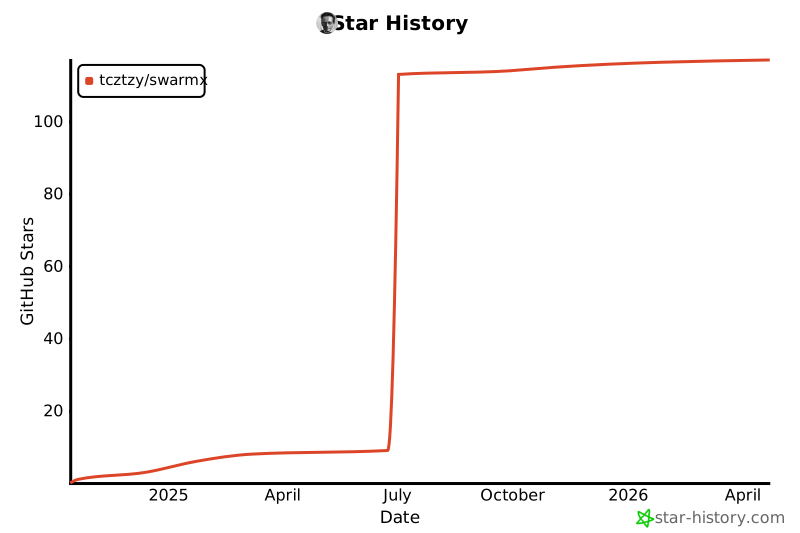
Star History
Quick start
SwarmX automatically loads environment variables from a .env file if present. You can either:
-
Use a .env file (recommended):
# Create a .env file in your project directory
echo "OPENAI_API_KEY=your-api-key" > .env
echo "OPENAI_BASE_URL=http://localhost:11434/v1" >> .env  # optional
uvx swarmx  # Start interactive REPL
-
Set environment variables manually:
export OPENAI_API_KEY="your-api-key"
# export OPENAI_BASE_URL="http://localhost:11434/v1"  # optional
uvx swarmx  # Start interactive REPL
API Server
You can also start SwarmX as an OpenAI-compatible API server:
uvx swarmx serve --host 0.0.0.0 --port 8000
This provides OpenAI-compatible endpoints:
POST /chat/completions- Chat completions with streaming supportGET /models- List available models
Use it with any OpenAI-compatible client:
import openai

client = openai.OpenAI(
    base_url="http://localhost:8000",
    api_key="dummy"  # SwarmX doesn't require authentication
)

response = client.chat.completions.create(
    model="agent-created-by-yourself",
    messages=[{"role": "user", "content": "Hello!"}]
)
Installation
Requires Python 3.11+
$ pip install swarmx # or `uv tool install swarmx`
Usage
import asyncio
from swarmx import Swarm, Agent

client = Swarm()

def transfer_to_agent_b():
    return agent_b


agent_a = Agent(
    name="Agent A",
    instructions="You are a helpful agent.",
    functions=[transfer_to_agent_b],
)

agent_b = Agent(
    name="Agent B",
    model="deepseek-r1:7b",
    instructions="你只能说中文。",  # You can only speak Chinese.
)


async def main():
    response = await client.run(
        agent=agent_a,
        messages=[{"role": "user", "content": "I want to talk to agent B."}],
    )

    print(response.messages[-1]["content"])


asyncio.run(main())
Context Variables
SwarmX supports special context variables that control agent behavior:
background
Provides additional context for the agent. This can be used for:
- Adding external knowledge (web search results, database queries)
- Compressing previous conversation history into summaries
- Isolating context for sub-agents who don't need full conversation history
Example:
context = {
    "background": "Recent news: AI conference announced for next month. User is interested in AI developments."
}
message_slice
Controls which messages are sent to the LLM using Python slice syntax. This enables:
- Context compression by sending only recent messages
- LLM-driven filtering decisions
- Memory management for long conversations
Slice patterns:
":10"- First 10 messages"-5:"- Last 5 messages":0"- No messages (useful withbackgroundfor context compression)"2:8"- Messages from index 2 to 7
Example:
context = {
    "message_slice": "-10:"  # Send only last 10 messages
}
tools
Dynamically selects which tools are available for the current completion. This allows:
- Context-aware tool selection
- Reducing tool overload by showing only relevant tools
- Dynamic tool routing based on conversation context
Example:
context = {
    "tools": [
        {
            "type": "function",
            "function": {
                "name": "search_web",
                "description": "Search the web for information",
                "parameters": {
                    "type": "object",
                    "properties": {
                        "query": {"type": "string"}
                    },
                    "required": ["query"]
                }
            }
        },
        {
            "type": "function",
            "function": {
                "name": "get_weather",
                "description": "Get weather information for a location",
                "parameters": {
                    "type": "object",
                    "properties": {
                        "location": {"type": "string"}
                    },
                    "required": ["location"]
                }
            }
        }
    ]
}
Advanced Usage Examples
Context Compression:
# Compress history into background and send no previous messages
context = {
    "background": "Previous conversation summary: User asked about weather, then travel plans.",
    "message_slice": ":0"  # No previous messages
}
RAG Pattern:
# Add web search results to background, send all messages for comprehensive context
context = {
    "background": "Web search results: Latest AI developments from yesterday's conference...",
    # No slice means all message might pass to LLM
}
Dynamic Tool Selection:
# Based on conversation topic, show only relevant tools
if "weather" in user_message:
    context = {"tools": [{"type": "function", "function": {"name": "get_weather", "description": "Get weather", "parameters": {"type": "object", "properties": {"location": {"type": "string"}}, "required": ["location"]}}}]}
elif "search" in user_message:
    context = {"tools": [{"type": "function", "function": {"name": "search_web", "description": "Search web", "parameters": {"type": "object", "properties": {"query": {"type": "string"}}, "required": ["query"]}}}]}
Architecture
graph TD
   classDef QA fill:#ffffff;
   classDef agent fill:#ffd8ac;
   classDef tool fill:#d3ecee;
   classDef result fill:#b4f2be;
   func1("transfer_to_weather_assistant()"):::tool
   Weather["Weather Assistant"]:::agent
   func2("get_weather('New York')"):::tool
   temp(64):::result
   A["It's 64 degrees in New York."]:::QA
   Q["What's the weather in ny?"]:::QA -->
   Triage["Triage Agent"]:::agent --> Weather --> A
   Triage --> func1 --> Weather
   Weather --> func2 --> temp --> A
1 maintainer

Metadata
1 maintainer
Release files for swarmx 0.7.0
For a detailed explanation of source distributions (sdists) and built distributions (wheels), please see the package formats documentation.
Source distribution (sdist)
| File | Size | Uploaded | Provenance | |
|---|---|---|---|---|
| swarmx-0.7.0.tar.gz | 26.2 kB | Without provenance | Details |
Built distribution (wheel)
| File | Interpreter | ABI | Platform | Reset |
|---|---|---|---|---|
| swarmx-0.7.0-py3-none-any.whl | Python 3 | none | any | Details |
Total release size: 57.0 kB
Release files / swarmx-0.7.0.tar.gz
| Download URL | swarmx-0.7.0.tar.gz |
|---|---|
| Size | 26.2 kB |
| Tags | Source |
|
SHA-256 checksum How to use checksums |
247f745cfbc5375f716d455a8fdd634c90df01a142ca6bacf44174d12a30be85
|
|
BLAKE2b-256 checksum How to use checksums |
ec119b2c87b4e42f6092444647c6c45712fd8b254fda9a41aebae7a02e92f1b6
|
| Upload date | |
|
Uploaded using Trusted Publishing? What is trusted publishing? |
No |
| Uploaded via |
uv/0.9.4
|
Release files / swarmx-0.7.0-py3-none-any.whl
| Download URL | swarmx-0.7.0-py3-none-any.whl |
|---|---|
| Size | 30.8 kB |
| Tags | Python 3 |
|
SHA-256 checksum How to use checksums |
667c3e6eb6b82f665732e56086fe2b4be47199c51579d427c6f063784ea62d3e
|
|
BLAKE2b-256 checksum How to use checksums |
35be4363a357730ea11f025bb86c2dea1dcf55db1c392912404b37bede5c37d5
|
| Upload date | |
|
Uploaded using Trusted Publishing? What is trusted publishing? |
No |
| Uploaded via |
uv/0.9.4
|
Security for swarmx 0.7.0
Provenance
Provenance describes where a file came from. On PyPI, provenance is shared via attestations, which provide a verifiable record of the build or publishing details. View details, limitations and caveats.
No provenance found
None of the files in this release were uploaded with provenance metadata.
A note on package security
PyPI is a repository for distributing packages, not a service for auditing them. While third-party security researchers and our staff do their best to detect and remove malicious packages, PyPI cannot guarantee the quality, security or suitability of any given package.
To learn more about protecting yourself from malicious actors, visit our package security documentation.














