
sxLaep: Rapid Enzyme/Non-Enzyme Prediction using sequence features and XGBoost

Project description
sxlaep: Rapid Enzyme/Non-Enzyme Prediction


sxlaep (Rapid Enzyme/Non-Enzyme Prediction) is an efficient enzyme/non-enzyme prediction tool for protein sequences. It is built on multi-physicochemical property features and the XGBoost machine learning algorithm.
Features
- Efficient Prediction: Fast and accurate enzyme/non-enzyme classification using optimized feature extraction and a pre-trained XGBoost model.
- Multi-Mode Support: Single-sequence prediction, batch prediction, and FASTA file batch prediction.
- Rich Feature Set: Multi-property pseudo-amino acid composition (Pseudo-AAC), CTD features, and windowed amino acid composition.
- Simple API: Clean Python API with standalone functions — no class instantiation needed.
- Command-Line Interface: Predict directly from the terminal with a single command.
- Parallel Processing: Multi-process feature extraction for large-scale datasets.
Dependencies
numpy,pandas,scikit-learn,xgboost,joblib- Requirements: Python 3.9 or higher.
Installation
pip install sxlaep
Quick Start
Command Line
# Shorthand: use the bundled pre-trained model
sxlaep --input sequences.fasta --output predictions.csv

# Or with explicit model path
sxlaep predict --model enzyme_xgb_model.ubj --fasta sequences.fasta --output predictions.csv
Python API
from pathlib import Path
import sxlaep
from sxlaep.model import load_model, predict_sequences

# Load the bundled model
ubj = Path(sxlaep.__file__).resolve().parent / "enzyme_xgb_model.ubj"
model = load_model(ubj)

# Single sequence
df = predict_sequences(model, ["MKVLWALIFLLKSAF"])
print(df)  # columns: pred_label, enzyme_probability
FASTA to CSV in one call:
from sxlaep import run_prediction_pipeline

df = run_prediction_pipeline(
    model_path="enzyme_xgb_model.ubj",
    fasta_path="sequences.fasta",
    output_csv="predictions.csv",
)
print(df[["sequence_id", "pred_label", "enzyme_probability"]].head())
API Reference
Model Loading
load_model(model_path)
Load an XGBoost classifier from native UBJSON (.ubj), JSON, or legacy joblib pickle (.pkl/.joblib).
from sxlaep.model import load_model

model = load_model("enzyme_xgb_model.ubj")
Prediction
predict_sequences(model, sequences, config=None, n_jobs=1)
Predict enzyme probabilities for a list of protein sequences. Returns a DataFrame with columns pred_label (0/1) and enzyme_probability (float).
predict_fasta(model_path, fasta_path, output_csv, config=None, n_jobs=1)
Load a model, predict all sequences in a FASTA file, and write results to CSV. Returns a DataFrame with columns sequence_id, description, pred_label, enzyme_probability.
run_prediction_pipeline(model_path, fasta_path, output_csv, feature_config=None, n_jobs=1)
One-shot convenience: predict_fasta with a slightly different signature.
Feature Extraction
extract_features(sequence, config=None) — Extract the full feature vector for one sequence.
extract_feature_matrix(sequences, config=None, n_jobs=1) — Extract a feature matrix from multiple sequences.
sanitize_sequence(sequence) — Clean a sequence to only the 20 standard amino acids.
FASTA Utilities
read_fasta(path) — Return a list of sequence strings from a FASTA file.
read_fasta_records(path) — Return a list of FastaRecord objects with identifier, description, and sequence fields.
Configuration
FeatureConfig(lag=10, weight=0.05, n_segments=3, add_length=True, properties=...)
Configure feature extraction parameters. The bundled model uses defaults; customize only when loading a custom-trained model.
CLI Reference
Shorthand (bundled model)
sxlaep --input proteins.fasta --output predictions.csv
| Argument | Required | Description |
|---|---|---|
--input, -i |
Yes | Input FASTA path |
--output, -o |
No | Output CSV path (default: sxlaep_predictions.csv) |
sxlaep predict (custom model)
sxlaep predict --model path/to/model.ubj --fasta sequences.fasta --output results.csv
| Argument | Required | Description |
|---|---|---|
--model |
Yes | Model path (.ubj / .pkl / .joblib) |
--fasta |
Yes | Input FASTA path |
--output |
No | Output CSV path (default: results/predictions.csv) |
--lag |
No | Pseudo-AAC lag (default: 10) |
--weight |
No | Pseudo-AAC weight (default: 0.05) |
--segments |
No | Window-AAC segments (default: 3) |
--add-length / --no-add-length |
No | Append sequence length (default: enabled) |
--properties |
No | Physicochemical properties: hydro, polar, charge (default: all three) |
--n-jobs |
No | Parallel workers (default: 1) |
Output CSV Format
| Column | Description |
|---|---|
sequence_id |
FASTA record ID (first token of header) |
description |
Full FASTA header |
pred_label |
0 = non-enzyme, 1 = enzyme |
enzyme_probability |
Estimated enzyme class probability |
Notes
- Sequence Format: Input sequences should contain single-letter codes for the 20 standard amino acids. Non-standard characters are automatically stripped.
- Sequence Length: Excessively short sequences (< 10 amino acids) may yield less reliable predictions.
- Model Format: The pre-trained model ships as
enzyme_xgb_model.ubj(XGBoost native UBJSON format), which loads without pickle version warnings.
Real-World Project Example
sxlaep has been successfully applied in a large-scale marine metagenomics research project. The Marine_Enzyme_Analysis_Pipeline_EN.ipynb notebook demonstrates comprehensive analysis of enzyme sequences from 16,240 Marine Metagenome-Assembled Genomes (MAGs).
Project Highlights:
- Dataset Scale: 33,479,647 predicted protein sequences
- Enzyme Identification: 17,492,382 enzyme sequences identified
- Analysis Scope: Metabolic scaling law, ecological strategies, and biochemical property characterization
1. Parse Prediction Results and Extract Ecological Data
import os
import glob
import numpy as np
import pandas as pd
from tqdm.notebook import tqdm

PRED_DIR = "/path/to/prediction_results"
csv_files = glob.glob(os.path.join(PRED_DIR, "*.csv"))
print(f"Found {len(csv_files)} MAG prediction result files.")

mag_ratios = []
mag_total_seqs = []
mag_mean_probs = []
all_probabilities = []

for f in tqdm(csv_files, desc="Parsing CSVs"):
    df = pd.read_csv(f, usecols=["pred_label", "enzyme_probability"])
    total_seqs = len(df)
    if total_seqs == 0:
        continue

    enzyme_count = (df["pred_label"] == 1).sum()
    ratio = enzyme_count / total_seqs

    if enzyme_count > 0:
        mean_prob = df.loc[df["pred_label"] == 1, "enzyme_probability"].mean()
        sampled_probs = df.loc[df["pred_label"] == 1, "enzyme_probability"].sample(frac=0.01, random_state=42).tolist()
        all_probabilities.extend(sampled_probs)
    else:
        mean_prob = 0.0

    mag_ratios.append(ratio * 100)
    mag_total_seqs.append(total_seqs)
    mag_mean_probs.append(mean_prob)

mag_ratios = np.array(mag_ratios)
mag_total_seqs = np.array(mag_total_seqs)
mag_enzyme_counts = mag_total_seqs * (mag_ratios / 100.0)
mag_mean_probs = np.array(mag_mean_probs)
all_probabilities = np.array(all_probabilities)
2. Ecological Strategy Classification
categories = []
for r_val in mag_ratios:
    if r_val < 40:
        categories.append("Streamlined\n(<40%)")
    elif r_val > 60:
        categories.append("Generalist\n(>60%)")
    else:
        categories.append("Intermediate\n(40-60%)")
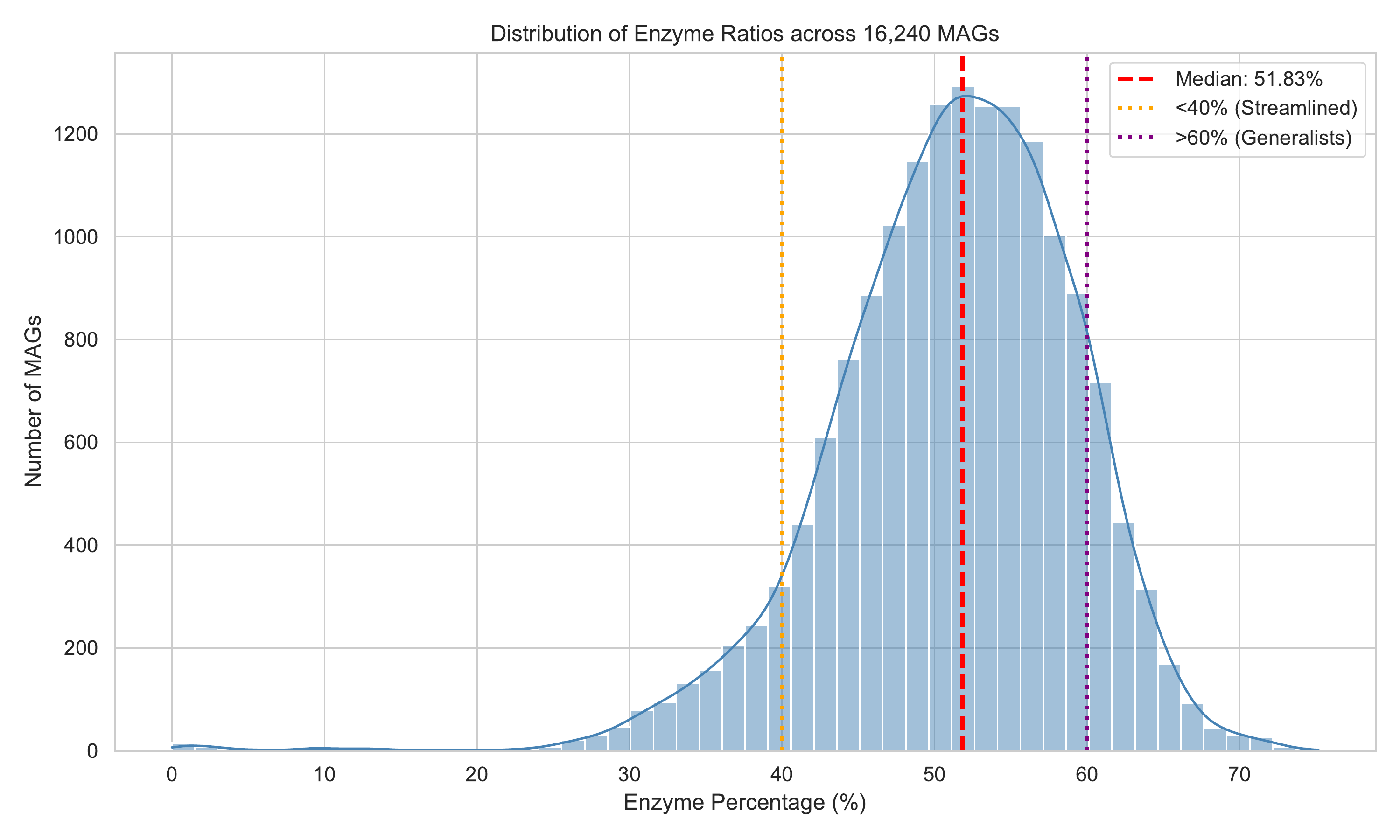
Figure: Distribution of enzyme ratios across 16,240 marine MAGs, revealing three distinct ecological strategies.
3. Metabolic Scaling Law Analysis
from scipy import stats

r, p_value = stats.pearsonr(mag_total_seqs, mag_enzyme_counts)
p_str = "P < 1e-10" if p_value < 1e-10 else f"P = {p_value:.2e}"

z = np.polyfit(mag_total_seqs, mag_enzyme_counts, 1)
p = np.poly1d(z)

print(f"Pearson R: {r:.3f}, {p_str}")
4. Prediction Probability Analysis
import seaborn as sns
import matplotlib.pyplot as plt

sns.histplot(all_probabilities, bins=50, kde=True, color="#3C5488")
plt.axvline(np.median(all_probabilities), color='red', linestyle='dashed',
            label=f'Median: {np.median(all_probabilities):.3f}')
plt.xlabel('XGBoost Probability')
plt.title('Prediction Probability Distribution (Sampled)')
plt.legend()
plt.show()
5. Biochemical Properties Calculation (Reservoir Sampling)
from Bio.SeqUtils.ProtParam import ProteinAnalysis

faa_files = glob.glob(os.path.join(PRED_DIR, "*_enzymes.faa"))
SAMPLE_RATE = 100000 / 17500000.0

sampled_seqs = []
lengths = []

def clean_seq(seq):
    return ''.join([aa for aa in seq if aa in "ACDEFGHIKLMNPQRSTVWY"])

for faa in tqdm(faa_files, desc="Sampling FASTA"):
    with open(faa, 'r') as f:
        seq_chunks = []
        for line in f:
            if line.startswith(">"):
                if seq_chunks:
                    seq = "".join(seq_chunks)
                    lengths.append(len(seq))
                    if random.random() < SAMPLE_RATE:
                        sampled_seqs.append(seq)
                seq_chunks = []
            else:
                seq_chunks.append(line.strip())

pis = []
mws = []

for seq in tqdm(sampled_seqs, desc="Computing ProtParam"):
    clean_s = clean_seq(seq)
    if not clean_s:
        continue
    pa = ProteinAnalysis(clean_s)
    try:
        pis.append(pa.isoelectric_point())
        mws.append(pa.molecular_weight() / 1000.0)  # kDa
    except Exception:
        pass
Troubleshooting
- Import error: Ensure the package is installed (
pip show sxlaep). - Model loading failure: Verify the model file path exists.
- Prediction errors: Check that input sequences contain standard amino acid characters.
- Performance: For very large datasets, consider batch processing to avoid memory overflow.
Getting Help
- Author: DHY
- Email: dhy.scut@outlook.com
License
MIT License.
Version: 1.0.5 | Last updated: 2026


Download files
Download the file for your platform. If you're not sure which to choose, learn more about installing packages.
Source Distribution
Built Distribution
Filter files by name, interpreter, ABI, and platform.
If you're not sure about the file name format, learn more about wheel file names.
Copy a direct link to the current filters
File details
Details for the file sxlaep-1.0.5.tar.gz.
File metadata
- Download URL: sxlaep-1.0.5.tar.gz
- Upload date:
- Size: 6.6 MB
- Tags: Source
- Uploaded using Trusted Publishing? No
- Uploaded via: twine/6.2.0 CPython/3.12.7
File hashes
| Algorithm | Hash digest | |
|---|---|---|
| SHA256 |
6966fe4025585bcf9d0fa4966e9b7c831ccf7b8640e1e17de302ad8ab5fd91e3
|
|
| MD5 |
71c17ac03a74027bee32cb320fd7baac
|
|
| BLAKE2b-256 |
3664b5c21683fb04642c1865e869269c75e05192b9d4a7a4b9cd30e76823ee3d
|
File details
Details for the file sxlaep-1.0.5-py3-none-any.whl.
File metadata
- Download URL: sxlaep-1.0.5-py3-none-any.whl
- Upload date:
- Size: 6.7 MB
- Tags: Python 3
- Uploaded using Trusted Publishing? No
- Uploaded via: twine/6.2.0 CPython/3.12.7
File hashes
| Algorithm | Hash digest | |
|---|---|---|
| SHA256 |
d75248ad43cdb31c7fab0057d156293d9859580358e8865820c456f578d68028
|
|
| MD5 |
18debf3c873fddccc50c17f2ab9328e4
|
|
| BLAKE2b-256 |
bf67881af992ac888f20c18f3a34fd2c0279cced747d74c9724e2ecf472d99a9
|






