
symbion
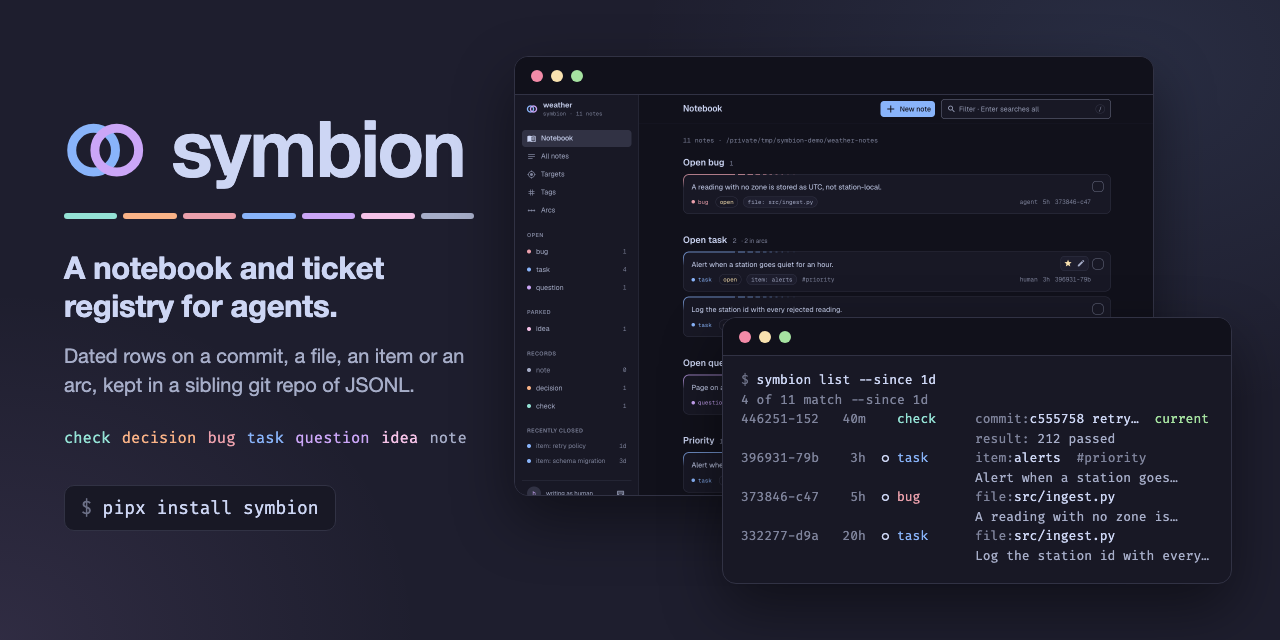
A per-project notebook and ticket registry for small projects, driven by a person and a coding agent through one CLI. The CLI stands alone; the agent side (a shared skill and a SessionStart hook) supports Claude Code and Codex.
A note is dated, attributed, retractable, and attached to something stable: a
commit, a file, a free-form item, or the whole project. Seven kinds by default:
check (a dated verification), decision (an ADR), bug, task, question
(needs the owner's answer), idea (parked) and note. A kind is a label on
three bits (status, parked, verdict); declare your own under [kinds] in
symbion.toml, and symbion schema prints the table. An arc is a named
line of work (an epic), shown as a checklist of rows across objects. The store is
a separate git repo of JSONL beside the project, so checking out an old branch
never time-travels your tickets.
Design and rationale: docs/superpowers/specs/2026-09-04-symbion-design.md.
The best command reference is the agent's: src/symbion/data/skill/SKILL.md
(linked at ~/.claude/skills/symbion for Claude Code or
~/.agents/skills/symbion for Codex).
Install
Python 3.11+ and git.
pipx install 'symbion[gui]'     # or: uv tool install 'symbion[gui]'
# [gui] adds the web UI (symbion serve); drop it for the core alone.
# Unreleased main: pipx install 'symbion[gui] @ git+https://github.com/phreakocious/symbion'
The core's three dependencies serve a person at a terminal: rich and
rich-argparse colour and align the output (a pipe gets plain text), and
argcomplete does TAB completion.
To work on symbion itself, install a clone editable:
pipx install -e /path/to/symbion (or uv tool install -e). Without pipx or uv:
cd /path/to/symbion
python3 -m venv .venv && .venv/bin/pip install -e .
ln -s "$PWD/.venv/bin/symbion" ~/.local/bin/symbion   # any directory on PATH
Then run command -v symbion from another directory. The SessionStart hook
finds symbion through PATH. Without it, the hook prints only
symbion: cannot read store at … because 'symbion' is not on PATH in a
project that adopted symbion, and nothing elsewhere.
TAB completion. Add your shell's line to its rc file:
eval "$(symbion completion zsh)"     # ~/.zshrc, after compinit
eval "$(symbion completion bash)"    # ~/.bashrc
symbion completion fish | source     # ~/.config/fish/config.fish
In zsh you can instead save the output as _symbion in a directory on
$fpath (oh-my-zsh: $ZSH_CUSTOM/completions). It stays out of a shared rc
file and loads on the first TAB, not at every shell start. Regenerate it after
an argcomplete upgrade.
TAB completes verbs, flags and the store's values: kinds, target types, the
TYPE:NAME targets its rows use, row ids (only open ones for resolve), arc
ids and tags. zsh and fish describe each value. A --dir on the line picks
the store.
Adopt in a fresh repo
From the repo's root:
1. Create the store and link the agent files.
symbion init          # lists each change and makes none (exit 1 if there are any)
symbion init --yes    # makes them
That sets up Claude Code; --agent codex sets up Codex instead, and
--agent both sets up both.
This creates ../<repo>-notes, a git repo with no remote, holding a commented
symbion.toml whose every value has a default. For Claude Code, the first
init on a machine also links ~/.claude/skills/symbion to the skill directory in the installed
package (SKILL.md, adoption.md, catalogs.md and the hook script), so an upgrade
reaches every project. It registers the hook in ~/.claude/settings.json when
that file does not exist. When it does, init says the hook is already there,
or prints the entry to append to hooks.SessionStart (it merges nothing), or
says the file is not valid JSON. A ~/.claude/skills/symbion that is not the
link is left alone and named.
For Codex, init --agent codex links ~/.agents/skills/symbion to the same
skill directory and registers the same hook script in $CODEX_HOME/hooks.json
(default ~/.codex/hooks.json), on the same terms: it writes that file only
when it is absent, and counts a registration inline in config.toml. Codex
skips a new hook until you trust it in /hooks. See the
Codex hook documentation. The hooks
need bash, so on Windows use WSL.
Give Codex access to the store. Codex's sandbox writes only inside the
project, and the store sits beside it. Launch codex --add-dir ../<repo>-notes, or add the store to sandbox_workspace_write.writable_roots
in Codex's config.toml; init prints the path. A .symbion pointer grants
no access, and symbion commit may still ask for approval. A linked worktree
uses the main checkout's store, so grant that one.
The only file init writes into the project is a .symbion pointer, when the
store is not the default sibling. It marks the pointer (git: ignored) or
(git: not ignored); a not-ignored one goes in with your next git add -A.
The hook runs in every project and says nothing where there is no store.
2. Check the read side. Start a session, or run the hook by hand:
CLAUDE_PROJECT_DIR=$PWD bash ~/.claude/skills/symbion/session_start.sh
bash ~/.agents/skills/symbion/session_start.sh     # the same, with only Codex set up
| output | meaning |
|---|---|
symbion: open outside arcs: bug 0, task 0, question 0 (; N open in arcs when arcs hold any), then a line per arc and the open rows |
working |
symbion --dir ../other-notes: open outside arcs: … |
working, on a store this repo's tree does not name (--dir, SYMBION_DIR, or a cwd inside a store); the header names it, so two summaries in one session can be told apart |
either, then N notes not yet in the store's git (symbion commit) |
working; run symbion commit at session end |
either, then N per-project symbion copies from an older init: … |
an old init left the skill, hook or registration in this project; remove them (the link replaces them) |
symbion: cannot read store at … because 'symbion' is not on PATH |
see Install |
symbion: no store at …; run \symbion init`` |
no store yet, or .symbion/SYMBION_DIR names a missing path |
| nothing | no store, no .symbion and no SYMBION_DIR, or the hook is not registered (or not trusted in Codex) |
3. Tell the agent. One line in CLAUDE.md (Claude Code) or AGENTS.md
(Codex):
- We use symbion for durable notes and tickets. Surface friction with it so it can be addressed.
If that instruction file is gitignored or its owner reviews every change to it, propose the line to the owner instead of writing it.
First session
A repo with history (known issues, TODOs, docs, a handoff file) starts with
adoption.md, installed beside SKILL.md. It says which catalogs to turn on
and what to bring in; its rows go in as one symbion add --from-json -,
validated together before any is written. Either way:
The first note is a check, written now: the state the store began at,
which no commit message records. It pays first: dated, re-checkable, and
visibly stale once HEAD moves. A check stamps HEAD and whether the tree is
dirty, untracked files included, so on a dirty tree (the instruction line from
step 3) it reads unverifiable (dirty tree). Commit, write it again, and it
reads current. Files the checked command writes count too, so git-ignore
__pycache__/ before checking pytest. A check on something outside the repo
(DNS, a host) takes --external and shows its age instead.
symbion add check --target commit:HEAD --checked "pytest -q" --result "147 passed"
symbion list --kind check    # unverifiable when dirty, current when clean, behind N once HEAD moves
The first checklist is an arc over free-form items. add each item with a
body. seed mints one bodiless task per name and is for fanning out over a
catalog.
aid=$(symbion arc create --name "Adoption" --scope item --desc "Usable by someone who was not in the room.")
symbion add task --target "item:write the README" --arc-id "$aid" --body "Done: a stranger can install and record a note."
symbion arc todo "$aid" --json      # open items
symbion resolve <id>                # tick one
symbion arc list                    # done/total per arc
symbion list --arc "$aid" --json    # every item, resolved included
Commit the store at session end. Writes never commit, so a git failure
never blocks a note; symbion summary shows the uncommitted count until you do.
symbion commit -m "adoption: README ticket closed"
symbion push         # when the store has a remote
Browse it (optional)
symbion serve # the one command that needs the gui extra
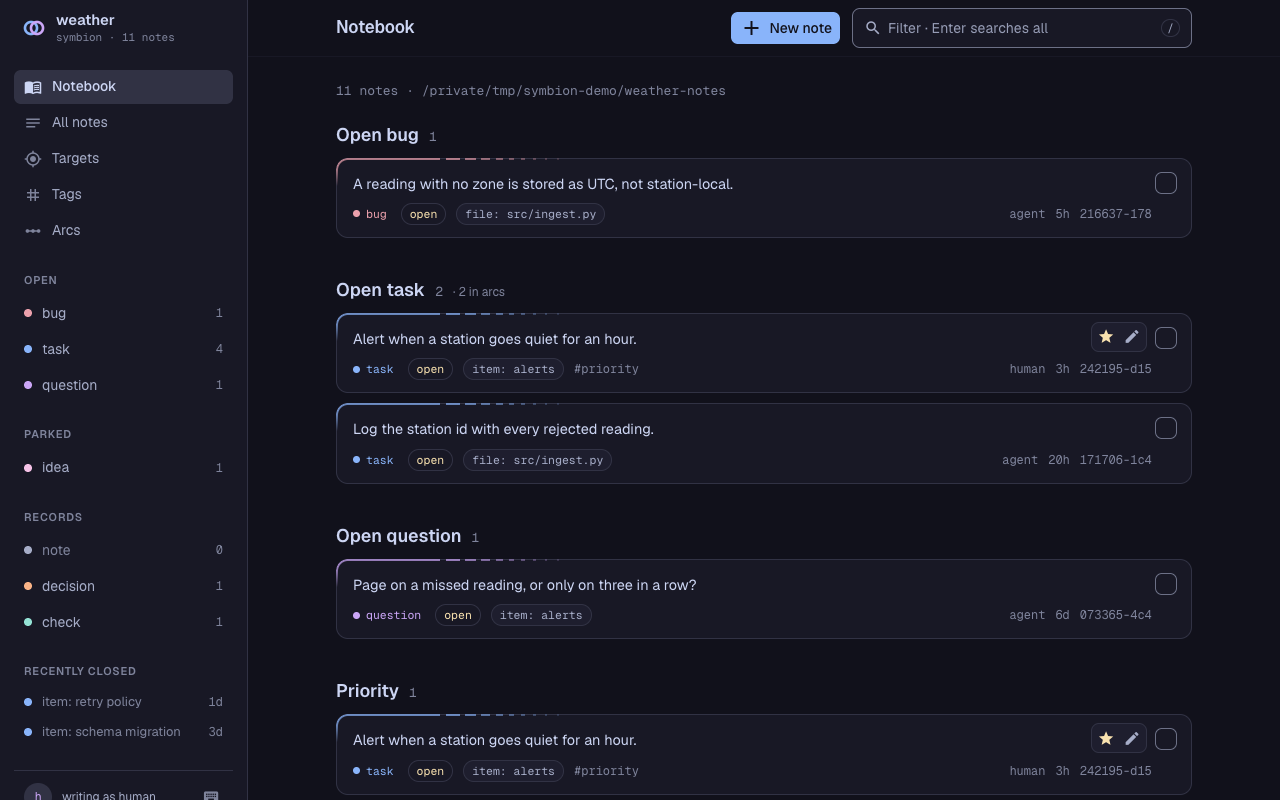
A local page on a port of the store's own, the same at every restart, so a link
to a row stays good (serve prints it, and --port picks another). It has:
- boards: by kind on the notebook, by target on the targets page;
- a note list where every tag, kind, author and target is a filter link;
- a search box (
/): its text filters the page as you type, and Enter searches the whole store (every word, literally, in any case, or a pasted note id); - a new note from any page (
n), on that page's object or any other:#tagand!kindin its body set its tags and kind, and Shift Enter adds it and starts the next; - a page per note with its earlier versions, a tag index, and arc checklists you tick;
- commit and push buttons, shown while there is something to commit or push.
? lists the keys. It writes as you: SYMBION_AUTHOR, else git
user.name, shown at the foot of the sidebar, or in the top bar on a window
too narrow for one. --author NAME overrides.
One serve per store: run it in each project, and each one's sidebar links
the other stores a serve is running on, on this machine. Each running
serve keeps a small record in ~/.cache/symbion/serve/ (or under
$XDG_CACHE_HOME). A second serve on one store warns: the sidebars link the
first until it stops, then the second. While a serve runs on a store, each id
that list, show and context print at a terminal links to its row's page
(cmd-click in iTerm2), and summary names the URL.
Catalogs, when a homogeneous set exists
A catalog is a shell command that prints one name per line. Declare it in the
store's symbion.toml:
[catalogs]
file = "git ls-files --cached --others --exclude-standard '*.py'"
test = "git ls-files --cached --others --exclude-standard 'tests/test_*.py'"

[renames]
file = "git"     # so reconcile can follow renamed files
Each key becomes a target type (--target file:src/x.py). An arc seeded over
it gets one task per member, and arc reconcile reports which are live,
renamed or stale as the tree changes.
Scope the command to where notes attach: no pathspec when docs and results
matter, a glob when only code does. A broad catalog costs only a refusal on an
ambiguous substring. Keep --others --exclude-standard: without it, a note on
a file made this session warns taken as typed on a correct name, and that
warning is the only thing that catches a typo.
Dry-run the first seed of every catalog type. What a command prints depends on the tool's version and the project's config:
symbion arc seed --scope file --dry-run # no arc needed; writes nothing
Names resolve exact, then unique substring, else as typed. cli.py matches
both src/symbion/cli.py and tests/test_cli.py, so it is refused: use the
full path.
A catalog of measured names (a reading, a serial) needs a resolver, or a
near-miss mints a second target: substring matching cannot see that 3.1416
is 3.14159. So does every store-derived catalog
(symbion list … --type X | jq …): it is empty until its first X row
exists, so without a resolver that first add is refused.
[resolvers]
reading = "python3 tools/resolve_reading.py"   # stdin: query, then names; exit 2 = ambiguous
The starter symbion.toml documents the protocol. A failing resolver stores
nothing; it never falls back to substring matching.
Within one write (add --from-json, arc seed --name …), names resolved by
earlier rows are candidates for later ones. A batch naming src/parser.py and
then p, against a catalog holding src/pipe.py, is refused as ambiguous
where two separate adds would store both.
Conventions
- Bodies are markdown.
list --full,showandcontextrender them on a terminal and print them as written on a pipe; a plainlistpage andsummaryflatten each to one clipped line. - A terminal and a pipe get different text. A terminal gets columns: the
id's last 10 characters (which
showtakes), age, a○/✓status mark, kind, target, tags, a ref count, and one body line cut to fit. A pipe, which scripts and agents read, gets the plain line. - Parked means parked. An
ideanever prints inarc todoorcontext, and prints insummaryonly when its--duedate is near or past, or when someone other than the reader wrote it (from <author>). Close one withresolve <id> --add-tag adopted --body "why"or--add-tag retired.list --kind ideais the shelf. - Kinds are the project's. Add or rename labels under
[kinds]insymbion.toml; renaming one that has rows also takes a one-linesedovernotes.jsonl, whichinitwrites into the toml. A kind with bothstatusandverdictis a pre-registration, closed byresolve --result. prioritystars a row for the next session's summary:supersede <id> --add-tag priority, until the row is resolved or--rm-tag prioritytakes the star off.- Due dates.
--due 2026-10-01(or an ISO datetime) on any status row. An open row past due or due within 7 days leads the session-start summary (overdue 2d,due in 3d).list --overduelists those past due, andsupersede <id> --due ''clears one. - Time is UTC. Rows are stamped in UTC, and symbion prints times and reads
a bare date in UTC. Set
TZto print and read them in that zone instead. - Author.
claudeinside a Claude Code session,codexinside a Codex one, else gituser.name;--authororSYMBION_AUTHORoverrides. A person typing! symbion add …in a session is recorded as the agent unless they pass one. Session start lists the open rows someone other than the reader raised or amended, parked ones included, so the owner's word reaches the agent:from <author>names who raised a row, andlast by <author>who wrote its newest version when that is someone else. - Record finished work as a resolved task:
add task --target … --status resolved --body "done: …"for work done before it had a ticket.
Where things live
- Store:
../<repo>-notes, beside the main worktree; linked worktrees share it.SYMBION_DIRor--dir PATH(anywhere in the argv) override. A store named from another repo, or a command run inside a store (to editsymbion.toml, say), resolves in the store's own repo and says so on stderr.initinside a store refuses. - A store not named after its repo: put its path in a
.symbionfile in the repo root (first non-blank line; relative to the repo, or absolute).symbion --dir ../other-notes init --yeswrites it. If the repo already reads a store that exists, init creates the new store and leaves the pointer alone;--repointchanges it. Commit it; a relative path survives a clone. It cannot live insymbion.toml, which is inside the store it has to find. Set it whenever the names differ: after a repo directory is renamed, every command, writes included, reportsno store at ../<new-name>-notesuntil a.symbionnames the old store. - Files:
notes.jsonl(append-only once committed: a correction is a new row that supersedes the old one; beforesymbion commit, an edit to your own row rewrites it),arcs.jsonl,symbion.toml. - Reading:
symbion summary(what the hook prints),symbion context --target TYPE:NAME,symbion context --branch REF,symbion list --json. Every command that prints rows takes--json.
Development
python3 -m venv .venv && .venv/bin/pip install -e '.[test,gui]'
.venv/bin/python -m pytest -q
The specs in docs/superpowers/specs/ are dated design records: why each
decision was made. SKILL.md (in src/symbion/data/skill/, beside
adoption.md and the hook) is what an agent reads; keep it short and its
footgun list honest. If this clone is your installed symbion (an editable
install, then symbion init --yes), ~/.claude/skills/symbion and, with
--agent codex, ~/.agents/skills/symbion link to that directory, so an edit
there reaches every session on the machine at once, as an edit to src/
reaches every symbion call.
1 maintainer

Metadata
1 maintainer
Release files for symbion 0.2.1
For a detailed explanation of source distributions (sdists) and built distributions (wheels), please see the package formats documentation.
Source distribution (sdist)
| File | Size | Uploaded | |
|---|---|---|---|
| symbion-0.2.1.tar.gz | 464.1 kB | Details |
Built distribution (wheel)
| File | Interpreter | ABI | Platform | Reset |
|---|---|---|---|---|
| symbion-0.2.1-py3-none-any.whl | Python 3 | none | any | Details |
Total release size: 776.5 kB
Release files / symbion-0.2.1.tar.gz
| Download URL | symbion-0.2.1.tar.gz |
|---|---|
| Size | 464.1 kB |
| Tags | Source |
|
SHA-256 checksum How to use checksums |
f769cb213227a3bf1563501a49297b3faab09631de2d42d1c41f1675afb65412
|
|
BLAKE2b-256 checksum How to use checksums |
0579c367e90a681ca44dcec1427b7908dae7810e4ccf7696ae89f63144fffc85
|
| Upload date | |
|
Uploaded using Trusted Publishing? What is trusted publishing? |
Yes |
| Uploaded via |
twine/7.0.0 CPython/3.13.14
|
Provenance
Provenance describes where a file came from. On PyPI, provenance is shared via attestations, which provide a verifiable record of the build or publishing details. View details, limitations and caveats.


PyPI Publish Attestation
PyPI verified that this artifact, at this checksum, originated from the publisher listed below.
Signed by GitHub Actions, verified by PyPI on Oct 3, 2026.
Transparency logRelease files / symbion-0.2.1-py3-none-any.whl
| Download URL | symbion-0.2.1-py3-none-any.whl |
|---|---|
| Size | 312.4 kB |
| Tags | Python 3 |
|
SHA-256 checksum How to use checksums |
a05f83faac7fca4aee5e1c69fe564445e5e272eb875a75b2fb47e6ede0237a5e
|
|
BLAKE2b-256 checksum How to use checksums |
b2d299c2a670d412880af8b7e2c64e8dfaff63678164f3efba15f70baca86aea
|
| Upload date | |
|
Uploaded using Trusted Publishing? What is trusted publishing? |
Yes |
| Uploaded via |
twine/7.0.0 CPython/3.13.14
|
Provenance
Provenance describes where a file came from. On PyPI, provenance is shared via attestations, which provide a verifiable record of the build or publishing details. View details, limitations and caveats.
PyPI Publish Attestation
PyPI verified that this artifact, at this checksum, originated from the publisher listed below.
Signed by GitHub Actions, verified by PyPI on Oct 3, 2026.
Transparency log













