
tabaudit
Find the problems in your dataset before your model does.
tabaudit is a command-line tool that audits a tabular ML dataset for the defects that
quietly inflate metrics and break models in production — target leakage, train/test
contamination, duplicates, label noise, class imbalance and schema problems — and gives it
a single Data Health Score with concrete, prioritised fixes.
pip install tabaudit
tabaudit audit train.csv --target churn --test test.csv --html report.html

Why
A model that scores 99% on a leaked dataset is worse than useless: it looks finished and
fails silently in production. Most of these defects take one line of pandas to fix — the
hard part is noticing them. tabaudit makes the check automatic, fast, and repeatable
(it runs in CI with --fail-under / --fail-on).
What it checks
| check | finds | severity |
|---|---|---|
leakage |
single features that predict the target almost perfectly on their own (incl. missingness leaks), identifier columns, columns named after the target | CRITICAL / HIGH / MEDIUM |
duplicates |
exact duplicate rows, feature-identical rows with conflicting labels, test rows that also appear in train | CRITICAL → LOW |
label_noise |
probably-mislabeled rows from an out-of-fold model's self-confidence, thresholds calibrated by fault injection, ranked and tiered | HIGH → INFO |
imbalance |
class ratio, classes with < 10 examples | HIGH → LOW |
schema |
≥ 50 % missing columns, missing labels, constant / near-constant columns, numbers stored as text, leftover index columns | HIGH → INFO |
impact |
how much of the apparent performance rests on the flagged columns: held-out AUC/R² with them and without | INFO (evidence, not a defect) |
Every finding carries a plain-English explanation of why it matters and what to do. Findings are weighted into a 0–100 score and an A–F grade.
Quick start
pip install tabaudit

# See every check fire on a synthetic dataset with planted defects
tabaudit demo

# Audit your own data
tabaudit audit data.csv --target label
tabaudit audit train.parquet -t label --test test.parquet --html report.html --json report.json

# Only some checks, sampled for speed, gate a CI pipeline:
# exit 1 if the score is under 75 OR any finding is HIGH/CRITICAL
tabaudit audit data.csv -t label -c leakage,duplicates --max-rows 20000 --fail-under 75 --fail-on high
Supported inputs: CSV, TSV, Parquet, Feather, JSON-lines. Classification and regression
targets are inferred automatically; omit --target to run only the unsupervised checks.
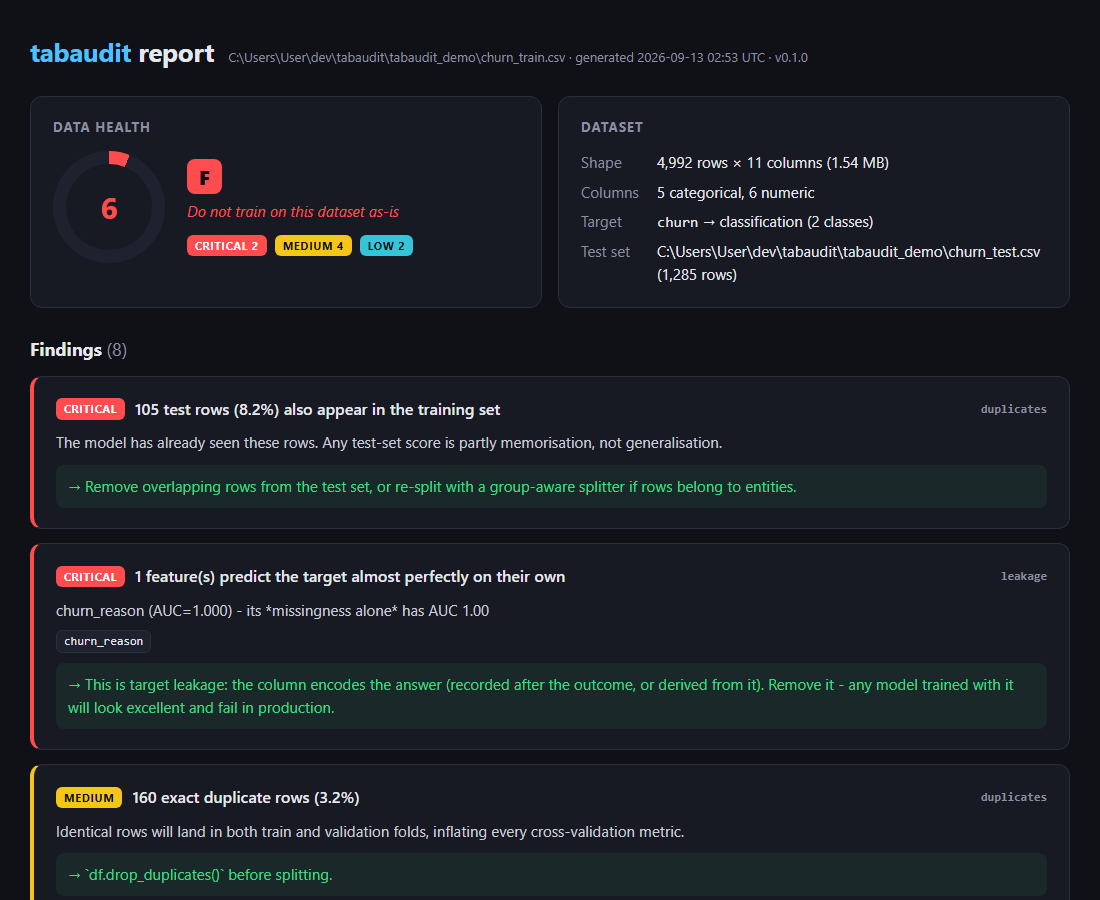
--html writes a self-contained report you can send to whoever owns the data:
Python API
from tabaudit import run_audit

report = run_audit("train.csv", target="churn", test="test.csv")
print(report.score, report.grade)          # 6 'F'
print(report.score_breakdown)              # {'schema': 90, 'duplicates': 63, 'leakage': 63, ...}
for f in report.sorted_findings():
    print(f.severity.value, f.title, f.columns)
report.to_dict()                            # JSON-serialisable

from tabaudit.fix import apply_fixes
clean, plan = apply_fixes(df, report, ["--drop-leaky"])   # safe fixes + the ones you allow
print(plan.applied, plan.skipped, plan.flags_offered)
Example output
┌────────────────────────────────── Verdict ──────────────────────────────────┐
│  Data Health Score  6/100   F                                               │
│  ██░░░░░░░░░░░░░░░░░░░░░░░░░░░░                                             │
│  Do not train on this dataset as-is                                         │
│   CRITICAL  2    MEDIUM  4    LOW  2                                        │
└─────────────────────────────────────────────────────────────────────────────┘
┌─  CRITICAL   105 test rows (8.2%) also appear in the training set ──────────┐
│  The model has already seen these rows. Any test-set score is partly        │
│  memorisation, not generalisation.                                          │
│  → Remove overlapping rows from the test set, or re-split with a            │
│  group-aware splitter if rows belong to entities.                           │
└──────────────────────────────────────────────────────────────── duplicates ─┘
┌─  CRITICAL   1 feature(s) predict the target almost perfectly on their own ─┐
│  churn_reason (AUC=1.000) - its *missingness alone* has AUC 1.00            │
│  → This is target leakage: the column encodes the answer (recorded after    │
│  the outcome, or derived from it). Remove it - any model trained with it    │
│  will look excellent and fail in production.                                │
└─────────────────────────────────────────────────────────────────── leakage ─┘
Results on real datasets
Ten well-known public datasets, loaded straight from OpenML and audited with default
settings — no tuning, no column dropping. Full write-up, including what the tool got
wrong on the first run and how it was fixed: docs/benchmarks.md.
| dataset | rows | score | after fix |
headline finding |
|---|---|---|---|---|
| titanic | 1 309 | 64 C | 64 C | HIGH boat predicts survival alone (AUC 0.97 vs next-best 0.74) — target leakage |
| spambase | 4 601 | 75 B | 90 A | HIGH 391 exact duplicate rows (8.5 %) |
| creditcard | 284 807 | 78 B | 85 B | HIGH 578 : 1 class imbalance; 9 144 duplicate rows |
| telco-customer-churn | 7 043 | 80 B | 86 B | TotalCharges is numeric but stored as text; 18 conflicting-label groups |
| breast-w | 699 | 82 B | 97 A | HIGH 236 exact duplicate rows (34 %) |
| bank-marketing | 45 211 | 83 B | 83 B | duration stands far above every other feature (AUC 0.81 vs 0.65) — a documented leak |
| adult | 48 842 | 84 B | 87 B | 5 groups of rows with identical features but different labels |
| credit-g | 1 000 | 93 A | 93 A | ~6 % of rows likely mislabeled |
| heart-statlog | 270 | 93 A | 93 A | ~6 % of rows likely mislabeled |
| diabetes | 768 | 93 A | 93 A | ~5 % of rows likely mislabeled |
- "after
fix" is the score oncetabaudit fixhas applied only the fixes that need no human decision — no flags. Five of ten improve, two by a whole grade, none gets worse. - 4 of 10 have a CRITICAL/HIGH finding; 10 of 10 have at least one MEDIUM. Every HIGH is a documented property of the dataset (Titanic's lifeboat column, spambase and breast-w duplicates, creditcard's 0.17 % fraud rate).
- The leakage check catches both the near-perfect leak (
boat) and the soft one (bank-marketingduration, which the dataset's own documentation says to drop), while correctly reporting breast-w's six strong-but-honest features as "easy task", not leakage. - Label-noise suspects were checked by hand on two datasets: of the 10 top-ranked rows, 5 look genuinely mislabeled, 5 are ambiguous, 0 look like false alarms (review sheet).
Reproduce with python benchmarks/run_benchmarks.py (~6 min, downloads ~50 MB).
Fixing what it finds
tabaudit fix repairs the findings that have exactly one defensible answer, and refuses
the rest out loud. It never touches the input: it writes <name>.clean.csv and
<name>.fixplan.json, and exits 0 even when fixes were skipped — skipping something you did
not authorise is correct behaviour, not a failure.
tabaudit fix train.csv --target churn --test test.csv          # safe fixes only
tabaudit fix train.csv --target churn --drop-leaky --flag-noise  # you take the judgement calls
 ?   1 feature(s) predict the target almost perfectly   drop_columns   needs --drop-leaky
 ✔   1 constant column(s)                               drop_columns   dropped 1 column(s)
 ✔   105 test rows (8.2%) also appear in the training…  drop_rows      dropped 106 row(s)
 ✔   160 exact duplicate rows (3.2%)                    drop_rows      dropped 158 row(s)
 ?   ~378 rows (7.6%) are likely mislabeled             flag_rows      needs --flag-noise
4,992 → 4,728 rows, 11 → 10 columns
3 fix(es) need your say-so: --drop-leaky --flag-noise
| fixed automatically | needs your say-so | never |
|---|---|---|
exact duplicates · rows shared with the test set (dropped from train, never test) · constant columns · leftover Unnamed: 0 columns · numbers stored as text · rows with no label |
target leakage and identifier columns (--drop-leaky) · likely-mislabeled rows (--flag-noise, which flags them in a tabaudit_suspect column and never relabels or drops) |
conflicting labels · mostly-missing and near-constant columns · class imbalance · scaling, encoding, imputation |
Across the ten benchmark datasets, the safe fixes alone take breast-w from 82 B to 97 A
and spambase from 75 B to 90 A (duplicates), and leave five datasets — including both with
the famous leaks — untouched. No dataset ever scored worse afterwards:
docs/benchmarks.md.
That last cell is the important one. A scaler fitted on a whole file bakes test-set
statistics into training data — the exact contamination this tool exists to detect — so
transformations are never written into the data. They are written as code: every run also
produces <name>_pipeline.py, a ColumnTransformer + Pipeline built from the cleaned
frame's dtypes, with the flagged-but-kept columns listed in EXCLUDED and the reason on the
line above. It runs as-is (python churn_train_pipeline.py → held-out accuracy: 0.816). On bank-marketing the honest output is that
nothing changes: both findings there are judgement calls, and the tool says so rather than
quietly deleting a column that may be a real feature. Full reasoning, both worked examples and
the guards: docs/fix.md.
Use it as a gate
tabaudit gate audits one or more files and prints a pass/fail line each; exit code 1 if
any file fails, so it plugs into anything that reads exit codes.
GitHub Actions — one step, pinned to a release tag:
- uses: sadiasamia121912/tabaudit@v0.3.0
  with:
    data: data/*.csv        # one or more files / globs
    target: label           # omit for unsupervised checks only
    fail-on: high           # any HIGH or CRITICAL finding fails the job
    fail-under: 75          # optional score bar (0-100)
pre-commit — every data file you commit gets audited:
- repo: https://github.com/sadiasamia121912/tabaudit
  rev: v0.3.0
  hooks:
    - id: tabaudit
      args: ["--target", "label", "--fail-on", "high"]
      files: ^data/.*\.csv$
Anything else — tabaudit gate data/*.csv -t label --fail-on high --fail-under 75.
Use --fail-on none to gate on the score alone.
How well does it detect things?
Finding real problems is one thing; knowing what the tool misses is another. So faults were planted in the same ten datasets — 5 % duplicate rows, 3 % random label flips, a noisy copy of the target, a column filled in only for one class — with known locations, and the audit was scored against them (3 seeds each, 120 runs, ~3 min):
| check | planted fault | result |
|---|---|---|
| duplicates | 5 % exact copies | found 30 / 30, precision 1.00 |
| leakage | target copy + noise | detected 30 / 30, 0 innocent columns accused |
| leakage | column present only for one class | detected 30 / 30, 0 innocent columns accused |
| label noise ("likely") | 3 % random flips | precision 0.80 (excluding the dataset's own pre-existing noise), recall 0.64 |
The first run of this harness found a blind spot (leaks confined to a class smaller than
the tree's leaf size — creditcard's 36 fraud rows) and showed that the cleanlab filter used
in v0.1.0 added nothing over the model's own self-confidence; both were fixed, and the ten
real-data scores did not change. What these numbers do and do not show — random flips are
an upper bound on real recall — is spelled out in
docs/evaluation.md.
Reproduce with python benchmarks/evaluate.py.
How it compares
Measured on a laptop, adult (48 842 rows × 15 columns) loaded from CSV, each tool at its
defaults, best of 2–3 runs (2026-09-15; dataleaks added 2026-09-16). "Adds" = install size
on top of the numpy + pandas + scikit-learn stack (314 MB) the first four need — dataleaks
needs only pandas.
| tabaudit | fg-data-profiling (ex ydata-profiling, measured at 4.18) |
deepchecks 0.19 | cleanlab 2.9 | dataleaks 0.1.2 | |
|---|---|---|---|---|---|
| what it is | dataset auditor, CLI-first | EDA report generator | ML validation suites (data, train/test, model) | label-quality library | leakage-only auditor, CLI + Python API |
| target leakage (single feature) | ✅ AUC/R² + missingness, gap rule | ❌ | ✅ feature–label PPS | ❌ | ⚠️ Pearson |r| ≥ 0.999, or a column-name regex + |r| ≥ 0.90 |
| train/test overlap | ✅ | ❌ | ✅ TrainTestSamplesMix |
❌ | ✅ exact + near-duplicates + shared values/entities |
| exact duplicates | ✅ | ✅ | ✅ | ✅ (+ near-duplicates) | ⚠️ across splits only, not within one file |
| conflicting labels | ✅ | ❌ | ✅ | ❌ | ❌ |
| class imbalance | ✅ target-aware | ⚠️ per-column alerts | ✅ | ✅ | ❌ |
| label noise (per-row suspects) | ✅ out-of-fold self-confidence | ❌ | ❌ | ✅ confident learning, you supply the probabilities | ❌ |
| schema: missing / constant / numeric-as-text | ✅ | ✅ | ✅ | ⚠️ nulls only | ⚠️ train/test dtype mismatch only |
| temporal / preprocessing / cross-dataset leakage | ❌ (Phase 7) | ❌ | ⚠️ date + index leakage | ❌ | ✅ you name the time columns / pass workflow metadata |
| what a flagged column is worth (held-out score with vs without) | ✅ impact |
❌ | ❌ | ❌ | ❌ |
| drift, outliers, model evaluation | ❌ | ❌ | ✅ | ✅ outliers | ❌ |
| one overall score | ✅ 0–100 + grade | ❌ | ❌ per-check pass/fail | ❌ per-issue-type scores | ✅ 0–1 risk score + level |
| CI gate out of the box | ✅ --fail-on / --fail-under, Action, pre-commit |
❌ | ⚠️ via conditions + your code | ❌ | ❌ exits 0 even on a CRITICAL finding |
| needs a model / probabilities from you | ❌ | ❌ | ❌ | ✅ for label issues | ❌ |
| measured detection quality published | ✅ docs/evaluation.md |
❌ | ❌ | ✅ papers | ❌ |
| adds to install | 14 MB | 338 MB | 176 MB | 2 MB (124 MB with [datalab]) |
1 MB |
time on adult |
9.8 s (all 5 checks) | 18.8 s (default report), 8.1 s (minimal) |
7.9 s (data_integrity, 12 checks) |
10.0 s (label issues; 99 s with features for near-duplicates/outliers) |
1.5 s |
| worked with current numpy 2 / scikit-learn 1.9 / pandas 3 | ✅ | ⚠️ pins pandas<3 (downgraded it); renamed fg-data-profiling in Apr 2026 (now 4.20), the ydata-profiling package gets no more updates |
❌ needed numpy<2 and scikit-learn<1.8 to import |
✅ | ✅ (pandas only) |
Where tabaudit loses. deepchecks covers far more ground — drift, outliers, model evaluation, weak segments, date/index leakage — and has a mature suite/condition system; if you already have a model and a train/test split, it is the more complete tool. fg-data-profiling is a much richer exploration report (distributions, correlations, interactions) and is the right thing for the first look at unfamiliar data. cleanlab's label-issue detection is more general (multi-class, near-duplicates, outliers, images, text) and comes with a decade of research behind it; tabaudit's own evaluation found that on tabular binary targets its filter added nothing over self-confidence, which says more about that setting than about cleanlab. tabaudit is the small, opinionated one: five checks, one number, an exit code, and a published measurement of what it misses.
dataleaks (first released 2026-09-06) is the closest thing to a direct competitor, and
it names kinds of leakage tabaudit does not look for at all: temporal (feature timestamps
recorded after the prediction time, test dates before train dates), preprocessing (a scaler
fit before the split), and cross-dataset entity overlap — the Phase 7 items on this roadmap.
It is 6× faster and needs only pandas. The trade-off is that its detectors are correlation-
and name-based rather than model-based: run on the four faults from
docs/evaluation.md,
planted in adult with the same benchmarks/inject.py injectors, it reported no findings
for any of them (duplicates, 3 % label flips, a noisy target copy, a missingness leak), and it
reports none on Titanic either, where boat is the textbook leak. It does catch an exact copy
of the target (CRITICAL) and rows shared between train and test (HIGH) — but it exits 0 either
way, so it cannot gate a pipeline as shipped. At v0.1.x that is a fair place for it to be; the
useful read is that the two tools overlap less than their descriptions suggest.
How the hard checks work
Short version. Every threshold, and the reason for it, is in docs/checks.md.
Leakage. For each feature alone, a shallow decision tree is cross-validated against the target. A single column with out-of-fold AUC ≥ 0.98 (or R² ≥ 0.98 for regression) is almost never a legitimate signal — it is the answer written down after the fact. Below that, a leak has to be an outlier: the sorted single-feature scores are split at their largest gap, and only a feature that sits ≥ 0.15 above every other one is flagged (HIGH if it scores ≥ 0.90, MEDIUM "soft leak" if ≥ 0.75). Several strong features bunched together mean the task is easy, not leaky — that case is reported at INFO. Missing values are encoded so the tree can split on missingness itself, which catches the common "this field is only filled in for positives" leak.
Impact. Naming a leak is cheap; knowing what it is worth is not. Whenever the leakage
check flags anything, the impact check fits two cross-validated models — all features, then
the same rows and folds without the flagged columns — and reports both held-out scores. On
titanic that is AUC 0.991 with boat and name, 0.875 without: 0.116 of the apparent
performance rests on two columns. Read it as the size of the bet rather than as proof, because
a legitimately strong feature moves the number identically; what it gives you is the honest
expectation if those columns turn out to be unavailable at prediction time. The finding is
always INFO, so pricing a defect never scores it twice, and a dataset with nothing flagged
pays no runtime for the check at all. On bank-marketing it prices the documented duration
soft leak at 0.133 AUC (0.933 → 0.800) for 13.6 s of extra work on 45 k rows; --max-rows
shortens that.
Label noise. An out-of-fold gradient-boosting model produces class probabilities for
every row; a row is a suspect when the model gives its given label little probability.
The model is deliberately regularised so its own mistakes are not read as label errors.
Leaky and identifier columns found by the leakage check are excluded first — otherwise
the leak makes the model agree with every wrong label and the noise is invisible.
Suspects are reported in two tiers: likely (model gives the given label < 20 %
probability) and suspected (< 30 %), ranked most-confident first. The thresholds were
set by planting label flips in 10 public datasets and measuring precision/recall
(docs/checks.md); the same test showed cleanlab's confident-learning filter, used in
v0.1.0, added nothing over self-confidence, so it was removed.
Measured on known ground truth
The demo generator knows exactly which labels it flipped, so the detector can be scored
honestly (python examples/validate_label_noise.py <noise_rate>; 6 000 rows, clean-data
AUC ≈ 0.88):
| planted noise | flipped rows | "likely" flagged | likely precision / recall | top-25 precision |
|---|---|---|---|---|
| 2.2 % | 110 | 299 | 24 % / 66 % | 60 % |
| 6.4 % | 317 | 380 | 54 % / 65 % | 72 % |
| 10.3 % | 514 | 425 | 71 % / 59 % | 76 % |
Random label flips on rows the model is genuinely unsure about are indistinguishable from
correct labels, so no detector can reach high precision and recall here. The point is
the ranked review list, not the raw count — and the count is a useful estimate at realistic
noise rates. The same measurement on ten real datasets, with the dataset's own noise
accounted for, is in docs/checks.md (label noise) and docs/evaluation.md.
Development
git clone https://github.com/sadiasamia121912/tabaudit && cd tabaudit
python -m venv .venv && .venv/Scripts/activate      # or source .venv/bin/activate
pip install -e ".[dev]"
pytest
ruff check src tests examples && ruff format --check src tests examples
Adding a check: drop a module in src/tabaudit/checks/ exposing
run(ctx: AuditContext) -> list[Finding] and register it in checks/__init__.py.
Checks run in registry order and may communicate through ctx.excluded_features.
Roadmap
- Group / time leakage: entity IDs shared across splits, features that peek into the future
- Near-duplicate detection (fuzzy text, numeric tolerance)
- Label-noise support for regression targets
- Audit results for popular public benchmark datasets — see Results on real datasets
-
pre-commithook and GitHub Action — see Use it as a gate - Measured detection quality by fault injection — see How well does it detect things?
- Apply the safe fixes, refuse the rest — see Fixing what it finds
- Generate leak-free
scikit-learnpipeline code from the cleaned frame — see Fixing what it finds
License
MIT
1 maintainer

Release files for tabaudit 0.3.0
For a detailed explanation of source distributions (sdists) and built distributions (wheels), please see the package formats documentation.
Source distribution (sdist)
| File | Size | Uploaded | |
|---|---|---|---|
| tabaudit-0.3.0.tar.gz | 67.4 kB | Details |
Built distribution (wheel)
| File | Interpreter | ABI | Platform | Reset |
|---|---|---|---|---|
| tabaudit-0.3.0-py3-none-any.whl | Python 3 | none | any | Details |
Total release size: 121.5 kB
Release files / tabaudit-0.3.0.tar.gz
| Download URL | tabaudit-0.3.0.tar.gz |
|---|---|
| Size | 67.4 kB |
| Tags | Source |
|
SHA-256 checksum How to use checksums |
ae74efe2ba97cb08a28c2417c7c9abe530af415503eb4385976c8fbe220f4efb
|
|
BLAKE2b-256 checksum How to use checksums |
cab0fb77f86b1fd0d31f71c91637d280cba551d368b5dd08d994f161235d2cac
|
| Upload date | |
|
Uploaded using Trusted Publishing? What is trusted publishing? |
No |
| Uploaded via |
twine/7.0.0 CPython/3.13.3
|
Release files / tabaudit-0.3.0-py3-none-any.whl
| Download URL | tabaudit-0.3.0-py3-none-any.whl |
|---|---|
| Size | 54.2 kB |
| Tags | Python 3 |
|
SHA-256 checksum How to use checksums |
a459d94ae8781cf134e47bb34a74a4dc043444b6acbbbf784781b238fd586bd8
|
|
BLAKE2b-256 checksum How to use checksums |
546980cfe2d6163dccbb796fb4fb6c8e3a639b87bac960b056f887ef19a4b733
|
| Upload date | |
|
Uploaded using Trusted Publishing? What is trusted publishing? |
No |
| Uploaded via |
twine/7.0.0 CPython/3.13.3
|














