
A package for timing-focused psychophysics using GLFW and OpenGL.

Project description
TachyPy

TachyPy is a psychophysics engine for Python focused on precise visual timing with OpenGL rendering, a GLFW-first display/input backend, and experiment-friendly stimulus helpers.
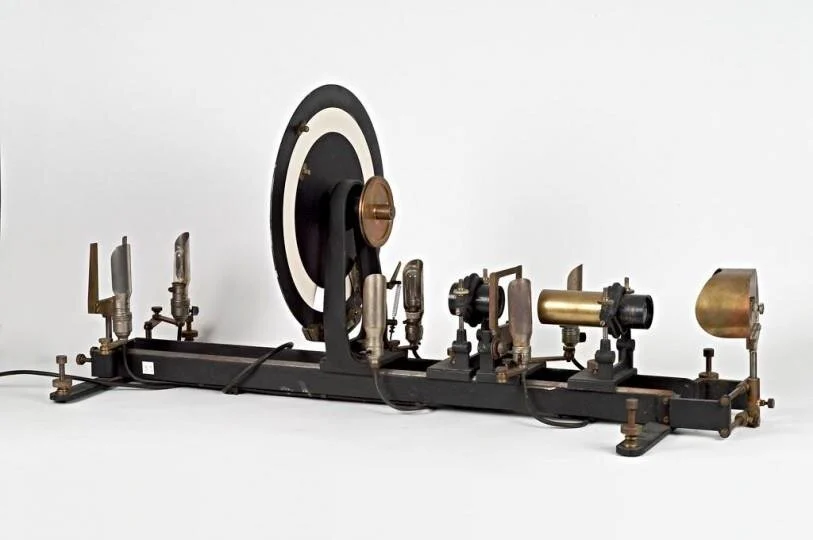
The name TachyPy comes from the tachistoscope: a classic laboratory instrument for presenting visual stimuli for precisely controlled, brief durations. TachyPy aims to bring that timing discipline into Python experiments while keeping the stimulus code readable and inspectable.
Timing Validation
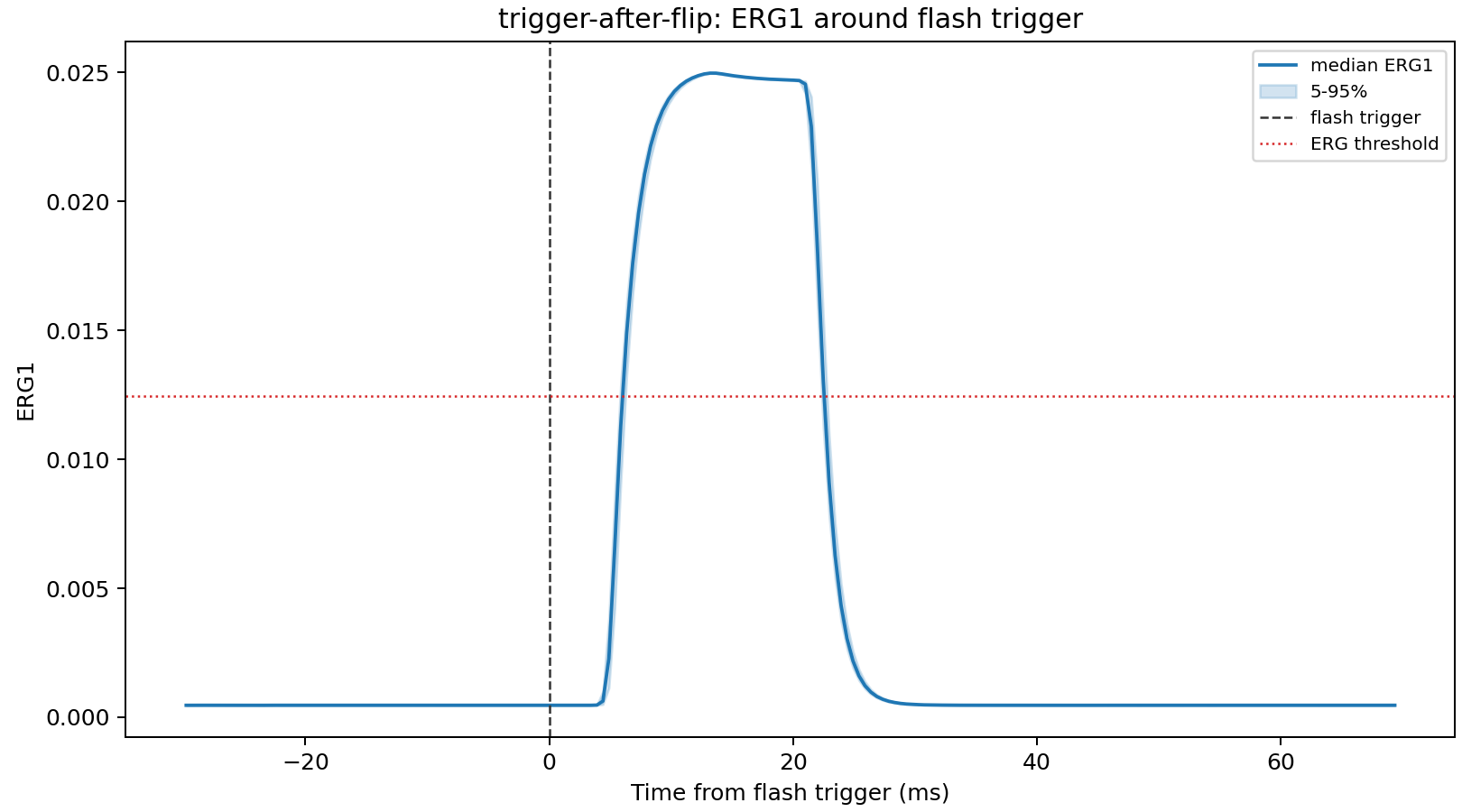
TachyPy's GLFW path has been tested with a photodiode setup using a centrally
presented white square on a uniform gray background. The photodiode was placed
at the screen center, over the white square, and the EEG recording captured both
serial trigger events and the photodiode signal on ERG1.
In the after-flip trigger condition shown above, the white square was presented for one 60 Hz frame. Across 120 flashes, the photodiode pulse width was close to one refresh interval and the trigger-to-photodiode alignment was stable:
- median ERG1 rise after flash trigger:
6.35 ms - SD of ERG1 rise after flash trigger:
0.20 ms - median photodiode pulse width:
16.60 ms - SD of photodiode pulse width:
0.18 ms
These measurements are hardware/display dependent, but they provide a concrete validation pattern for TachyPy timing tests: combine serial trigger logging, photodiode measurements, and TachyPy flip timestamps rather than relying on software timestamps alone.
Highlights
- OpenGL stimulus rendering (
Texture,Shapes, fixation, etc.). - GLFW-first window/input handling via
Screenfor tighter display control. - Backend-aware input handling through
ResponseHandler. - Multiple text paths:
Text(Pillow-first convenience text; legacy pygame fallback if installed),GLText(OpenGL bitmap glyphs),GLTextSDF(distance-field text),GLSystemText(system fonts via FreeType + HarfBuzz).
- Psychophysics helpers (
make_gabor, gratings, normalization, dithering). - Audio playback utility (
Audio) with backend abstraction (sounddeviceordummy). - Test suite for core logic and regressions.
Installation
Install base package:
pip install tachypy
The base install includes GLFW for display/input, PyOpenGL, Pillow text support, and pyserial for serial/trigger workflows. Pygame is no longer a base dependency.
Editable install for development:
git clone https://github.com/Charestlab/tachypy.git
cd tachypy
pip install -e .
Optional extras:
pip install -e ".[test]"        # pytest
pip install -e ".[pygame]"      # legacy pygame compatibility backend
pip install -e ".[text]"        # Pillow text fallback
pip install -e ".[system_text]" # FreeType + HarfBuzz system-font text
pip install -e ".[audio_sd]"    # sounddevice backend
sounddevice / PortAudio prerequisites
sounddevice requires PortAudio on some systems.
Linux (Debian/Ubuntu):
sudo apt update
sudo apt install libportaudio2 libportaudiocpp0 portaudio19-dev
macOS:
Install Homebrew (if needed):
/bin/bash -c "$(curl -fsSL https://raw.githubusercontent.com/Homebrew/install/HEAD/install.sh)"
Then install PortAudio:
brew install portaudio
Windows:
sounddevice wheels often already include what is needed. If installation still fails, one workaround is:
choco install portaudio
Quick Start
import os
from tachypy import Screen, ResponseHandler

backend = os.getenv("TACHYPY_BACKEND", "glfw")
screen = Screen(
    screen_number=0,
    fullscreen=False,
    width=1280,
    height=720,
    backend=backend,
)
responses = ResponseHandler(screen=screen)

running = True
while running:
    screen.fill((128, 128, 128))
    screen.flip()

    responses.get_events()
    if responses.should_quit() or responses.was_key_pressed("esc"):
        running = False
    if responses.was_key_pressed("space"):
        print("Space pressed")

screen.close()
To run the full demo:
python example_tachypy.py
The demo defaults to GLFW. Legacy pygame compatibility remains available if installed:
TACHYPY_BACKEND=pygame python example_tachypy.py
Choose a font for demo text rendering with GLFW GLSystemText:
TACHYPY_BACKEND=glfw TACHYPY_FONT="Avenir Next, Helvetica, Arial" python example_tachypy.py
Backend Notes
Screen(backend="glfw"): GLFW-managed window/events, with top-left logical coordinate handling aligned to TachyPy conventions.Screen(backend="pygame"): legacy SDL/Pygame-managed compatibility backend. Install withtachypy[pygame].- For robust key/mouse behavior across backends, initialize
ResponseHandler(screen=screen)so it can route event polling correctly. DraggableManagernow works on both backends when events are read throughResponseHandler(screen=screen).
Text Rendering Notes
Textis convenience-first and works for most instruction screens.GLText/GLTextSDF/GLSystemTextrender text directly in OpenGL and are backend-independent.GLSystemTextsupports system font selection by family name, fallback list (e.g."Avenir Next, Helvetica, Arial"), or direct font file path.- For production instruction text, prefer
GLSystemTextwith.[system_text]. - The legacy pygame text path requires
tachypy[pygame].
API Naming
The psychophysics module exposes modern English APIs (for example
make_gabor, make_sine_grating, normalize_to_unit_interval).
Legacy French names remain as compatibility wrappers and emit
DeprecationWarning.
Testing
Run tests:
pip install -e ".[test]"
pytest
Current suite covers audio timing helpers, response/key state handling, backend behavior, psychophysics invariants, text layout/renderer basics, and other regression-prone utility paths.
For CI/headless testing, use:
TACHYPY_AUDIO_BACKEND=dummy pytest
Documentation
Expanded docs live in /docs and include:
- getting started
- backend behavior and input routing
- text rendering options
- audio backend guidance
- examples and contribution workflow
Hosted docs (Read the Docs): https://tachypy.readthedocs.io/
If Read the Docs is not auto-updating after pushes, reconnect GitHub in RTD and re-sync project webhooks from the RTD project settings.
Main Modules
screen.py: display/context lifecycle and backend abstraction.responses.py: keyboard/mouse event handling and key-state queries.text.py,gltext.py,gltext_sdf.py,glsystemtext.py: text rendering.textures.py,shapes.py,draggable.py,scrollbar.py: visual primitives.psychophysics.py: stimulus generation and normalization utilities.audio.py: sound playback and timing helpers.
Contributing
- Fork and clone the repository.
- Create a branch for your change.
- Add tests for behavioral changes.
- Run
pytest. - Open a pull request.
License
MIT. See LICENSE.
Release history Release notifications | RSS feed


Download files
Download the file for your platform. If you're not sure which to choose, learn more about installing packages.
Source Distribution
Built Distribution
Filter files by name, interpreter, ABI, and platform.
If you're not sure about the file name format, learn more about wheel file names.
Copy a direct link to the current filters
File details
Details for the file tachypy-0.1.11.tar.gz.
File metadata
- Download URL: tachypy-0.1.11.tar.gz
- Upload date:
- Size: 61.5 kB
- Tags: Source
- Uploaded using Trusted Publishing? No
- Uploaded via: twine/6.2.0 CPython/3.14.5
File hashes
| Algorithm | Hash digest | |
|---|---|---|
| SHA256 |
07d77a90a90ac7ea74b3243dea1c522e9f7d8d97200742a83d403d219fa332cb
|
|
| MD5 |
f661b37cc1762df8079e922bf1465e34
|
|
| BLAKE2b-256 |
bbefa1c417d69e77154f71886997ecfd193306463e094e2b1e29197382da3188
|
File details
Details for the file tachypy-0.1.11-py3-none-any.whl.
File metadata
- Download URL: tachypy-0.1.11-py3-none-any.whl
- Upload date:
- Size: 50.2 kB
- Tags: Python 3
- Uploaded using Trusted Publishing? No
- Uploaded via: twine/6.2.0 CPython/3.14.5
File hashes
| Algorithm | Hash digest | |
|---|---|---|
| SHA256 |
c5dc3cb6464f3d878b323384eb459376e947a34388c97e3c7966cdb4291361a8
|
|
| MD5 |
ca65de3ab42205c98d709b804dedda8a
|
|
| BLAKE2b-256 |
6f71b5401d48c924e8e50c38940d9319d6b5883b7ef8cc2cf72768784f3212da
|






