
tbkit — a Tight-Binding package
| Package |     |
| Quality |    |
| Documentation |  |
| Downloads |   |
| Community |     |
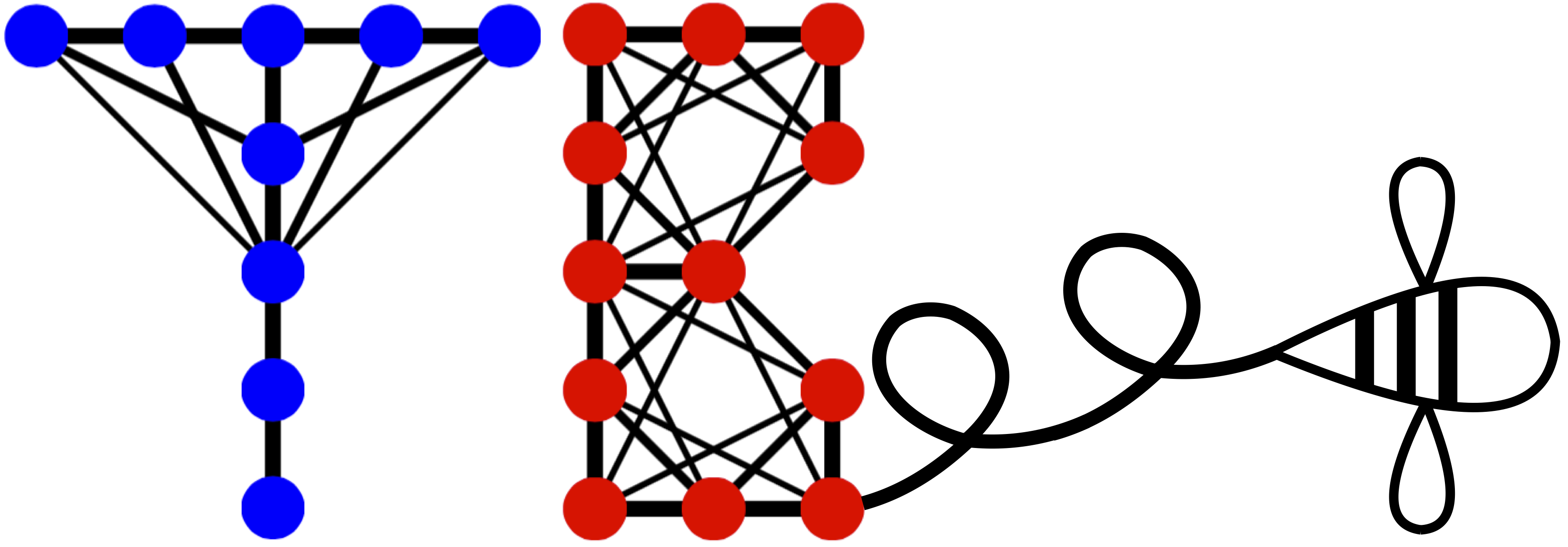
tbkit is a Python package to build and solve Tight-Binding models, written in vectorized NumPy/SciPy. It aims to make the mechanics of Tight-Binding models — lattices, hoppings, Hamiltonians, spectra, band structures — explicit and easy to inspect, so it works as well for teaching as for research prototyping.
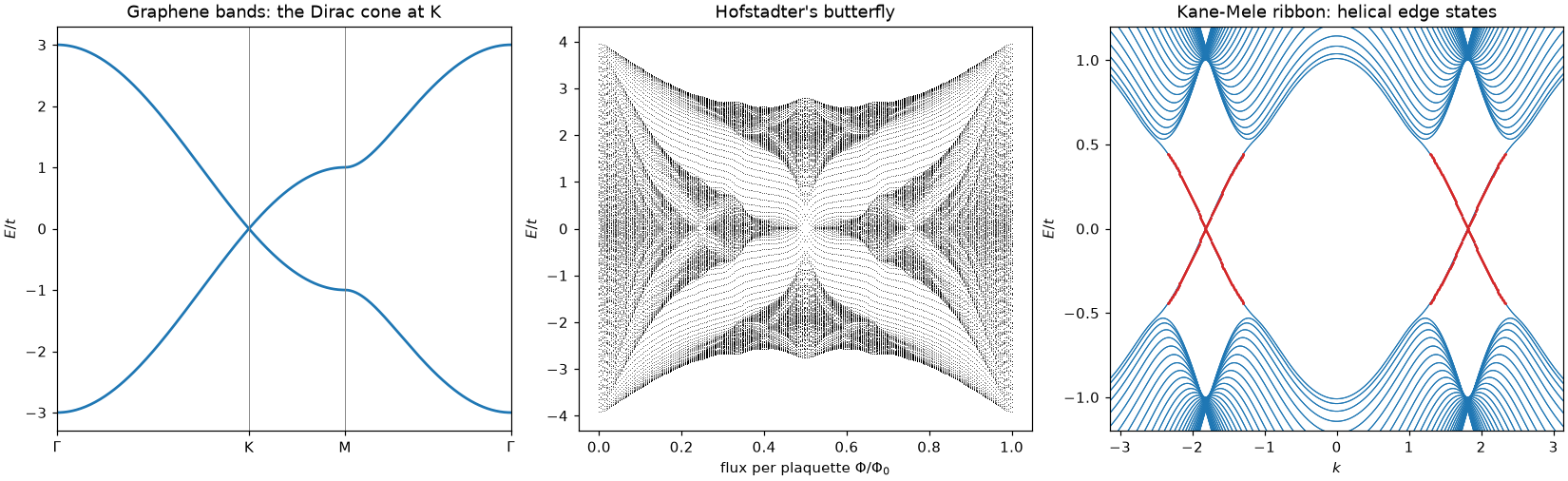
For computational physics beyond tight-binding — quantum mechanics,
classical mechanics, statistical physics, general relativity, and more —
see physicskit, whose
physicskit.condensed subpackage covers tight-binding band theory and
topology alongside superconductivity.
Examples
Building and solving models
Finite lattices, defects, several orbitals per site, real space to k-space and back, k·p models discretized into lattice models, saved models and Wannier90 imports, maximally localized Wannier functions, and solvers for very large lattices.
Fields, strain and disorder
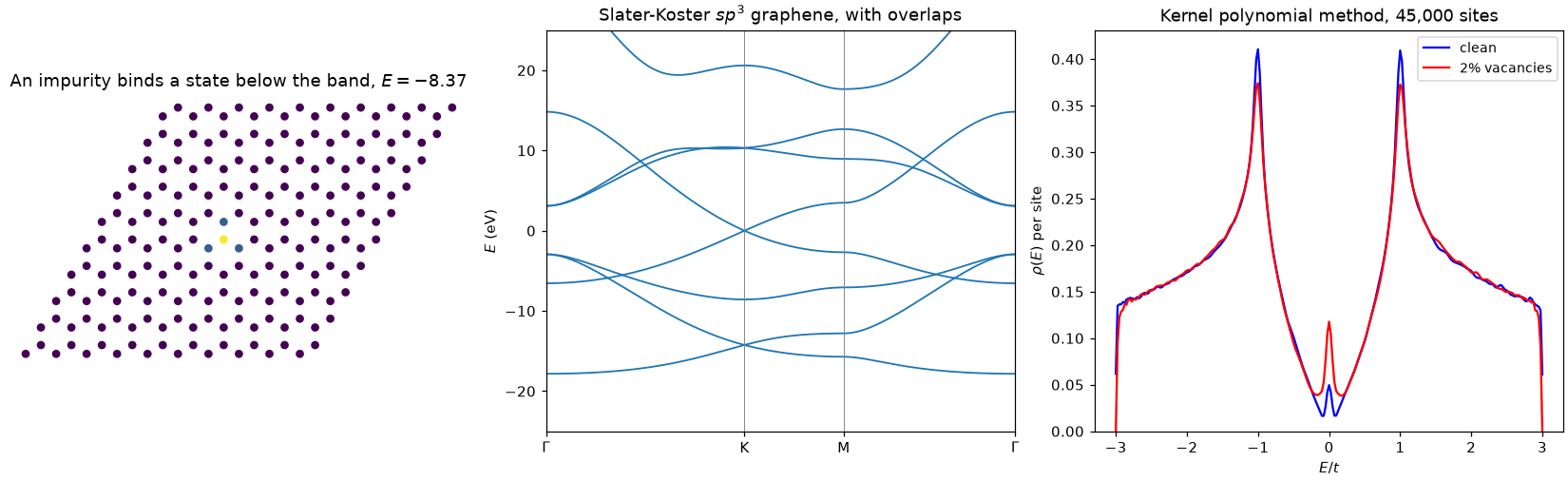
What happens to a lattice under a magnetic field (Peierls substitution), under strain, and with disorder.
Band topology
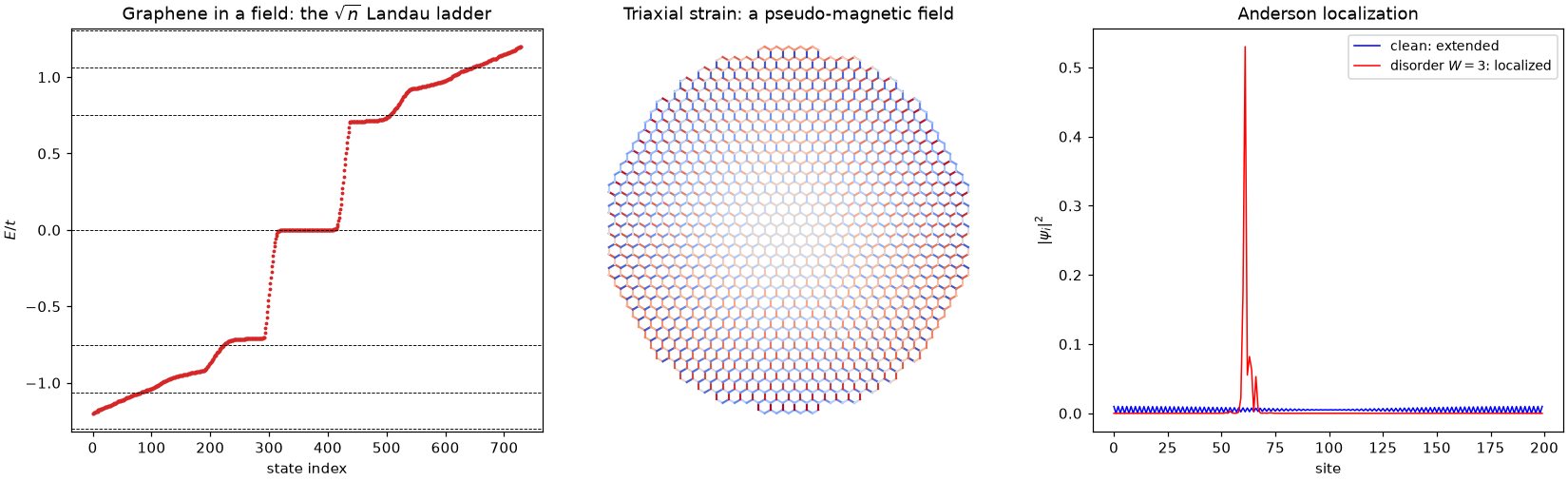
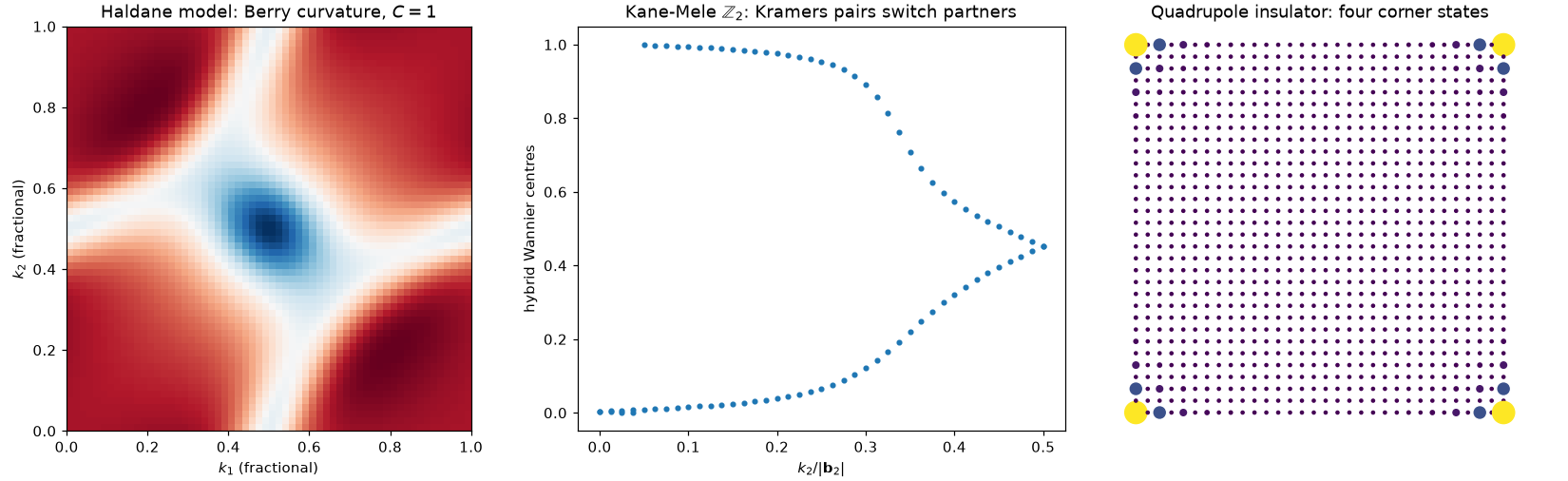
Chern numbers, Berry phases, the Z2 invariant (and the four 3D indices), spin and mirror Chern numbers, the Bott index and entanglement spectrum, Weyl points and their chirality, Kitaev's Majorana number, quantum geometry, symmetry classes, higher-order and 3D topological phases.
Response and transport
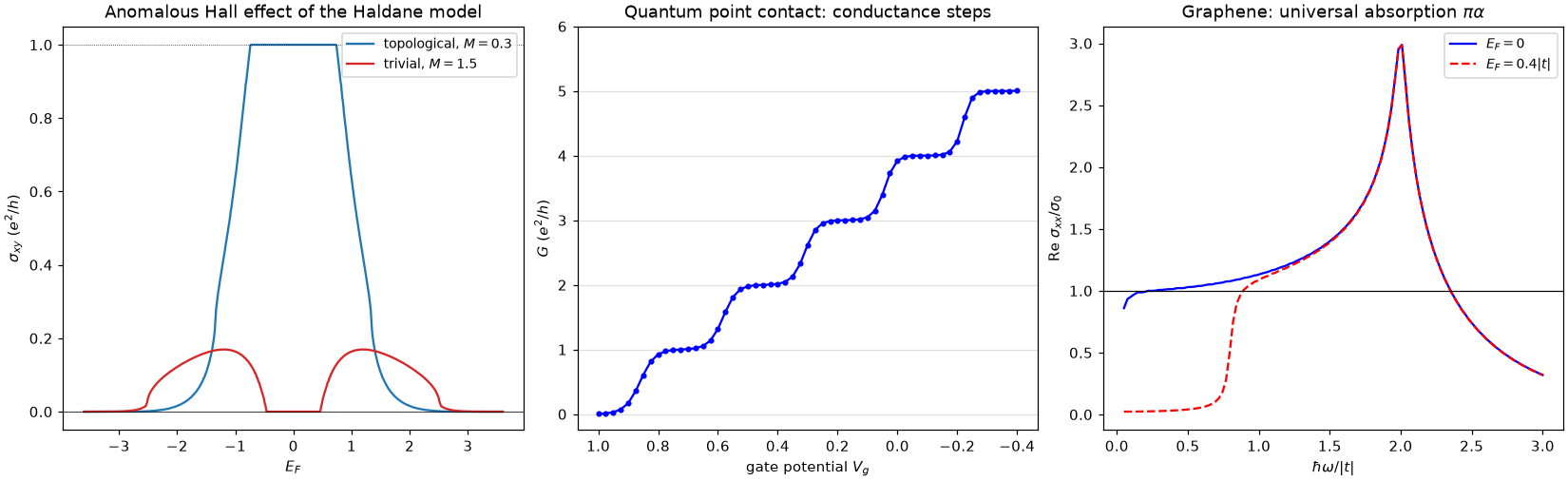
Hall conductivities at any Fermi level (with the orbital magnetization, Nernst and thermal Hall responses), Landauer transport between leads, and linear and nonlinear optical response.
Flat bands and interactions
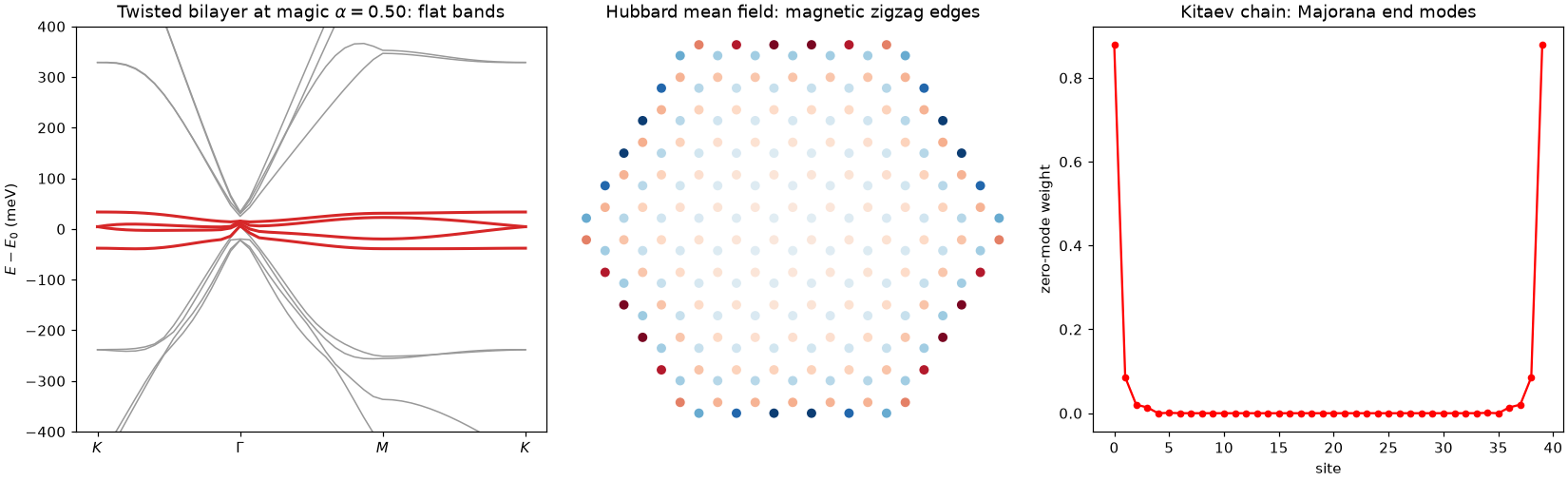
Flat bands from lattice geometry and from a moiré twist, the Hubbard model in mean field, and superconductivity.
Driven and open systems
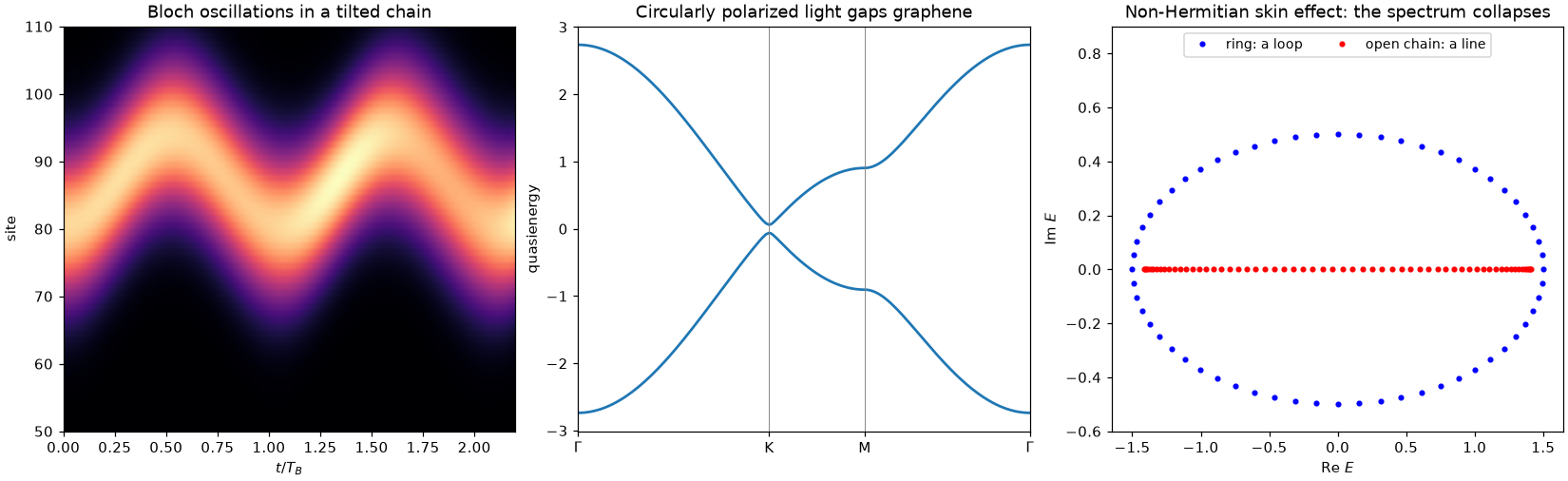
Wavepacket dynamics, periodically driven (Floquet) lattices, and non-Hermitian bands with exceptional points.
Install
Requires Python >= 3.10 (tested on 3.10-3.15).
pip install tbkit
# or
conda install -c conda-forge tbkit
tbkit.continuum (k·p models to tight-binding) also needs sympy:
pip install "tbkit[continuum]"
# or
conda install -c conda-forge tbkit sympy
or, for an editable install from a clone (e.g. to run the test suite or work on tbkit itself):
git clone https://github.com/cpoli/tbkit
cd tbkit
pip install -e .
or, to also install the tools needed to run the test suite:
pip install -e ".[test]"
pytest tests/
The test suite has 100% line coverage of the tbkit package; see the
HTML coverage report.
Quick start
Real-space flake, nearest-neighbor square lattice:
from tbkit.lattice import Lattice
from tbkit.system import System

lat = Lattice(unit_cell=[{'tag': 'a', 'r0': (0., 0.)}],
                       prim_vec=[(1., 0.), (0., 1.)])
lat.get_lattice(n1=10, n2=10)

sys = System(lat)
sys.set_hopping([{'n': 1, 't': 1.}])
sys.get_ham()
sys.get_eig()
print(sys.en)
Graphene band structure (reciprocal space):
import numpy as np
from tbkit.lattice import Lattice
from tbkit.kspace import KSpace, reciprocal_vectors

DX, DY = 0.5 * 3 ** 0.5, 0.5
unit_cell = [{'tag': 'a', 'r0': (0., 0.)}, {'tag': 'b', 'r0': (DX, DY)}]
prim_vec = [(2 * DX, 0.), (DX, 1.5)]
lat = Lattice(unit_cell=unit_cell, prim_vec=prim_vec)

gra = KSpace(lat)
gra.set_hopping([{'i': 0, 'j': 1, 'R': (0, 0), 't': 1.},
                        {'i': 0, 'j': 1, 'R': (-1, 0), 't': 1.},
                        {'i': 0, 'j': 1, 'R': (0, -1), 't': 1.}])

b1, b2 = (np.array(v) for v in reciprocal_vectors(prim_vec))
Gamma, K, M = np.zeros(2), (b1 - b2) / 3, b1 / 2
gra.k_path([Gamma, K, M, Gamma], nk=60)
fig = gra.plot_bands(node_labels=[r'$\Gamma$', 'K', 'M', r'$\Gamma$'])
fig.savefig('graphene_bands.png')
A magnetic field is added with System.set_magnetic_field (uniform field) or
System.set_peierls_phase (arbitrary vector potential), applied to the
hoppings after set_hopping/set_hopping_manual:
sys.set_hopping_manual(hop_dict)
sys.set_magnetic_field(alpha=0.01)  # flux quanta per unit area
sys.get_ham()
See examples/magnetic_field/plot_magnetic_field.py for a full
worked example (an Aharonov-Bohm ring, reproducing the textbook result that
the spectrum is periodic in the enclosed flux with period one flux quantum).
A Chern number is the Berry curvature of a group of bands, integrated over the Brillouin zone:
chern = gra.chern_number(bands=[0], nk=40) # ~0 for plain graphene
See examples/topology/plot_haldane_topology.py for the
Haldane model (the first Chern insulator), reproducing its topological
phase transition (Chern number 1 -> 0) and Berry-curvature map.
A spin-1/2 degree of freedom is added with KSpace(lat, spin=True); onsite
values and hoppings then also accept 2x2 (Pauli) matrices:
from tbkit.kspace import KSpace, PAULI

kmele = KSpace(lat, spin=True)
kmele.set_hopping([{'i': 0, 'j': 0, 'R': (1, 0), 't': 1j*lam*PAULI['z']}])  # intrinsic SOC
A ribbon -- periodic in one direction, finite in the other, the standard
way to see edge states -- is cut out of a periodic model with
tbkit.kspace.ribbon:
from tbkit.kspace import ribbon

rib = ribbon(lat, list_hop, width=30, direction=1)   # 30 unit cells wide
fig = rib.plot_bands()
See examples/topology/plot_edge_states.py for the zigzag
graphene ribbon's zero-energy edge band, and the Kane-Mele ribbon's helical
edge states crossing a spin-orbit gap.
Documentation
Rendered docs (tutorial, API reference, example gallery): https://cpoli.github.io/tbkit/
docs/source/tutorial.rst-- a narrative walkthrough of the package, from building a lattice through topology, spin-orbit coupling, and edge states.docs/source/history/-- a chronology of the breakthroughs behind Tight-Binding theory (Bloch's theorem through higher-order topology), one page per theme, each one linked to the corresponding tbkit functionality and example above.docs/source/tbkit.rst-- the API reference (auto-generated from docstrings).ROADMAP.md-- what is planned next, and what tbkit does not do yet (compared with Kwant and PythTB).
Build the HTML docs with cd docs && make html (output in docs/build/html).
A note on the API
Version 0.2 modernized the package to run on current Python/NumPy/SciPy and cleaned up the API:
- Sublattice tags are plain one-character strings (
'a') rather than byte strings (b'a'). - Classes are named in
PascalCase(Lattice,System, ...) rather than lowercase names identical to their module (lattice.lattice,system.system, ...), which used to makeimport tbkit.lattice as latticesilently bind the wrong object.
For continuity, the pre-0.2 lowercase class names (lattice, system,
plot, propagation, save) remain available as aliases of the new
classes, so from tbkit.lattice import lattice still works.
License
BSD 3-Clause, see LICENSE.
1 maintainer

Metadata
1 maintainer
Release files for tbkit 0.6.0
For a detailed explanation of source distributions (sdists) and built distributions (wheels), please see the package formats documentation.
Source distribution (sdist)
| File | Size | Uploaded | |
|---|---|---|---|
| tbkit-0.6.0.tar.gz | 360.5 kB | Details |
Built distribution (wheel)
| File | Interpreter | ABI | Platform | Reset |
|---|---|---|---|---|
| tbkit-0.6.0-py3-none-any.whl | Python 3 | none | any | Details |
Total release size: 612.5 kB
Release files / tbkit-0.6.0.tar.gz
| Download URL | tbkit-0.6.0.tar.gz |
|---|---|
| Size | 360.5 kB |
| Tags | Source |
|
SHA-256 checksum How to use checksums |
2f7ca7c0f7474b14de5861edeca11826e2a1492356a73c8a8fa03fd98042140c
|
|
BLAKE2b-256 checksum How to use checksums |
5ffca5526534b281e857ae2cc7dc629ef685a13af5f97d2f48b7dc51ac1d4085
|
| Upload date | |
|
Uploaded using Trusted Publishing? What is trusted publishing? |
Yes |
| Uploaded via |
twine/7.0.0 CPython/3.13.14
|
Provenance
Provenance describes where a file came from. On PyPI, provenance is shared via attestations, which provide a verifiable record of the build or publishing details. View details, limitations and caveats.


PyPI Publish Attestation
PyPI verified that this artifact, at this checksum, originated from the publisher listed below.
Signed by GitHub Actions, verified by PyPI on Oct 13, 2026.
Transparency logRelease files / tbkit-0.6.0-py3-none-any.whl
| Download URL | tbkit-0.6.0-py3-none-any.whl |
|---|---|
| Size | 252.0 kB |
| Tags | Python 3 |
|
SHA-256 checksum How to use checksums |
1f9629c3c6a16f4ce3e759bbcd590811fb7efeafa4d8bd12c71359907df1dbe9
|
|
BLAKE2b-256 checksum How to use checksums |
6f8a3c4115446122dedecefbb19289ad9f654e78f3cb7f64f192fb61f5f40c29
|
| Upload date | |
|
Uploaded using Trusted Publishing? What is trusted publishing? |
Yes |
| Uploaded via |
twine/7.0.0 CPython/3.13.14
|
Provenance
Provenance describes where a file came from. On PyPI, provenance is shared via attestations, which provide a verifiable record of the build or publishing details. View details, limitations and caveats.
PyPI Publish Attestation
PyPI verified that this artifact, at this checksum, originated from the publisher listed below.
Signed by GitHub Actions, verified by PyPI on Oct 13, 2026.
Transparency log













