
A fast, differentiable, JIT-free, debugging-friendly finite element library for PyTorch.
Documentation | Installation | Quickstart | Examples | Citation






TensorMesh is a finite element method (FEM) library built natively on PyTorch. It is designed to solve partial differential equations (PDEs) with the ergonomics of modern deep learning frameworks — automatic differentiation, GPU acceleration, eager execution — without sacrificing the rigour of classical FEM. Custom weak forms are written in pure Python; the library takes care of tensorized assembly, sparse linear algebra, boundary conditions, and time integration.
Core strengths
- GPU-native & differentiable. Built on PyTorch from the ground up. Moving an entire FEM workflow to the GPU takes a single line of code — every downstream assembly, solve, and gradient inherits the device automatically, with no separate backend or data-marshalling step. Native autograd flows seamlessly through assembly and solve, enabling end-to-end differentiable PDE pipelines.
- High-performance tensorized assembly. A fully tensorized Map-Reduce algorithm powered by TensorGalerkin, which fuses element-wise operations into monolithic GPU kernels, eliminating Python-level loops and delivering order-of-magnitude speedups over CPU-based FEM stacks.
- JIT-free & debugging-friendly. Eager execution with no compilation overhead. Dynamic meshes, adaptive refinement, and interactive workflows just work — no recompilation latency, no opaque traces.
- Comprehensive element & mesh support. Triangular, tetrahedral, pyramid, and prismatic elements with automated mesh generation for common geometries and seamless Gmsh / VTKHDF5 I/O. Multi-field mixed assembly (e.g. LBB-stable Taylor-Hood Stokes) declares each field's order independently of the mesh — quadratic spaces are generated topologically even on linear meshes.
- Flexible Solvers. Powered by torch-sla, our companion library for differentiable sparse linear algebra. Linear, nonlinear, and eigenvalue solvers run across multiple backends on CPU and GPU, with full autograd support, batched solves, and distributed multi-GPU scaling.
- Pythonic API. Custom weak forms in pure Python — no separate DSL, no form compiler. If you can write PyTorch, you can write FEM.
Installation
Requirements: Python ≥ 3.10, PyTorch ≥ 2.0.
pip install tensormesh-fem             # CPU stack (SciPy + PyTorch Krylov)
pip install "tensormesh-fem[gpu]"      # + all PyPI solver backends (cuDSS + PyAMG)
The base install ships the CPU sparse stack via
torch-sla — SciPy direct/iterative plus a
device-agnostic native-PyTorch Krylov backend that already runs on
CUDA/ROCm. If you only want one extra backend, use [cudss] or [pyamg]
instead:
pip install "tensormesh-fem[cudss]"    # NVIDIA cuDSS (fastest GPU direct)
pip install "tensormesh-fem[pyamg]"    # PyAMG algebraic multigrid
Two more backends — STRUMPACK (portable direct, CPU/CUDA/ROCm) and NVIDIA
AmgX — ship as prebuilt wheels on
torch-sla's GitHub Releases,
not PyPI. The quotes are needed because [...] is a shell glob character.
Install from source (for development)
git clone https://github.com/camlab-ethz/TensorMesh.git
cd TensorMesh
pip install -e ".[test]"
After installing, sanity-check the install:
python -m tensormesh.verify_install
To see which sparse-solver backends are usable on your machine — and a one-line install hint for any that are not — run:
import torch_sla
torch_sla.show_backends()
Quickstart
Solve $-\Delta u = f$ on the unit square with homogeneous Dirichlet boundary conditions, where $f(x, y) = 2\pi^2\sin(\pi x)\sin(\pi y)$ so the exact solution is $u(x, y) = \sin(\pi x)\sin(\pi y)$:
import math
import torch
from tensormesh import ElementAssembler, NodeAssembler, Mesh, Condenser

# 1. Generate a triangular mesh of the unit square.
mesh = Mesh.gen_rectangle(chara_length=0.05)

# 2. Stiffness weak form:  a(u, v) = ∫ ∇u · ∇v dΩ
class LaplaceAssembler(ElementAssembler):
    def forward(self, gradu, gradv):
        return gradu @ gradv

# 3. Load weak form:  l(v) = ∫ f v dΩ
class SourceAssembler(NodeAssembler):
    def forward(self, v, f):
        return f * v

# 4. Source term, evaluated at every mesh node.
x, y = mesh.points[:, 0], mesh.points[:, 1]
f_vals = 2 * math.pi**2 * torch.sin(math.pi * x) * torch.sin(math.pi * y)

# 5. Assemble the stiffness matrix and load vector.
K = LaplaceAssembler.from_mesh(mesh)()
b = SourceAssembler.from_mesh(mesh)(point_data={"f": f_vals})

# 6. Apply Dirichlet BCs by static condensation, then solve.
condenser = Condenser(mesh.boundary_mask)
K_, b_ = condenser(K, b)
u_ = K_.solve(b_, verbose = True)
u = condenser.recover(u_)

# 7. Compare against the analytical solution.
u_exact = torch.sin(math.pi * x) * torch.sin(math.pi * y)
print(f"L2 error: {(u - u_exact).norm() / u_exact.norm():.3e}")
[torch-sla] solve: n=431, nnz=2859, dtype=float64, device=cpu, symmetric=True, spd=False, backend=scipy, method=lu
L2 error: 3.135e-03
The workflow is Mesh → Assembler → SparseMatrix → Condenser → Solve.
Move everything to GPU with a single mesh = mesh.cuda(); enable
gradients with mesh.points.requires_grad_(True) and the same script
becomes an inverse problem.
See the full walkthrough in the Quickstart.
Examples
A small selection from the example gallery. Nothing to install — these run in your browser as Colab notebooks:
|
Basics — elements, basis functions, meshes | |
Poisson — the full pipeline in 25 lines |
|
h-adaptivity — solve → estimate → mark → remesh | |
Helmholtz — complex-valued FEM end to end |
|
Stokes — Taylor-Hood mixed elements + convergence | |
Lid-driven cavity — steady Navier-Stokes |
|
Flow past obstacles — CSG meshing + Picard iteration | |
Inverse design — autograd through the FEM solve |
|
Physics-informed learning — train on the Galerkin residual | |
3D Poisson — the same weak form on tetrahedra |
|
Cantilever beam — 3D linear elasticity | |
Hyperelastic beam — large deformation, energy minimisation |
|
Heat equation — implicit stepping, animated | |
Wave equation — explicit stepping + energy conservation |
|
Allen-Cahn — phase field, a Newton solve every step | ||
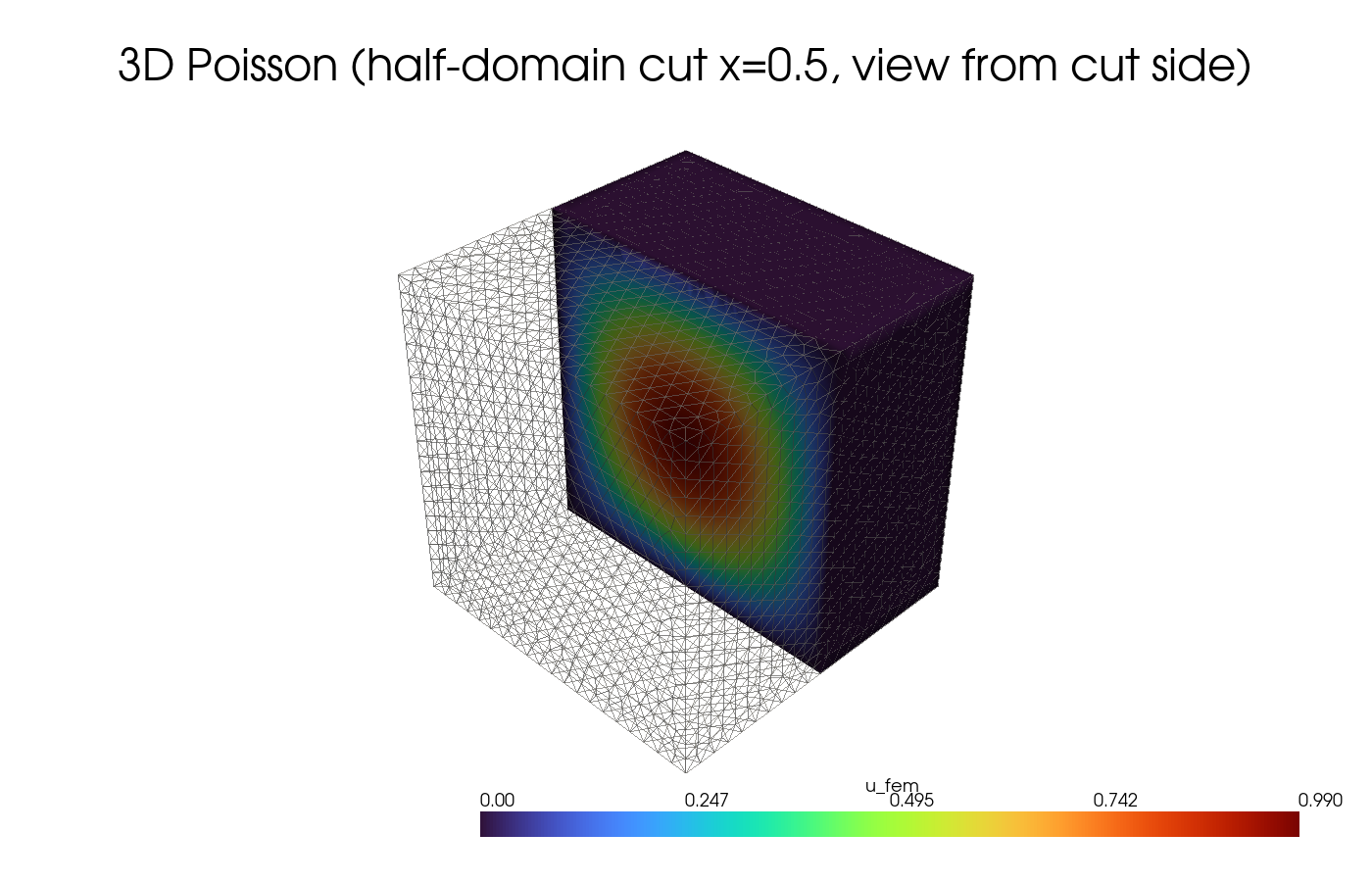 3D Poisson — tetrahedral mesh, cut view of the scalar field. |
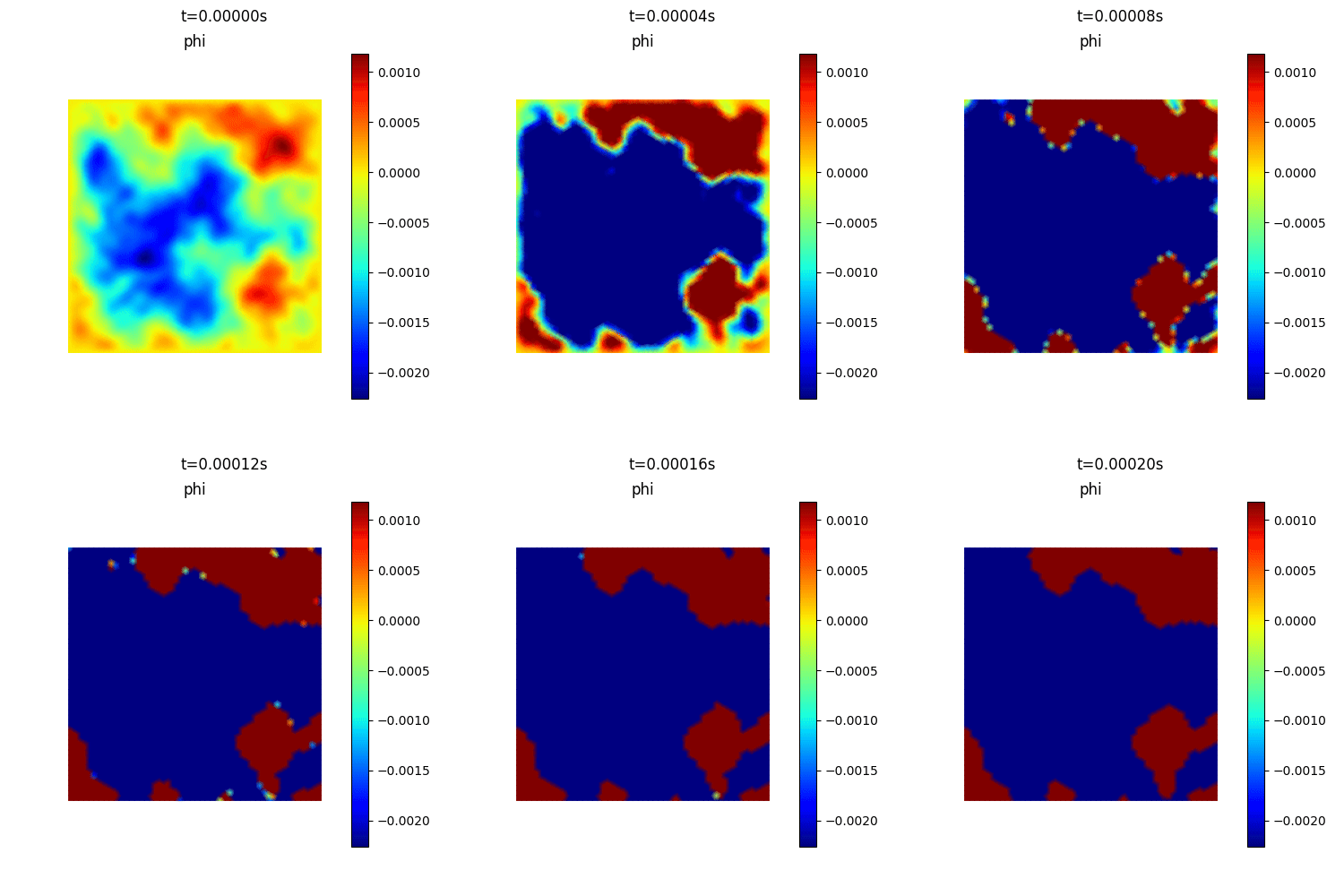 Allen–Cahn phase field — nonlinear time evolution with Newton iteration per step. |
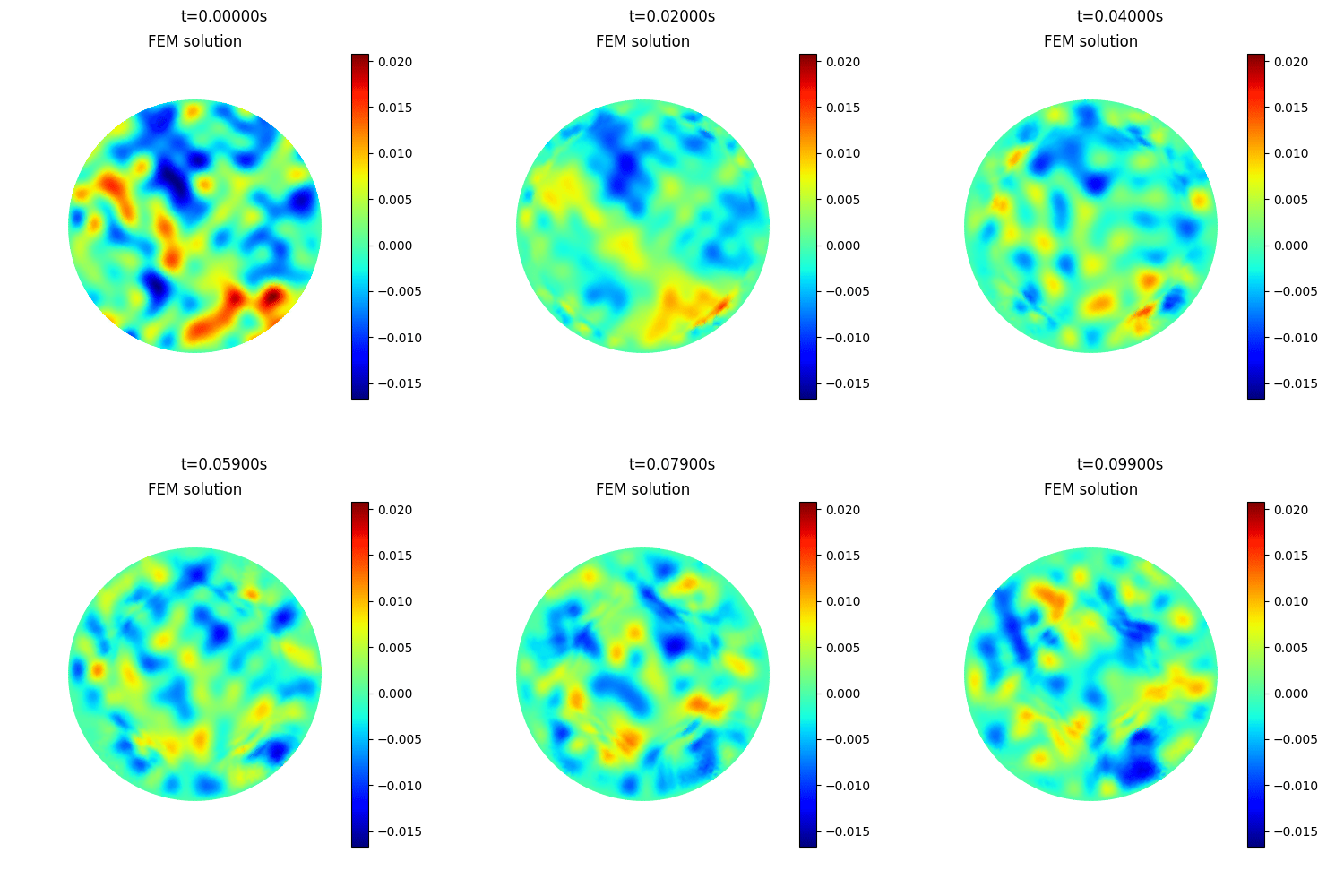 Wave equation — explicit central-difference time integration. |
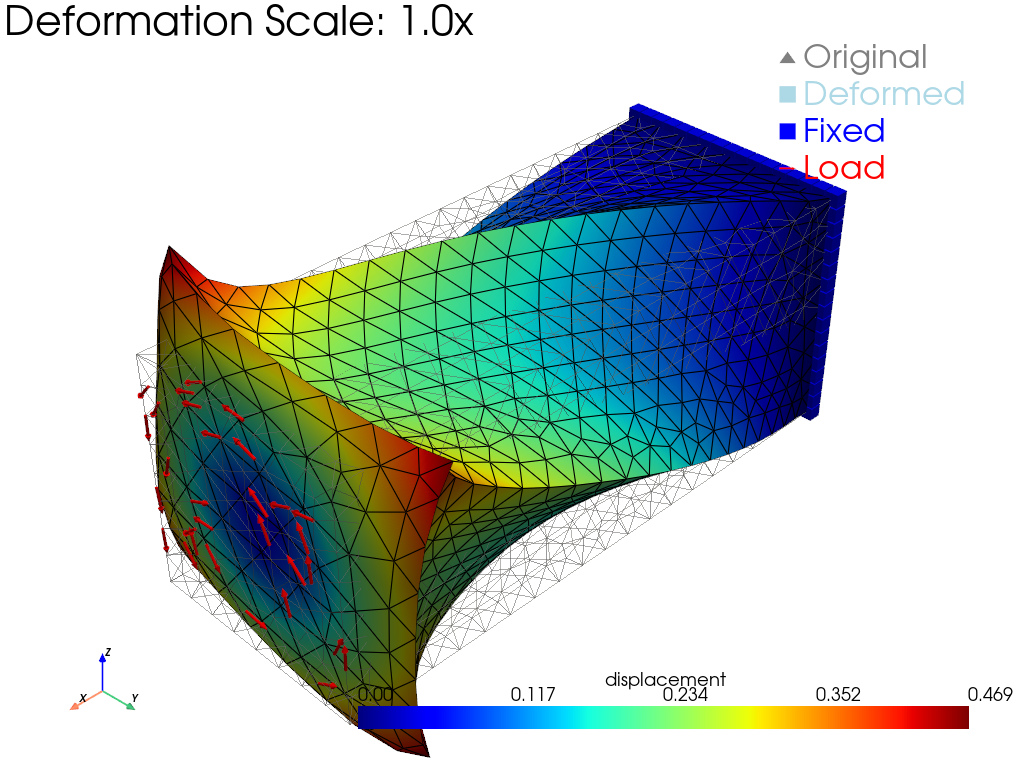 Hyperelastic rubber — large-deformation solid mechanics with a Newton solver. |
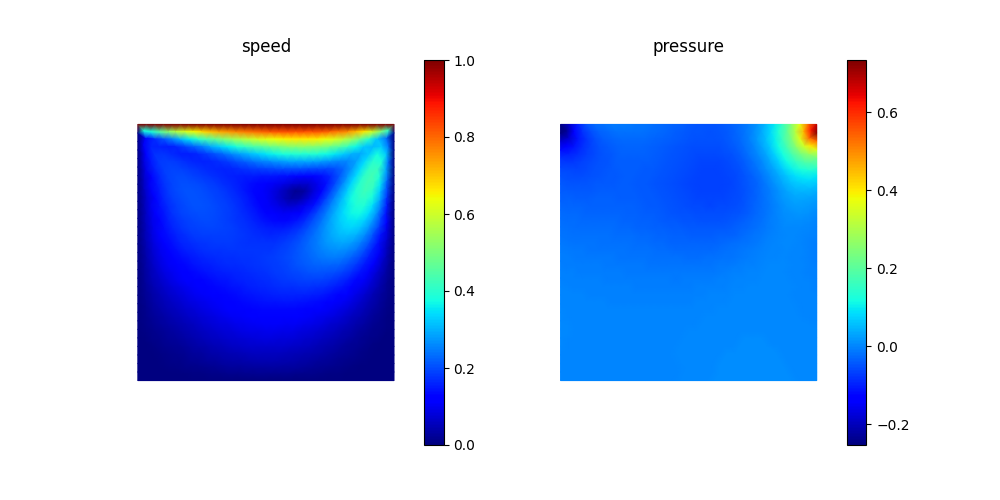 Lid-driven cavity — incompressible Navier–Stokes; velocity field and streamlines. |
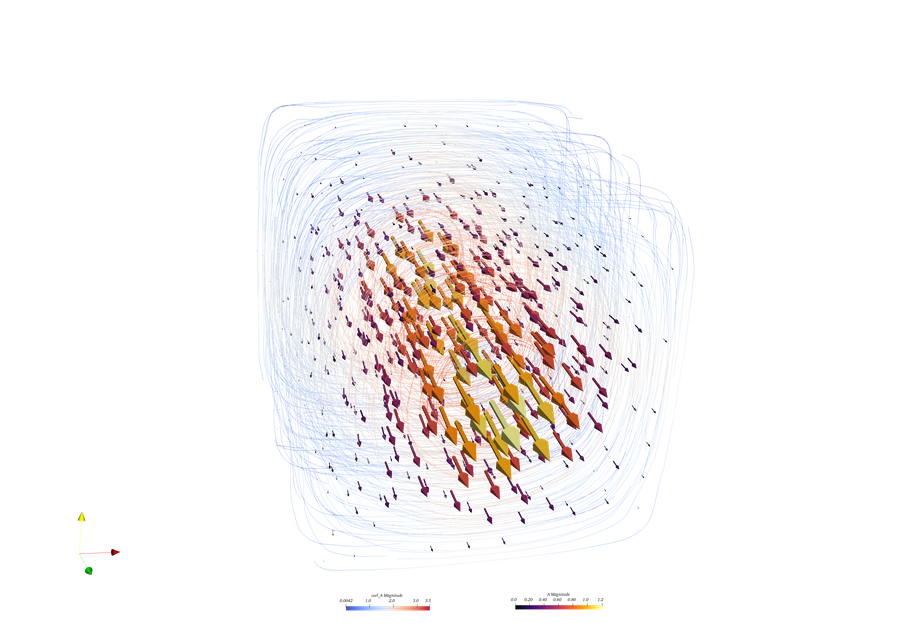 Magnetostatics — 3D magnetic field around a current-carrying wire (stabilized nodal curl-curl). |
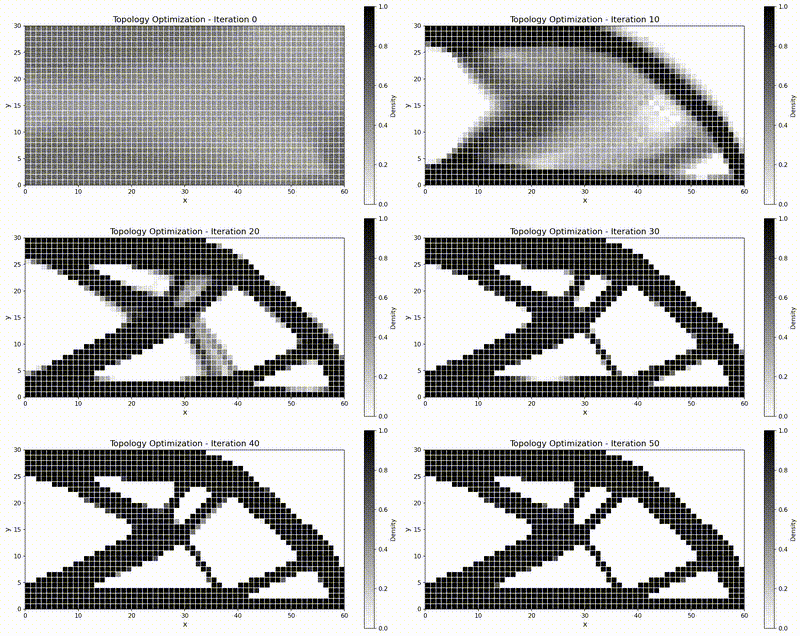 Topology optimization — compliance minimization via the Optimality Criteria method. |
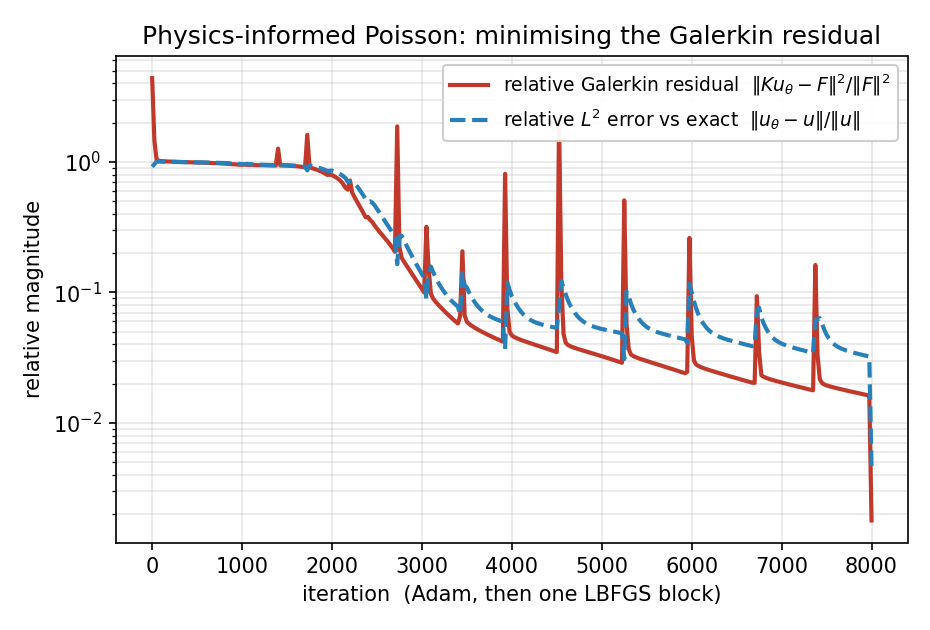 Physics-informed learning — a network trained to minimize the assembled Galerkin residual. |
| Category | Path | Description |
|---|---|---|
| Basics | examples/basics/ |
Mesh visualization, basis functions, element gallery |
| Poisson | examples/poisson/ |
2D / 3D Poisson, batched RHS, h-adaptivity |
| Diffusion | examples/diffusion/ |
Heat equation, Allen-Cahn phase field |
| Wave | examples/wave/ |
Wave equation; Helmholtz; phononic-crystal band structures (Bloch-Floquet); open-domain acoustics/photonics with PML + plane-wave ports; waveguide mode analysis |
| Solid | examples/solid/ |
Cantilever beam, hyperelasticity, contact, plasticity, vibration modes + FRF |
| Fluid | examples/fluid/ |
Taylor-Hood mixed elements throughout: Stokes convergence study, lid-driven cavity, cylinder flow, flow past obstacles, Rayleigh-Bénard, Taylor-Green |
| Magnetostatics | examples/maxwell/ |
3D Maxwell: magnetic field around a current-carrying wire via a stabilized nodal curl-curl formulation |
| Inverse design | examples/inverse_design/ |
Coefficient-field identification and density-based topology optimization, all via autograd |
| Physics-informed | examples/physics_informed/ |
Train a neural network to minimize the assembled Galerkin residual |
| Dataset | examples/dataset/ |
Batch dataset generation for ML (heat, wave, Poisson) |
| Distributed | examples/distributed/ |
Multi-GPU Poisson via torchrun (partitioned assembly + distributed solve), graph coloring, partitioning, benchmarks |
Feature comparison
| Feature | FEniCS | scikit-fem | JAX-FEM | torch-fem | TensorMesh |
|---|---|---|---|---|---|
| Custom weak forms (Pythonic) | ⚠️ | ✅ | ❌ | ❌ | ✅ |
| Easy install | ❌ | ✅ | ⚠️ | ✅ | ✅ |
| Easy debug | ❌ | ✅ | ❌ | ✅ | ✅ |
| Easy I/O | ❌ | ❌ | ❌ | ❌ | ✅ |
| Large meshes | ✅ | ✅ | ❌ | ❌ | ✅ |
| GPU support | ✅ | ❌ | ✅ | ✅ | ✅ |
| Efficiency | ✅ | ❌ | ✅ | ⚠️ | ✅ |
| End-to-end autograd | ⚠️ | ❌ | ✅ | ✅ | ✅ |
| Deep-learning integration | ❌ | ❌ | ⚠️ | ✅ | ✅ |
| Maturity | ✅ | ✅ | ⚠️ | ⚠️ | ⚠️ |
Custom Weak Forms (Pythonic) — user-defined bilinear / linear forms directly in Python, without a separate DSL such as UFL. End-to-End Autograd — gradients flow natively through the entire pipeline; FEniCS supports this via the external
dolfin-adjointpackage. Maturity — reflects project age, ecosystem size, and production deployments.
Architecture
The core workflow: Mesh → Assembler → SparseMatrix → Condenser → Solve.
| Module | Description |
|---|---|
tensormesh.mesh |
Mesh data structure; built-in generators (gen_rectangle, gen_circle, gen_cube, gen_L, …); Gmsh / VTK-HDF5 I/O |
tensormesh.element |
Shape functions, quadrature rules, element transformations (geometric order 1–4) |
tensormesh.assemble |
ElementAssembler, NodeAssembler, FacetAssembler, FacetBilinearAssembler for matrix, vector, and boundary-matrix assembly; MixedElementAssembler for multi-field block systems (Taylor-Hood, generalized order pairs) |
tensormesh.sparse |
SparseMatrix (subclass of torch_sla.SparseTensor); linear & nonlinear sparse solves via torch-sla backends (SciPy / native PyTorch Krylov / cuDSS / STRUMPACK / PyAMG / AmgX) |
tensormesh.operator |
Condenser for Dirichlet boundary conditions via static condensation; BlochReducer for Bloch-Floquet periodic BCs; robin_operator / port_source wave boundary operators |
tensormesh.ode |
Time integrators: explicit / implicit Euler, midpoint, Runge–Kutta |
tensormesh.dataset |
Parametric PDE dataset generation (Poisson, Heat, Wave, linear elasticity) |
tensormesh.visualization |
Matplotlib and PyVista plotting backends |
tensormesh.functional |
Tensor utilities for FEM (elasticity, Voigt notation, common ops) |
tensormesh.material |
Material property definitions for solid mechanics |
tensormesh.optimizer |
Optimization algorithms (e.g. OC for topology optimization) |
Documentation
Full documentation, including a user guide, an example gallery, the API reference, and performance benchmarks, lives at docs.tensor-mesh.com.
Key entry points:
- Getting started — installation, quickstart, and an install smoke-test.
- User guide — meshes, weak forms, mixed assembly, boundary conditions, linear solvers, time integration, differentiability, distributed FEM.
- Example gallery — runnable examples from Poisson to Navier–Stokes and topology optimization.
- API reference — module-by-module signatures and docstrings.
- Performance — benchmarks against FEniCS / Firedrake / MFEM / scikit-fem / JAX-FEM / torch-fem.
Community
- Discord — real-time chat, help channels, and showcase.
- GitHub Discussions — announcements, Q&A, ideas & RFCs.
- GitHub Issues — bug reports and feature requests.
- Email to Shizheng Wen at shizheng.wen@sam.math.ethz.ch — collaborations and partnerships.
Contributing
Contributions are welcome — see CONTRIBUTING.md for the
development setup, test workflow, documentation build, and PR conventions.
Citation
TensorMesh is the FEM solver component of the TensorGalerkin framework. If you use TensorMesh in your research, please cite the TensorGalerkin paper:
@article{wen2026tensorgalerkin,
  title   = {Learning, Solving and Optimizing PDEs with {TensorGalerkin}:
             an Efficient High-Performance Galerkin Assembly Algorithm},
  author  = {Wen, Shizheng and Chi, Mingyuan and Yu, Tianwei and
             Moseley, Ben and Michelis, Mike Yan and Ren, Pu and
             Sun, Hao and Mishra, Siddhartha},
  journal = {arXiv preprint arXiv:2602.05052},
  year    = {2026}
}
If your work also relies on torch-sla (TensorMesh's solver backend),
please additionally cite:
@article{chi2026torchsla,
  title   = {torch-sla: Differentiable Sparse Linear Algebra with Adjoint
             Solvers and Sparse Tensor Parallelism for PyTorch},
  author  = {Chi, Mingyuan and Wen, Shizheng},
  journal = {arXiv preprint arXiv:2601.13994},
  year    = {2026}
}
Acknowledgements



1 maintainer

Metadata
1 maintainer
Release files for tensormesh-fem 0.2.1
For a detailed explanation of source distributions (sdists) and built distributions (wheels), please see the package formats documentation.
Source distribution (sdist)
| File | Size | Uploaded | |
|---|---|---|---|
| tensormesh_fem-0.2.1.tar.gz | 264.9 kB | Details |
Built distribution (wheel)
| File | Interpreter | ABI | Platform | Reset |
|---|---|---|---|---|
| tensormesh_fem-0.2.1-py3-none-any.whl | Python 3 | none | any | Details |
Total release size: 577.9 kB
Release files / tensormesh_fem-0.2.1.tar.gz
| Download URL | tensormesh_fem-0.2.1.tar.gz |
|---|---|
| Size | 264.9 kB |
| Tags | Source |
|
SHA-256 checksum How to use checksums |
d7c2ceb1a36d40276fc7fdd48a5265156c001ecda201a4e4d0b074807a56f07f
|
|
BLAKE2b-256 checksum How to use checksums |
49976a2bd3cfda0b2f8d0a5a225ee2372e921e159141c58f5f0eaea7ac6b9756
|
| Upload date | |
|
Uploaded using Trusted Publishing? What is trusted publishing? |
Yes |
| Uploaded via |
twine/7.0.0 CPython/3.13.14
|
Provenance
Provenance describes where a file came from. On PyPI, provenance is shared via attestations, which provide a verifiable record of the build or publishing details. View details, limitations and caveats.


PyPI Publish Attestation
PyPI verified that this artifact, at this checksum, originated from the publisher listed below.
Signed by GitHub Actions, verified by PyPI on Sep 28, 2026.
Transparency logRelease files / tensormesh_fem-0.2.1-py3-none-any.whl
| Download URL | tensormesh_fem-0.2.1-py3-none-any.whl |
|---|---|
| Size | 313.1 kB |
| Tags | Python 3 |
|
SHA-256 checksum How to use checksums |
8606214936bab943a17846a2cbf857fd4070ad169a3682951da88d09a22fe525
|
|
BLAKE2b-256 checksum How to use checksums |
138d5fea355f8bc76c3fcd88a7aba4e465503113fe6c6675edcb2a95e1ef3838
|
| Upload date | |
|
Uploaded using Trusted Publishing? What is trusted publishing? |
Yes |
| Uploaded via |
twine/7.0.0 CPython/3.13.14
|
Provenance
Provenance describes where a file came from. On PyPI, provenance is shared via attestations, which provide a verifiable record of the build or publishing details. View details, limitations and caveats.
PyPI Publish Attestation
PyPI verified that this artifact, at this checksum, originated from the publisher listed below.
Signed by GitHub Actions, verified by PyPI on Sep 28, 2026.
Transparency log













