
Reflect on how you actually use AI coding agents. Reads your local Claude Code, Codex, and Gemini CLI traces, builds rich per-session narratives, and synthesizes cross-session patterns you can act on this week — with an interactive HTML dashboard.
Verified details
These details have been verified by PyPIProject links
GitHub Statistics
Maintainers

Project description
tessera
Reflect on how you actually use AI coding agents.
Reads your local Claude Code, Codex, and Gemini CLI session traces, builds rich per-session narratives, then synthesizes cross-session patterns you can act on this week — surfaced as an interactive HTML dashboard you open in any browser. No API key, no server, no telemetry.
🔍 Live demo → (fictional data, click around to see what tessera produces — no install needed)
Adding another agent CLI is one parser function; the narrative + synthesis layers are agent-agnostic.
What you actually get
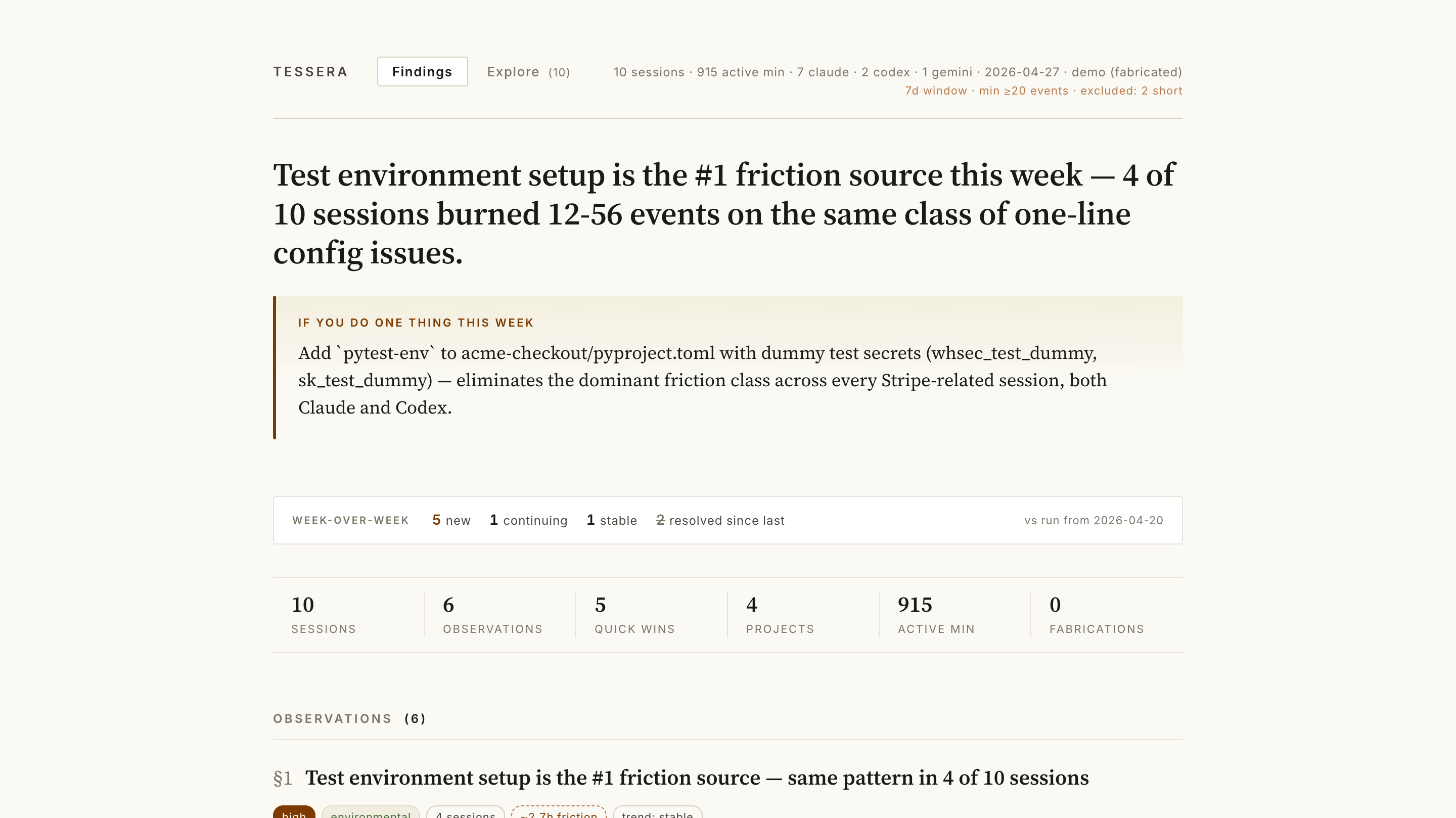
Run one command, open one HTML file. Two views:
Findings — the cross-session synthesis:
Headline: 40+ atella sessions each rediscover python=.venv/bin/python, git-root≠stella-backend/, PYTHONPATH=src — a single CLAUDE.md would eliminate 200+ wasted events/week
If you do one thing this week:
printf '...' >> stella-backend/pyproject.tomlAND createstella-backend/CLAUDE.md: …§3 Missing git fetch before PR diff inflates scope 5-10x high · workflow · 8 sessions · ~46m friction · trend: stable In 6 sessions, diffing a PR against local main without first fetching showed 35-69 files instead of 6-14. Fix: prepend
git fetch origin main &&to the array-pr-review skill.Week-over-week: 4 new · 2 continuing · 1 worsening · 3 resolved since last
Plus quick wins (one-line fixes you can copy with a button), per-project drilldowns, and inline [u]/[w]/[k]/[s] rating buttons that feed the next run's prompt.
Explore — browse all the data:
- Sessions table (sortable, filterable by agent / project / waste signature, click to drill into the full per-session narrative — tasks, friction with quotes, key decisions with retrospectives, dead ends, env issues, deterministic stats)
- All recurring environmental issues across all sessions, sorted by occurrence count
- All counterfactuals + lessons in three columns
- Per-project deep view
Every cited session is verifiable — citations use 4-char ref tokens (S001–S{n}) that map deterministically back to real session_ids. Fabrication rate by design: 0%.
The output is also written as synthesis.json (raw) and synthesis.md (shareable markdown).
How it works
~/.claude/projects/        ─┐
~/.codex/sessions/         ─┤    [1] normalize        [2] per-session             [3] cross-session       [4] dashboard
~/.gemini/tmp/             ─┴──▶ symlink into temp ─▶ narrative (1 LLM call ─▶ synthesis (1 LLM call ─▶ synthesis.html
                                  no copies, no       per session, cached by      on all narratives,         (Findings + Explore,
                                  source mods)        content hash)               ref-token citations)       inline rating)
Two LLM stages, both via your local claude CLI:
- Per-session narrative — each session's compressed event stream (~30-50K tokens) gets one Sonnet 4.6 call producing structured narrative (goal, tasks, friction moments, key decisions, dead ends, recurring env issues, counterfactual). Cached by content hash; re-runs skip unchanged sessions.
- Cross-session synthesis — all narratives compacted to high-signal fields (~150K tokens), one Sonnet 4.6 call producing observations + quick wins + per-project headlines. Validator drops any cited ref not in the input set.
See docs/schema/v1.md for the full per-session schema, docs/ARCHITECTURE.md for module-level flow, and docs/adding-an-agent.md to plug in your own agent CLI (Aider, Cline, Cursor, etc.) as a single Python file in ~/.config/tessera/normalizers/.
Install
Requires Python 3.11+ and at least one of these LLM CLIs authenticated:
claude(Anthropic Claude Code) — default backend, noANTHROPIC_API_KEYneeded; routes through your Claude Code authcodex(OpenAI Codex CLI) — works with ChatGPT subscription authgemini(Google Gemini CLI) — works withgcloud auth
pip install tessera-agents
# or
uv tool install tessera-agents
The PyPI package is
tessera-agents(the bare nametesserawas taken). The CLI binary, slash command, and import are all justtessera.
Pick a backend
Default is Claude. Switch with --backend:
tessera run --backend codex     # uses your `codex exec` for narrate + synthesis
tessera run --backend gemini    # uses `gemini -p`
tessera weekly --backend codex  # the closed loop on a different model
TESSERA_BACKEND=codex tessera run   # or set the env var globally
tessera doctor shows which backends are installed.
Use
First run (do this once)
tessera doctor             # ~2s. checks `claude` CLI, agent trace dirs, gives a cost estimate.
tessera run --lookback-days 30 --min-events 10
# → prompts you to confirm estimated cost before the LLM stage
# → opens synthesis.html when done
A heavy first run (250+ sessions) can hit $10-15. The pre-flight prompt tells you the number before you commit; pass --limit 100 to bound it.
The closed loop: tessera weekly (the main habit)
tessera weekly             # last 7 days, ~5 min cached
# 1. Narrates new sessions + synthesizes patterns
# 2. Evaluates every active experiment from prior weeks:
#    "did the user actually try this? did dead-ends drop?"
# 3. Opens the dashboard
What you do on the dashboard each Monday (~10 min):
- Read the "Last week's experiments" verdicts at top (graduated / not tried / inconclusive)
- Skim "Since last run" deltas (new / escalating / resolved)
- Click
[useful]on 1–3 behavioral patterns you commit to trying this week - Click
SAVE, paste the one-liner — those patterns are now active experiments
Next week, tessera will evaluate whether the patterns you committed to actually moved the needle. This is the self-improving loop: insight → commitment → measured outcome → next insight, every week.
Automate it via launchd (Mondays 9am):
cp launchd/com.tessera.weekly.plist ~/Library/LaunchAgents/
sed -i '' "s|YOUR_USERNAME|$(whoami)|g" ~/Library/LaunchAgents/com.tessera.weekly.plist
launchctl load ~/Library/LaunchAgents/com.tessera.weekly.plist
Auditing the loop
Every recommendation, every rating, every evaluation lands in an append-only logbook at ~/.config/tessera/logbook.jsonl. View it:
tessera logbook --summary           # aggregate stats: acceptance + graduation rate
tessera logbook --event insight.surfaced --tail 20
tessera logbook --json | jq '...'   # programmatic queries
One-off retrospective (the original mode)
tessera run                # last 30 days, ~5min cached / ~50min cold
open synthesis.html        # read findings, drill in, rate inline
After rating: click the floating SAVE button on the dashboard, paste the resulting one-liner in your terminal. Ratings feed the next run's synthesis prompt and the in-session coach (see below).
tessera run --all-time            # full history, no time filter
tessera run --lookback-days 60    # custom window
tessera run --min-events 5        # include shorter sessions (default 20)
In-session real-time nudges (sibling tool)
The tessera-live plugin watches your live sessions for known waste patterns (browser spirals, blind retries, runaway call rates, etc.) and nudges Claude with a short note when one appears. Silent on the happy path. Reads your dashboard ratings to enrich nudges with your validated playbook.
Power-user subcommands
tessera narrate              # per-session extraction only (no synthesis)
tessera synthesize           # synthesis only (reads existing narratives)
tessera synthesize --project atella   # filter to one project
tessera dashboard            # re-render the HTML from existing synthesis + narratives
tessera rate                 # interactive CLI rating (alternative to inline)
tessera rate-import < ratings.json  # apply ratings from dashboard
tessera eval                 # quality metrics (fabrication rate, etc.)
Slash command (inside Claude Code)
/tessera            # 30-day window
/tessera 60         # 60-day window
/tessera all-time   # everything
Common options
--lookback-days N         Window in days. Default 30. Use --all-time for no cap.
--min-events N            Skip sessions with fewer events. Default 20.
--limit N                 Cap to N most-recent sessions. 0 = no limit.
--model NAME              Claude model. Default claude-sonnet-4-6.
--concurrency N           Per-session extraction concurrency. Default 10.
--force                   Bypass narrative cache (still writes).
--output PATH             Where to write synthesis JSON. Default ./synthesis.json.
--narratives-dir DIR      Per-session JSON output dir. Default ./narratives.
--format text|json|markdown   Terminal output format. Default text.
--no-history              Don't read or save to history.
--prior-runs N            How many prior runs to feed back as context. Default 3.
--claude-projects DIR     Override Claude Code projects dir.
--codex-sessions DIR      Override Codex sessions dir.
--gemini-tmp DIR          Override Gemini CLI tmp dir.
Cost
| Scenario | Sessions | Cost (Sonnet 4.6) | Wall clock |
|---|---|---|---|
| Weekly run, cache hits | 50-100 | ~$1-3 | 5-10 min |
| Cold run on a new machine | 50-100 | ~$5-12 | 30-50 min |
| Full historical backfill | 1000-2000 | ~$15-30 (one-time) | 4-6 hours |
| Re-synthesis only (no narrate) | any | ~$0.50 | 5-15 min |
All token usage routes through your claude CLI auth — no separate billing.
What it doesn't do
- Doesn't run continuously. Call it when you want a reflection.
- Doesn't score your work. No leaderboard, no "healthy %."
- Doesn't hallucinate evidence. Every cited ref maps to a real session; fabricated refs are dropped with a visible count in the dashboard's "Fabrications" stat.
- Doesn't classify with keywords. Task types and waste signatures come from LLM judgment grounded in event evidence, validated against a closed vocabulary.
- Doesn't send your data anywhere. Local read of trace files; LLM calls go through your existing auth; output stays on disk.
Privacy
Everything runs locally. Trace files are read from ~/.claude/projects/, ~/.codex/sessions/, and ~/.gemini/tmp/ (or wherever you've configured those agents). The two LLM calls (per-session narrative + cross-session synthesis) route through your existing authenticated claude CLI — no separate API key, no telemetry, no analytics. Cached narratives, synthesis output, and run history live under ~/.cache/tessera/ and ~/.config/tessera/.
The dashboard quotes verbatim text from your sessions — friction moments, error messages, decision rationale. Review before sharing screenshots or synthesis.md — they may contain code snippets, file paths, secrets you typed into prompts, or other content from your sessions.
Repo layout
tessera/
├── .claude-plugin/plugin.json     # Claude Code plugin manifest
├── commands/tessera.md            # /tessera slash command
├── docs/
│   ├── schema/v1.md               # per-session narrative schema spec
│   └── ARCHITECTURE.md            # module-level pipeline overview
├── pyproject.toml                 # publishes tessera to PyPI
├── src/tessera/
│   ├── cli.py                     # `tessera <command>` entry points
│   ├── pipeline.py                # symlink-based normalize orchestrator
│   ├── _normalize_script.py       # cross-agent event schema normalizer
│   ├── history.py                 # ratings + prior-run context store
│   ├── narratives/
│   │   ├── deterministic.py       # event-stream metadata extraction
│   │   ├── compressor.py          # event stream → compact narrative
│   │   ├── extractor.py           # per-session LLM call
│   │   ├── validator.py           # schema validation rules
│   │   ├── cache.py               # per-session content-hash cache
│   │   ├── pipeline.py            # per-session orchestrator
│   │   ├── synthesis.py           # cross-session LLM call + ref-citation validator
│   │   ├── render.py              # text + markdown renderers
│   │   ├── dashboard.py           # interactive HTML dashboard
│   │   └── eval.py                # quality metrics
│   └── coach/                     # in-session hook (separate plugin: ../tessera-live/)
├── tests/                         # pytest
├── CONTRIBUTING.md
├── LICENSE                        # MIT
└── README.md
One repo, three distribution paths. The Claude Code plugin and the pip package share the same source.
Contributing
See CONTRIBUTING.md. The most useful PR is probably a parser for a new agent CLI — drop a normalize_<agent>() function into _normalize_script.py matching the existing event schema, and the entire downstream pipeline (narratives, synthesis, dashboard) works on it for free.
License
MIT — see LICENSE.
Project details
Verified details
These details have been verified by PyPIProject links
GitHub Statistics
Maintainers


Download files
Download the file for your platform. If you're not sure which to choose, learn more about installing packages.
Source Distribution
Built Distribution
Filter files by name, interpreter, ABI, and platform.
If you're not sure about the file name format, learn more about wheel file names.
Copy a direct link to the current filters
File details
Details for the file tessera_agents-0.7.2.tar.gz.
File metadata
- Download URL: tessera_agents-0.7.2.tar.gz
- Upload date:
- Size: 188.0 kB
- Tags: Source
- Uploaded using Trusted Publishing? Yes
- Uploaded via: twine/6.1.0 CPython/3.13.12
File hashes
| Algorithm | Hash digest | |
|---|---|---|
| SHA256 |
a50696f42093231e6b47a690735775fa78bb42ca5e08a460e99b94c6636946b2
|
|
| MD5 |
665cc26f774e09e05aa029845575b164
|
|
| BLAKE2b-256 |
b8cf9f05c40c318883deab9ed96bbf13f9ac0eb53f70d158bca038e1811ee0d9
|
Provenance
The following attestation bundles were made for tessera_agents-0.7.2.tar.gz:
Publisher:
publish.yml on annasba07/tessera
-
Statement:
-
Statement type:
https://in-toto.io/Statement/v1 -
Predicate type:
https://docs.pypi.org/attestations/publish/v1 -
Subject name:
tessera_agents-0.7.2.tar.gz -
Subject digest:
a50696f42093231e6b47a690735775fa78bb42ca5e08a460e99b94c6636946b2 - Sigstore transparency entry: 1799496786
- Sigstore integration time:
-
Permalink:
annasba07/tessera@77bafaf9c379d347ee44a53fe6f861f905032cd3 -
Branch / Tag:
refs/tags/v0.7.2 - Owner: https://github.com/annasba07
-
Access:
public
-
Token Issuer:
https://token.actions.githubusercontent.com -
Runner Environment:
github-hosted -
Publication workflow:
publish.yml@77bafaf9c379d347ee44a53fe6f861f905032cd3 -
Trigger Event:
push
-
Statement type:
File details
Details for the file tessera_agents-0.7.2-py3-none-any.whl.
File metadata
- Download URL: tessera_agents-0.7.2-py3-none-any.whl
- Upload date:
- Size: 169.3 kB
- Tags: Python 3
- Uploaded using Trusted Publishing? Yes
- Uploaded via: twine/6.1.0 CPython/3.13.12
File hashes
| Algorithm | Hash digest | |
|---|---|---|
| SHA256 |
c7f5148cee15c54789cf751a593c5f98627b639d4ed62e80a44b777062345f9f
|
|
| MD5 |
33316ee81611e33d7e73defd220ebeef
|
|
| BLAKE2b-256 |
ad236f71717477c8ebb2f69cad42a98f29c481cb764cb700167b12fe1d4b3ca9
|
Provenance
The following attestation bundles were made for tessera_agents-0.7.2-py3-none-any.whl:
Publisher:
publish.yml on annasba07/tessera
-
Statement:
-
Statement type:
https://in-toto.io/Statement/v1 -
Predicate type:
https://docs.pypi.org/attestations/publish/v1 -
Subject name:
tessera_agents-0.7.2-py3-none-any.whl -
Subject digest:
c7f5148cee15c54789cf751a593c5f98627b639d4ed62e80a44b777062345f9f - Sigstore transparency entry: 1799496992
- Sigstore integration time:
-
Permalink:
annasba07/tessera@77bafaf9c379d347ee44a53fe6f861f905032cd3 -
Branch / Tag:
refs/tags/v0.7.2 - Owner: https://github.com/annasba07
-
Access:
public
-
Token Issuer:
https://token.actions.githubusercontent.com -
Runner Environment:
github-hosted -
Publication workflow:
publish.yml@77bafaf9c379d347ee44a53fe6f861f905032cd3 -
Trigger Event:
push
-
Statement type:






