
Threshold-aware scoring and feature selection under sensitivity-specificity constraints
Verified details
These details have been verified by PyPIProject links
GitHub Statistics
Maintainers

Project description
threshscore


Threshold-aware binary classification scoring for Python.
The Problem
Standard metrics like F1-score or ROC AUC measure overall performance, but they ignore deployment constraints. In medical screening, fraud detection, or any safety-critical application, you need both high sensitivity (catch most cases) and high specificity (limit false alarms) - simultaneously. A classifier with 95% sensitivity and 40% specificity may look fine on F1 yet fail completely in production.
What is missing is a score that tells you directly: does this classifier meet my operating constraints, and by how much?
The Solution: Centering-based Scoring
threshscore introduces a score built around two operating constraints:
s_thr- minimum sensitivity required (e.g. 0.80: detect at least 80% of positives)p_thr- minimum specificity required (e.g. 0.60: correctly reject at least 60% of negatives)
The score has a guaranteed centering property: it equals exactly 0.5 at the target operating point, rises above 0.5 when both constraints are exceeded, and falls below 0.5 when either constraint is missed.
| Score | Meaning |
|---|---|
| 0.5 | classifier is exactly at the target operating point |
| > 0.5 | both constraints are met with margin |
| < 0.5 | at least one constraint is not met |
This makes the score directly interpretable and comparable across classifiers, tasks, and threshold pairs - without needing to look at sensitivity and specificity separately.
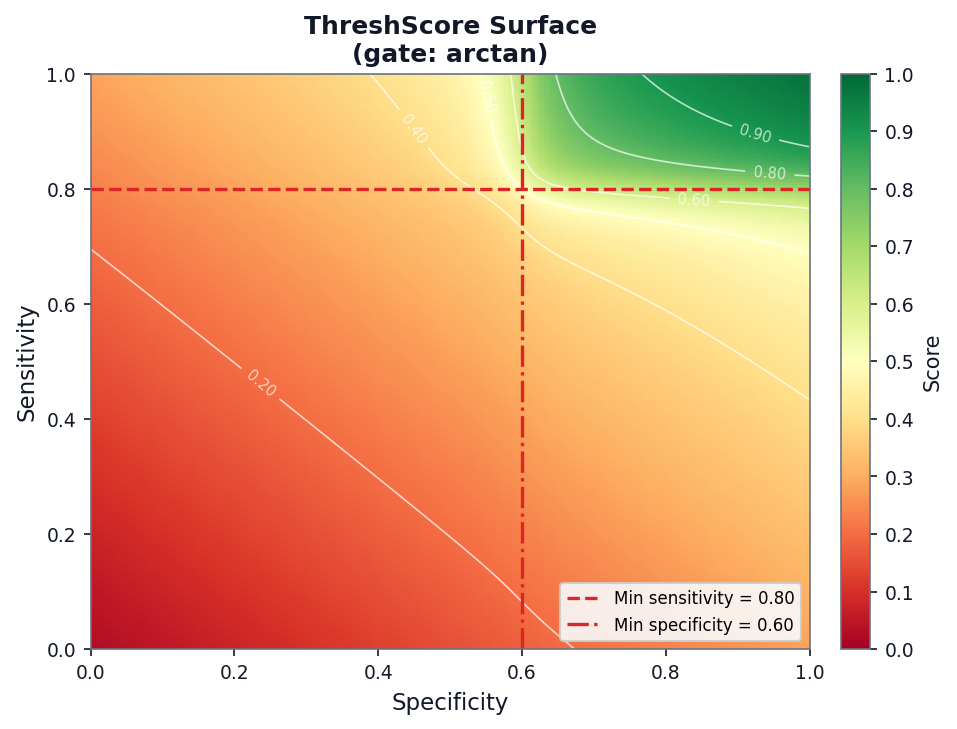
Score surface on the (sensitivity, specificity) plane with s_thr = 0.80, p_thr = 0.60.
Green = both constraints met (score > 0.5); Red = constraints not met (score < 0.5).
The score equals 0.5 exactly at the intersection of the two threshold lines.
Installation
pip install threshscore
Requires Python 3.9+, NumPy, scikit-learn, matplotlib.
Quick Start
import threshscore

# Score from pre-computed metrics (returns a float)
# Constraints: at least 80% sensitivity and 60% specificity

print(threshscore.score_from_metrics(0.80, 0.60, s_thr=0.80, p_thr=0.60))
# 0.5        <- exactly at the operating point

print(threshscore.score_from_metrics(0.90, 0.75, s_thr=0.80, p_thr=0.60))
# ~0.84      <- both constraints exceeded

print(threshscore.score_from_metrics(0.70, 0.50, s_thr=0.80, p_thr=0.60))
# ~0.33      <- constraints not met
import numpy as np
import threshscore

y_true  = np.array([0, 0, 1, 1, 1, 0, 1, 0])
y_score = np.array([0.1, 0.2, 0.8, 0.9, 0.7, 0.3, 0.6, 0.4])
y_pred  = (y_score >= 0.5).astype(int)

# Score from binary predictions (returns a ScoreResult object)
result = threshscore.score_from_predictions(
    y_true, y_pred, s_thr=0.80, p_thr=0.60
)
print(result.score)        # centering-based score
print(result.sensitivity)  # achieved sensitivity
print(result.specificity)  # achieved specificity

# Score from probability scores (binarises at threshold; includes ROC/PR AUC)
result = threshscore.score_from_scores(
    y_true, y_score, threshold=0.5, s_thr=0.80, p_thr=0.60
)

# All standard metrics at once
m = threshscore.compute_metrics(y_true, y_pred, y_score)
print(m.f1, m.roc_auc, m.pr_auc)

# Sweep all decision thresholds and find the best operating point
sweep = threshscore.sweep(y_true, y_score)
best  = sweep.best_by_sensitivity_at_specificity(min_specificity=0.60)

# Plots (all return (Figure, Axes))
fig, ax = threshscore.plot.plot_roc(y_true, y_score)
fig, ax = threshscore.plot.plot_pr(y_true, y_score)
fig, ax = threshscore.plot.plot_threshold(y_true=y_true, y_score=y_score)
fig, ax = threshscore.plot.plot_confusion(m.confusion_matrix)
fig, ax = threshscore.plot.plot_heatmap(
    sensitivity_threshold=0.80, specificity_threshold=0.60
)
fig, ax = threshscore.plot.plot_gate("arctan")
How It Works
Gate functions
The core building block is a gate function: a monotone S-curve anchored so that
g(threshold, threshold) = 0.5. It acts as a soft switch - values well above the
threshold saturate toward 1, values well below saturate toward 0.
Four gate functions are built in:
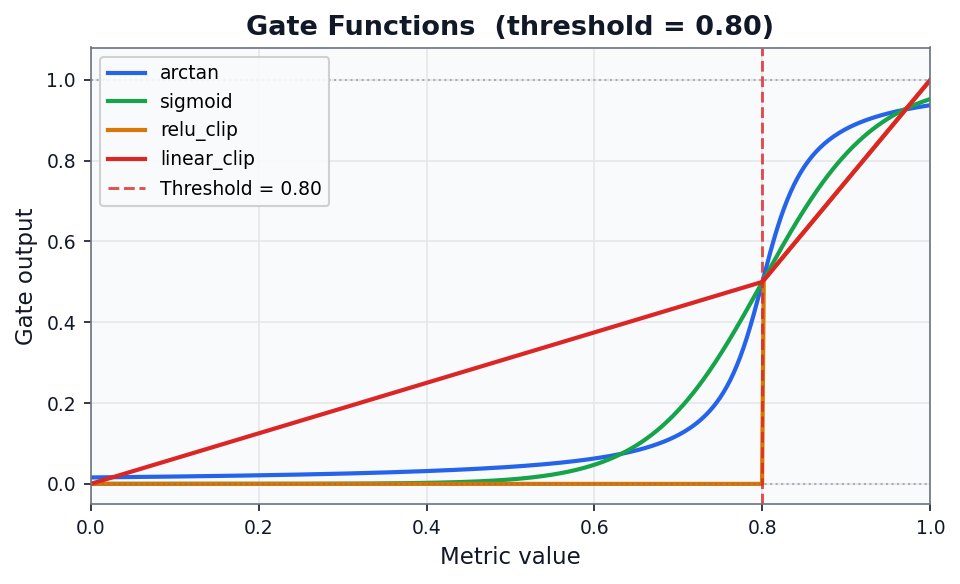
All four built-in gate functions at threshold = 0.80. Every gate returns exactly 0.5 at the threshold, regardless of the threshold value chosen.
| Name | Shape | Key parameter |
|---|---|---|
arctan (default) |
Smooth S-curve | k=25 (steepness) |
sigmoid |
Smooth S-curve | k=15 (steepness) |
relu_clip |
Hard zero below threshold, linear above | - |
linear_clip |
Linear everywhere, anchored at threshold | - |
Sensitivity gate and specificity gate
One gate is applied per constraint. The sensitivity gate g_s maps the observed
sensitivity relative to s_thr; the specificity gate g_p maps the observed
specificity relative to p_thr. Each independently signals whether its constraint is
satisfied, and both are anchored at 0.5 at their respective thresholds.
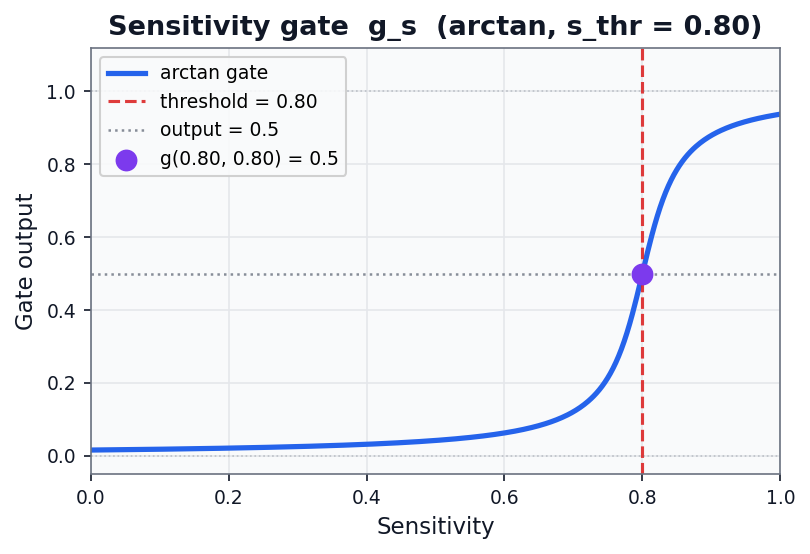
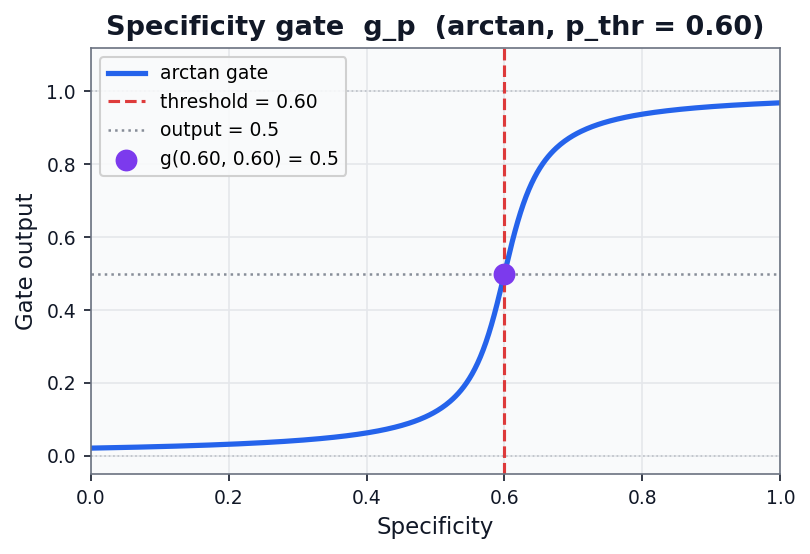
Left: sensitivity gate g_s anchored at s_thr = 0.80. Right: specificity gate g_p anchored at p_thr = 0.60. The purple dot marks the centering point: g = 0.5 at the threshold.
Score formula
The final score combines the two gates with a balanced performance term:
q     = 0.5 * (sens + spec)                           # balanced accuracy
g_s   = 0.5 + (1/pi) * arctan(k * (sens - s_thr))    # sensitivity gate
g_p   = 0.5 + (1/pi) * arctan(k * (spec - p_thr))    # specificity gate
gate  = g_s * g_p                                      # soft-AND of both constraints
score = clip(0.5 + 0.5*(gate - 0.25) + 0.5*(q - q_thr), 0, 1)
where q_thr = 0.5*(s_thr + p_thr).
The gate product g_s * g_p is a soft-AND: it rises above its baseline of 0.25 only
when both constraints are satisfied. This is the key distinction from additive penalty
approaches (like penalized balanced accuracy), which can mask a failing constraint behind
a strong result on the other.
Centering proof: when sens = s_thr and spec = p_thr, both gates equal 0.5, so
gate = 0.25 and q = q_thr, giving score = 0.5 exactly - for any choice of
threshold pair and any gate function.
API Reference
| Entry point | Input | Returns |
|---|---|---|
score_from_metrics(sens, spec, ...) |
Pre-computed sensitivity and specificity | float |
score_from_predictions(y_true, y_pred, ...) |
Binary labels and predictions | ScoreResult |
score_from_scores(y_true, y_score, ...) |
Labels and probability scores | ScoreResult |
compute_metrics(y_true, y_pred, y_score) |
Labels, predictions, scores | Metrics |
sweep(y_true, y_score) |
Labels and probability scores | SweepResult |
ScoreResult exposes: score, sensitivity, specificity, sensitivity_gate,
specificity_gate, gate_name, metrics.
| Feature | Description |
|---|---|
| Centering property | Score = 0.5 at the operating point by construction, for all built-in gates |
| Gate functions | arctan (default), sigmoid, relu_clip, linear_clip: pluggable and configurable |
| Standard metrics | Sensitivity, specificity, precision, recall, F1, accuracy, ROC AUC, PR AUC, confusion matrix |
| Threshold sweep | Evaluate every decision threshold; rank by F1, sensitivity, or specificity constraint |
| 6 plot types | ROC, PR curve, threshold vs. metrics, confusion matrix, score heatmap, gate shape |
| Custom gate functions | Subclass BaseGate and register with one line |
| Type-annotated | Full mypy --strict compliance |
| Well-tested | 188 tests, property-based tests via Hypothesis |
Gate Function Reference
# Use a different built-in gate
result = threshscore.score_from_predictions(
    y_true, y_pred,
    gate="sigmoid",
    gate_params={"k": 20.0},
)

# Visualise all gate shapes
fig, ax = threshscore.plot.plot_gate(threshold=0.8)

# Define and register a custom gate
from threshscore.gates import BaseGate, register

class StepGate(BaseGate):
    @property
    def default_params(self):
        return {}

    def __call__(self, value: float, threshold: float, **params) -> float:
        return 1.0 if value >= threshold else 0.0

register("step", StepGate())
result = threshscore.score_from_predictions(y_true, y_pred, gate="step")
Documentation
Contributing
threshscore is primarily a reproducible research tool accompanying an IEEE publication. Bug reports and questions are welcome via GitHub Issues. For code contributions (new gate functions, fixes), see CONTRIBUTING.md.
License
MIT: see LICENSE.
Project details
Verified details
These details have been verified by PyPIProject links
GitHub Statistics
Maintainers
Release history Release notifications | RSS feed


Download files
Download the file for your platform. If you're not sure which to choose, learn more about installing packages.
Source Distribution
Built Distribution
Filter files by name, interpreter, ABI, and platform.
If you're not sure about the file name format, learn more about wheel file names.
Copy a direct link to the current filters
File details
Details for the file threshscore-0.1.0.tar.gz.
File metadata
- Download URL: threshscore-0.1.0.tar.gz
- Upload date:
- Size: 1.2 MB
- Tags: Source
- Uploaded using Trusted Publishing? Yes
- Uploaded via: twine/6.1.0 CPython/3.13.12
File hashes
| Algorithm | Hash digest | |
|---|---|---|
| SHA256 |
33d0b040f0aeceff26f0c2746e78039b293ffe763ecbebe7ec24aeec86d72d0d
|
|
| MD5 |
83b128e45e1624e2a5e8e13a68597ae7
|
|
| BLAKE2b-256 |
c26e266a0adab9fc8c209b79344bb5f065aa57229829e3e45dde3be2725fd34b
|
Provenance
The following attestation bundles were made for threshscore-0.1.0.tar.gz:
Publisher:
publish.yml on BiomedicalDataMining/threshscore
-
Statement:
-
Statement type:
https://in-toto.io/Statement/v1 -
Predicate type:
https://docs.pypi.org/attestations/publish/v1 -
Subject name:
threshscore-0.1.0.tar.gz -
Subject digest:
33d0b040f0aeceff26f0c2746e78039b293ffe763ecbebe7ec24aeec86d72d0d - Sigstore transparency entry: 1734167490
- Sigstore integration time:
-
Permalink:
BiomedicalDataMining/threshscore@0f0a7d512bdc1406d9797c9eb0980f1d6017dbbb -
Branch / Tag:
refs/tags/v0.1.0 - Owner: https://github.com/BiomedicalDataMining
-
Access:
public
-
Token Issuer:
https://token.actions.githubusercontent.com -
Runner Environment:
github-hosted -
Publication workflow:
publish.yml@0f0a7d512bdc1406d9797c9eb0980f1d6017dbbb -
Trigger Event:
push
-
Statement type:
File details
Details for the file threshscore-0.1.0-py3-none-any.whl.
File metadata
- Download URL: threshscore-0.1.0-py3-none-any.whl
- Upload date:
- Size: 28.8 kB
- Tags: Python 3
- Uploaded using Trusted Publishing? Yes
- Uploaded via: twine/6.1.0 CPython/3.13.12
File hashes
| Algorithm | Hash digest | |
|---|---|---|
| SHA256 |
e0fb30d8190a2868031458e7aa5fecc3bfd0f6cf335c29265ca40f6426008a15
|
|
| MD5 |
cc9e90b62169bf446e2b63c4a6928022
|
|
| BLAKE2b-256 |
0d1acc3507e6fdca680554074298cb311dbb15052d81af1bd2c347d1dcb1b4c5
|
Provenance
The following attestation bundles were made for threshscore-0.1.0-py3-none-any.whl:
Publisher:
publish.yml on BiomedicalDataMining/threshscore
-
Statement:
-
Statement type:
https://in-toto.io/Statement/v1 -
Predicate type:
https://docs.pypi.org/attestations/publish/v1 -
Subject name:
threshscore-0.1.0-py3-none-any.whl -
Subject digest:
e0fb30d8190a2868031458e7aa5fecc3bfd0f6cf335c29265ca40f6426008a15 - Sigstore transparency entry: 1734167528
- Sigstore integration time:
-
Permalink:
BiomedicalDataMining/threshscore@0f0a7d512bdc1406d9797c9eb0980f1d6017dbbb -
Branch / Tag:
refs/tags/v0.1.0 - Owner: https://github.com/BiomedicalDataMining
-
Access:
public
-
Token Issuer:
https://token.actions.githubusercontent.com -
Runner Environment:
github-hosted -
Publication workflow:
publish.yml@0f0a7d512bdc1406d9797c9eb0980f1d6017dbbb -
Trigger Event:
push
-
Statement type:






