
Implements a topological sort algorithm with ability to tolerate existing but disabled nodes

Project description
Tolerant toposort
Tolerant toposort extends the PyPi package toposort to support disabled nodes within the graph
It takes a (directed) dependency graph, and disabled nodes as input,and returns ordered batches of nodes which are independent of disabled nodes
data = {
            2:  {11},
            9:  {11, 8},
            10: {11, 3},
            11: {7, 5},
            8:  {7, 3},
        }
disabled = {5}
toposort(data, disabled)
[{3, 7}, {8}]
Examples
Simple
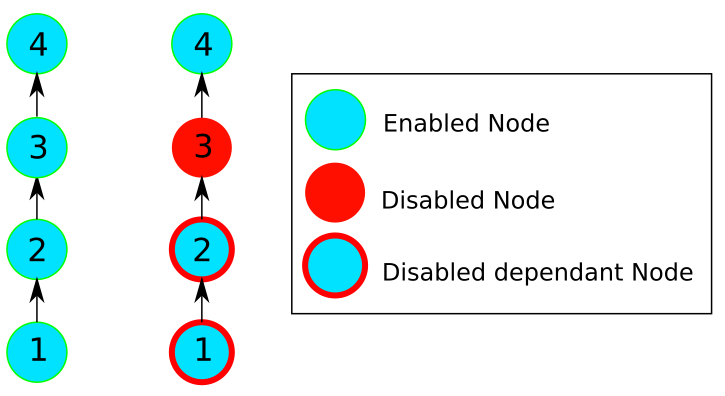
Item 1 depends on Item 2, depends on 3, depends on 4
With Item 3 disabled both 2 and 1 are implicitly disabled.
However, using tolerant toposort, we find we can still process Item 4
data = {
            1:  {2},
            2:  {3},
            3:  {4},
        }
disabled = {3}
result = toposort(data, disabled)
[{4}]
Less Simple
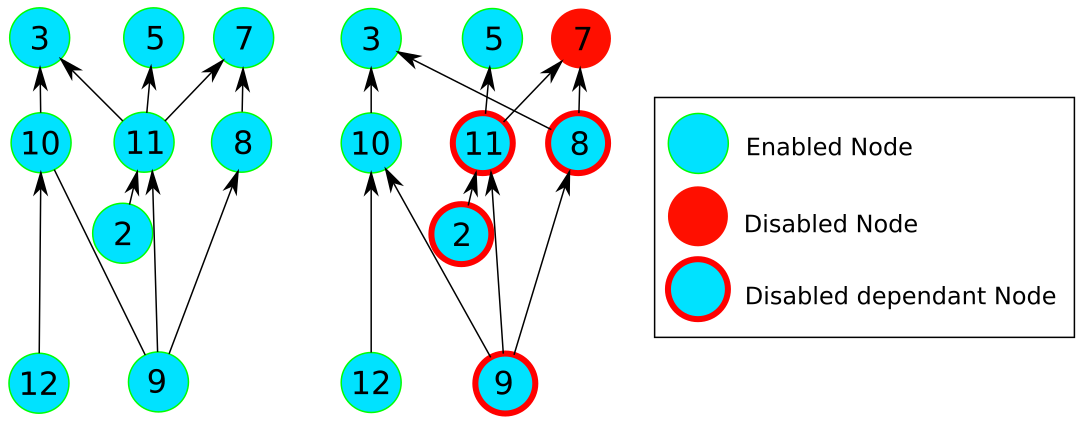
A more complicated graph with Item 7 disabled
Again, using tolerant toposort, we find we can still process Items 3 and 5, then 10, and then 12:
data = {2: {2,11},
        9: {11, 8, 10},
       10: {3},
       11: {7, 5},
        8: {7, 3},
       12: {10},
       }
disabled = {7}
result = toposort(data, disabled)
[{3, 5}, {10}, {12}]
Use Case
The original use case was building packages.
The aim was to process(build) as many nodes(packages) as possible in a tree of nodes:
- Whilst processing, a node might fail to be processed
- Or the node might be known to be failed prior to processing
- If a node was failed then it and its dependants could not be processed
- Fixing, aka re-enabling, nodes took time
- Processing nodes took time
- Processing a node only to find its dependant was failed, took time
- Once a node was processed, it needed no further processing
The main issue was if a node failed ( or was failed prior), then no more nodes could safely be processed, and that switched what should have been concurrent:
- fixing nodes
- processing nodes
into a repetition of process batches,node fails,fix node,process batches,node fails,fix node,process batches...
Requirements for the improvements:
- To have the best handle on the number of disabled nodes (ie attempt to process as many nodes much as possible)
- Concurrently be able to:
- repeatedly process batches, revealing failed nodes as they appear, recalculate batches, continue processing
- Fix failed nodes as they 'appear', removing them from the disabled list as they are supposedly fixed
With tolerant toposort:
- Processing of all independant ( of disabled ) nodes can be attempted
- As disabled nodes are encountered they can be added to the disabled set, and a revised batch set created
- Processing can then continue until all possible nodes have been attempted
- The maximum set of disabled nodes is returned
Typical Usage Foo
Typical Usage Too
from tolerant.toposort import toposort,CircularDependencyError

class ProcessException(Exception):
    def __init__(self,node):
        super(ProcessException, self).__init__('')
        self.node = node

def get_graph():
    """ build and return your graph """
    return {2: {2,11},
            9: {11, 8, 10},
           10: {3},
           11: {7, 5},
            8: {7, 3},
           12: {10},
           13: {12},
           14: {2}
           }

def process(node):
    """
    perform a once-only process on a node.
    return the success of the proceess
    """
    print(f"processing {node}")
    return node != 12;

def main():
    disabled = {9}            # add any known disabled items at start-up
    already_processed = set() # persist this between runs!!
    graph = get_graph()
    while(True):
        print(f"calling toposort")
        batches = toposort(graph,disabled)
        if not batches:
            print(f"batches is empty")
            break
        processedAny = False
        try:
            for batch in batches:
                for node in batch:
                    if node in already_processed:
                       print(f"already processed {node}")
                       continue
                    if process(node):
                        already_processed.add(node)
                        print(f"processed {node}")
                        processedAny= True
                    else:
                        raise ProcessException(node)
            # our work is done ( bar enabling any disabled)
            if not processedAny:
                print(f"no processing so finished")
                break
        except ProcessException as pe:
            # pe.node can now be concurrently 'enabled'
            print(f"disabled {pe.node}")
            disabled.add(pe.node)
    if not disabled:
        # we are done
        pass
main()
API
Module tolerant.toposort
Generates successive batches of dependant items which are enabled and do not depend on disabled items
Based on toposort with these changes:
- toposort and toposort_flatten take an optional set of disabled items. These disabled items, and their dependents, will not be included in the returned batch(es)
Functions
Function toposort
def toposort(
    data,
    disabled=set()
  )
Dependencies are expressed as a dictionary whose keys are items
and whose values are a set of dependent items.
Returns a list of sets in topological order. The first set consists of items with no
dependences, each subsequent set consists of items that depend upon
items in the preceeding sets.
Args
-
data - the dependency graph dependencies are expressed as a dictionary whose keys are items and whose values are a set of dependent items.
-
disabled(optional) - Set of items which, with their dependents, should not be included in the output
Returns
- a list of sets in topological order which are not disabled, or depend on
a disabled item.
The first set consists of items with no dependences, each subsequent set consists of items that depend upon items in the preceeding sets.
Function toposort_flatten
def toposort_flatten(
    data,
    sort=True,
    disabled=set()
  )
Returns a single list of dependencies. For any set returned by toposort(), those items are sorted and appended to the result (just to make the results deterministic).
Args
-
data - the dependency graph dependencies are expressed as a dictionary whose keys are items and whose values are a set of dependent items.
-
sort(True) - should each batch be sorted
-
disabled(optional) - Set of items which, with their dependents, should not be included in the output
Classes
Class CircularDependencyError
class CircularDependencyError(
    data
)
An item eventually depends on itself
NOTE : we tolerate items directly depending on themeselves
Args
- data : the list containing the circular dependency
Testing
 nose2
 python3 setup.py test
Install
sudo python3 setup.py install
Release history Release notifications | RSS feed


Download files
Download the file for your platform. If you're not sure which to choose, learn more about installing packages.
Source Distribution
Built Distribution
Filter files by name, interpreter, ABI, and platform.
If you're not sure about the file name format, learn more about wheel file names.
Copy a direct link to the current filters
File details
Details for the file tolerant_toposort-1.9.1rc5.tar.gz.
File metadata
- Download URL: tolerant_toposort-1.9.1rc5.tar.gz
- Upload date:
- Size: 146.4 kB
- Tags: Source
- Uploaded using Trusted Publishing? No
- Uploaded via: twine/4.0.2 CPython/3.10.10
File hashes
| Algorithm | Hash digest | |
|---|---|---|
| SHA256 |
335a0a89c3a8c3f0955da11d31459963e0d95639074142cfb80f079e8eef8553
|
|
| MD5 |
f9e878f1797b9389e7ca5c1662e7d08b
|
|
| BLAKE2b-256 |
2e873c3bf4a9a029247ff5e0ca25b4b9fd8ed75fe6c50529a70586f163f14f87
|
File details
Details for the file tolerant_toposort-1.9.1rc5-py3-none-any.whl.
File metadata
- Download URL: tolerant_toposort-1.9.1rc5-py3-none-any.whl
- Upload date:
- Size: 10.5 kB
- Tags: Python 3
- Uploaded using Trusted Publishing? No
- Uploaded via: twine/4.0.2 CPython/3.10.10
File hashes
| Algorithm | Hash digest | |
|---|---|---|
| SHA256 |
e74de2cb2b0aa3d7835335166815c18fab4cdaaaff0d475924d59b667e76385c
|
|
| MD5 |
5cb8dbeb3ff8ac2c0b92a04ab8111a42
|
|
| BLAKE2b-256 |
030a63d94559c188b62d34ca6497c3a5ffeed9010e46fab09912110c15ca1820
|






