
This release is a pre-release and may not be stable for production use.
torch-cubic-spline-grids





Cubic spline interpolation on multidimensional grids in PyTorch.
The primary goal of this package is to provide learnable, continuous parametrisations of 1-4D spaces.
Overview
torch_cubic_spline_grids provides a set of PyTorch components called grids.
Grids are defined by
- their dimensionality (1d, 2d, 3d, 4d...)
- the number of points covering each dimension (
resolution) - the number of values stored on each grid point (
n_channels) - how we interpolate between values on grid points
All grids in this package consist of uniformly spaced points covering the full extent of each dimension.
First steps
Let's make a simple 2D grid with one value on each grid point.
import torch
from torch_cubic_spline_grids import CubicBSplineGrid2d

grid = CubicBSplineGrid2d(resolution=(5, 3), n_channels=1)
grid.ndimis2grid.resolutionis(5, 3)(or(h, w))grid.n_channelsis1grid.data.shapeis(1, 5, 3)(or(c, h, w))
In words, the grid extends over two dimensions (h, w) with 5 points
in h and 3 points in w.
There is one value stored at each point on the 2D grid.
The grid data is stored in a tensor of shape (c, *grid_resolution).
We can obtain the value (interpolant) at any continuous point on the grid.
The grid coordinate system extends from [0, 1] along each grid dimension.
The interpolant is obtained by sequential application of
cubic spline interpolation along each dimension of the grid.
coords = torch.rand(size=(10, 2))  # values in [0, 1]
interpolants = grid(coords)
interpolants.shapeis(10, 1)
Optimisation
Values at each grid point can be optimised by minimising a loss function associated with grid interpolants. In this way the continuous space of the grid can be made to more accurately model a 1-4D space.
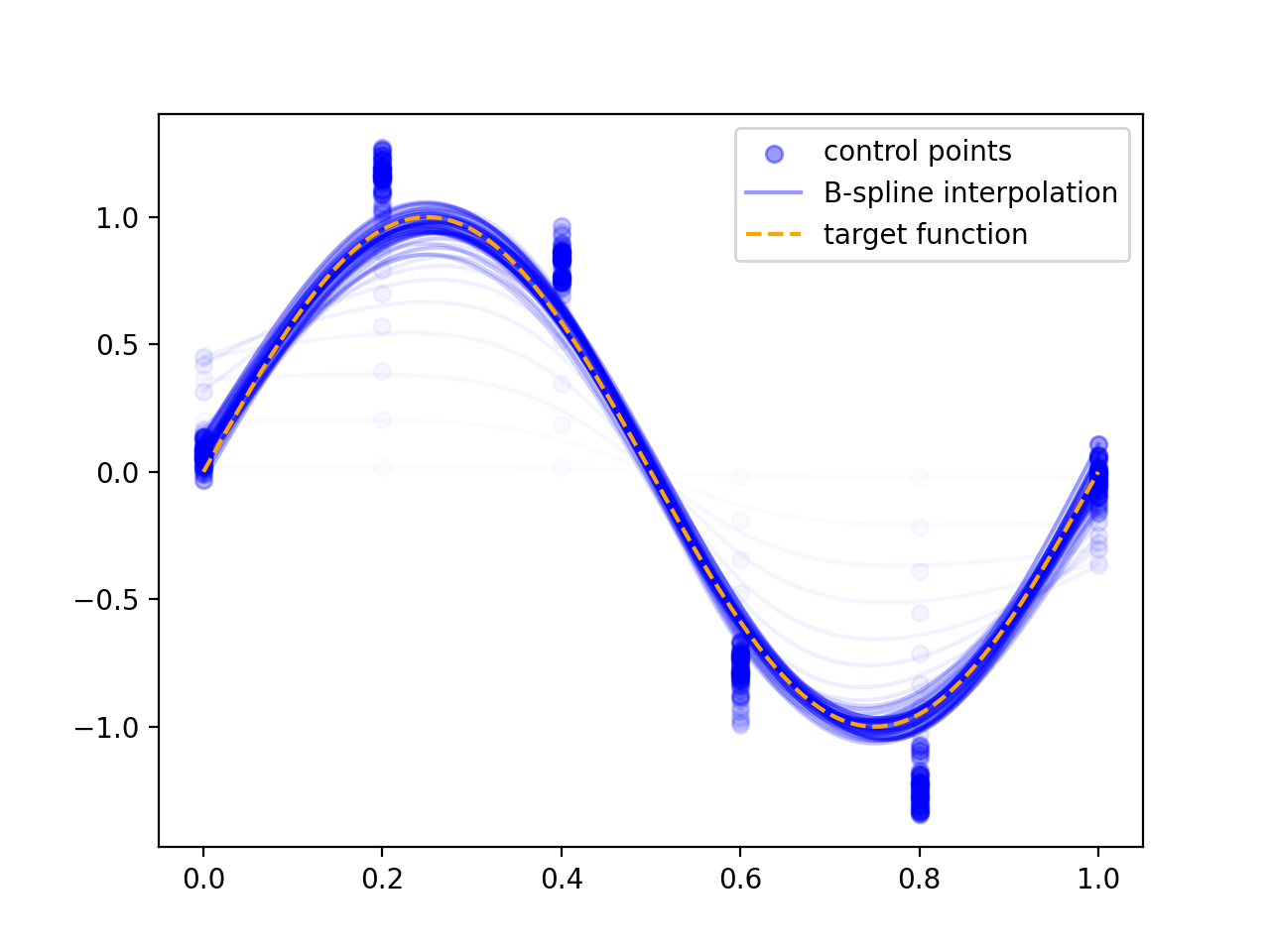
The image above shows the values of 6 control points on a 1D grid being optimised such that interpolating between them with cubic B-spline interpolation approximates a single oscillation of a sine wave.
Notebooks are available for this 1D example and a similar 2D example.
Types of grids
torch_cubic_spline_grids provides grids which can be interpolated with cubic
B-spline interpolation or cubic Catmull-Rom spline interpolation.
| spline | continuity | interpolating? |
|---|---|---|
| cubic B-spline | C2 | No |
| Catmull-Rom spline | C1 | Yes |
If your need the resulting curve to intersect the data on the grid you should use the cubic Catmull-Rom spline grids
CubicCatmullRomGrid1dCubicCatmullRomGrid2dCubicCatmullRomGrid3dCubicCatmullRomGrid4d
If you require continuous second derivatives then the cubic B-spline grids are more suitable.
CubicBSplineGrid1dCubicBSplineGrid2dCubicBSplineGrid3dCubicBSplineGrid4d
Regularisation
The number of points in each dimension should be chosen such that interpolating on the grid can approximate the underlying phenomenon being modelled without overfitting. A low resolution grid provides a regularising effect by smoothing the model.
Installation
torch_cubic_spline_grids is available on PyPI
pip install torch-cubic-spline-grids
Related work
This is a PyTorch implementation of the way Warp models continuous deformation fields and locally variable optical parameters in cryo-EM images. The approach is described in Dimitry Tegunov's paper:
Many methods in Warp are based on a continuous parametrization of 1- to 3-dimensional spaces. This parameterization is achieved by spline interpolation between points on a coarse, uniform grid, which is computationally efficient. A grid extends over the entirety of each dimension that needs to be modeled. The grid resolution is defined by the number of control points in each dimension and is scaled according to physical constraints (for example, the number of frames or pixels) and available signal. The latter provides regularization to prevent overfitting of sparse data with too many parameters. When a parameter described by the grid is retrieved for a point in space (and time), for example for a particle (frame), B-spline interpolation is performed at that point on the grid. To fit a grid’s parameters, in general, a cost function associated with the interpolants at specific positions on the grid is optimized.
For a fantastic introduction to splines I recommend Freya Holmer's YouTube video.
5 maintainers


Metadata
5 maintainers
Release files for torch-cubic-spline-grids 0.6.0rc2
For a detailed explanation of source distributions (sdists) and built distributions (wheels), please see the package formats documentation.
Source distribution (sdist)
| File | Size | Uploaded | |
|---|---|---|---|
| torch_cubic_spline_grids-0.6.0rc2.tar.gz | 148.0 kB | Details |
Built distribution (wheel)
| File | Interpreter | ABI | Platform | Reset |
|---|---|---|---|---|
| torch_cubic_spline_grids-0.6.0rc2-py3-none-any.whl | Python 3 | none | any | Details |
Total release size: 162.9 kB
Release files / torch_cubic_spline_grids-0.6.0rc2.tar.gz
| Download URL | torch_cubic_spline_grids-0.6.0rc2.tar.gz |
|---|---|
| Size | 148.0 kB |
| Tags | Source |
|
SHA-256 checksum How to use checksums |
b9d2beb7ba93f5c03006ff9a8a6e3c3ef86cfe3ed812f9c74d2da11e12f78138
|
|
BLAKE2b-256 checksum How to use checksums |
e90bed74883e60fb9a6784d0ce62f7bb869ad9ec4db517653a3ae9f44d4701c0
|
| Upload date | |
|
Uploaded using Trusted Publishing? What is trusted publishing? |
Yes |
| Uploaded via |
twine/7.0.0 CPython/3.13.14
|
Provenance
Provenance describes where a file came from. On PyPI, provenance is shared via attestations, which provide a verifiable record of the build or publishing details. View details, limitations and caveats.


PyPI Publish Attestation
PyPI verified that this artifact, at this checksum, originated from the publisher listed below.
Signed by GitHub Actions, verified by PyPI on Sep 11, 2026.
Transparency logRelease files / torch_cubic_spline_grids-0.6.0rc2-py3-none-any.whl
| Download URL | torch_cubic_spline_grids-0.6.0rc2-py3-none-any.whl |
|---|---|
| Size | 14.9 kB |
| Tags | Python 3 |
|
SHA-256 checksum How to use checksums |
842e497f23b5514ec634c27ef3cbaff2d656dd197e8c7eb4d79d7ea54d3f2db6
|
|
BLAKE2b-256 checksum How to use checksums |
1b8b87a3385b6bb1d12c0d04a10c751822232e23537c7dfb897b71dd68563efb
|
| Upload date | |
|
Uploaded using Trusted Publishing? What is trusted publishing? |
Yes |
| Uploaded via |
twine/7.0.0 CPython/3.13.14
|
Provenance
Provenance describes where a file came from. On PyPI, provenance is shared via attestations, which provide a verifiable record of the build or publishing details. View details, limitations and caveats.
PyPI Publish Attestation
PyPI verified that this artifact, at this checksum, originated from the publisher listed below.
Signed by GitHub Actions, verified by PyPI on Sep 11, 2026.
Transparency log













