
The single-file graph database: a knowledge graph that lives in one YAML file, queried with full SPARQL 1.1. Built for LLM agents.

Project description


🦕 Live demo — 600 real Freebase facts, click around, run SPARQL in the browser · PyPI
trikedb
The single-file graph database. You query it like a real triple store — full SPARQL 1.1, reads and writes. Underneath, it's one YAML file. Built for LLM agents.
triples:
  - {s: salesflow-crm, p: PROVIDES, o: crm-sync-job}
  - {s: crm-sync-job, p: INGESTS_TO, o: RAW_CRM_CONTACTS, schedule: hourly}
  - {s: LEGACY_DUMP, p: MIGRATED_TO, o: RAW_CRM_CONTACTS, deprecated: true}
That file is the database. No server, no daemon, no cloud deployment. It diffs cleanly in git, survives in a repo next to your code, and — the part trikedb is actually designed around — an LLM agent can Read it directly and reason over your domain without hallucinating entity names.
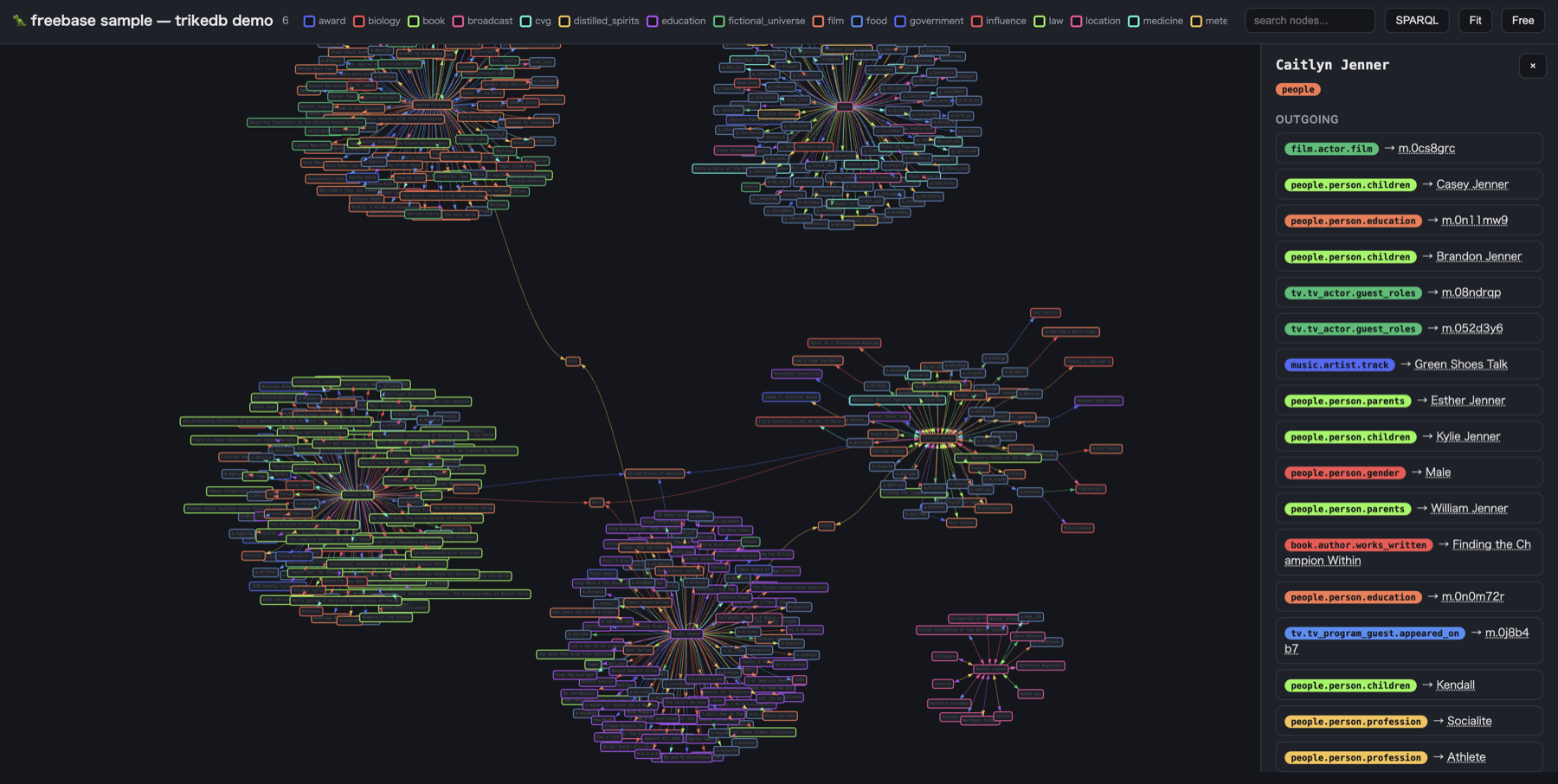
And it renders as an interactive workbench (live demo — 600 real Freebase facts):
Why
RDF graph databases are powerful, correct — and heavy. SPARQL endpoints, OWL reasoners, enterprise semantic layers: great at scale, overkill when what you need is a curated map of a few hundred facts that your AI agents (and teammates) can trust.
trikedb keeps the interface of the big system — real SPARQL 1.1 (rdflib's engine, not a homegrown subset) — and shrinks the machinery down to an embedded library over a file you can read, diff, and commit:
| A full triple-store deployment | trikedb | |
|---|---|---|
| Storage | server / cloud service | one YAML file |
| Query | SPARQL 1.1 | SPARQL 1.1 (same language, rdflib engine) |
| Writes | SPARQL Update | SPARQL Update — persisted back to the YAML |
| Schema | OWL + reasoners | a predicate whitelist, plus SHACL shapes via [shacl] |
| Inference | DL reasoning engines | OWL-RL materialization via [owl] — inferred facts land in the YAML, reviewable |
| Agent integration | a service to operate | the agent reads the file, or trikedb mcp (stdio, embedded) |
| Setup time | an afternoon (or a sprint) | pip install trikedb |
If you need full OWL-DL reasoning at scale, named graphs, and multi-tenant governance, you want a full enterprise semantic platform. If you want a knowledge graph today, in a file, in git — that's trikedb. And because the storage maps cleanly onto RDF, graduating to a bigger system later is an export, not a rewrite: each team keeps its own YAML graph, and stitching them together (or migrating them wholesale) is just merging triples.
Curation-first, not extraction-first
Most "AI knowledge graph" tools use an LLM to extract triples from text. That's great for bootstrapping, but extracted graphs inherit hallucinations. trikedb takes the opposite stance: the graph is curated data (by humans, or by agents you supervise), the ontology constrains what can be said, and LLMs consume the graph rather than invent it. When an agent reads
- {s: crm-sync-job, p: INGESTS_TO, o: RAW_CRM_CONTACTS}
there is no step where a table name can be made up.
Install
From PyPI:
pip install trikedb           # library + CLI
pip install 'trikedb[mcp]'    # + MCP server for AI agents
Quickstart (Python)
from trikedb import TrikeDB

db = TrikeDB("pipeline.yaml", ontology={
    "PROVIDES": "SaaS vendor -> ingestion job",
    "INGESTS_TO": "ingestion job -> warehouse table",
    "MIGRATED_TO": "deprecated table -> its replacement",
})

db.add("salesflow-crm", "PROVIDES", "crm-sync-job")
db.add("crm-sync-job", "INGESTS_TO", "RAW_CRM_CONTACTS", schedule="hourly")
db.add("crm-sync-job", "OWNS", "x")   # OntologyError: predicate not declared

# Pattern matching — None is a wildcard, '*' globs
for t in db.triples(p="INGESTS_TO", o="RAW_*"):
    print(t.s, "->", t.o, t.attrs)

# Multi-pattern queries with variable joins (zero dependencies)
db.query(["?vendor PROVIDES ?job", "?job INGESTS_TO ?table"])
# [{'vendor': 'salesflow-crm', 'job': 'crm-sync-job', 'table': 'RAW_CRM_CONTACTS'}]

# Or real SPARQL 1.1 — FILTER, OPTIONAL, aggregates, the lot.
# Delegated to rdflib, not hand-rolled. The prefix t: is pre-bound.
db.sparql("""
  SELECT ?vendor ?table WHERE {
    ?vendor t:PROVIDES ?job .
    ?job t:INGESTS_TO ?table .
    FILTER(STRSTARTS(STR(?table), "urn:trikedb:RAW_"))
  }
""")
db.sparql("ASK { ?x t:MIGRATED_TO ?y }")  # True

# Writes go through SPARQL too — and land back in the YAML
db.sparql("INSERT DATA { t:figly t:PROVIDES t:figly-export-job }")
db.sparql("DELETE WHERE { ?job t:INGESTS_TO t:LEGACY_CONTACTS_DUMP }")
db.save()  # or pass autosave=True and skip this

db.to_rdflib()               # plain rdflib.Graph, if you want to go further
db.to_html("pipeline.html")  # interactive graph workbench (see demos below)
db.to_jsonld()               # best-effort export for real RDF tooling
Quickstart (CLI)
trikedb add pipeline.yaml salesflow-crm PROVIDES crm-sync-job
trikedb add pipeline.yaml crm-sync-job INGESTS_TO RAW_CRM_CONTACTS -a schedule=hourly

trikedb query pipeline.yaml -w "?vendor PROVIDES ?job" -w "?job INGESTS_TO ?table"
# vendor         job           table
# -------------  ------------  ----------------
# salesflow-crm  crm-sync-job  RAW_CRM_CONTACTS

trikedb sparql pipeline.yaml \
  "SELECT ?v ?t WHERE { ?v t:PROVIDES ?j . ?j t:INGESTS_TO ?t }"

# updates persist straight back to the file
trikedb sparql pipeline.yaml \
  "INSERT DATA { t:figly t:PROVIDES t:figly-export-job }"

trikedb stats pipeline.yaml
trikedb html pipeline.yaml -o pipeline.html
trikedb jsonld pipeline.yaml
Importing from CSV and Markdown docs
The YAML file is the store, but triples can come from wherever your team already writes:
# CSV/TSV with an s,p,o header — extra columns become edge attributes
trikedb import pipeline.yaml new_vendors.csv

# Markdown: every table whose header has s/p/o columns is picked up;
# prose and other tables are ignored. Your design docs are data.
trikedb import pipeline.yaml design_doc.md
<!-- anywhere inside an ordinary design doc: -->
| s                 | p          | o                  | schedule  |
|-------------------|------------|--------------------|-----------|
| clickpath-pa      | PROVIDES   | clickpath-webhook  |           |
| clickpath-webhook | INGESTS_TO | RAW_PRODUCT_EVENTS | streaming |
Imports are deterministic — no LLM extraction, so nothing gets invented. The ontology is enforced on the way in, and "true"/"false" cells become booleans. See examples/acme_design_doc.md and examples/acme_new_vendors.csv.
Validation and inference (SHACL / OWL)
The predicate whitelist is the seatbelt; when you want real schema
validation, use SHACL (pip install 'trikedb[shacl]' — delegated to
pySHACL, not hand-rolled):
conforms, report = db.validate("""
@prefix sh: <http://www.w3.org/ns/shacl#> .
@prefix t:  <urn:trikedb:> .
t:BotShape a sh:NodeShape ;
  sh:targetSubjectsOf t:USES_ROLE ;
  sh:property [ sh:path t:type ; sh:hasValue "bot" ; sh:minCount 1 ] .
""")
trikedb validate graph.yaml shapes.ttl # exit code 1 on violations — CI-friendly
For inference, declare OWL characteristics on your predicates and
materialize what follows (pip install 'trikedb[owl]', OWL-RL via
owlrl):
db.declare("INHERITS", "transitive")     # stored as a reviewable triple
db.add("LEVEL3", "INHERITS", "LEVEL2")
db.add("LEVEL2", "INHERITS", "LEVEL1")
db.infer(apply=True)                     # adds (LEVEL3, INHERITS, LEVEL1) — marked inferred: true
Inference is materialization, not magic: derived facts land in the
YAML tagged inferred: true, so the git diff shows exactly what the
reasoner concluded and a human can review it like any other change.
(For ad-hoc transitivity you often don't need OWL at all — SPARQL
property paths like t:INHERITS+ already walk chains at query time.)
Remote graphs (S3)
The file doesn't have to be local (pip install 'trikedb[remote]'):
db = TrikeDB("s3://team-bucket/kg/pipeline.yaml") # read and write
trikedb sparql s3://team-bucket/kg/pipeline.yaml "SELECT ?s WHERE { ?s ?p ?o } LIMIT 5"
trikedb mcp s3://team-bucket/kg/pipeline.yaml       # whole team's agents share one graph
Auth is delegated to the standard AWS credential chain (env vars,
~/.aws/credentials profiles, SSO, IAM roles) via fsspec/s3fs — trikedb
stores no credentials, and your bucket policy is the access control:
readers get s3:GetObject, writers get s3:PutObject, per-prefix
policies give each team its own graph. gs://, az:// and plain
https:// (read-only) work through the same mechanism with the
matching fsspec backend installed.
Concurrency is last-write-wins in this version — point writers through a single MCP process or CI job, or keep writes in git-reviewed batches.
Workspaces: many graphs, one view
Real teams have more than one graph — finance, data platform, HR. A workspace file unions them:
# workspace.yaml
graphs:
  finance:  finance.yaml
  platform: s3://team-bucket/kg/platform.yaml   # local and remote mix freely
  snowflake: ../infra/ontology/snowflake.yaml
Every command accepts it (trikedb sparql workspace.yaml ...,
trikedb html workspace.yaml, trikedb serve workspace.yaml). In the
HTML view each project tiles into its own cluster with a per-graph
filter bar; every triple carries a graph: attribute naming its source.
The payoff is automatic joins: because RDF triples merge on shared
names, (tanaka, OWNS_BUDGET, PJ240) in finance and
(PJ240, USES, YM71307) in platform become one SPARQL-walkable path —
no foreign keys, no schema negotiation. Unions are read-only views;
each member graph stays owned (and permissioned) by its team, and
writes go to the member file.
Serving a graph (UI + REST + remote MCP)
One process, three doors (pip install 'trikedb[serve]'):
trikedb serve workspace.yaml --port 8080 --token $SECRET
/— the workbench UI, always showing the current graph/sparql— minimal REST:POST {"query": "..."}→ JSON, for apps/mcp— MCP over Streamable HTTP, for agents anywhere:
claude mcp add kg https://kg.internal:8080/mcp --transport http \
  --header "Authorization: Bearer $SECRET"
Same nine MCP tools as stdio — the server definition is shared, only
the transport differs. v1 auth is a single static Bearer token
(OAuth 2.1 delegation to an IdP is the planned v2). Pair it with an
s3:// graph and the server is stateless — run it anywhere.
The file format
A trikedb file is ordinary YAML with three top-level keys (only triples is required):
ontology:            # optional — omit it for free-form predicates
  predicates:
    PROVIDES: "SaaS vendor -> ingestion job"
    AFFECTED_BY: "table -> change event"

nodes:               # optional — free-form node properties
  salesflow-crm: {type: saas, url: "https://salesflow.example", plan: enterprise}
  RAW_CRM_CONTACTS: {type: table, schema: ACME_RAW, pii: true}

triples:
  # compact form for plain facts
  - {s: adastra-ads, p: PROVIDES, o: ads-spend-collector}

  # any extra keys become edge attributes
  - s: RAW_AD_SPEND_DAILY
    p: AFFECTED_BY
    o: "2025-04-01 adastra API v3: spend now in micros (was cents)"
Three conventions worth stealing (see examples/acme_pipeline.yaml):
- Change events as objects.
AFFECTED_BYedges pointing at dated event strings give your graph a memory — "why did this number change in April?" becomes a query. deprecated: trueon edges renders them dashed in the HTML view and lets agents filter dead paths.via:/schedule:attributes carry operational detail without polluting the node set.- Node properties keep growing. That's the RDF promise: attach
type,url,schema, owners — whatever your team needs — without a schema migration.typedrives color grouping in the HTML view, and node properties are queryable in SPARQL (?x t:type "table"). Set them from code withdb.set_node("RAW_CRM_CONTACTS", pii=True).
An ontology layer for AI agents (MCP)
trikedb is embedded, not hosted. For agents, "embedded" means MCP over stdio — the graph runs inside the agent session, no server to operate. Register it with any MCP client:
{
  "mcpServers": {
    "kg": {
      "command": "uvx",
      "args": ["--from", "trikedb[mcp]", "trikedb", "mcp", "/absolute/path/to/graph.yaml"]
    }
  }
}
The agent gets sparql, match, get_node, ontology, stats to read, and add_triple, set_node, remove_triples, import_source to write. Every write autosaves to the YAML — so agent contributions arrive as reviewable git diffs.
This is also the answer to "just throw docs at it": the agent is the extractor, trikedb is the validated write path. Point your agent at a pile of documents and ask it to record the facts; it reads them (any format — it's an LLM), calls add_triple for each fact, and the ontology rejects any predicate it tries to invent. Extraction stays flexible, the graph stays clean, and a human reviews the diff.
Using it with LLM agents (no MCP)
The zero-setup loop:
-
Keep
graph.yamlin your repo, next to the code it describes. -
Tell your agent about it once (in your agent's project instructions / system prompt):
Before any task touching the data pipeline, read
pipeline.yaml. It is the source of truth for which jobs feed which tables. Predicates are limited to the ontology declared in the file. -
Agents propose edits as diffs to the YAML — reviewable in a PR like any other change. The ontology check (
trikedb.addraises on unknown predicates) keeps generated edits inside the vocabulary you chose. -
Humans browse the same graph via
trikedb html.
One source of truth, two projections: YAML for machines, HTML for people.
What trikedb is not
- Not a SPARQL implementation of its own. The SPARQL surface is deliberately not hand-rolled — your YAML is loaded into rdflib and queried/updated by rdflib's battle-tested engine. Mapping rule: subjects/predicates become URIs under
urn:trikedb:; objects with whitespace (change events, notes) become literals. Triples inserted via SPARQL start without edge attributes; surviving triples keep theirs. The lighterquery()/triples()API also exists for quick pattern matching. - Not an extraction pipeline. It won't turn your PDFs into a graph. Pair it with an extractor if you want that — then curate what comes out.
- Not for millions of triples. Everything is in memory and scans are linear. The sweet spot is the hundreds-to-thousands range, where a curated graph is even possible.
Examples
examples/freebase_sample.yaml— real-world data: ~600 facts from the Freebase knowledge graph (CC BY, extracted from the WebQSP benchmark subgraphs) around Tupac Shakur, Agatha Christie, Nikola Tesla and more. Node types are inferred from predicate domains. This powers the live demo.examples/acme_pipeline.yaml— a fictional data platform showing the operational conventions: ontology, deprecations, change events.examples/python_ecosystem.yaml— free-form predicates, no ontology.examples/trikedb_quickstart.ipynb— runnable notebook quickstart with an inline graph.
Live demo: https://ryutoyoda.github.io/trikedb/
The exported HTML is a small workbench, not just a picture: click a node for a right-hand panel with all its properties (URLs become links), search nodes top-right, and open the SPARQL console to run real SPARQL 1.1 in the browser — powered by Oxigraph compiled to WASM, loaded from CDN on first use. Change events render as red diamonds with a timeline bar at the bottom; the initial layout adapts to graph shape (--layout flow|free|auto).
Benchmark
On WebQSP (knowledge-graph QA), the same small LLM answers 60% alone vs 83% with a trikedb graph as context — a +23-point delta under a deterministic, reproducible protocol. Scripts, method, and an honest scoring-sensitivity analysis live in benchmarks/.
Development
Uses uv:
uv sync --extra dev
uv run pytest
License
MIT
Release history Release notifications | RSS feed


Download files
Download the file for your platform. If you're not sure which to choose, learn more about installing packages.
Source Distribution
Built Distribution
Filter files by name, interpreter, ABI, and platform.
If you're not sure about the file name format, learn more about wheel file names.
Copy a direct link to the current filters
File details
Details for the file trikedb-0.11.0.tar.gz.
File metadata
- Download URL: trikedb-0.11.0.tar.gz
- Upload date:
- Size: 45.7 kB
- Tags: Source
- Uploaded using Trusted Publishing? No
- Uploaded via: uv/0.8.5
File hashes
| Algorithm | Hash digest | |
|---|---|---|
| SHA256 |
ddc7e1018362e3bb05a2d66fd962e688dfd664357cc69a7d5a932e993f4a5f8e
|
|
| MD5 |
075b7ea8d1787acaa7a2e8daf02b9ad8
|
|
| BLAKE2b-256 |
539ce26b0436bf0425d676d1f72b40180bd096e16aa67ad11617fd75d65e6eb3
|
File details
Details for the file trikedb-0.11.0-py3-none-any.whl.
File metadata
- Download URL: trikedb-0.11.0-py3-none-any.whl
- Upload date:
- Size: 35.6 kB
- Tags: Python 3
- Uploaded using Trusted Publishing? No
- Uploaded via: uv/0.8.5
File hashes
| Algorithm | Hash digest | |
|---|---|---|
| SHA256 |
86f97ceb568c48b97d53157d21ced39a30e65df3a1fad0f6548e420c23e4f05f
|
|
| MD5 |
311989d3a80ad2edd66764ae72f6ed9f
|
|
| BLAKE2b-256 |
f6a7b1f9581ae60b31ce00dd10e5b2d5376a16912ab4ac786031c5d5dcd234fc
|






