



trikedb
A knowledge graph your agent can read, in one file you can diff.
Your agent already reads your code. What it cannot read is everything that is not in the code: which job feeds which table, who owns what, which of two similar-looking services is the live one. So it guesses, and the guess is a plausible name that does not exist.
trikedb is where you write that down — one YAML file, in the repo, next to the code it describes:
triples:
  - {s: salesflow-crm, p: PROVIDES, o: crm-sync-job}
  - {s: crm-sync-job, p: INGESTS_TO, o: RAW_CRM_CONTACTS, schedule: hourly}
  - {s: LEGACY_DUMP, p: MIGRATED_TO, o: RAW_CRM_CONTACTS, deprecated: true}
That file is the database. No server, no daemon, no deployment. It diffs in git like any other file, a human can read it, and an agent can query it with real SPARQL 1.1 — executed by Oxigraph, not a homegrown subset — or just open the file and read it.
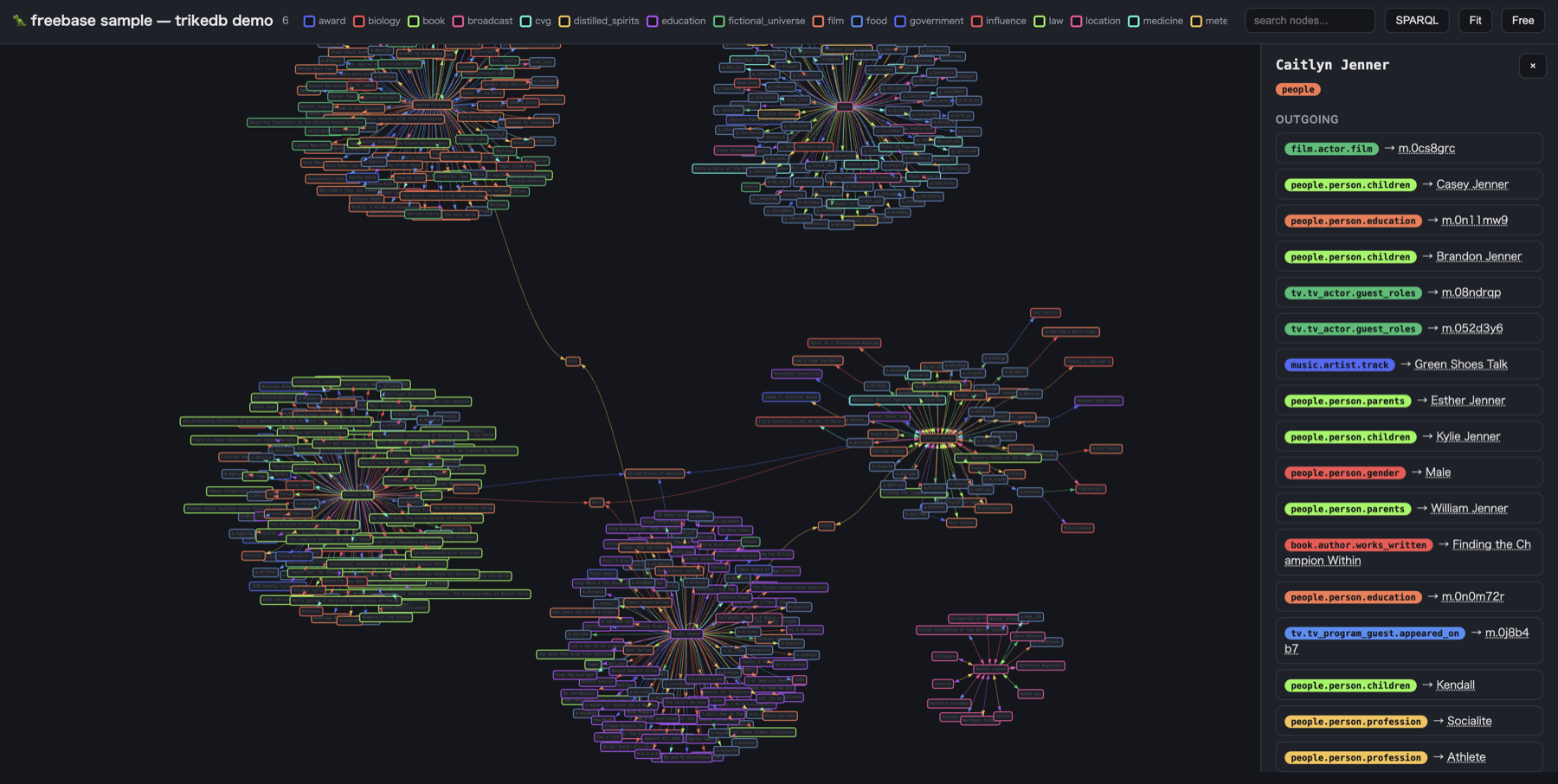
Live demos — a company as five graphs · a data platform with an action log · 600 real facts, filterable, with an in-browser SPARQL console
Install
pip install trikedb          # library + CLI
pip install 'trikedb[mcp]'   # + MCP server, so an agent can use it
pip install 'trikedb[all]'   # + serve, OAuth, SHACL, OWL, semantic search, S3/warehouse graphs
Every optional feature is an extra, so the core stays PyYAML + rdflib + pyoxigraph. The full list is in the reference.
Start with three facts
No schema, no modelling session. Write facts, look at them:
from trikedb import TrikeDB

db = TrikeDB("graph.yaml")               # the file is created on first write
db.add("salesflow-crm", "PROVIDES", "crm-sync-job")
db.add("crm-sync-job", "INGESTS_TO", "RAW_CRM_CONTACTS", schedule="hourly")
db.set_node("RAW_CRM_CONTACTS", type="table", pii=True)

db.query(["?vendor PROVIDES ?job", "?job INGESTS_TO ?table"])
db.to_html("graph.html")                 # a clickable page for your teammates
Or from a blank repo, without writing any Python:
trikedb init graph.yaml --template agent-memory   # a starting graph with a real shape
trikedb add graph.yaml salesflow-crm PROVIDES crm-sync-job
trikedb query graph.yaml -w "?vendor PROVIDES ?job"
trikedb ui graph.yaml                             # open it in a browser
The four you actually need
There are more, but a graph that earns its keep is usually built out of these:
db.add(s, p, o, **attrs) |
state a fact. Any keyword becomes an edge attribute — prov= is the one worth standardizing on, so every fact can be traced back to its source |
db.act(s, p, o, by=…, state=…) |
record something that happened: it is stamped with a time, appended to the node's history, and moves the node to the state it left behind |
db.find(question, where=…) |
the retrieval an agent wants: search by meaning, then filter on exact properties |
db.sparql(query) |
the full query language, when patterns are not enough |
Everything else — inference, SHACL, workspaces, S3 and warehouse storage, the HTTP server — is there when you need it and costs nothing until then. See the reference.
Then lock it down
A graph is only worth reading if it cannot fill up with junk. Declare what may be said, and every write path — yours, the CLI's, an agent's — is held to it. A shape is checked wherever the node's type is known, in either direction:
db = TrikeDB("graph.yaml", ontology={
    "PROVIDES":   "SaaS vendor -> ingestion job",
    "INGESTS_TO": {"description": "ingestion job -> warehouse table",
                   "domain": "job", "range": "table"},
})

db.set_node("crm-sync-job", type="job")
db.set_node("RAW_CRM_CONTACTS", type="table")

db.add("crm-sync-job", "OWNS", "anything")                # OntologyError: undeclared predicate
db.add("RAW_CRM_CONTACTS", "INGESTS_TO", "crm-sync-job")  # OntologyError: written backwards
Actions can declare when they may run and who may sign them — the half a type check cannot reach. An order delivered before it ever shipped breaks no type; a price change approved by nobody is type-correct. Both are refused here:
db.declare_link("DELIVERED_TO", domain="order", range="region",
                requires="SHIPPED_FROM",   # this has to have happened first
                by="courier")              # and this is who may do it

db.act("ORD-25101", "DELIVERED_TO", "Riverside", by="Kai")   # OntologyError: never shipped
Hand it to an agent
Register the graph as an MCP server and the agent gets sixteen tools —
sparql, match, search, find, get_node, history, ontology, stats
to read, add_triple, act, set_node, remove_triples, import_source to
write, and extraction_prompt, preview_triples, add_triples to turn a
document into facts without guessing at the vocabulary:
{
  "mcpServers": {
    "kg": {
      "command": "uvx",
      "args": ["--from", "trikedb[mcp]", "trikedb", "mcp", "/absolute/path/to/graph.yaml"]
    }
  }
}
Writes autosave to the YAML, so an agent's contribution arrives as a reviewable git diff, and the ontology rejects any predicate it tries to invent. That is the answer to "just throw the docs at it": the agent is the extractor, trikedb is the validated write path. Extraction stays flexible; the vocabulary does not.
No MCP client? Then the whole integration is one line in your agent's project
instructions — "before any task touching the pipeline, read graph.yaml" —
and the file does the rest.
Point it at a document
You have a model already. trikedb writes the prompt and judges the answer;
the call in between is yours, so there is no SDK to install and no key to hand
over. The prompt is built from the graph being written into — its declared
predicates, its existing node names — which is why the model does not invent
EMPLOYED_BY beside WORKS_AT, or open a second node for a company already in
the file:
rows = db.extract(open("press-release.md").read(), llm=my_model)

for f in db.preview(rows):          # nothing is written yet
    print(f["verdict"], f["triple"], f["detail"])

# new       Acme BASED_IN Osaka
# new       Sato WORKS_AT Acme
# conflict  Tanaka WORKS_AT Globex
#           └ WORKS_AT is declared functional and Tanaka already holds 'Acme'
llm is any callable taking the prompt and returning text — three lines around
whichever SDK you use, and five of them are written out in
examples/extract_providers.py.
Or skip the API entirely and run the two halves from a shell, with a person or a chat window in the middle:
trikedb extract graph.yaml report.md > prompt.txt   # paste it anywhere
trikedb import graph.yaml answer.md --dry-run       # what it would do
trikedb import graph.yaml answer.md                 # what it did
--dry-run is worth having on its own, and works on any source — CSV, Markdown,
another graph. Every row comes back as new, same, update, rejected or
conflict, with the reason, and nothing is written until you have read them.
A conflict is not a guess: a predicate declared functional may hold one
object per subject, so a second one is a contradiction the graph can prove.
How well does the constrained prompt actually do? Run it and see — the cases, the answer sheets and the scorer are in evals/, along with the unconstrained baseline to compare against. No scores are committed there, because a committed score is one model on one day.
What people put in it
- An agent's memory of your systems. Which warehouse role can read what, which ingestion job is the live one, which repo a change belongs in. None of it is in the code, all of it is what an agent gets wrong.
- A service and ownership map. Who calls whom, who is on call, which of the three similarly named services is deprecated.
- A decision and incident log with preconditions.
act()plusrequiresmeans "deployed" cannot be recorded for something that was never approved — enforced on write, not in a review checklist. - A data governance ledger. PII tables, who may access them, retention.
by:andrequires:are an authorization model that diffs in a pull request.
The common thread: a few hundred to a few thousand facts that somebody curates on purpose. That is the size where a graph is both possible and worth trusting.
Why not just a Markdown file?
Because a Markdown file cannot refuse a bad write, and neither can the agent writing to it. Every fact here passes the same guard — predicate declared, direction right, precondition met — whoever writes it. And once the facts are structured you can ask questions no grep answers: everything two hops from this table, every PII column with no owner, what changed since March.
It also measurably helps the model. On WebQSP
(knowledge-graph QA), the same local model answers 42.7% alone vs 77.7% with a
trikedb graph as context — Hits@1 over 300 questions, paired McNemar p = 9e-20,
0.59 s per question. Method, caveats, and an honest scoring-sensitivity analysis:
benchmarks/.
What trikedb is not
- Not an extraction pipeline. It will not call a model, hold your key, or parse your PDFs. It writes the prompt from your ontology and judges every row against it before the write — the model and the decision stay yours. Extracted graphs inherit hallucinations; this is the part that makes them visible before they land.
- Not for millions of triples. Everything is in memory and scans are linear. Hundreds to thousands is the range where a curated graph is even possible.
- Not its own SPARQL engine. Reads run on Oxigraph, updates and OWL/SHACL on rdflib. Graduating to a full triple store later is an export, not a rewrite.
- Not a replacement for Obsidian if what you want is human notes. This is for facts a machine has to be right about.
Where to go next
- docs/REFERENCE.md — every feature, the file format, and the compatibility and safety contract · 日本語 · 简体中文
- docs/ARCHITECTURE.md — the layering, and where new code goes
- docs/SCALING.md — measured limits at 1k / 10k / 100k triples
- examples/ — the graphs behind the demos, plus a runnable notebook
- evals/ — extraction cases, the scorer, and the baseline to measure against
- CONTRIBUTING.md — how to run the tests and what a good pull request looks like
License
MIT. Copyright (c) 2026 Ryuto Yoda.
Bundled data
One third-party dataset is shipped, and one is not:
- Freebase — the
examples/freebase_*.yamlgraphs are a small extract of the Freebase dump, licensed CC BY 2.5. They are in the repository so the demo pages can be rebuilt from their source. - WebQSP — the benchmark questions and gold answers come from
The Value of Semantic Parse Labeling for KBQA
(Yih et al., 2016), via the
rmanluo/RoG-webqsprepack. No dataset content is committed here:benchmarks/webqsp_bench.py preparedownloads the test split at run time. What is tracked isbenchmarks/*_data.json— the scored results the charts and the number above are read from.
Neither is required to use trikedb.
1 maintainer

Release files for trikedb 0.42.1
For a detailed explanation of source distributions (sdists) and built distributions (wheels), please see the package formats documentation.
Source distribution (sdist)
| File | Size | Uploaded | |
|---|---|---|---|
| trikedb-0.42.1.tar.gz | 581.8 kB | Details |
Built distribution (wheel)
| File | Interpreter | ABI | Platform | Reset |
|---|---|---|---|---|
| trikedb-0.42.1-py3-none-any.whl | Python 3 | none | any | Details |
Total release size: 713.3 kB
Release files / trikedb-0.42.1.tar.gz
| Download URL | trikedb-0.42.1.tar.gz |
|---|---|
| Size | 581.8 kB |
| Tags | Source |
|
SHA-256 checksum How to use checksums |
fad27cec8346d2b58c76e104517be900a2e1f2014177de3dc74b3952721b0126
|
|
BLAKE2b-256 checksum How to use checksums |
7b2a02f099731e6f37b28092b6c4dcbe6fbc55b965509fbd5413ff192733c02f
|
| Upload date | |
|
Uploaded using Trusted Publishing? What is trusted publishing? |
No |
| Uploaded via |
uv/0.12.19 {"installer":{"name":"uv","version":"0.12.19","subcommand":["publish"]},"python":null,"implementation":{"name":null,"version":null},"distro":{"name":"macOS","version":null,"id":null,"libc":null},"system":{"name":null,"release":null},"cpu":null,"openssl_version":null,"setuptools_version":null,"rustc_version":null,"ci":null}
|
Release files / trikedb-0.42.1-py3-none-any.whl
| Download URL | trikedb-0.42.1-py3-none-any.whl |
|---|---|
| Size | 131.5 kB |
| Tags | Python 3 |
|
SHA-256 checksum How to use checksums |
ea80aadf4a6ed94920d9f637c6a260f2a7533e04debfaaa370e9e7405c736223
|
|
BLAKE2b-256 checksum How to use checksums |
b2040b6665677342e844d085dae51462c53b6209056657a9bbc30039be6909a1
|
| Upload date | |
|
Uploaded using Trusted Publishing? What is trusted publishing? |
No |
| Uploaded via |
uv/0.12.19 {"installer":{"name":"uv","version":"0.12.19","subcommand":["publish"]},"python":null,"implementation":{"name":null,"version":null},"distro":{"name":"macOS","version":null,"id":null,"libc":null},"system":{"name":null,"release":null},"cpu":null,"openssl_version":null,"setuptools_version":null,"rustc_version":null,"ci":null}
|














