

TurkicNLP
NLP toolkit for 20+ Turkic languages — a pip-installable Python library inspired by Stanza, with adaptations for the low-resource, morphologically rich Turkic language family.
Maintained by Sherzod Hakimov





Citation
If you use TurkicNLP in your research, please cite:
@misc{hakimov2026turkicnlpnlptoolkit,
      title={TurkicNLP: An NLP Toolkit for Turkic Languages},
      author={Sherzod Hakimov},
      year={2026},
      eprint={2602.19174},
      archivePrefix={arXiv},
      primaryClass={cs.CL},
      url={https://arxiv.org/abs/2602.19174},
}
Arxiv preprint
Code samples
Discord Channel
Datasets & Models
Features
- 24 Turkic languages from Turkish to Sakha, Kazakh to Uyghur
- Script-aware from the ground up — Latin, Cyrillic, Perso-Arabic, Old Turkic Runic
- Automatic script detection and bidirectional transliteration
- Apertium FST morphology for ~20 Turkic languages via Python-native
hfstbindings (no system install) - Stanza/UD integration — pretrained tokenization, POS tagging, lemmatization, dependency parsing, and NER via Stanza models trained on Universal Dependencies treebanks
- NLLB embeddings + translation backend — sentence/document vectors and MT via NLLB-200
- Language identification (
LanguageDetection, GlotLID model) — FastText-based LID with 1,000+ Glottolog language labels - Speech recognition (
SpeechRecognizer) — speech-to-text for 20 Turkic languages via Meta's Omnilingual ASR, with output in TurkicNLP scripts and a speech → text → analysis pipeline - Multilingual Glot500 neural models — POS tagging & dependency parsing (15 languages), morphological analysis & lemmatization (23 languages) via shared Glot500 backbone
- Multiple backends — choose between rule-based, Apertium FST, Stanza, or Glot500 neural backends per processor
- License isolation — library is Apache-2.0; Apertium GPL-3.0 data downloaded separately
- Stanza-compatible API —
Pipeline,Document,Sentence,Word
Installation
Requirements: Python 3.9 – 3.12 (speech recognition: Python 3.10 – 3.12)
TurkicNLP has a small core and optional extras for each group of components:
pip install turkicnlp                    # core — tokenization, rule-based processing, transliteration, CoNLL-U I/O
pip install "turkicnlp[hfst]"           # + Apertium FST morphology (Linux and macOS only)
pip install "turkicnlp[stanza]"         # + Stanza neural models (tokenize, POS, lemma, depparse, NER)
pip install "turkicnlp[lid]"            # + Language detection (GlotLID model; FastText + HF weights)
pip install "turkicnlp[translation]"    # + NLLB embeddings and machine translation
pip install "turkicnlp[transformers]"   # + Glot500 multilingual POS/DepParse/Morph models
pip install "turkicnlp[all]"            # all text components above (Linux and macOS only)
pip install "turkicnlp[asr]"            # + speech recognition (Omnilingual ASR) — see below, use a separate environment
pip install "turkicnlp[dev]"            # development tools (pytest, black, ruff, mypy)
Choosing an environment: text-only vs. speech + text
Speech recognition is built on omnilingual-asr, whose
dependency fairseq2 pins torch==2.8, numpy<2 and huggingface_hub<1, and therefore transformers 4.x.
All other TurkicNLP components also work with these versions, so there are two tested setups:
| Text environment | Speech + text environment | |
|---|---|---|
| Extras | [all] |
[all,asr] |
| Use it for | all text components | speech recognition and all text components |
| Python | 3.9 – 3.12 | 3.10 – 3.12 |
| torch / torchaudio | 2.10 / – | 2.8 / 2.8 |
| numpy | 2.x | 1.26 |
| transformers / huggingface_hub | 5.x / 1.x | 4.57 / 0.36 |
| stanza | 1.11 | 1.11 |
| Exact versions | requirements/lock-text.txt |
requirements/lock-speech.txt |
⚠️ Do not add
[asr]to an existing text environment: it downgrades torch, numpy and huggingface_hub, which breakstransformers5.x. Create a fresh environment instead.
Text environment
python3 -m venv venv
source venv/bin/activate              # Windows: venv\Scripts\activate
pip install --upgrade pip
pip install "turkicnlp[all]"          # from PyPI
# or, from a clone of this repository:
pip install -e ".[all]"
Speech + text environment
System requirements: libsndfile and a C++ compiler with CMake (kenlm, a dependency of omnilingual-asr, is compiled from source).
# macOS
brew install libsndfile cmake
# Ubuntu / Debian
sudo apt-get install libsndfile1 cmake build-essential

python3.10 -m venv venv-asr
source venv-asr/bin/activate
pip install --upgrade pip
pip install "turkicnlp[all,asr]"      # from PyPI (from the first release that includes ASR)
# or, from a clone of this repository:
pip install -e ".[all,asr]"
Reproducing the tested versions
The lock files pin every package of the two tested environments (Python 3.10, macOS arm64):
pip install -r requirements/lock-text.txt   && pip install -e .   # text environment
pip install -r requirements/lock-speech.txt && pip install -e .   # speech + text environment
Version constraints and known issues
- Stanza < 1.12. The custom Azerbaijani, Uzbek, Turkmen, Tatar and Bashkir Stanza models were trained with Stanza 1.11;
Stanza 1.15 fails to load their parsers (
size mismatch for deprel.scorer). The extras enforcestanza>=1.8,<1.12. - sentencepiece is needed to build the Glot500 (XLM-R) tokenizer with
transformers4.x; it is included in the[transformers],[translation]and[all]extras. - torchaudio 2.8.
omnilingual-asrdoes not pin torchaudio; newer versions fail to load against torch 2.8 (Symbol not found: _torch_library_impl). The[asr]extra pinstorchaudio>=2.8,<2.9. kenlmbuild fails on macOS with'climits' file not found. A stale/Library/Developer/CommandLineTools/usr/include/c++/v1left by an old Command Line Tools install shadows the SDK's C++ headers. Either remove it once:sudo mv /Library/Developer/CommandLineTools/usr/include/c++ /Library/Developer/CommandLineTools/usr/include/c++.old
or point the compiler at the SDK headers for the install:export CXXFLAGS="-nostdinc++ -isystem $(xcrun --show-sdk-path)/usr/include/c++/v1" export CMAKE_POLICY_VERSION_MINIMUM=3.5 # kenlm's CMakeLists predates CMake 4 pip install -e ".[all,asr]"
- Memory for speech recognition.
omniASR_LLM_1B(9 GB checkpoint) runs in about 6 GB of RAM with the default low-memory loading (memory-mapped checkpoint, bfloat16 weights). For smaller machines useomniASR_LLM_300Mor a CTC model (omniASR_CTC_300M, 1.3 GB).
Verify the installation
import turkicnlp

# Core (no downloads)
from turkicnlp.scripts import Script
from turkicnlp.scripts.transliterator import Transliterator
print(Transliterator("kaz", Script.CYRILLIC, Script.LATIN).transliterate("Қазақстан"))   # Qazaqstan

# Text components (downloads models on first use)
nlp = turkicnlp.Pipeline("kaz", processors=["tokenize", "pos", "lemma", "depparse"])
doc = nlp("Мен мектепке бардым.")
print([(w.text, w.upos, w.lemma) for w in doc.words])
# [('Мен', 'PRON', 'мен'), ('мектепке', 'NOUN', 'мектеп'), ('бардым', 'VERB', 'бар'), ('.', 'PUNCT', '.')]

# Speech environment only
print(turkicnlp.list_asr_languages(check_model=True))   # {'tur': {'Latn': 'tur_Latn'}, 'aze': {...}, ...}
Platform compatibility
Installation tests run nightly across all combinations of OS, Python version, and install extra (see CI workflow).
| Extra | Ubuntu 22.04 / 24.04 | macOS 14 / 15 | Windows 2025 |
|---|---|---|---|
| base | ✅ 3.9 – 3.12 | ✅ 3.9 – 3.12 | ✅ 3.9 – 3.12 |
[hfst] |
✅ 3.9 – 3.12 | ✅ 3.9 – 3.12 | ❌ not available |
[stanza] |
✅ 3.9 – 3.12 | ✅ 3.9 – 3.12 | ✅ 3.9 – 3.12 |
[lid] |
✅ 3.9 – 3.12 | ✅ 3.9 – 3.12 | ✅ 3.9 – 3.12 |
[transformers] |
✅ 3.9 – 3.12 | ✅ 3.9 – 3.12 | ✅ 3.9 – 3.12 |
[translation] |
✅ 3.9 – 3.12 | ✅ 3.9 – 3.12 | ✅ 3.9 – 3.12 |
[all] |
✅ 3.9 – 3.12 | ✅ 3.9 – 3.12 | ❌ not available |
[asr] |
not yet in CI | ✅ 3.10 (manually tested) | not tested |
Windows users: the
hfstPython package has no published wheels for Python 3.7 or later on Windows — this is an upstream limitation with no current workaround. All features except Apertium FST morphology work normally on Windows; useturkicnlp[stanza]orturkicnlp[translation]instead. If you need Apertium FST morphology on Windows, the recommended approach is Windows Subsystem for Linux (WSL), wherehfstinstalls normally.
Quick Start
import turkicnlp

# Download models for a language
turkicnlp.download("kaz")

# Build a pipeline
nlp = turkicnlp.Pipeline("kaz", processors=["tokenize", "pos", "lemma", "ner", "depparse"])

# Process text
doc = nlp("Мен мектепке бардым")

# Access annotations
for sentence in doc.sentences:
    for word in sentence.words:
        print(f"{word.text}\t{word.lemma}\t{word.upos}\t{word.feats}")

# Export to CoNLL-U
print(doc.to_conllu())
Embeddings (NLLB)
import math
import turkicnlp

turkicnlp.download("tur", processors=["embeddings"])
nlp = turkicnlp.Pipeline("tur", processors=["embeddings"])

doc1 = nlp("Bugün hava çok güzel ve parkta yürüyüş yaptım.")
doc2 = nlp("Parkta yürüyüş yapmak bugün çok keyifliydi çünkü hava güzeldi.")

def cosine_similarity(a, b):
    dot = sum(x * y for x, y in zip(a, b))
    norm_a = math.sqrt(sum(x * x for x in a))
    norm_b = math.sqrt(sum(y * y for y in b))
    return dot / (norm_a * norm_b)

print(len(doc1.embedding), len(doc2.embedding))
print(f"cosine = {cosine_similarity(doc1.embedding, doc2.embedding):.4f}")
print(doc1._processor_log)  # ['embeddings:nllb']
Language ID (LanguageDetection, GlotLID model)
import turkicnlp

lid = turkicnlp.LanguageDetection()  # defaults to all Turkic languages supported by TurkicNLP
labels, probs = lid.predict("salam, hemmelere!", k=3)
print(labels, probs)

# Limit to specific labels
limited = turkicnlp.LanguageDetection(
    languages=[
        "__label__eng_Latn",
        "__label__tur_Latn",
        "__label__kaz_Cyrl",
    ]
)
print(limited.predict("Merhaba dünya!", k=1))
Speech Recognition (Omnilingual ASR)
SpeechRecognizer wraps Meta's Omnilingual ASR models
(omniASR_LLM_1B by default) behind TurkicNLP conventions:
- languages are given as TurkicNLP ISO 639-3 codes (
kaz,uzb, …) and mapped to Omnilingual codes (kaz_Cyrl,uzn_Latn, …); - only the 20 Turkic languages below are accepted; each code is checked against the model's
supported_langs, and non-Turkic languages (eng,rus, …) are rejected; - transcripts are returned in the language's primary TurkicNLP script (or the one you request), using the toolkit's transliterator where the model writes another script;
- recordings longer than the model's 40-second limit are split at pauses and the pieces are transcribed and joined;
- the model is loaded once and shared by all languages; by default it is loaded memory-mapped in bfloat16 (≈ 6 GB RAM).
Requires the speech + text environment. The model weights are downloaded on first use
(9.1 GB for omniASR_LLM_1B) and cached in ~/.cache/fairseq2/assets/.
Transcribe audio files
import turkicnlp

asr = turkicnlp.SpeechRecognizer(
    model_card="omniASR_LLM_1B",   # default; see the model table below
    device="cpu",                  # default: "cuda" if available, else "cpu"
    dtype="bfloat16",              # default ("auto"): bfloat16, or float16 on Apple "mps"
    low_memory=True,               # default: memory-map the checkpoint while loading
)

files = ["asr_samples/kaz_sample.wav", "asr_samples/tur_sample.wav"]
texts = asr.transcribe(files, lang=["kaz", "tur"], batch_size=2)
print(texts)
# ['мен бүгін мектепке бардым алматы қазақстанның ең үлкен қаласы',
#  "bugün hava çok güzel ali dün ankara'ya gitti"]
The interface mirrors Omnilingual ASR's ASRInferencePipeline.transcribe(audio_files, lang=..., batch_size=...);
lang is one code for all inputs or a list with one code per input. A single input returns a string, a list returns a list.
Segments, details and output script
res = asr.transcribe("asr_samples/kaz_sample.wav", lang="kaz", return_details=True)
print(res.lang, res.model_lang, res.script)   # kaz kaz_Cyrl Cyrl
print(res.text)
for seg in res.segments:                      # time-aligned pieces (long audio is split at pauses)
    print(f"[{seg.start:.2f}-{seg.end:.2f}] {seg.text}")

# Ask for another script: Kazakh in the 2021 Latin alphabet
print(asr.transcribe("asr_samples/kaz_sample.wav", lang="kaz", script="Latn"))
# men bügın mektepke bardym almaty qazaqstannyñ eñ ülken qalasy

# The model writes Karakalpak and Crimean Tatar in Cyrillic; TurkicNLP returns their primary Latin script
res = asr.transcribe("kaa_audio.wav", lang="kaa", return_details=True)
print(res.model_text)   # Cyrillic, as produced by the model
print(res.text)         # Latin (2016 Karakalpak alphabet)
Other input types
import soundfile as sf

wav, sr = sf.read("asr_samples/tur_sample.wav")
asr.transcribe(wav, lang="tur", sample_rate=sr)                         # waveform array
asr.transcribe({"waveform": wav, "sample_rate": sr}, lang="tur")        # dict
asr.transcribe(open("asr_samples/tur_sample.wav", "rb").read(), lang="tur")   # encoded bytes

# Hugging Face datasets audio columns work directly
# from datasets import load_dataset
# ds = load_dataset(..., split="test")
# asr.transcribe(list(ds["audio"][:8]), lang="kir", batch_size=4)
Stereo audio is converted to mono and resampled to 16 kHz automatically.
Speech → text → analysis
nlp = turkicnlp.Pipeline(
    "kaz",
    processors=["asr", "tokenize", "pos", "lemma", "depparse"],
    asr_model_card="omniASR_LLM_1B",   # asr_* options configure the recognizer
    asr_device="cpu",                  # also: asr_dtype, asr_batch_size, asr_max_segment_seconds
)
doc = nlp.from_audio("asr_samples/kaz_sample.wav")
print(doc.text)
print(doc.audio_segments)              # [{'start': 0.0, 'end': 4.86, 'text': '...'}]
for w in doc.words:
    print(w.text, w.upos, w.lemma, w.head, w.deprel)
Omnilingual ASR outputs lowercase text without punctuation, so tagging and parsing quality on transcripts can be lower than on edited text.
Command line
python run_asr.py asr_samples/kaz_sample.wav asr_samples/tur_sample.wav --lang kaz tur --device cpu
python run_asr.py lecture.wav --lang tat --model omniASR_LLM_300M      # smaller model
python run_asr.py interview.wav --lang uzb --script Cyrl --analyze      # + tokenize/POS/depparse
asr_samples/ contains two short synthetic test recordings (Kazakh and Turkish).
Models and memory
Any Omnilingual ASR model card can be passed as model_card:
| Model card | Checkpoint | Notes |
|---|---|---|
omniASR_LLM_300M |
6.5 GB | smallest LLM model |
omniASR_LLM_1B (default) |
9.1 GB | ≈ 6 GB RAM with low-memory loading (tested on a 16 GB MacBook) |
omniASR_LLM_3B |
17.5 GB | GPU recommended |
omniASR_LLM_7B |
31.2 GB | best quality; GPU required in practice |
omniASR_CTC_300M / _1B / _3B |
1.3 / 3.9 / 12.3 GB | faster, no language conditioning (the language code is ignored) |
If the process is killed for lack of memory, keep low_memory=True and dtype="bfloat16" (the defaults) or use a smaller model.
dtype="float32" doubles the memory needed.
Supported languages
| Language | Code | Omnilingual code(s) | Output script |
|---|---|---|---|
| Turkish | tur |
tur_Latn |
Latin |
| Azerbaijani | aze |
aze_Latn, aze_Cyrl |
Latin |
| South Azerbaijani | azb |
aze_Arab |
Perso-Arabic |
| Turkmen | tuk |
tuk_Latn |
Latin |
| Gagauz | gag |
gag_Latn |
Latin |
| Kazakh | kaz |
kaz_Cyrl |
Cyrillic (Latin via transliteration) |
| Kyrgyz | kir |
kir_Cyrl |
Cyrillic |
| Tatar | tat |
tat_Cyrl |
Cyrillic (Latin via transliteration) |
| Bashkir | bak |
bak_Cyrl |
Cyrillic |
| Crimean Tatar | crh |
crh_Cyrl |
Latin (transliterated) |
| Karakalpak | kaa |
kaa_Cyrl |
Latin (transliterated) |
| Nogai | nog |
nog_Cyrl |
Cyrillic |
| Kumyk | kum |
kum_Cyrl |
Cyrillic |
| Karachay-Balkar | krc |
krc_Cyrl |
Cyrillic |
| Uzbek | uzb |
uzn_Latn, uzb_Cyrl |
Latin |
| Uyghur | uig |
uig_Arab, uig_Cyrl |
Perso-Arabic |
| Sakha | sah |
sah_Cyrl |
Cyrillic |
| Altai | alt |
alt_Cyrl |
Cyrillic |
| Khakas | kjh |
kjh_Cyrl |
Cyrillic |
| Chuvash | chv |
chv_Cyrl |
Cyrillic |
Not available: Tuvan, Khalaj, Ottoman Turkish and Old Turkic (no Omnilingual language code).
turkicnlp.list_asr_languages(check_model=True) lists the codes supported by the installed model.
Machine Translation (NLLB)
import turkicnlp

# Downloads once into ~/.turkicnlp/models/huggingface/facebook--nllb-200-distilled-600M
turkicnlp.download("tur", processors=["translate"])

nlp = turkicnlp.Pipeline(
    "tur",
    processors=["translate"],
    translate_tgt_lang="eng",
)

doc = nlp("Bugün hava çok güzel ve parkta yürüyüş yaptım.")
print(doc.translation)
print(doc._processor_log)  # ['translate:nllb']
translate_tgt_lang accepts either ISO-639-3 ("eng", "tuk", "kaz") or explicit Flores-200 codes ("eng_Latn", "kaz_Cyrl").
Using the Stanza Backend
from turkicnlp.processors.stanza_backend import (
    StanzaTokenizer, StanzaPOSTagger, StanzaLemmatizer, StanzaNERProcessor, StanzaDepParser
)
from turkicnlp.models.document import Document

# Models are downloaded automatically on first use
doc = Document(text="Merhaba dünya.", lang="tur")

for Proc in [StanzaTokenizer, StanzaPOSTagger, StanzaLemmatizer, StanzaNERProcessor, StanzaDepParser]:
    proc = Proc(lang="tur")
    proc.load()
    doc = proc.process(doc)

for word in doc.words:
    print(f"{word.text:12} {word.upos:6} {word.lemma:12} head={word.head} {word.deprel}")

# Export to CoNLL-U
print(doc.to_conllu())
Mixed Backends
from turkicnlp.processors.tokenizer import RegexTokenizer
from turkicnlp.processors.stanza_backend import StanzaPOSTagger, StanzaNERProcessor, StanzaDepParser
from turkicnlp.models.document import Document

doc = Document(text="Мен мектепке бардым.", lang="kaz")

# Rule-based tokenizer + Stanza POS/parsing (pretokenized mode)
tokenizer = RegexTokenizer(lang="kaz")
tokenizer.load()
doc = tokenizer.process(doc)

pos = StanzaPOSTagger(lang="kaz")
pos.load()
doc = pos.process(doc)

ner = StanzaNERProcessor(lang="kaz")
ner.load()
doc = ner.process(doc)

parser = StanzaDepParser(lang="kaz")
parser.load()
doc = parser.process(doc)
Multi-Script Support
# Kazakh — auto-detects Cyrillic vs Latin
doc = nlp("Мен мектепке бардым")    # Cyrillic
doc = nlp("Men mektepke bardym")     # Latin

# Explicit script selection
nlp_cyrl = turkicnlp.Pipeline("kaz", script="Cyrl")
nlp_latn = turkicnlp.Pipeline("kaz", script="Latn")

# Transliteration bridge — run Cyrillic model on Latin input
nlp = turkicnlp.Pipeline("kaz", script="Latn", transliterate_to="Cyrl")
Uyghur (Perso-Arabic)
nlp_ug = turkicnlp.Pipeline("uig", script="Arab")
doc = nlp_ug("مەن مەكتەپكە باردىم")
Transliteration
The Transliterator class converts text between scripts for any supported language pair:
from turkicnlp.scripts import Script
from turkicnlp.scripts.transliterator import Transliterator

# Kazakh Cyrillic → Latin (2021 official alphabet)
t = Transliterator("kaz", Script.CYRILLIC, Script.LATIN)
print(t.transliterate("Қазақстан Республикасы"))
# → Qazaqstan Respublikasy

# Uzbek Latin → Cyrillic
t = Transliterator("uzb", Script.LATIN, Script.CYRILLIC)
print(t.transliterate("O'zbekiston Respublikasi"))
# → Ўзбекистон Республикаси

# Uyghur Perso-Arabic → Latin (ULY)
t = Transliterator("uig", Script.PERSO_ARABIC, Script.LATIN)
print(t.transliterate("مەكتەپ"))
# → mektep

# Azerbaijani Latin → Cyrillic
t = Transliterator("aze", Script.LATIN, Script.CYRILLIC)
print(t.transliterate("Azərbaycan"))
# → Азәрбайҹан

# Turkmen Latin → Cyrillic
t = Transliterator("tuk", Script.LATIN, Script.CYRILLIC)
print(t.transliterate("Türkmenistan"))
# → Түркменистан

# Tatar Cyrillic → Latin (Zamanälif)
t = Transliterator("tat", Script.CYRILLIC, Script.LATIN)
print(t.transliterate("Татарстан Республикасы"))
# → Tatarstan Respublikası
Common Turkic Script (CTS)
All 21 supported languages can be converted to the Common Turkic Alphabet — a unified (34 letters) Latin-based script designed for cross-language interoperability across the Turkic family. Turkish, which already uses a CTS-compatible alphabet, converts with no changes to most letters:
from turkicnlp.scripts import Script
from turkicnlp.scripts.transliterator import Transliterator

# Turkish Latin → CTS (near-identical alphabets)
t = Transliterator("tur", Script.LATIN, Script.COMMON_TURKIC)
print(t.transliterate("Türkçe güzel bir dil"))
# → Türkçe güzel bir dil

# Other languages gain a shared representation
t = Transliterator("kaz", Script.CYRILLIC, Script.COMMON_TURKIC)
print(t.transliterate("Қазақстан"))
# → Qazaqstan

t = Transliterator("aze", Script.LATIN, Script.COMMON_TURKIC)
print(t.transliterate("Azərbaycan dili"))
# → Azärbaycan dili

t = Transliterator("tuk", Script.LATIN, Script.COMMON_TURKIC)
print(t.transliterate("Türkmen dili baýdyr"))
# → Türkmen dili baydır
Old Turkic Runic Script
TurkicNLP supports transliteration of Old Turkic runic inscriptions (Orkhon-Yenisei script, Unicode block U+10C00–U+10C4F) to Latin:
from turkicnlp.scripts import Script
from turkicnlp.scripts.transliterator import Transliterator

t = Transliterator("otk", Script.OLD_TURKIC_RUNIC, Script.LATIN)

# Individual runic characters
print(t.transliterate("\U00010C34\U00010C07\U00010C2F\U00010C19"))
# → törk  (Türk)

# The transliterator maps each runic character to its standard
# Turkological Latin equivalent, handling both Orkhon and Yenisei
# variant forms (e.g., separate glyphs for consonants with
# back vs. front vowel contexts).
Neural POS Tagger & Dependency Parser (Glot500)
The multilingual Glot500-based model provides UPOS tagging and dependency parsing for 15 Turkic languages (10 trained + 5 zero-shot). Requires pip install "turkicnlp[transformers]".
import turkicnlp

# Download tokenizer + multilingual Glot500 POS/DepParse model
turkicnlp.download("kaz", processors=["tokenize", "pos", "depparse"])

nlp = turkicnlp.Pipeline(
    "kaz",
    processors=["tokenize", "pos", "depparse"],
    pos_backend="multilingual_glot500",
    depparse_backend="multilingual_glot500",
)

doc = nlp("Мен мектепке бардым.")

for sentence in doc.sentences:
    for word in sentence.words:
        print(f"{word.text:12} {word.upos:6} head={word.head} {word.deprel}")
Morpheme Tokenizer (Hybrid Neural + FST)
The MorphemeTokenizer segments inflected Turkic words into labeled surface morphemes. It uses the neural morph model (Glot500) as its primary analyzer, enriched by Apertium HFST transducers and language-specific suffix allomorph tables with phonological rules (vowel harmony, consonant context). Requires pip install "turkicnlp[transformers]".
from turkicnlp.processors.morpheme_tokenizer import MorphemeTokenizer

# --- Kazakh ---
tok = MorphemeTokenizer(lang="kaz")
tok.load()

result = tok.segment("бармадым")
print(result.segments)
# ['бар', 'ма', 'ды', 'м']

print(result.labeled)
# [('бар', 'STEM'), ('ма', 'NEG'), ('ды', 'PST'), ('м', '1SG')]

result = tok.segment("оқығандар")
print(result.labeled)
# [('оқы', 'STEM'), ('ған', 'PTCP.PST'), ('дар', 'PLUR')]

# --- Turkish ---
tok = MorphemeTokenizer(lang="tur")
tok.load()

result = tok.segment("evlerinden")
print(result.labeled)
# [('ev', 'STEM'), ('ler', 'PLUR'), ('in', 'POSS.2SG'), ('den', 'ABL')]

result = tok.segment("gidiyorlar")
print(result.labeled)
# [('gid', 'STEM'), ('iyor', 'PROG'), ('lar', '3PL')]

# Apostrophe boundaries are handled for proper nouns
result = tok.segment("İstanbul'da")
print(result.labeled)
# [('İstanbul', 'STEM'), ("'da", 'LOC')]

# --- Uzbek ---
tok = MorphemeTokenizer(lang="uzb")
tok.load()

result = tok.segment("kitobimdan")
print(result.labeled)
# [('kitob', 'STEM'), ('im', 'POSS.1SG'), ('dan', 'ABL')]

result = tok.segment("bolalarning")
print(result.labeled)
# [('bola', 'STEM'), ('lar', 'PLUR'), ('ning', 'GEN')]
The tokenizer supports all 16 languages with suffix allomorph tables: Turkish, Azerbaijani, Kazakh, Uzbek, Kyrgyz, Tatar, Bashkir, Turkmen, Crimean Tatar, Sakha, Khakas, Tuvan, Altai, Chuvash, Gagauz, and Kumyk.
Neural Morphological Analyzer & Lemmatizer (Glot500)
The multilingual Glot500-based morph model provides UPOS tagging, UD morphological features, and lemmatization for 23 Turkic languages. Requires pip install "turkicnlp[transformers]".
import turkicnlp

# Download tokenizer + multilingual Glot500 morph model
turkicnlp.download("tur", processors=["tokenize", "morph_neural"])

nlp = turkicnlp.Pipeline(
    "tur",
    processors=["tokenize", "morph_neural"],
)

doc = nlp("Çocuklar okula gidiyorlar.")

for sentence in doc.sentences:
    for word in sentence.words:
        print(f"{word.text:20} {word.upos:6} {word.lemma:15} {word.feats}")
Output:
Çocuklar             NOUN   çocuk           Case=Nom|Number=Plur
okula                NOUN   okul            Case=Dat|Number=Sing
gidiyorlar           VERB   gitmek          Aspect=Prog|Mood=Ind|Number=Plur|Person=3|Tense=Pres|VerbForm=Fin
.                    PUNCT  .               _
The morph analyzer also works for low-resource languages:
# Sakha (Yakut) — directly trained
turkicnlp.download("sah", processors=["tokenize", "morph_neural"])
nlp = turkicnlp.Pipeline("sah", processors=["tokenize", "morph_neural"])
doc = nlp("Мин оскуолаҕа бардым.")

# Karakalpak — zero-shot via Uzbek proxy embedding
turkicnlp.download("kaa", processors=["tokenize", "morph_neural"])
nlp = turkicnlp.Pipeline("kaa", processors=["tokenize", "morph_neural"])
doc = nlp("Men mektepke bardım.")
Supported Languages and Components
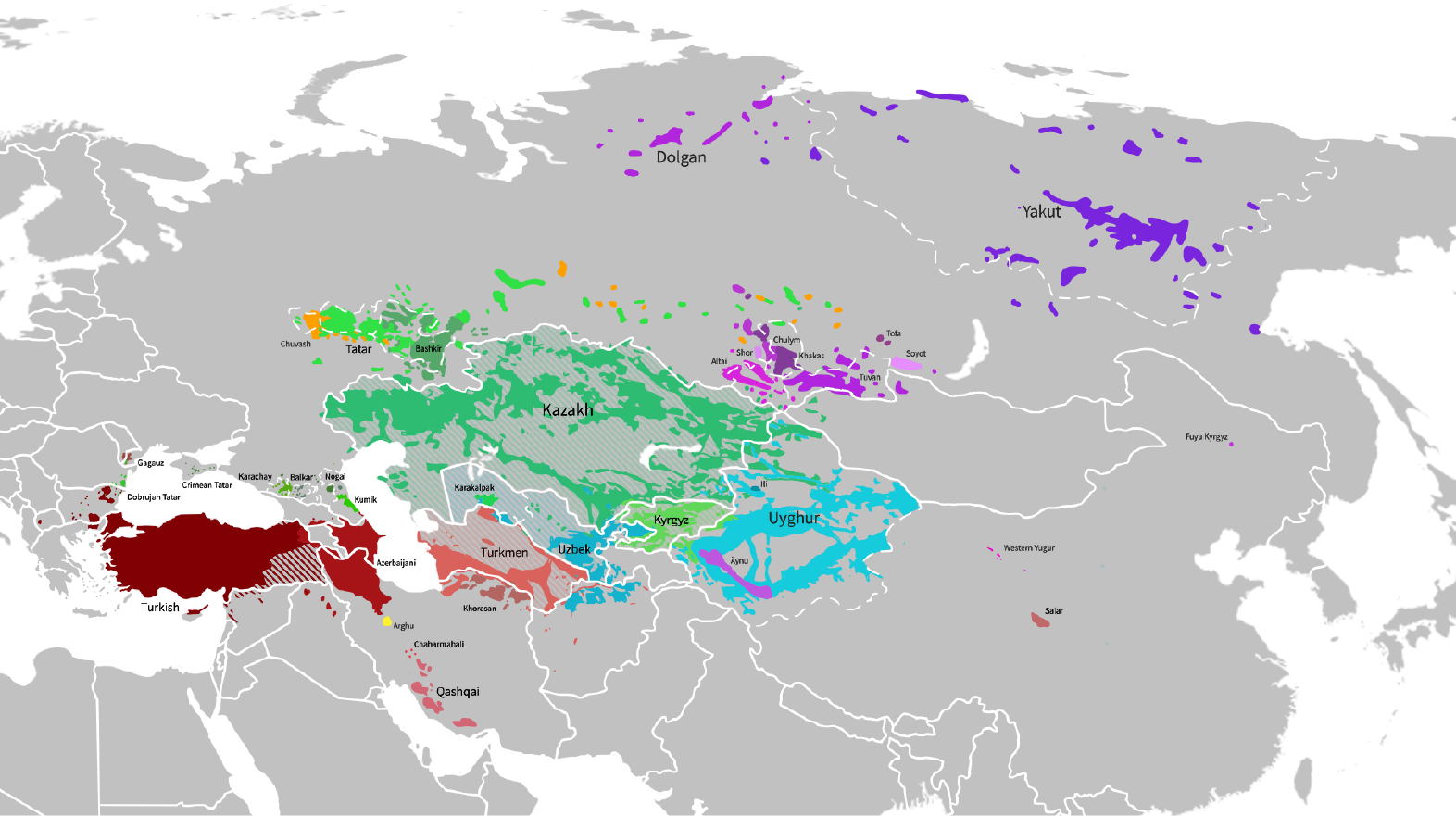
Geographic distribution of Turkic languages (source: Wikimedia Commons)
The table below shows all supported languages with their available scripts and processor status.
Legend:
| Symbol | Backend | Description |
|---|---|---|
| ■ | Rule-based | Regex tokenizer, abbreviation lists |
| ◆ | Apertium FST | Finite-state morphology via hfst (GPL-3.0, downloaded separately) |
| ● | Stanza/UD | Neural models trained on Universal Dependencies treebanks |
| ▲ | Custom Stanza | Custom-trained Stanza models hosted by turkic-nlp |
| ◇ | Glot500 Neural | Multilingual POS tagger & dependency parser (Glot500 backbone, 15 languages) |
| ◈ | Glot500 Neural Morph | Multilingual morphological analyzer & lemmatizer (Glot500 backbone, 23 languages) |
| ★ | NLLB | Embeddings and machine translation via NLLB-200 |
| ○ | Planned | Implementation planned |
| — | Not available yet |
Oghuz Branch
| Language | Code | Script(s) | Tokenize | Morph | POS | Lemma | DepParse | NER | Embed | Translate |
|---|---|---|---|---|---|---|---|---|---|---|
| Turkish | tur |
Latn | ■ ● | ◆ ◈ | ● ◇ | ● ◈ | ● ◇ | ● | ★ | ★ |
| Azerbaijani | aze |
Latn, Cyrl | ■▲ | ◆ ◈ | ▲ ◇ | ▲ ◈ | ▲ ◇ | — | ★ | ★ |
| Iranian Azerbaijani | azb |
Arab | ■ | — | — | — | — | — | ★ | ★ |
| Turkmen | tuk |
Latn, Cyrl | ■▲ | ◆ ◈ | ▲ ◇ | ▲ ◈ | ▲ ◇ | — | ★ | ★ |
| Gagauz | gag |
Latn | ■ | ◆ ◈ | ◈ | ◈ | — | — | — | — |
Kipchak Branch
| Language | Code | Script(s) | Tokenize | Morph | POS | Lemma | DepParse | NER | Embed | Translate |
|---|---|---|---|---|---|---|---|---|---|---|
| Kazakh | kaz |
Cyrl, Latn | ■ ● | ◆ ◈ | ● ◇ | ● ◈ | ● ◇ | ● | ★ | ★ |
| Kyrgyz | kir |
Cyrl | ■ ● | ◆ ◈ | ● ◇ | ● ◈ | ● ◇ | — | ★ | ★ |
| Tatar | tat |
Cyrl, Latn | ■▲ | ◆ ◈ | ▲ ◇ | ▲ ◈ | ▲ ◇ | — | ★ | ★ |
| Bashkir | bak |
Cyrl | ■▲ | ◆ ◈ | ▲ ◇ | ▲ ◈ | ▲ ◇ | — | ★ | ★ |
| Crimean Tatar | crh |
Latn, Cyrl | ■ | ◆ ◈ | ◈ | ◈ | — | — | ★ | ★ |
| Karakalpak | kaa |
Latn, Cyrl | ■ | ◆ ◈ | ◇ ◈ | ◈ | ◇ | — | — | — |
| Nogai | nog |
Cyrl | ■ | ◆ ◈ | ◇ ◈ | ◈ | ◇ | — | — | — |
| Kumyk | kum |
Cyrl | ■ | ◆ ◈ | ◇ ◈ | ◈ | ◇ | — | — | — |
| Karachay-Balkar | krc |
Cyrl | ■ | ◆ ◈ | ◇ ◈ | ◈ | ◇ | — | — | — |
Karluk Branch
| Language | Code | Script(s) | Tokenize | Morph | POS | Lemma | DepParse | NER | Embed | Translate |
|---|---|---|---|---|---|---|---|---|---|---|
| Uzbek | uzb |
Latn, Cyrl | ■ ▲ | ◆ ◈ | ▲ ◇ | ▲ ◈ | ▲ ◇ | — | ★ | ★ |
| Uyghur | uig |
Arab, Latn | ■ ● | ◆ ◈ | ● ◇ | ● ◈ | ● ◇ | — | ★ | ★ |
Siberian Branch
| Language | Code | Script(s) | Tokenize | Morph | POS | Lemma | DepParse | NER | Embed | Translate |
|---|---|---|---|---|---|---|---|---|---|---|
| Sakha (Yakut) | sah |
Cyrl | ■ | ◆ ◈ | ◇ ◈ | ◈ | ◇ | — | — | — |
| Altai | alt |
Cyrl | ■ | ◆ ◈ | ◈ | ◈ | — | — | — | — |
| Tuvan | tyv |
Cyrl | ■ | ◆ ◈ | ◈ | ◈ | — | — | — | — |
| Khakas | kjh |
Cyrl | ■ | ◆ ◈ | ◈ | ◈ | — | — | — | — |
Oghur Branch
| Language | Code | Script(s) | Tokenize | Morph | POS | Lemma | DepParse | NER | Embed | Translate |
|---|---|---|---|---|---|---|---|---|---|---|
| Chuvash | chv |
Cyrl | ■ | ◆ ◈ | ◈ | ◈ | — | — | — | — |
Arghu Branch
| Language | Code | Script(s) | Tokenize | Morph | POS | Lemma | DepParse | NER | Embed | Translate |
|---|---|---|---|---|---|---|---|---|---|---|
| Khalaj | klj |
Latn | ■ | ◈ | ◈ | ◈ | — | — | — | — |
Historical Languages
| Language | Code | Script(s) | Tokenize | Morph | POS | Lemma | DepParse | NER | Embed | Translate |
|---|---|---|---|---|---|---|---|---|---|---|
| Ottoman Turkish | ota |
Arab, Latn | ■ | ◈ | ◇ ◈ | ◈ | ◇ | — | — | — |
| Old Turkic | otk |
Orkh, Latn | ■ | — | — | — | — | — | — | — |
Stanza/UD Model Details
The Stanza backend provides neural models trained on Universal Dependencies treebanks. Official Stanza models (●) are downloaded via Stanza's model hub. Custom-trained models (▲) are hosted at turkic-nlp/trained-stanza-models and downloaded automatically.
| Language | Stanza Code | Type | UD Treebank(s) | Stanza Processors | NER Dataset |
|---|---|---|---|---|---|
| Turkish | tr |
● | IMST (default), BOUN, FrameNet, KeNet, ATIS, Penn, Tourism | tokenize, pos, lemma, depparse, ner | Starlang NER |
| Kazakh | kk |
● | KTB | tokenize, pos, lemma, depparse, ner | KazNERD |
| Uyghur | ug |
● | UDT | tokenize, pos, lemma, depparse | — |
| Kyrgyz | ky |
● | KTMU | tokenize, pos, lemma, depparse | — |
| Uzbek | uz |
▲ | UzUDT | tokenize, pos, lemma, depparse | — |
| Turkmen | tk |
▲ | Tk-TUD | tokenize, pos, lemma, depparse | — |
| Azerbaijani | az |
▲ | Az-TUD | tokenize, pos, lemma, depparse | — |
| Tatar | ta |
▲ | Ta-TUD | tokenize, pos, lemma, depparse | — |
| Bashkir | ba |
▲ | Ba-TUD | tokenize, pos, lemma, depparse | — |
Multilingual Glot500 Neural Models
TurkicNLP provides two multilingual neural models built on a frozen Glot500 backbone with script adapters, language embeddings, and shared BiLSTM layers. Both models are hosted at turkic-nlp/trained-stanza-models and downloaded automatically.
| Model | Symbol | Tasks | Languages | Architecture |
|---|---|---|---|---|
| POS & DepParser | ◇ | UPOS, dependency parsing | 10 trained + 5 zero-shot (15 total) | Glot500 → ScriptAdapter → LangEmbed → BiLSTM → POS Head + Biaffine Parser |
| Morph Analyzer | ◈ | UPOS, UD morph features, lemmatization | 20 trained + 3 zero-shot (23 total) | Glot500 → ScriptAdapter → LangEmbed → BiLSTM → POS Head + MorphFeat Head + CharCNN LemmaHead |
POS & DepParser supported languages: Turkish, Azerbaijani, Uzbek, Turkmen, Kazakh, Kyrgyz, Bashkir, Tatar, Uyghur, Ottoman Turkish + zero-shot: Karakalpak, Kumyk, Sakha, Karachay-Balkar, Nogai
Morph Analyzer supported languages: Turkish, Azerbaijani, Uzbek, Turkmen, Kazakh, Kyrgyz, Bashkir, Tatar, Uyghur, Ottoman Turkish, Crimean Tatar, Khakas, Sakha, Tuvan, Chuvash, Gagauz, Kumyk, Southern Altai, Khalaj, Northern Altai + zero-shot: Karakalpak, Karachay-Balkar, Nogai
Transliteration Support
Bidirectional script conversion is available for all multi-script languages. The transliterator uses a greedy longest-match algorithm with per-language mapping tables.
| Language | Direction | Scripts | Standard |
|---|---|---|---|
| Kazakh | ↔ Bidirectional | Cyrillic ↔ Latin | 2021 official Latin alphabet |
| Uzbek | ↔ Bidirectional | Cyrillic ↔ Latin | 1995 official Latin alphabet |
| Azerbaijani | ↔ Bidirectional | Cyrillic ↔ Latin | 1991 official Latin alphabet |
| Tatar | ↔ Bidirectional | Cyrillic ↔ Latin | Zamanälif |
| Turkmen | ↔ Bidirectional | Cyrillic ↔ Latin | 1993 official Latin alphabet |
| Karakalpak | ↔ Bidirectional | Cyrillic ↔ Latin | 2016 Latin alphabet |
| Crimean Tatar | ↔ Bidirectional | Cyrillic ↔ Latin | Standard Crimean Tatar Latin |
| Uyghur | ↔ Bidirectional | Perso-Arabic ↔ Latin | Uyghur Latin Yéziqi (ULY) |
| Ottoman Turkish | → One-way | Latin → Perso-Arabic | Academic transcription |
| Old Turkic | → One-way | Runic → Latin | Turkological convention |
Apertium FST Quality Levels
| Level | Description | Languages |
|---|---|---|
| Production | >90% coverage on news text | Turkish, Kazakh, Tatar |
| Stable | Good coverage, actively maintained | Azerbaijani, Kyrgyz, Uzbek |
| Beta | Reasonable coverage, some gaps | Turkmen, Bashkir, Uyghur, Crimean Tatar, Chuvash |
| Prototype | Limited coverage, experimental | Gagauz, Sakha, Karakalpak, Nogai, Kumyk, Karachay-Balkar, Altai, Tuvan, Khakas |
Model Catalog and Apertium Downloads
TurkicNLP uses a model catalog to define download sources per language/script/processor. The catalog lives in:
turkicnlp/resources/catalog.json(packaged default)- Remote override:
ModelRegistry.CATALOG_URL(orTURKICNLP_CATALOG_URL)
For each language, the catalog stores the Apertium source repo and the expected FST script. When turkicnlp.download() is called, it reads the catalog and downloads precompiled .hfst binaries from the url fields. If a language has no URL configured, download will fail with a clear error until the catalog is populated with hosted binaries (for example, a turkic-nlp/apertium-data releases repository).
Download folder
All models and resources are downloaded into this folder: ~/.turkicnlp.
Architecture
TurkicNLP follows Stanza's modular pipeline design:
Pipeline("tur", processors=["tokenize", "morph", "pos", "ner", "depparse"])
    │
    ▼
  Document ─── text: "Ben okula vardım"
    │
    ├── script_detect    → script = "Latn"
    ├── tokenize         → sentences, tokens, words
    ├── morph (Apertium) → lemma, pos, feats (via HFST)
    ├── pos (neural)     → refined UPOS, XPOS, feats
    ├── ner (neural)     → BIO tags and entity spans
    └── depparse         → head, deprel
    │
    ▼
  Document ─── annotated with all layers
Pipeline("sah", processors=["tokenize", "morph_neural"])
    │
    ▼
  Document ─── text: "Мин оскуолаҕа бардым"
    │
    ├── script_detect          → script = "Cyrl"
    ├── tokenize               → sentences, tokens, words
    └── morph_neural (Glot500) → upos, feats, lemma
    │
    ▼
  Document ─── annotated with morphological analysis
Pipeline("azb", processors=["embeddings", "translate"], translate_tgt_lang="eng")
    │
    ▼
  Document ─── text: "من کتاب اوخویورام"
    │
    ├── script_detect          → script = "Arab"
    ├── embeddings (NLLB)      → sentence/document vectors
    └── translate (NLLB)       → sentence/document translation
           (src resolved from FLORES map: azb -> azb_Arab,
            tgt resolved from ISO-3: eng -> eng_Latn)
    │
    ▼
  Document ─── annotated with all layers
Key Abstractions
- Document → Sentence → Token → Word hierarchy (maps to CoNLL-U)
- Processor ABC with
PROVIDES,REQUIRES,NAMEclass attributes - Pipeline orchestrator with dependency resolution and script-aware model loading
- ProcessorRegistry for pluggable backends (rule, Apertium, Stanza, Glot500, NLLB)
- ModelRegistry with remote catalog and local caching at
~/.turkicnlp/models/ - NLLB FLORES language map for ISO-3 to NLLB code resolution in translation (e.g.
tuk->tuk_Latn)
Model Storage Layout
~/.turkicnlp/models/
├── kaz/
│   ├── Cyrl/
│   │   ├── tokenize/rule/
│   │   ├── morph/apertium/    ← GPL-3.0 (downloaded separately)
│   │   │   ├── kaz.automorf.hfst
│   │   │   ├── LICENSE
│   │   │   └── metadata.json
│   │   ├── pos/neural/
│   │   └── depparse/neural/
│   └── Latn/
│       └── tokenize/rule/
├── tur/
│   └── Latn/
│       └── ...
├── multilingual/
│   ├── multilingual_glot500.pt           ← POS/DepParse checkpoint
│   └── multilingual_morph_glot500.pt     ← Morph analyzer checkpoint
├── huggingface/
│   ├── cis-lmu--glot500-base/            ← Shared Glot500 backbone
│   │   ├── config.json
│   │   ├── model.safetensors
│   │   └── ...
│   └── facebook--nllb-200-distilled-600M/
│       ├── config.json
│       ├── model.safetensors (or pytorch_model.bin)
│       ├── tokenizer.json
│       └── ...
└── catalog.json

# Stanza models are managed by Stanza at ~/stanza_resources/
Notes:
- Omnilingual ASR checkpoints are managed by fairseq2 and cached in
~/.cache/fairseq2/assets/. - NLLB embeddings and translation use a shared Hugging Face model under
~/.turkicnlp/models/huggingface/. - The NLLB model is downloaded once and reused across supported Turkic languages.
- The Glot500 backbone is shared between the POS/DepParse and Morph analyzer models under
~/.turkicnlp/models/huggingface/. - Unlike Apertium/Stanza components, NLLB and Glot500 artifacts are not duplicated per language/script directory.
License
- Library code: Apache License 2.0
- Stanza models: Apache License 2.0 — managed by Stanza's own download mechanism
- Apertium FST data: GPL-3.0 — downloaded separately at runtime, never bundled in the pip package
- Omnilingual ASR models and code: Apache License 2.0 — downloaded by fairseq2 at runtime
- NLLB-200 model weights/tokenizer: CC-BY-NC-4.0 — downloaded from Hugging Face at runtime and reused from
~/.turkicnlp/models/huggingface/(non-commercial license terms apply)
Development
git clone https://github.com/turkic-nlp/turkicnlp.git
cd turkicnlp
pip install -e ".[dev]"
python -m pytest        # "python -m" guarantees the pytest of the active environment

# Speech recognition tests run without the model (the backend is mocked);
# run the full suite in the speech + text environment as well:
source venv-asr/bin/activate && pip install pytest && python -m pytest
Contributing
Contributions are welcome, especially:
- New language support — tag mappings, abbreviation lists, test data
- Neural model training — POS taggers, parsers, NER models
- Apertium FST improvements — better coverage for prototype-level languages
- Other - any other aspect that you want
Create issues, Pull Requests etc.
Acknowledgements
TurkicNLP builds on the work of many researchers and communities. We gratefully acknowledge the following:
Stanza
Stanza provides the pretrained neural models for tokenization, POS tagging, lemmatization, dependency parsing, and NER.
Peng Qi, Yuhao Zhang, Yuhui Zhang, Jason Bolton, and Christopher D. Manning. 2020. Stanza: A Python Natural Language Processing Toolkit for Many Human Languages. In Proceedings of the 58th Annual Meeting of the Association for Computational Linguistics: System Demonstrations. [paper]
Universal Dependencies Treebanks
The Stanza models are trained on Universal Dependencies treebanks created by the following teams:
Turkish (UD_Turkish-IMST)
Umut Sulubacak, Memduh Gokirmak, Francis Tyers, Cagri Coltekin, Joakim Nivre, and Gulsen Cebiroglu Eryigit. Universal Dependencies for Turkish. COLING 2016. [paper]
Turkish (UD_Turkish-BOUN)
Utku Turk, Furkan Atmaca, Saziye Betul Ozates, Gozde Berk, Seyyit Talha Bedir, Abdullatif Koksal, Balkiz Ozturk Basaran, Tunga Gungor, and Arzucan Ozgur. Resources for Turkish Dependency Parsing: Introducing the BOUN Treebank and the BoAT Annotation Tool. Language Resources and Evaluation 56(1), 2022. [paper]
Turkish (UD_Turkish-FrameNet, KeNet, ATIS, Penn, Tourism)
Busra Marsan, Neslihan Kara, Merve Ozcelik, Bilge Nas Arican, Neslihan Cesur, Asli Kuzgun, Ezgi Saniyar, Oguzhan Kuyrukcu, and Olcay Taner Yildiz. Starlang Software and Ozyegin University. These treebanks cover diverse domains including FrameNet frames, WordNet examples, airline travel, Penn Treebank translations, and tourism reviews.
Kazakh (UD_Kazakh-KTB)
Aibek Makazhanov, Jonathan North Washington, and Francis Tyers. Towards a Free/Open-source Universal-dependency Treebank for Kazakh. TurkLang 2015. [paper]
Uyghur (UD_Uyghur-UDT)
Marhaba Eli (Xinjiang University), Daniel Zeman (Charles University), and Francis Tyers. [treebank]
Kyrgyz (UD_Kyrgyz-KTMU)
Ibrahim Benli. [treebank]
Ottoman Turkish (UD_Ottoman_Turkish-BOUN)
Saziye Betul Ozates, Tarik Emre Tiras, Efe Eren Genc, and Esma Fatima Bilgin Tasdemir. Dependency Annotation of Ottoman Turkish with Multilingual BERT. LAW-XVIII, 2024. [paper]
NER Datasets
Turkish NER (Starlang)
B. Ertopcu, A. B. Kanburoglu, O. Topsakal, O. Acikgoz, A. T. Gurkan, B. Ozenc, I. Cam, B. Avar, G. Ercan, and O. T. Yildiz. A New Approach for Named Entity Recognition. UBMK 2017. [paper]
Kazakh NER (KazNERD)
Rustem Yeshpanov, Yerbolat Khassanov, and Huseyin Atakan Varol (ISSAI, Nazarbayev University). KazNERD: Kazakh Named Entity Recognition Dataset. LREC 2022. [paper]
Glot500
The multilingual Glot500 model serves as the frozen backbone for TurkicNLP's neural POS/DepParse and Morph analyzer models.
ImaniGooghari, Ayyoob, Peiqin Lin, Amir Hossein Kargaran, Silvia Severini, Masoud Jalili Sabet, Nora Kassner, Chunlan Ma, Helmut Schmid, André Martins, François Yvon, and Hinrich Schütze. 2023. Glot500: Scaling Multilingual Corpora and Language Technology to 500 Languages. In Proceedings of the 61st Annual Meeting of the Association for Computational Linguistics (Volume 1: Long Papers). [paper]
GlotLID
The language detection model
Amir Hossein Kargaran, Ayyoob Imani, François Yvon, Hinrich Schütze (2023). GlotLID: Language Identification for Low-Resource Languages. The 2023 Conference on Empirical Methods in Natural Language Processing. Model
Wiktextract / Kaikki.org
Morphological training data for extended Turkic languages was extracted from Wiktionary using Wiktextract. The structured data is available at kaikki.org.
Tatu Ylonen. 2022. Wiktextract: Wiktionary as Machine-Readable Structured Data. In Proceedings of the 13th Conference on Language Resources and Evaluation (LREC 2022). [paper]
UniMorph
The Universal Morphology (UniMorph) project provides morphological paradigms used for training and evaluating the multilingual morph analyzer across Turkic languages.
John Sylak-Glassman. 2016. The Composition and Use of the Universal Morphological Feature Schema (UniMorph Schema). Johns Hopkins University. [paper]
NLLB Embeddings & Machine Translation
TurkicNLP embeddings backend uses encoder pooling on:
Reference:
NLLB Team, Marta R. Costa-jussà, et al. 2022. No Language Left Behind: Scaling Human-Centered Machine Translation. [paper]
Omnilingual ASR
Speech recognition uses Meta's Omnilingual ASR models:
Reference:
Omnilingual ASR Team. 2025. Omnilingual ASR: Open-Source Multilingual Speech Recognition for 1600+ Languages.
Common Turkic Alphabet
Uyghur Transliteration
Reference:
Osman, T. Uyghur Multi-Script Converter (Version 1.0) [Computer software]
Other Organisations
- Apertium — morphological transducers covering 20+ Turkic languages
- SIGTURK — ACL Special Interest Group on Turkic Languages
- ISSAI — Institute of Smart Systems and Artificial Intelligence, Nazarbayev University, for Kazakh NLP resources
- Universal Dependencies — the framework and community behind Turkic treebanks
- Turkic Interlingua — resources for machine translation for Turkic languages
- Turkic UD - group working on harmonizing Turkic UD treebanks
- TurkLang - Conference on Computer Processing of Turkic Languages (2013-present)
- Turkic Academy - facilitates and encourages scientific and educational cooperation among Turkic countries and communities.
- Organization of Turkic States - primary objective is to foster comprehensive cooperation among Turkic States
Metadata
Release files for turkicnlp 0.4.0
For a detailed explanation of source distributions (sdists) and built distributions (wheels), please see the package formats documentation.
Source distribution (sdist)
| File | Size | Uploaded | |
|---|---|---|---|
| turkicnlp-0.4.0.tar.gz | 240.3 kB | Details |
Built distribution (wheel)
| File | Interpreter | ABI | Platform | Reset |
|---|---|---|---|---|
| turkicnlp-0.4.0-py3-none-any.whl | Python 3 | none | any | Details |
Total release size: 495.3 kB
Release files / turkicnlp-0.4.0.tar.gz
| Download URL | turkicnlp-0.4.0.tar.gz |
|---|---|
| Size | 240.3 kB |
| Tags | Source |
|
SHA-256 checksum How to use checksums |
7d62aa629152d3d331829673ff530ec7030524fc16b50334173339e4f59e712e
|
|
BLAKE2b-256 checksum How to use checksums |
9bf71cd05c86ec0f634dd0e6097ccfe88e3d1a56c67caf514977ba93c202dc1e
|
| Upload date | |
|
Uploaded using Trusted Publishing? What is trusted publishing? |
No |
| Uploaded via |
twine/6.2.0 CPython/3.13.5
|
Release files / turkicnlp-0.4.0-py3-none-any.whl
| Download URL | turkicnlp-0.4.0-py3-none-any.whl |
|---|---|
| Size | 255.0 kB |
| Tags | Python 3 |
|
SHA-256 checksum How to use checksums |
9863049ba86ec022d5252ed3375fbb4cd796a73bd893b757e0bce435f5cc9224
|
|
BLAKE2b-256 checksum How to use checksums |
661ed52583cc1803377452b6e18fbae744d8eac3d6188735b1dbf779b8f2402f
|
| Upload date | |
|
Uploaded using Trusted Publishing? What is trusted publishing? |
No |
| Uploaded via |
twine/6.2.0 CPython/3.13.5
|















