
tvccointreg




Time-Varying-Coefficient regression and Generalized Cointegration in Python.
📦 PyPI: https://pypi.org/project/tvccointreg/ — install with pip install tvccointreg
🌐 Documentation site: https://merwanroudane.github.io/tvccointreg/
tvccointreg implements the generalized cointegration framework of
Hall, S. G., Swamy, P. A. V. B., & Tavlas, G. S. (2015). A Note on Generalizing the Concept of Cointegration.
together with the surrounding Swamy time-varying-coefficient (TVC) literature (Swamy & Mehta 1975; Swamy, Tavlas, Hall & co-authors 2003–2014; Granger 2008).
Conventional cointegration (Engle–Granger 1987) is an inherently linear
concept: it can only recover a structural relationship if that relationship
happens to be linear in unit-root variables. Most economic theory, however,
implies nonlinear relationships among variables that are nonstationary but
not necessarily unit-root. tvccointreg lets you:
- estimate a model that is linear in variables but with time-varying coefficients — the Swamy–Mehta / Granger representation of any nonlinear relationship (eq. 7);
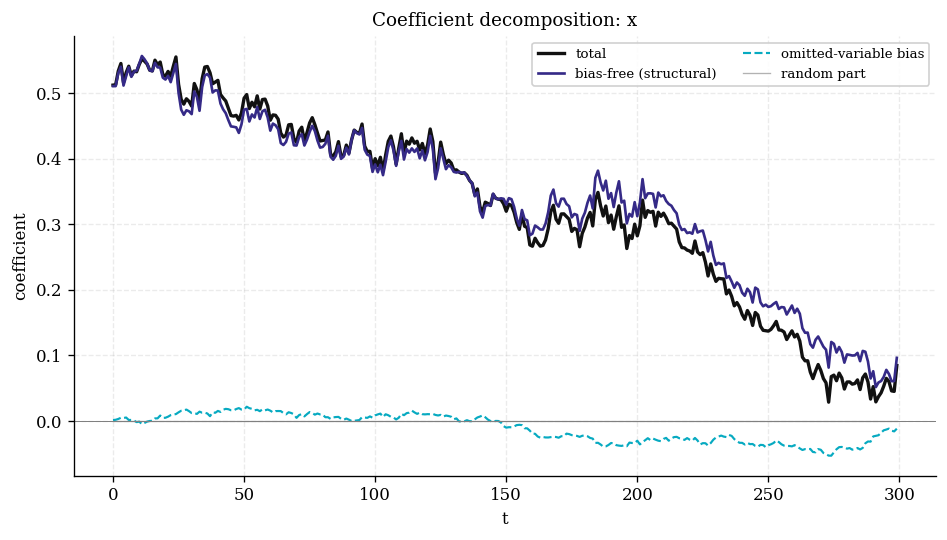
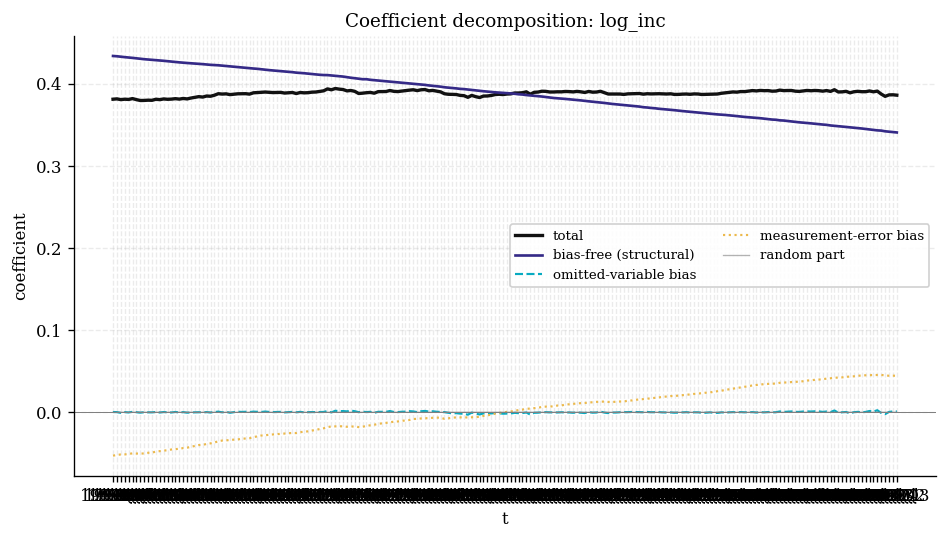
- decompose each coefficient into a bias-free structural component plus omitted-variable bias and measurement-error bias using coefficient drivers (eq. 8);
- test for generalized cointegration — i.e. whether the bias-free structural partial derivative is nonzero — with standard χ²/normal inference (no Dickey–Fuller tables);
- produce journal-quality tables (text / LaTeX booktabs / HTML) and publication-quality plots with the MATLAB Parula colormap by default.
Table of contents
- Installation
- The 60-second tour
- Concepts: how the paper maps to the code
- The estimator
- API reference
- Detailed syntax
- Visualizations
- Worked example: spurious vs. real
- Testing
- Citing
- References
Installation
From PyPI:
pip install tvccointreg

# with the optional ADF stationarity diagnostic
pip install "tvccointreg[adf]"
Or from source:
git clone https://github.com/merwanroudane/tvccointreg.git
cd tvccointreg
pip install -e ".[dev]"      # editable install with test extras
Requirements: numpy, scipy, pandas, matplotlib. statsmodels is optional
(used only for the ADF stationarity diagnostic and some examples).
The 60-second tour
from tvccointreg import TVCModel, DriverSpec
from tvccointreg.datasets import simulate_nonlinear_cointegration

# 1) A nonlinear relationship between nonstationary variables.
sim = simulate_nonlinear_cointegration(T=300, seed=1, nonlinearity=0.4)

# 2) Partition the drivers into the three sets (Assumption 1 / eq. 8).
spec = DriverSpec(
    names=list(sim.drivers.columns),
    bias_free=["x_lag", "y_lag"],   # true coefficient variation
    omitted=["w"],                  # omitted-variable bias
    measurement=[],                 # measurement-error bias
)

# 3) Fit by iteratively rescaled GLS.
res = TVCModel(sim.y, sim.X, sim.drivers, driver_spec=spec).fit()

# 4) Journal table + generalized cointegration test.
print(res.summary())
res.coint_test()
==============================================================================
      Time-Varying-Coefficient Regression  /  Generalized Cointegration
==============================================================================
Dep. variable: y                       No. observations: 300
No. coefficients: 2                    No. drivers: 3
Estimator: Iteratively rescaled GLS    Covariance: GLS
R-squared: 0.8311                      Log-likelihood: -78.07
Converged: True                        Resid ADF p-value: 0.0000
==============================================================================
Variable    Coef (mean)  Bias-free    Std.Err          t    p-value    G-Coint
------------------------------------------------------------------------------
x                0.3283     0.3392     0.0698     4.8614     0.0000 ***     Yes
==============================================================================
                   Signif.: *** p<0.01  ** p<0.05  * p<0.10
       Bias-free = structural derivative; G-Coint via Wald test on it.
==============================================================================
On this DGP the recovered bias-free coefficient correlates 0.99 with the true time-varying derivative, and the residuals are stationary (ADF p ≈ 0) — exactly the standard-inference result the paper proves.
Concepts: how the paper maps to the code
| Paper (Hall–Swamy–Tavlas 2015) | Symbol | In tvccointreg |
|---|---|---|
| TVC model, eq. (7) | y_t = γ_0t + γ_1t x_1t + … + γ_{K-1,t} x_{K-1,t} |
TVCModel(y, X, drivers) |
| Coefficient-driver eq., eq. (8) | γ_jt = π_j0 + Σ_d π_jd z_dt + ε_jt |
DriverSpec(...) + the drivers matrix |
| Three components of a coefficient | bias-free / omitted-variable / measurement-error | DriverSpec(bias_free=, omitted=, measurement=) |
| Concentrated model | y_t = w_t'π + u_t, u_t = Σ_j x_jt ε_jt |
estimation.build_design, estimation.irgls |
| Variance structure | Var(u_t) = Σ_j σ_j² x_jt² |
estimation.variance_components (Hildreth–Houck–Swamy) |
| Consistent estimator (§3.3) | iteratively rescaled GLS | TVCModel.fit(method="irgls") |
| Bias-free component | γ_jt^BF = π_j0 + Σ_{d∈BF} π_jd z_dt |
res.bias_free_coefficients() |
| Generalized cointegration, eqs. (5)–(6) | ∂y/∂x ≠ 0 ⇔ bias-free component ≠ 0 |
res.coint_test() |
| Standard inference (§3.3) | χ² Wald / normal, not Dickey–Fuller | Wald + delta-method t in cointegration.py |
| Drivers vs. instruments (Table 1) | drivers should be correlated with the misspecification | the omitted / measurement sets |
The definition, in one line
y and x are generalized-cointegrated if, holding all other relevant preexisting conditions w constant, the bias-free part of
∂y/∂xis nonzero.
Cointegration is thus a property of the real-world structural relationship, not of any particular statistical model — and it survives nonlinearity and omitted regressors.
The estimator
Substituting the driver equation (8) into the TVC model (7) gives a model that
is linear in the stacked parameter vector π:
y_t = w_t' π + u_t ,   w_t = ( x_0t·z_t , x_1t·z_t , … ) ,   u_t = Σ_j x_jt ε_jt
Var(u_t | x_t) = Σ_j σ_j² x_jt²          (Hildreth–Houck–Swamy structure)
tvccointreg then:
- OLS start on the concentrated design
W. - Variance components
σ_j²from a non-negative regression of squared residuals on squared regressors (scipy.optimize.nnls). - GLS with weights
1/h_t,h_t = Σ_j σ_j² x_jt²; iterate to convergence (iteratively rescaled GLS). - Recover the time-varying coefficients
γ_jt = z_t'π_j + ε̂_jt, where the random part is the best linear predictorε̂_jt = σ_j² x_jt u_t / h_t. - Decompose
γ_jtinto bias-free / omitted / measurement parts using the driver-set masks, and test the bias-free block.
Inference uses the GLS covariance (W'Ω⁻¹W)⁻¹ (the paper's standard-inference
result) or a heteroskedasticity-robust sandwich (cov_type="robust").
Note / honest caveat. As in the paper, validity hinges on Assumption 1 — that the chosen drivers genuinely span the bias components. This is an identifying assumption, not something the data can confirm; choose drivers that are plausibly correlated with the suspected misspecification (Table 1).
API reference
TVCModel(y, X, drivers, driver_spec=None, driver_sets=None, add_const=True, index=None)
Build a model. y (T,), X (T, K−1), drivers (T, m). A constant regressor and
a constant driver are added automatically. Accepts NumPy arrays or pandas
objects (column names are picked up automatically).
.fit(method="irgls", max_iter=100, tol=1e-8, cov_type="gls", verbose=False)→TVCResults.
DriverSpec(names, bias_free=[], omitted=[], measurement=[])
Three-set partition of the drivers. Any driver not listed defaults to
bias_free. .describe() prints the partition.
TVCResults
| Method | Returns |
|---|---|
| `.summary(fmt="text" | "latex" |
.coef_table() |
per-regressor average coefficient frame |
.coint_test(alpha=0.05, skip_const=True) |
tidy DataFrame of test results (and .coint_results_) |
.tv_coefficients(include_random=True) |
T×K time-varying coefficients |
.bias_free_coefficients() |
T×K bias-free (structural) coefficients |
.components(regressor) |
bias-free / omitted / measurement / random / total |
.coefficient_se() |
pointwise standard errors |
.diagnostics() |
R², log-lik, convergence, residual ADF |
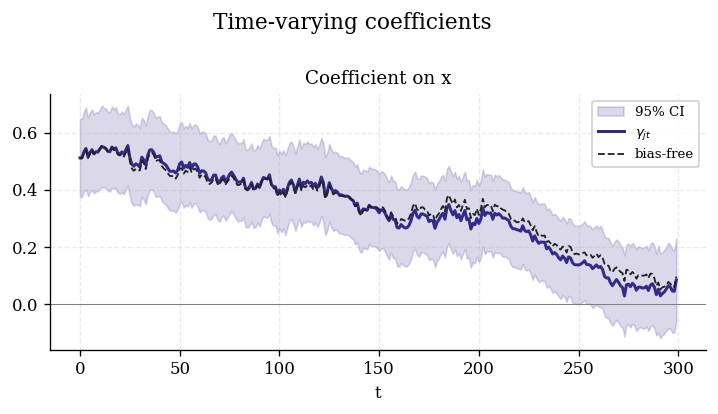
.plot_coefficients(...) |
TVC paths with CI bands |
.plot_decomposition(regressor) |
the three-component decomposition |
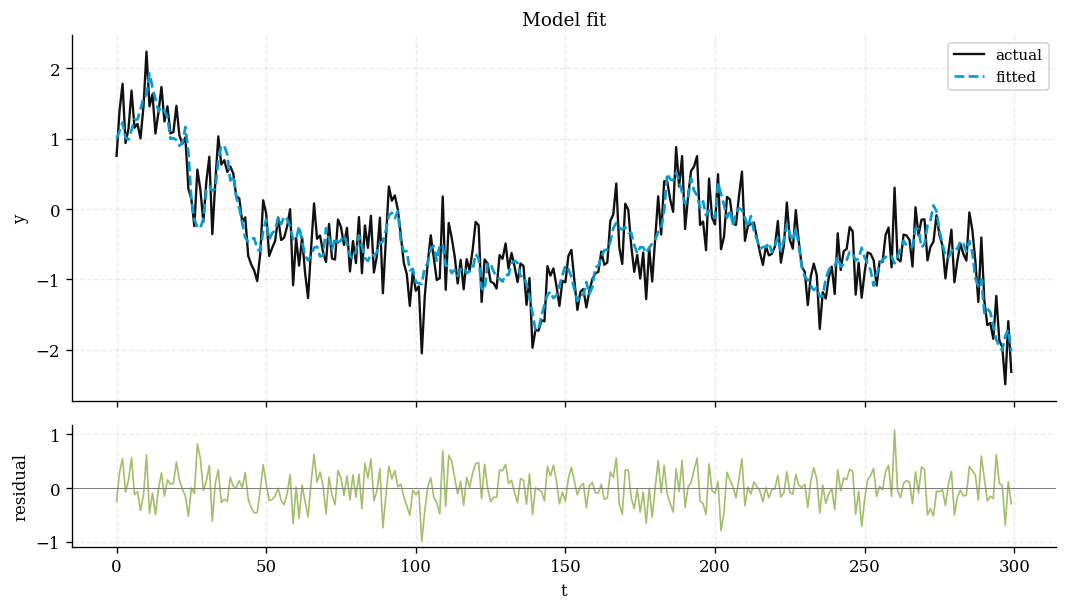
.plot_fit() |
actual vs fitted + residuals |
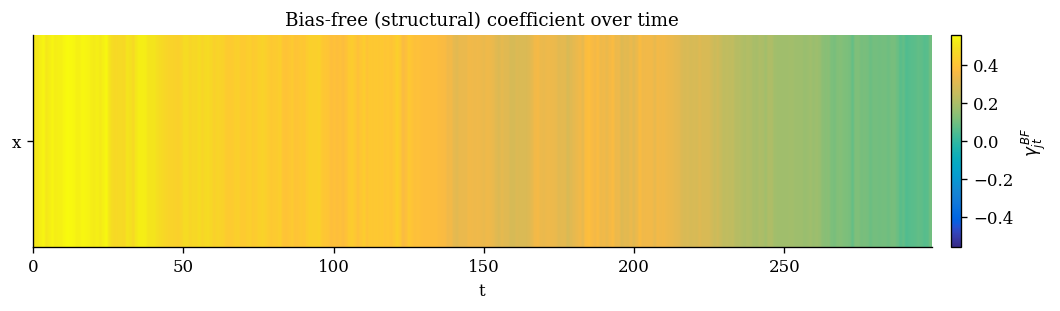
.plot_coint_heatmap() |
Parula heatmap of bias-free paths |
Datasets
simulate_nonlinear_cointegration(T, seed, nonlinearity, omitted, measurement_error)simulate_spurious(T, seed)
Colormaps
parula_colors(n), matlab_jet_colors(n), turbo_colors(n), bluered_colors(n),
sinha_colors(n), resolve_colorscale("Parula", n), get_cmap("parula").
Detailed syntax
Using raw NumPy arrays and reading off a specific test:
import numpy as np
from tvccointreg import TVCModel, DriverSpec

res = TVCModel(y, X, Z,                       # y:(T,), X:(T,K-1), Z:(T,m)
               driver_sets={"bias_free": ["z1"],
                            "omitted":   ["z2"],
                            "measurement": ["z3"]}).fit()

ct = res.coint_test()
print(ct.loc["x1", "cointegrated"], ct.loc["x1", "p_value"])
Robust covariance and OLS (homoskedastic) comparison:
res_robust = TVCModel(y, X, Z, driver_spec=spec).fit(cov_type="robust")
res_ols    = TVCModel(y, X, Z, driver_spec=spec).fit(method="ols")
Exporting a LaTeX table for a paper:
with open("table1.tex", "w") as f:
    f.write(res.summary(fmt="latex"))
Pulling the time-varying coefficient path of one regressor:
gamma_x = res.tv_coefficients()["x"]          # pandas Series indexed by t
bf_x    = res.bias_free_coefficients()["x"]
Visualizations
All plots default to the MATLAB Parula colormap and return a matplotlib
Figure.
plot_coefficients() |
plot_decomposition("x") |
 |
 |
plot_fit() |
plot_coint_heatmap() |
 |
 |
Worked example: spurious vs. real
examples/spurious_vs_real.py reproduces the central point of the paper:
================ SPURIOUS (independent random walks) ================
Naive OLS slope = 1.125  (p = 5.97e-46)   <- spuriously 'significant'
Generalized cointegration: NO (p = 0.708)

================ GENUINE generalized cointegration ================
Generalized cointegration: YES (p = 1.34e-35)
A naive OLS regression of one random walk on another is wildly "significant", yet the generalized-cointegration test on the bias-free component correctly finds no structural relationship.
Empirical application: the US consumption function (real data)
examples/real_data_consumption.py applies the method to real US quarterly
macro data (statsmodels macrodata, 1959Q1–2009Q3, 202 obs after lagging).
We model the long-run relationship between real personal consumption and
real disposable income (both in logs, both strongly trending / I(1)):
import numpy as np, pandas as pd
from statsmodels.datasets import macrodata
from tvccointreg import TVCModel, DriverSpec

d = macrodata.load_pandas().data
d.index = pd.period_range("1959Q1", periods=len(d), freq="Q")
zscore = lambda s: (s - s.mean()) / s.std(ddof=0)

y = np.log(d["realcons"]).rename("log_cons")
X = np.log(d[["realdpi"]]).rename(columns={"realdpi": "log_inc"})
drivers = pd.DataFrame({
    "inc_lag":  zscore(np.log(d["realdpi"]).shift(1)),
    "trend":    zscore(pd.Series(np.arange(len(d)), index=d.index)),
    "realint":  zscore(d["realint"]),
    "unemp":    zscore(d["unemp"]),
    "cons_lag": zscore(np.log(d["realcons"]).shift(1)),
})
df = pd.concat([y, X, drivers], axis=1).dropna()

spec = DriverSpec(
    names=["inc_lag", "trend", "realint", "unemp", "cons_lag"],
    bias_free=["inc_lag", "trend"],   # true elasticity variation
    omitted=["realint", "unemp"],     # interest-rate / labour-market channels
    measurement=["cons_lag"],         # dynamics / measurement
)
res = TVCModel(df["log_cons"], df[["log_inc"]], df[spec.names],
               driver_spec=spec, index=df.index.astype(str)).fit()
print(res.summary())
print(res.coint_test())
Result (verbatim output):
==============================================================================
      Time-Varying-Coefficient Regression  /  Generalized Cointegration
==============================================================================
Dep. variable: log_cons                No. observations: 202
No. coefficients: 2                    No. drivers: 5
Estimator: Iteratively rescaled GLS    Covariance: GLS
R-squared: 0.9999                      Log-likelihood: 752.32
Converged: True                        Resid ADF p-value: 0.0000
==============================================================================
Variable    Coef (mean)  Bias-free    Std.Err          t    p-value    G-Coint
------------------------------------------------------------------------------
log_inc          0.3886     0.3886     0.0528     7.3626     0.0000 ***     Yes
==============================================================================
| regressor | avg_bias_free | std_err | t_stat | wald | df | p_value | cointegrated |
|---|---|---|---|---|---|---|---|
| log_inc | 0.3886 | 0.0528 | 7.3626 | 56.9504 | 3 | 0.0000 | True |
Reading the result.
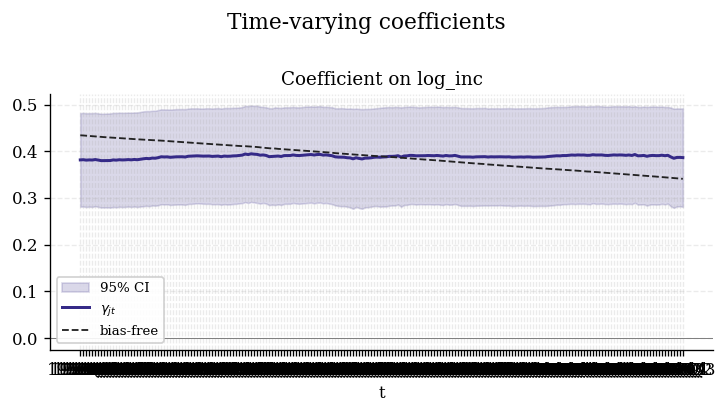
- Generalized cointegration is confirmed between consumption and income (Wald = 56.95, 3 df, p ≈ 0): the bias-free structural elasticity is firmly nonzero, so the long-run relationship is genuine, not spurious.
- Standard inference is valid here: the composite residuals are stationary (ADF p = 1.9 × 10⁻⁷), exactly the condition under which Hall–Swamy–Tavlas show the TVC test uses ordinary χ²/normal critical values rather than Dickey–Fuller ones.
- The bias-free income elasticity drifts down over the sample, from 0.43
(1959Q2) to 0.34 (2009Q3) — the direct income channel after the
dynamics (
cons_lag) and omitted business-cycle conditions (realint,unemp) are stripped out into the bias terms. A declining direct sensitivity of consumption to current income over five decades is consistent with greater consumption smoothing / financial deepening.
| Bias-free income elasticity over time | Coefficient decomposition |
|---|---|
 |
 |
Run it yourself:
python examples/real_data_consumption.py
Multiple regressors
The framework handles several regressors at once — each gets its own
time-varying coefficient and its own cointegration verdict.
examples/consumption_multivariate.py estimates a two-regressor consumption
function (disposable income and the real interest rate) on the same data:
| Regressor | Bias-free coef | t | Wald | p-value | Cointegrated |
|---|---|---|---|---|---|
| log_realDPI (income) | 0.6666 *** | 10.13 | 111.40 | <0.0001 | Yes |
| realint (real rate) | −0.0007 ** | −2.26 | 8.37 | 0.039 | Yes |
Positive income elasticity (~0.67) and a negative real-rate effect (intertemporal substitution); R² = 0.9998, residuals stationary (ADF p = 3.5×10⁻⁹). See the rendered results on the documentation site.
Testing
pip install -e ".[dev]"
pytest -q
The suite checks coefficient recovery, that the three components sum exactly to the total coefficient, detection of genuine generalized cointegration, rejection of spurious relationships, and the Parula palette/colorscale helpers.
Publishing (maintainer notes)
The package is PyPI-ready (python -m build + twine check both pass).
First release — manual upload with an API token
- Create accounts on TestPyPI and PyPI, and generate an API token for each (Account settings → API tokens).
- Build and check:
python -m build
python -m twine check dist/*
- Dry-run on TestPyPI first, then install from there to confirm:
python -m twine upload --repository testpypi dist/*
pip install --index-url https://test.pypi.org/simple/ \
    --extra-index-url https://pypi.org/simple/ tvccointreg
- Upload to the real PyPI:
python -m twine upload dist/*
When prompted, use__token__as the username and the API token (starting withpypi-) as the password.
Subsequent releases — automated via Trusted Publishing (recommended)
.github/workflows/publish.yml publishes automatically when you publish a
GitHub Release. One-time setup: on PyPI add a Trusted Publisher
(Project → Publishing) for repository merwanroudane/tvccointreg, workflow
publish.yml, environment pypi. After that, no tokens or secrets are needed —
just bump version in pyproject.toml and __version__, tag, and publish a
Release.
Remember: a version number can only be uploaded to PyPI once. Bump the version for every release.
Citing
If you use this package, please cite both the package and the underlying paper.
@software{roudane_tvccointreg,
  author  = {Merwan Roudane},
  title   = {tvccointreg: Time-Varying-Coefficient Regression and
             Generalized Cointegration in Python},
  year    = {2026},
  url     = {https://github.com/merwanroudane/tvccointreg}
}

@incollection{hall_swamy_tavlas_2015,
  author  = {Hall, Stephen G. and Swamy, P. A. V. B. and Tavlas, George S.},
  title   = {A Note on Generalizing the Concept of Cointegration},
  year    = {2015}
}
References
- Hall, S. G., Swamy, P. A. V. B., & Tavlas, G. S. (2015). A Note on Generalizing the Concept of Cointegration.
- Hall, S. G., Swamy, P. A. V. B., & Tavlas, G. S. (2014). Time Varying Coefficient Models; A Proposal for Selecting the Coefficient Driver Sets. University of Leicester WP 14/18.
- Swamy, P. A. V. B., & Mehta, J. S. (1975). Bayesian and non-Bayesian Analysis of Switching Regressions and of Random Coefficient Regression Models. JASA.
- Swamy, P. A. V. B., Tavlas, G. S., Hall, S. G., et al. (2010). Nonparametric Nonstationary Regression.
- Granger, C. W. J. (2008). Non-linear Models: Where Do We Go Next — Time-Varying Parameter Models? Studies in Nonlinear Dynamics & Econometrics.
- Hildreth, C., & Houck, J. P. (1968). Some Estimators for a Linear Model with Random Coefficients. JASA.
- Engle, R. F., & Granger, C. W. J. (1987). Co-integration and Error Correction. Econometrica.
- Cramér, H. (1946). Mathematical Methods of Statistics.
Author
Dr Merwan Roudane · merwanroudane920@gmail.com · github.com/merwanroudane
Released under the MIT License.
1 maintainer

Metadata
1 maintainer
Release files for tvccointreg 0.1.1
For a detailed explanation of source distributions (sdists) and built distributions (wheels), please see the package formats documentation.
Source distribution (sdist)
| File | Size | Uploaded | Provenance | |
|---|---|---|---|---|
| tvccointreg-0.1.1.tar.gz | 38.1 kB | Without provenance | Details |
Built distribution (wheel)
| File | Interpreter | ABI | Platform | Reset |
|---|---|---|---|---|
| tvccointreg-0.1.1-py3-none-any.whl | Python 3 | none | any | Details |
Total release size: 69.0 kB
Release files / tvccointreg-0.1.1.tar.gz
| Download URL | tvccointreg-0.1.1.tar.gz |
|---|---|
| Size | 38.1 kB |
| Tags | Source |
|
SHA-256 checksum How to use checksums |
d303abbbdd7dc265788b9cc704e32e109fb89799e1243b598440de753935a314
|
|
BLAKE2b-256 checksum How to use checksums |
af9eeafe9ca0148acd27d710b5cf1411bd512663fa2400a87993ee4607d9ebc9
|
| Upload date | |
|
Uploaded using Trusted Publishing? What is trusted publishing? |
No |
| Uploaded via |
twine/6.2.0 CPython/3.11.0
|
Release files / tvccointreg-0.1.1-py3-none-any.whl
| Download URL | tvccointreg-0.1.1-py3-none-any.whl |
|---|---|
| Size | 30.9 kB |
| Tags | Python 3 |
|
SHA-256 checksum How to use checksums |
5c15862ad8c05b4ac725b8af82bbdcfa5dc6508a99069d66491112da878bf454
|
|
BLAKE2b-256 checksum How to use checksums |
c2f923722d6c349704f7699bd19113f897f37d4dc0415268c34e7c6a74f95a17
|
| Upload date | |
|
Uploaded using Trusted Publishing? What is trusted publishing? |
No |
| Uploaded via |
twine/6.2.0 CPython/3.11.0
|
Security for tvccointreg 0.1.1
Provenance
Provenance describes where a file came from. On PyPI, provenance is shared via attestations, which provide a verifiable record of the build or publishing details. View details, limitations and caveats.
No provenance found
None of the files in this release were uploaded with provenance metadata.
A note on package security
PyPI is a repository for distributing packages, not a service for auditing them. While third-party security researchers and our staff do their best to detect and remove malicious packages, PyPI cannot guarantee the quality, security or suitability of any given package.














