

TradingView™ Screener API
TradingView™ Screener API: simple Python library to retrieve data from TradingView™ Screener



🚀 Try the Code Generator
Build screener queries visually and get Python code instantly!

The Code Generator lets you:
- Select from 10 screener types (Stock, ETF, Crypto, Forex, Bond, Government Bond, Futures, Coin, Index, Economics)
- Build filters visually with 13,000+ fields, combined with AND / OR
- Generate ready-to-use Python code
- Copy and run in your environment
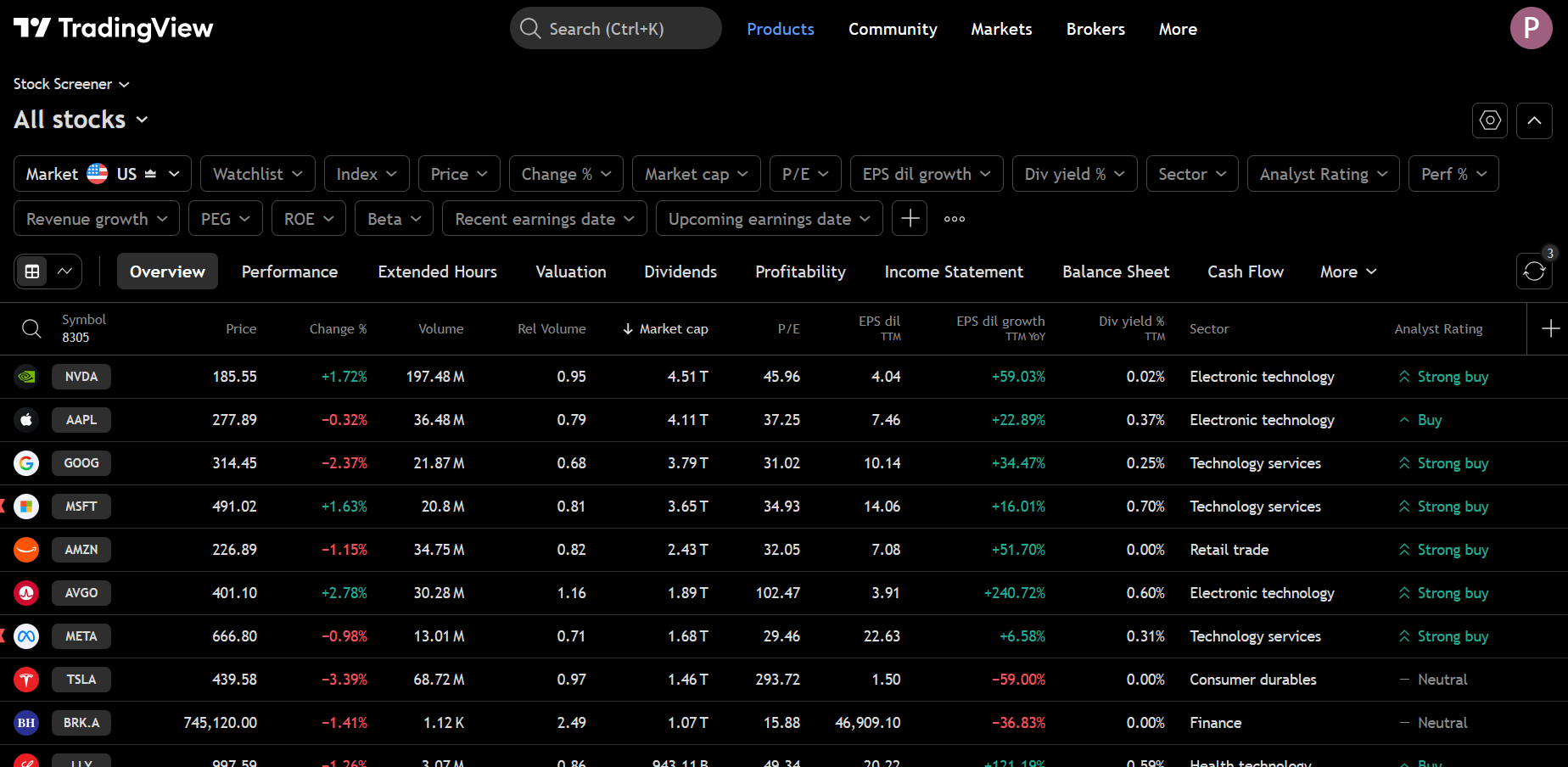
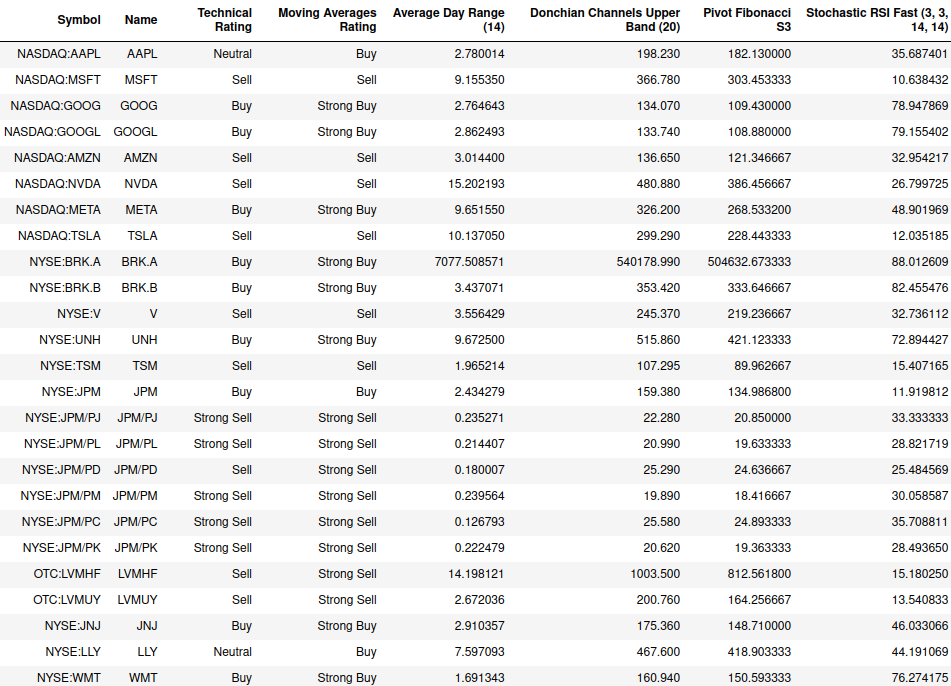
Get the results as a Pandas Dataframe
Disclaimer
This is an unofficial, third-party library and is not affiliated with, endorsed by, or connected to TradingView™ in any way. TradingView™ is a trademark of TradingView™, Inc. This independent project provides a Python interface to publicly available data from TradingView's screener. Use of this library is at your own risk and subject to TradingView's terms of service.
What's New in v0.8.0
Beyond the screener - tvscreener now reads the data behind TradingView's symbol pages, charts and calendars. No account needed.
Financial Statements
About 20 years of annual and 8 years of quarterly statements, in TradingView's layout (industrial, bank or insurer):
import tvscreener as tvs

income = tvs.get_financials("NASDAQ:AAPL")                         # income statement, by fiscal year
balance = tvs.get_financials("NASDAQ:AAPL", "balance_sheet", "FQ")  # balance sheet, by quarter
income["Total revenue"].pct_change()                                # revenue growth
Real-Time Quotes
Quotes pushed by TradingView as they change, including pre/after-market prices:
for quote in tvs.stream_quotes(["NASDAQ:AAPL", "BINANCE:BTCUSDT"], duration=60):
    print(quote["symbol"], quote.get("price"), quote["updated"])
Events, Seasonals and the Economic Calendar
events = tvs.get_corporate_events("NASDAQ:AAPL")      # dividends, earnings vs estimates, splits
seasonals = tvs.get_seasonals("NASDAQ:AAPL")          # monthly returns by year
macro = tvs.get_economic_calendar("2026-10-12", "2026-10-18", countries=["US", "EU"], importance="high")
News, Filings and Earnings Call Transcripts
news = tvs.get_news("NASDAQ:AAPL", corp_activity="insider_trading")   # also: provider, market, sector...
docs = tvs.get_documents("NASDAQ:AAPL", category="call_transcript")    # 10-Q, 10-K, transcripts
transcript = tvs.get_document(docs["transcript_id"].iloc[0])
calls = tvs.get_earnings_calls("NASDAQ:AAPL")                          # dates, transcript and audio links
Market Helpers
tvs.search_symbols("US0378331005")                      # by ticker, name, ISIN or CUSIP
tvs.get_peers("NASDAQ:AAPL")                            # largest companies of the same industry
tvs.get_forward_curve("NYMEX:CL")                       # futures term structure
tvs.get_yield_matrix(["US", "DE", "JP"])                # government yields by country and tenor
tvs.get_volatility_smile("NASDAQ:AAPL", "2026-11-13")   # implied volatility by strike
For AI Assistants (MCP)
Everything above is also available to Claude and other MCP clients (pip install tvscreener[mcp], then claude mcp add tvscreener -- tvscreener-mcp). The server has 24 tools:
| Tools | Data |
|---|---|
financials, corporate_events, seasonals |
Statements, dividends, earnings, splits, monthly returns |
quotes |
Current prices, bid/ask, pre/after-market |
news, company_documents, earnings_calls, read_text |
Filtered news, filings, transcripts and their full text |
find_symbols, peers, forward_curve, volatility_smile |
Symbol search, peers, futures and options |
get_calendar (kind="economic"), yield_curve (several countries) |
Economic calendar, yield matrix |
discover_fields, custom_query, search_stocks... |
Screeners, as before |
custom_query now rejects unknown fields, filter keys and operators with a clear message instead of ignoring them.
Guides: Financials and Events · News and Filings · Real-Time Quotes
What's New in v0.2.0
MCP Server Integration - This release adds Model Context Protocol (MCP) support, enabling AI assistants like Claude to query market data directly.
MCP Server for AI Assistants
# Install with MCP support
pip install tvscreener[mcp]

# Run MCP server
tvscreener-mcp

# Register with Claude Code
claude mcp add tvscreener -- tvscreener-mcp
MCP Tools:
discover_fields- Search 3500+ available fields by keywordcustom_query- Flexible queries with any fields and filterssearch_stocks/search_crypto/search_forex- Simplified screenersget_top_movers- Get top gainers/losers
What's New in v0.1.0
Major API Enhancement Release - This release significantly expands the library with new screeners, 13,000+ fields, and a more intuitive API.
New Screeners
- BondScreener - Query government and corporate bonds
- FuturesScreener - Query futures contracts
- CoinScreener - Query coins from CEX and DEX exchanges
Expanded Field Coverage
- 13,000+ fields across all screener types (up from ~300)
- Complete technical indicator coverage with all time intervals
- Fields organized by category with search and discovery methods
Pythonic Comparison Syntax
from tvscreener import StockScreener, StockField

ss = StockScreener()
ss.where(StockField.PRICE > 50)
ss.where(StockField.VOLUME >= 1_000_000)
ss.where(StockField.MARKET_CAPITALIZATION.between(1e9, 50e9))
ss.where(StockField.SECTOR.isin([
    'Electronic Technology',
    'Technology Services',
    'Health Technology',
    'Health Services',
]))
df = ss.get()
Fluent API
# Chain methods for cleaner code
ss = StockScreener()
ss.select(StockField.NAME, StockField.PRICE, StockField.CHANGE_PERCENT)
ss.where(StockField.PRICE > 100)
df = ss.get()
Field Presets
from tvscreener import StockScreener, STOCK_VALUATION_FIELDS, STOCK_DIVIDEND_FIELDS

ss = StockScreener()
ss.specific_fields = STOCK_VALUATION_FIELDS + STOCK_DIVIDEND_FIELDS
Type-Safe Validation
The library now validates that you're using the correct field types with each screener, catching errors early.
Main Features
- Query Stock, ETF, Forex, Crypto, Bond, Government Bond, Futures, Coin, Option, Index and Economics Screeners
- OR / nested filters with
|and&, and operators such ashas(),above_pct(),in_day_range() - TradingView presets (gainers, losers, all-time highs...) and earnings, dividend, IPO and economic calendars
- Financial statements: about 20 years of annual and 8 years of quarterly income statement, balance sheet and cash flow
- Real-time quotes pushed by TradingView, recent dividends, earnings and splits, and seasonals
- News with filters, filings and earnings call transcripts
- Yield curves and matrix, futures forward curves, IV term structure and smile, symbol search, peers and single-symbol lookups
- All the fields available: 13,000+ fields across all screener types
- Any time interval (
no need to be a registered user- 1D, 5m, 1h, etc.) - Fluent API with
select()andwhere()methods for cleaner code - Field discovery - search fields by name, get technicals, filter by category
- Field presets - curated field groups for common use cases
- Type-safe validation - catches field/screener mismatches
- Filters by any fields, symbols, markets, countries, etc.
- Get the results as a Pandas Dataframe
- Styled output with TradingView-like colors and formatting
- Streaming/Auto-update - continuously fetch data at specified intervals
Installation
The source code is currently hosted on GitHub at: https://github.com/deepentropy/tvscreener
Binary installers for the latest released version are available at the Python Package Index (PyPI)
# or PyPI
pip install tvscreener
From pip + GitHub:
$ pip install git+https://github.com/deepentropy/tvscreener.git
Usage
Basic Screeners
import tvscreener as tvs

# Stock Screener
ss = tvs.StockScreener()
df = ss.get()  # returns a dataframe with 150 rows by default

# Forex Screener
fs = tvs.ForexScreener()
df = fs.get()

# Crypto Screener
cs = tvs.CryptoScreener()
df = cs.get()

# Bond Screener (NEW)
bs = tvs.BondScreener()
df = bs.get()

# Futures Screener (NEW)
futs = tvs.FuturesScreener()
df = futs.get()

# Coin Screener (NEW) - CEX and DEX coins
coins = tvs.CoinScreener()
df = coins.get()

# Option Screener - option chains with greeks and IV (underlying required)
opts = tvs.OptionScreener("NASDAQ:AAPL")
opts.where(tvs.OptionField.DELTA.between(0.4, 0.6))
df = opts.get()

# Implied volatility term structure
df = tvs.get_iv_term_structure("NASDAQ:AAPL")

# ETF Screener - ETFs sorted by assets under management
etfs = tvs.ETFScreener()
etfs.where(tvs.StockField.EXPENSE_RATIO < 0.1)
df = etfs.get()

# Index Screener - indices, CFDs, crypto market caps
df = tvs.IndexScreener().main_indices().get()

# Economics Screener - 15,000+ economic indicators
es = tvs.EconomicsScreener()
es.where(tvs.EconomicsField.COUNTRY_CODE == 'US')
df = es.get()

# Government bond yield curve
df = tvs.get_yield_curve("US")
OR Filters and Presets
ss = tvs.StockScreener()
ss.where((tvs.StockField.SECTOR == 'Finance') | (tvs.StockField.SECTOR == 'Utilities'))
ss.where(tvs.StockField.PRICE.above_pct(tvs.StockField.SIMPLE_MOVING_AVERAGE_50, 5))
df = ss.get()

# TradingView's own screens
df = tvs.StockScreener().set_preset(tvs.Preset.GAINERS).get()
Calendars
earnings = tvs.get_earnings_calendar("2026-10-12", "2026-10-18")
dividends = tvs.get_dividends_calendar("2026-10-12", "2026-10-18")
ipos = tvs.get_ipo_calendar("2026-10-01", "2026-10-31", markets=tvs.Market.ALL)
macro = tvs.get_economic_calendar("2026-10-12", "2026-10-18", countries=["US", "EU"], importance="high")
Financials, Events and Real-Time Quotes
income = tvs.get_financials("NASDAQ:AAPL", "income", "FY")       # ~20 fiscal years
balance = tvs.get_financials("NASDAQ:AAPL", "balance_sheet", "FQ")
events = tvs.get_corporate_events("NASDAQ:AAPL")                  # dividends, earnings, splits
seasonals = tvs.get_seasonals("NASDAQ:AAPL")                      # monthly returns by year

for quote in tvs.stream_quotes(["NASDAQ:AAPL", "BINANCE:BTCUSDT"], duration=60):
    print(quote["symbol"], quote.get("price"))
News, Filings and Market Helpers
news = tvs.get_news("NASDAQ:AAPL", corp_activity="insider_trading")
text = tvs.get_article(news["id"].iloc[0])
docs = tvs.get_documents("NASDAQ:AAPL", category="call_transcript")
transcript = tvs.get_document(docs["transcript_id"].iloc[0])

tvs.search_symbols("US0378331005")             # ISIN -> NASDAQ:AAPL and other listings
tvs.get_peers("NASDAQ:AAPL")
tvs.get_forward_curve("NYMEX:CL")
tvs.get_yield_matrix(["US", "DE", "JP"])
tvs.get_volatility_smile("NASDAQ:AAPL", "2026-11-13")
Fluent API
Use select() and where() for cleaner, chainable code:
from tvscreener import StockScreener, StockField

ss = StockScreener()
ss.select(
    StockField.NAME,
    StockField.PRICE,
    StockField.CHANGE_PERCENT,
    StockField.VOLUME,
    StockField.MARKET_CAPITALIZATION
)
ss.where(StockField.MARKET_CAPITALIZATION > 1e9)
ss.where(StockField.CHANGE_PERCENT > 5)
df = ss.get()
Field Discovery
Search and explore the 13,000+ available fields:
from tvscreener import StockField

# Search fields by name or label
rsi_fields = StockField.search("rsi")
print(f"Found {len(rsi_fields)} RSI-related fields")

# Get all technical indicator fields
technicals = StockField.technicals()
print(f"Found {len(technicals)} technical fields")

# Get recommendation fields
recommendations = StockField.recommendations()
Field Presets
Use curated field groups for common analysis needs:
from tvscreener import (
    StockScreener, get_preset, list_presets,
    STOCK_PRICE_FIELDS, STOCK_VALUATION_FIELDS, STOCK_DIVIDEND_FIELDS,
    STOCK_PERFORMANCE_FIELDS, STOCK_OSCILLATOR_FIELDS
)

# See all available presets
print(list_presets())
# ['stock_price', 'stock_volume', 'stock_valuation', 'stock_dividend', ...]

# Use presets directly
ss = StockScreener()
ss.specific_fields = STOCK_VALUATION_FIELDS + STOCK_DIVIDEND_FIELDS
df = ss.get()

# Or get preset by name
fields = get_preset('stock_performance')
Available Presets:
| Category | Presets |
|---|---|
| Stock | stock_price, stock_volume, stock_valuation, stock_dividend, stock_profitability, stock_performance, stock_oscillators, stock_moving_averages, stock_earnings |
| Crypto | crypto_price, crypto_volume, crypto_performance, crypto_technical |
| Forex | forex_price, forex_performance, forex_technical |
| Bond | bond_basic, bond_yield, bond_maturity |
| Futures | futures_price, futures_technical |
| Coin | coin_price, coin_market |
Time Intervals for Technical Fields
Apply different time intervals to technical indicators:
from tvscreener import StockScreener, StockField

ss = StockScreener()

# Get RSI with 1-hour interval
rsi_1h = StockField.RELATIVE_STRENGTH_INDEX_14.with_interval("60")

# Available intervals: 1, 5, 15, 30, 60, 120, 240, 1D, 1W, 1M
ss.specific_fields = [
    StockField.NAME,
    StockField.PRICE,
    rsi_1h,
    StockField.MACD_LEVEL_12_26.with_interval("240"),  # 4-hour MACD
]
df = ss.get()
Parameters
For detailed usage examples, see the documentation and notebooks below.
Styled Output
You can apply TradingView-style formatting to your screener results using the beautify function. This adds colored text for ratings and percent changes, formatted numbers with K/M/B suffixes, and visual indicators for buy/sell/neutral recommendations.
import tvscreener as tvs

# Get raw data
ss = tvs.StockScreener()
df = ss.get()

# Apply TradingView styling
styled = tvs.beautify(df, tvs.StockField)

# Display in Jupyter/IPython (shows colored output)
styled
The styled output includes:
- Rating columns with colored text and directional arrows:
- Buy signals: Blue color with up arrow (↑)
- Sell signals: Red color with down arrow (↓)
- Neutral: Gray color with dash (-)
- Percent change columns: Green for positive, Red for negative
- Number formatting: K, M, B, T suffixes for large numbers
- Missing values: Displayed as "--"
Streaming / Auto-Update
You can use the stream() method to continuously fetch screener data at specified intervals. This is useful for monitoring real-time market data.
import tvscreener as tvs

# Basic streaming with iteration limit
ss = tvs.StockScreener()
for df in ss.stream(interval=10, max_iterations=5):
    print(f"Got {len(df)} rows")

# Streaming with callback
from datetime import datetime

def on_update(df):
    print(f"Updated at {datetime.now()}: {len(df)} rows")

ss = tvs.StockScreener()
try:
    for df in ss.stream(interval=5, on_update=on_update):
        # Process data
        pass
except KeyboardInterrupt:
    print("Stopped streaming")

# Stream with filters
ss = tvs.StockScreener()
ss.set_markets(tvs.Market.AMERICA)
for df in ss.stream(interval=30, max_iterations=10):
    print(df.head())
Parameters:
interval: Refresh interval in seconds (minimum 1.0 to avoid rate limiting)max_iterations: Maximum number of refreshes (None = infinite)on_update: Optional callback function called with each DataFrame
Documentation
📖 Full Documentation - Complete guides, API reference, and examples.
Quick Links
| Guide | Description |
|---|---|
| Quick Start | Get up and running in 5 minutes |
| Filtering | Complete filtering reference |
| Stock Screening | Value, momentum, dividend strategies |
| Technical Analysis | RSI, MACD, multi-timeframe |
| Financials and Events | Statements, dividends, earnings, seasonals |
| News and Filings | Filtered news, 10-Q/10-K, call transcripts |
| Streaming | Screener refreshes and real-time quotes |
| API Reference | Screeners, Fields, Enums |
Jupyter Notebooks
Interactive examples organized by use case:
| Notebook | Description |
|---|---|
| 01-quickstart.ipynb | Overview of all 6 screeners |
| 02-stocks.ipynb | Stock screening strategies |
| 03-crypto.ipynb | Crypto analysis |
| 04-forex.ipynb | Forex pairs screening |
| 05-bonds-futures.ipynb | Bonds and futures |
1 maintainer

Metadata
1 maintainer
Release files for tvscreener 0.8.1
For a detailed explanation of source distributions (sdists) and built distributions (wheels), please see the package formats documentation.
Source distribution (sdist)
| File | Size | Uploaded | |
|---|---|---|---|
| tvscreener-0.8.1.tar.gz | 251.1 kB | Details |
Built distribution (wheel)
| File | Interpreter | ABI | Platform | Reset |
|---|---|---|---|---|
| tvscreener-0.8.1-py3-none-any.whl | Python 3 | none | any | Details |
Total release size: 518.3 kB
Release files / tvscreener-0.8.1.tar.gz
| Download URL | tvscreener-0.8.1.tar.gz |
|---|---|
| Size | 251.1 kB |
| Tags | Source |
|
SHA-256 checksum How to use checksums |
26a9d4595ff405c34a2311a230580e5a1a67c4a913a678b0cbefcd6d1aaa0783
|
|
BLAKE2b-256 checksum How to use checksums |
63f3ecad09062eea044d58dab4345040db4e53bfe795c504d4901b26f13c00bf
|
| Upload date | |
|
Uploaded using Trusted Publishing? What is trusted publishing? |
Yes |
| Uploaded via |
twine/7.0.0 CPython/3.13.14
|
Provenance
Provenance describes where a file came from. On PyPI, provenance is shared via attestations, which provide a verifiable record of the build or publishing details. View details, limitations and caveats.


PyPI Publish Attestation
PyPI verified that this artifact, at this checksum, originated from the publisher listed below.
Signed by GitHub Actions, verified by PyPI on Oct 15, 2026.
Transparency logRelease files / tvscreener-0.8.1-py3-none-any.whl
| Download URL | tvscreener-0.8.1-py3-none-any.whl |
|---|---|
| Size | 267.2 kB |
| Tags | Python 3 |
|
SHA-256 checksum How to use checksums |
ae211212acee67edad6197a6dd73d97fb5008f51c3aa32e3c6a996907f6c614a
|
|
BLAKE2b-256 checksum How to use checksums |
788eb5c960874d9ad3c750f8696c183968a638eb82785e39ee0f4cef884b9c37
|
| Upload date | |
|
Uploaded using Trusted Publishing? What is trusted publishing? |
Yes |
| Uploaded via |
twine/7.0.0 CPython/3.13.14
|
Provenance
Provenance describes where a file came from. On PyPI, provenance is shared via attestations, which provide a verifiable record of the build or publishing details. View details, limitations and caveats.
PyPI Publish Attestation
PyPI verified that this artifact, at this checksum, originated from the publisher listed below.
Signed by GitHub Actions, verified by PyPI on Oct 15, 2026.
Transparency log













