
Two-Key
AI agent authorization and MCP gateway — dual-path policy + judge approval, single-use capability tokens, and an encrypted ledger.

Two independent keys must turn before an AI agent can act.









Two independent keys must turn before an AI agent can act.
🎯 The Problem
AI agents can be given permission to use a tool without being given authority to perform every consequential action that tool can perform.
Traditional tool permissions answer:
"Can this agent call this tool?"
Two-Key asks a different question:
"Is this specific action authorized to execute?"
Two-Key is an authorization layer for AI agents that use tools. Before a consequential tool call executes, Two-Key requires independent authorization through a deterministic policy path and an independent judge path:
- The policy key (Path A). The rules you sign compile to bytecode. A small deterministic VM checks every call against fields read from the call's own arguments: the tool, the amount, the counterparty, the data class, and fields you define. It reads no prose, so no prompt can talk it out of a rule.
- The judgment key (Path B). One or more AI judges, each with its own credential, review the call against your written constitution. Two-Key refuses to start with a judge that holds the agent's own credential.
Only when both keys turn does Two-Key issue a single-use token, bound to the exact arguments, the signed constitution, and the ledger state. The gateway runs the tool only with that token, and every decision, allowed or denied, is written to an encrypted, hash-chained ledger with a signed head.
What you get:
- Works with the agent you have. Grok, ChatGPT, Claude, Gemini, or a local Ollama model proposes the call as data; Two-Key decides.
- Judges you choose. xAI, OpenAI, Anthropic, Gemini, or Ollama. One
judge is enough to start; the
high_assuranceprofile asks for judges from two makers and a yes from a local one. - In front of any MCP server (0.5.0).
two-key mcp-proxyshows the agent only the tools you signed and runs every call through both keys. - Facts from your systems, not from the agent (0.5.0). A field such as "this invoice matches its purchase order" comes from your own lookup, and is looked up again just before the tool runs.
- An audit trail you can check. AES-256-GCM at rest, a hash chain, a
head signed by the principal and a witness key, and
two-key audit. - A copy in your SIEM (0.7.0). Every decision can go to syslog or an HTTPS webhook as it is written, in Two-Key's own schema, ECS, or OCSF, with reason codes and digests but no argument values. A collector that is down never blocks a decision.
- Keys you can recover. Passphrase backup of every key, in three bundles.
- Small on purpose. Python 3.10 or later, one required dependency
(
cryptography), Apache-2.0.
Status: beta. 0.7.0 is the current release: it adds the SIEM export, a start-up check that refuses to run when the monitored agent is Two-Key's own account, and a count of the tokens the gateway refuses. 0.6.0 added Windows support, content scanning with your antivirus or DLP product, and a start-up check for paths another account could change. Maintainer-reviewed and tested with live LLM agents and judges. Read Known limits and docs/FIT.md before you rely on it.
Contents
- Quick start
- Put Two-Key in front of an MCP server
- Documentation
- Components
- Dual-path authorization
- Architecture
- What this repo leaves out
- Known limits
- Roadmap
- Install and versions
- Layout
- History and license
Quick start
Install 0.7.0 from PyPI (docs/PYPI.md):
pip install "two-key[yaml]==0.7.0"
Tag v0.7.0 was not moved. It is the git snapshot from before this
packaging, not a second release.
Or run the offline demo from a clone. It uses test-double judges, so it needs no API keys:
python3 -m venv .venv
. .venv/bin/activate
pip install -e ".[yaml]"
python -m two_key demo
python -m two_key authorize --help
Real judges are configured in examples/judges.yaml. The operator guide is
docs/HOWTO.md. Before a real agent runs, close every way
around Two-Key: docs/CONNECTING.md.
Put Two-Key in front of an MCP server
New in 0.5.0 (#2):
pip install "two-key[mcp]==0.7.0"
An MCP client (a desktop assistant, an IDE, an agent framework) normally
starts an MCP server and calls its tools directly. With Two-Key, the client
starts two-key mcp-proxy instead. The proxy starts the real server itself,
shows the agent only the tools you signed, and runs every call through both
keys before the server sees it. Facts such as a purchase-order match come
from your own hook, never from the agent. A refused call comes back to the
agent as a tool error with a reason code.
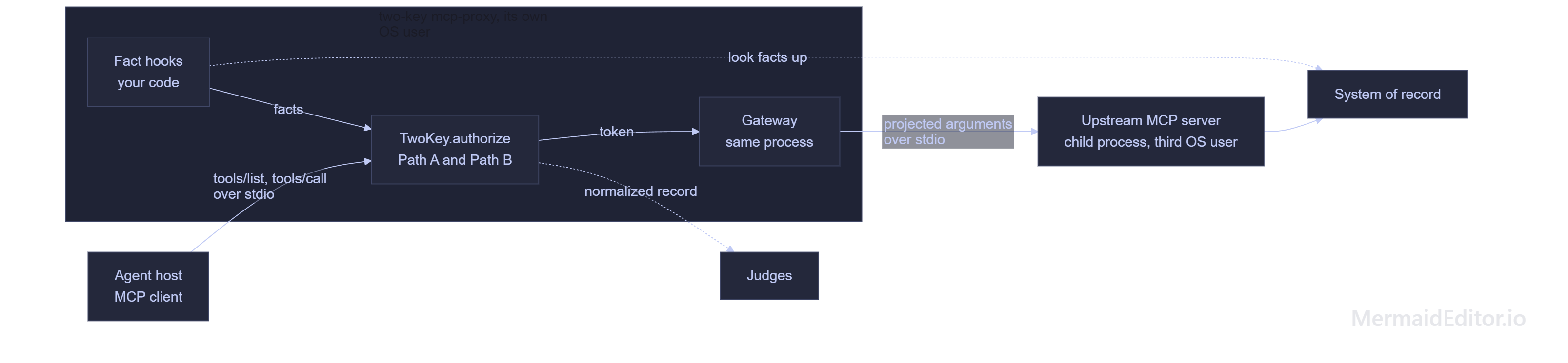
two-key mcp-draft-specs drafts the tool specs from the server's own
schemas for you to review and sign. The walkthrough, with a worked
example, is HOWTO
"Put Two-Key in front of an MCP server".
Run the proxy and the upstream server as separate OS users, so neither the
agent nor the server can reach the proxy's keys (HOWTO "Key custody").
The proxy speaks stdio only and does not listen on the network; an agent
on another machine starts it over SSH with a forced command
(CONNECTING),
a route that still needs live testing. From 0.7.0 the proxy
refuses to start when the account that started it is Two-Key's own, is
root, or can change Two-Key's files (on_agent_access).
Documentation
| Read | For |
|---|---|
| docs/FIT.md | Whether Two-Key is the right control for you |
| docs/HOWTO.md | Setup, configuration, the MCP proxy, and operations |
| docs/CONNECTING.md | Connecting the agent and every hook so it cannot go around Two-Key, with a checklist |
| docs/SCANNERS.md | Content scanning with your antivirus or DLP product (0.6.0) |
| docs/SIEM.md | Sending the ledger to a SIEM, and checking a copy against it (0.7.0) |
| docs/JUDGES_AND_QUORUM.md | How judges vote and how the two keys combine |
| docs/THREAT_MODEL.md | Trust boundaries and residual risk |
| docs/SCOPE.md | What is included, left out, and planned |
| docs/COMPARISON.md | What Two-Key is not a substitute for |
| ROADMAP.md | The path to 1.0 |
| CHANGES.md | Every change, with upgrade notes |
| SECURITY.md | How to report a vulnerability |
| docs/PYPI.md | Registering the package name and publishing a release |
Components
- Constitution: User/admin-configurable set of signed rules (prose, hard rules, and tool specs). The principal signs it; Two-Key enforces the signed form.
- Policy Enforcer (Path A): Deterministic bytecode policy VM. It evaluates structured fields derived from the argument bytes according to the signed tool specs. It does not read free text or English.
- Judge (Path B): Trusted AI agent (local or cloud, preferably suited to the use case). It scores the normalized action record (and optionally the proposal). It has no direct access to any registered tool.
- Monitored Agent: The untrusted agent under constraint. It proposes actions; it has no direct access to any registered tool.
- Tool Gateway: Accepts a single-use capability token and invokes the registered tool. It runs in the
TwoKeyprocess on theTwoKeyledger object (TwoKey.gateway()); a gateway in another process or on another host is not supported (#45). Its verifier holds only the capability public key, so it cannot mint. That is an API property, not key isolation. - Registered Tool: The tool protected by the dual-path authorization and the capability token.
- MCP proxy (0.5.0; the
mcpextra):two-key mcp-proxysits between an MCP client and one upstream MCP server. It shows the agent only the signed tools, pins their schemas, and runs everytools/callthrough both keys and the in-process gateway.two-key mcp-draft-specsdrafts the tool specs for the principal to review and sign. See HOWTO "Put Two-Key in front of an MCP server". - SIEM export (0.7.0): the ledger can copy each entry, as
it is written, to a syslog sink or an HTTPS webhook, and
two-key siem-exportwrites the same events to a file thattwo-key siem-verifychecks back against the ledger. A per-kind field allowlist decides what leaves: reason codes, digests, sizes, the tool id, and the data class, never argument values or proposal text. See docs/SIEM.md. - Caller-supplied facts and the guard (0.5.0): a field declared
source: callergets its value from your integration (facts=), never from the agent's arguments, and is looked up again before the tool runs.two_key.guard.Guarddoes both lookups and both keys in one call for any agent loop; the MCP proxy runs on it. See HOWTO "Caller-supplied facts".
Dual-path authorization
- Path A is a policy VM. Hard rules compile to bytecode. The VM reads five built-in structured fields (tool, amount_usd, data_class, counterparty, and irreversible) and any custom fields the principal declares under
fields:(boolean, integer, enum, or string; up to 64; see examples/custom_fields.yaml and HOWTO "Custom Path A fields"). It does not read English. A fault is a deny. A field's description is a signed note for people, never a rule. The signed constitution must include tool_specs. Those fields are read from the argument bytes by two_key/derive.py. A claim that disagrees with the bytes is a deny. Omittingtool_specswill not sign and will not load. A key the spec does not name does not reach the tool.deny_unmappeddefaults off, so the call can still be allowed and that key is dropped at the gateway. The ledger records the dropped key names (dropped_keys), never their values. Set it true to deny the key instead. Apayloadpath names a value that is not interpreted. It may not equal, contain, or sit under an amount, currency, or counterparty path; such a spec does not load. With noshape, it covers that value's children.shapemay lock it to a string, a number, or a list of strings.max_lengthbounds a string or a list. Shape does not read the contents. The spec does not list every nested key. A counterparty path must listallow. A party that is not on that list iscounterparty_not_allowed; an@example.orgentry (0.5.0) admits every plain address at exactly that domain, with a signing warning. The tool receives the canonical party, not the raw spelling. Every tool maps each custom field a rule reads or marks itnot_applicable, or the constitution does not sign (0.5.0), and acase: exactstring field keeps a case-sensitive id as written. A value that cannot be read (for example10**400) is aderive_faileddeny, and any other exception inauthorizeis aninternal_error:deny, written to the ledger. - Path B is a judge quorum. Judges are hooks for xAI/Grok, OpenAI,
Anthropic, Gemini, and Ollama. The minimum is one judge, and that judge
must not be the monitored agent: it may run any model from any vendor,
but never with the agent's credential, at any address. A missing,
malformed, errored, or
timed-out ballot does not count as yes. The default policy has no
diversity floors.
QuorumPolicy.high_assurance()(orprofile: high_assurancein judges.yaml) needs judges from at least two model makers, at least one local judge, and a yes from a local judge; use it for destructive, irreversible, financial, or external-send tools. A judge's maker is who made its model, as the operator labels it (maker:, default: itsprovider). It is not verified, and it is a rule about the judges only: it is never compared with the monitored agent.require_local_yeswith no local judge does not start. A judge is local only when it says so (local_weights: true) and itsbase_urlhost is on an allowlist: loopback, RFC 1918, or IPv6 unique-local. A:cloud/-cloudmodel is never local, for any judge class. Withrequired_yesunset, the approval threshold ismin(2, number_of_judges). The default policy permits a one-judge deployment, but the operator must still configure at least one judge; Two-Key does not create or select judges automatically. With one configured judge, one affirmative vote is required. With two or more judges, two affirmative votes are required by default. This is not a general majority rule: for example, a three-judge setup requires two affirmative votes, and a four-judge setup also requires two. Operators who want a different threshold, such as a majority or unanimity, must explicitly configurerequired_yesto the desired number of affirmative votes. Withrequired_yes: 1and more than one judge, one judge approves alone while the others are down;TwoKeywarns at start, andmin_respondingcloses it.require_path_a_firstis not a floor and it is not a skip. After a derive deny, judges do not receive the argument bytes unlesstool_args_on_derive_denyis set. A call that cannot be read under its spec (derive_failed:) then reaches no judge: there is nothing to judge, and Path B is ledgered asskipped:derive_failed. Other denies still go to the judges, with non-empty arguments attached. - A short-lived single-use token is issued only if both paths allow. The
token is signed by a capability key that lives outside the ledger
directory, not by handing that private key to the gateway. It is bound
to the tool, the argument hash, the ledger Merkle root at issuance, the
constitution hashes,
spec_hash, and the derived form. It livesttl_seconds(default 120, at most 300). Redemption writes an intent before the tool runs, so a crash cannot run that token twice. - The gateway redeems that token with the public half of the capability key. It does not hold the minting key, and it never scans. With a content scanner configured (0.6.0), Two-Key scans the call before the two keys decide, and the gateway checks the verdict and file digests the token binds. Tool output is not scanned.
Both paths answer once the call is well-formed, within limits, and readable
under its spec. A Path A deny does not skip Path B, so the ledger has both
results. A call that cannot be read (derive_failed:) is denied without
asking the judges, unless tool_args_on_derive_deny lets them see its
arguments. A malformed or oversized
call (malformed_proposal, proposal_too_large, action_too_large,
malformed_action:, args_too_large, invalid_call:) is denied before
either path runs, and only its size and digest are ledgered.
authorize_from_agent does not execute the tool. An agent is untrusted whether it is hosted locally or in
the cloud.
Architecture
A monitored agent and a Path B judge do not call each other, and neither calls the gateway. The caller runs the agent. Two-Key then runs both paths once the call is well-formed and within limits. Only the gateway runs a tool.
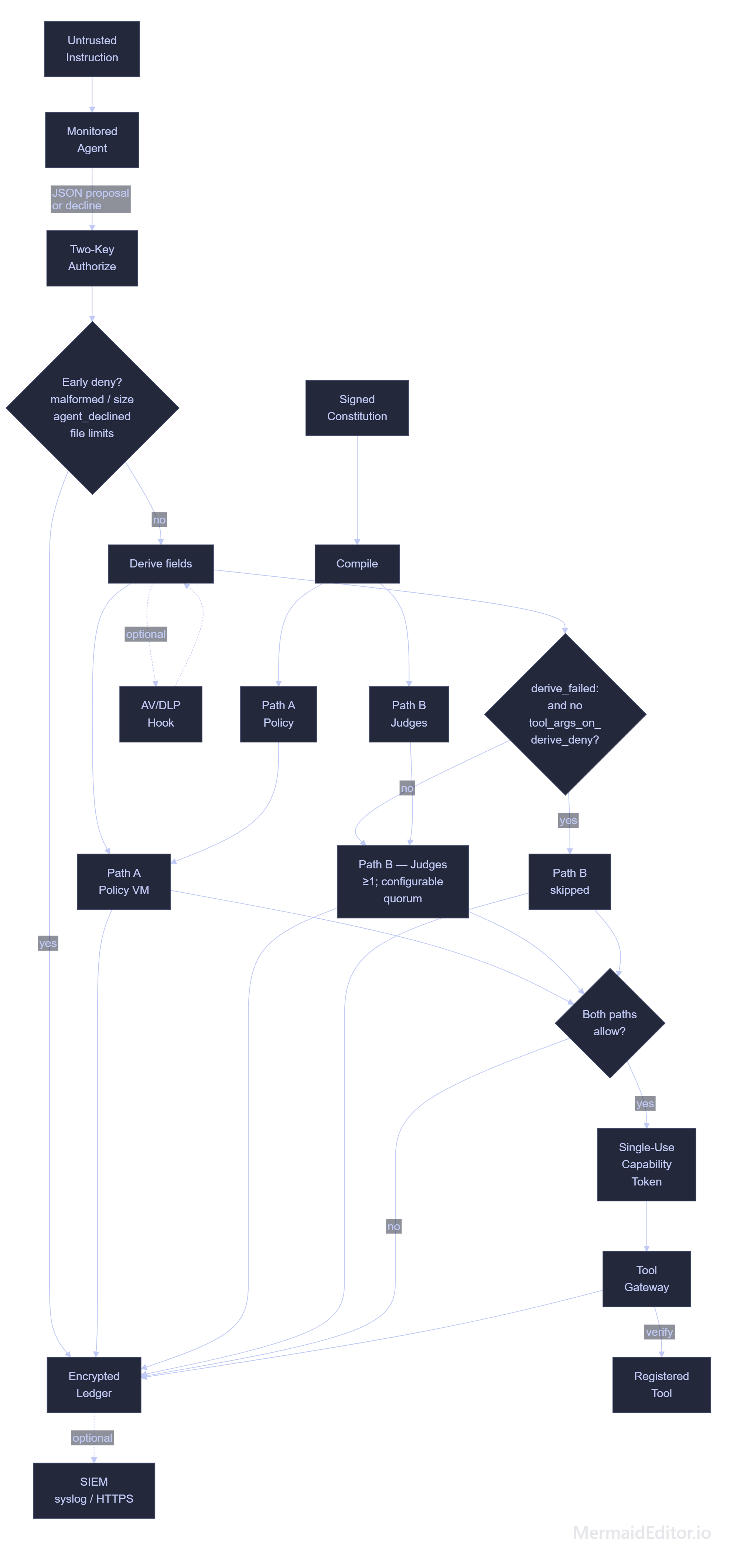
MonitoredAgent.complete sends the constitution prose and the instruction.
It does not receive Path A bytecode, judge credentials, or tool
credentials. It receives tool_specs only as the opt-in, read-only
vocabulary=tk.agent_vocabulary(tools=[...]): tool ids, argument paths,
value syntax, floors, and data classes, never a value (no allow list,
enum value, bound, or rule). The exact values a call needs, such as the
payee id, come from the instruction or the prose (HOWTO "Designing a
constitution"). Either way Path A checks every call.
Its reply is data: tool, arguments, proposal, and optional structured
fields, or a decline ({"decline": "<reason>"}), which is a ledgered
agent_declined deny with no token and neither path run. Omitting
data_class means classified, whatever the tool's floor is. Classes
combine as a set: medical or financial on a personal tool stays
medical or financial, both together are financial+medical, and only
classified is classified (HOWTO "Data classes"). Extra keys are rejected. authorize_from_agent parses that JSON,
records agent id, hosting, and trusted: false, and does not call the
model again. Those fields are operator/library metadata (str, at most 256
characters after strip); non-str or oversize is a deny. Hosting is local or
cloud. It is not trust, and it does not skip either path.
Path A reads only the structured fields: the five built-in ones and the
declared custom fields, all derived from the argument bytes. Path B judges see the
normalized action record. Non-empty tool arguments are attached on that
record as tool_args, except after a derive deny. Set
tool_args_on_derive_deny: true on the quorum policy to send those bytes
anyway; without it, a derive_failed: call is not sent to the judges at
all. A rule deny that is not a derive deny still attaches the arguments. The proposal string is not sent unless that
judge has receives_proposal: true, or the quorum policy is
judge_inputs: record_and_proposal. The code default, and
examples/judges.yaml, is record_only.
Judges are loaded into TwoKey from their own config and their own API
keys. The operator declares the monitored agent (monitored_agent: in
judges.yaml, or TwoKey(monitored_agent=...)): its model, base_url, and
credential. The agent's own report is never used. At start-up TwoKey
resolves every judge and the agent to a normalized model (Unicode forms
and dashes folded), the endpoint host:port, the upstream that serves it
and how that was found (resolved_by: endpoint, model_prefix, or
declared_upstream), scoped tenant ids (a tenant: mapping of
organization, project, account, or deployment, plus what the URL
shows), and a credential fingerprint under a per-install key, whitespace
stripped (HMAC-SHA256 for an API token; PBKDF2-HMAC-SHA256, 600,000
iterations, for a username and password, fingerprinted as one pair, and for
any secret that contains :). Every credential a side holds is fingerprinted, sent or not.
A judge may run any model from any vendor. A judge is not the monitored agent, and
TwoKey refuses to start (judge_matches_agent:), when it holds the monitored
agent's credential (the same API token, or the same username and password),
at any address: a credential identifies its holder wherever it is sent. Two
sides that send no credential are the same agent only on the same address (the
endpoint host:port, every alias of this machine folded to localhost),
where nothing tells them apart. Everything else starts. Likely accidents
are allowed with a two-key: WARNING: line on stderr and recorded in
constitution_loaded (judge_agent_separation.warnings): the same model
on the same address, the same model through a shared route or a local or
unrecognized proxy with no declared upstream:, a shared tenant id, one
side keyless on the same address, and an identity whose upstream cannot be
resolved. Addresses are compared as configured; DNS names are not
resolved. A username and password are sent as HTTP Basic over HTTPS only.
allow_same_provider_judge and allow_same_model_distinct_tenant are
accepted and have no effect. Without a declaration it refuses with
monitored_agent_required:. Provider labels are never compared. HOWTO has
the details.
Judges vote in parallel under one hard deadline. A missing, malformed, or
timed-out ballot is an abstention, and an abstention is not a yes. No
judge, no deadline, or two judges with the same id does not start. Each
ballot is paired with its judge by position and takes its judge id from
the judge; a ballot that names another judge abstains
(judge_id_mismatch). A cloud judge makes the round deny when
agent_session is missing. A judge is cloud when it is not on a loopback
host, or when its model name ends in :cloud or -cloud, on any host
(an Ollama cloud model served through localhost is still cloud). If that string equals the credential of any judge, local or
cloud, wherever it connects, the ballot abstains with
cloud_judge_reused_agent_session and the round denies. The credential
named for the monitored agent is compared the same way on every call, so a
placeholder does not hide that key. The key is not sent to the judge and
not written to the ledger. A session that is not that key is still yours
to pass. X-Two-Key-Judge-Session is a call id minted here. It is not a
session at the model host.
Without a local judge, the constitution prose, the action record, and any attached tool arguments go to the cloud judges' vendors.
Judges do not enforce the allow lists or the data class; Path A does.
judges.yaml and agents.yaml are trusted operator configuration: a
callback auth entry imports the module it names, so whoever can write
those files can run code in the TwoKey process.
Every decision in the ledger records policy_digest, the digest of the
quorum policy in effect (opt-outs included, written in full once in
constitution_loaded), and identities_digest, the digest of the resolved
judge and agent identities written once in constitution_loaded: model,
upstream, endpoint, tenant ids, and credential fingerprint, never a key.
Every JSON and YAML input is parsed strictly: a repeated key at any depth
is refused, never last-one-wins, and so is a YAML merge key (<<), whose
winning value the text does not show. An integer of more than 4,300 digits
is refused or denied as invalid_call. Unknown top-level keys in judges.yaml or
agents.yaml are refused. Tool arguments or a proposal over 256 KiB, or
tool arguments, the action claim, or a structured proposal nested more than
62 levels, are denied before they are ledgered.
One call, in code order:
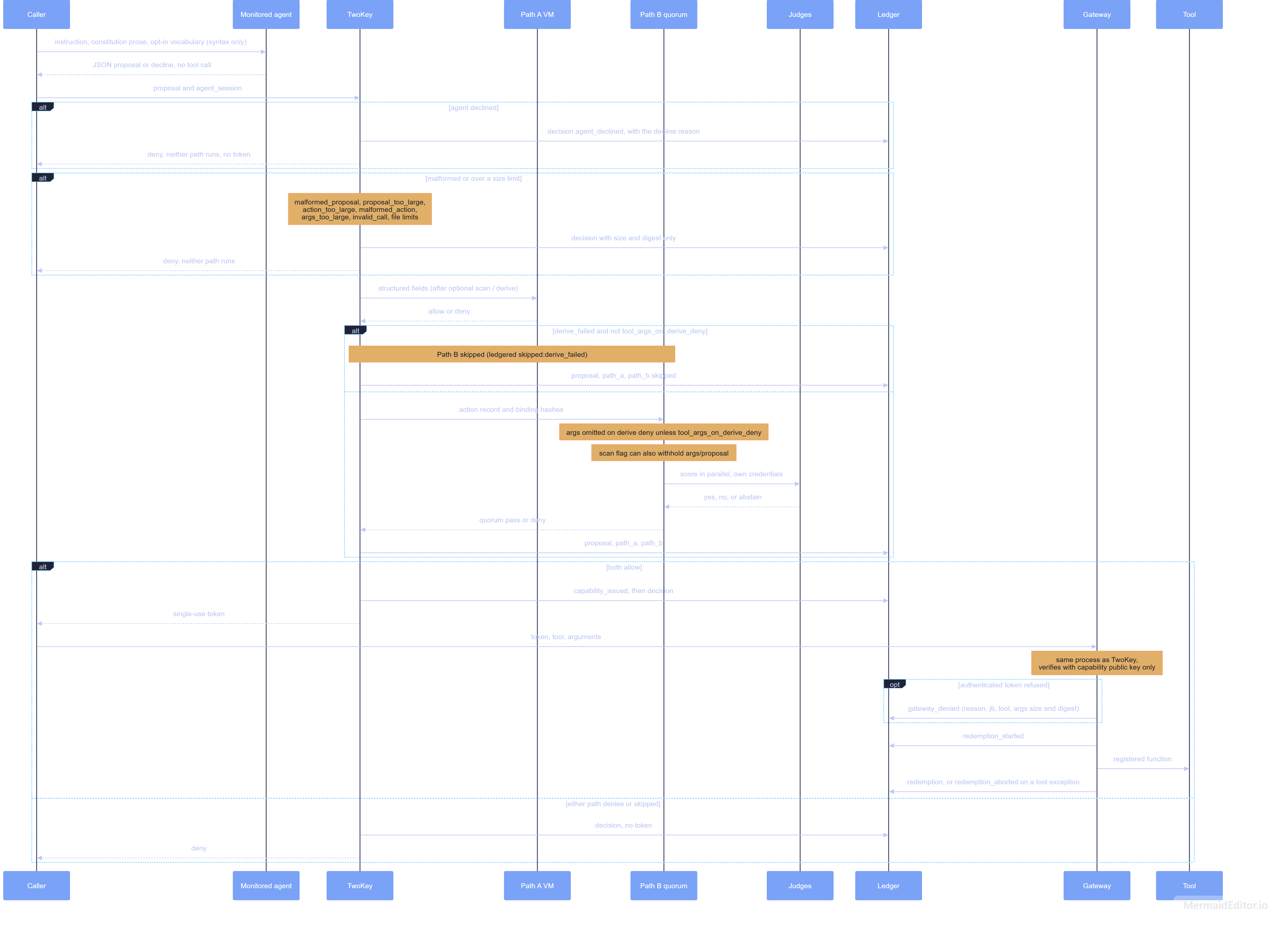
The token is signed by the capability key (<ledger>.capability/capability.pem,
outside the ledger directory). It is bound to the tool, the argument hash,
the ledger Merkle root and size at issuance, the constitution hashes,
spec_hash, and the derived form. The gateway is built with
TwoKey.gateway() (or ToolGateway(tk.ledger, tk.issuer.verifier(), ...)
in the same process); either way it keeps only the public half of the
capability key. It recomputes the form from the same bytes. It checks the
signature, expiry, a lifetime no longer than the TTL (ttl_too_long), an
issue time at most 5 s ahead (issued_in_future), and that nothing revoked
or reloaded the constitution after issuance. It writes redemption_started before the tool runs. It does not
scan the bytes for sensitive text. The principal key still signs the
constitution and the ledger head. A token signed with that principal key
does not redeem, and a capability key equal to the principal key is
refused. The capability key is created once, mode 0600 in a 0700
directory, and, like the witness key, is read only as a regular file that
the group and others cannot read, never through a symlink. Once a token has been issued it is never regenerated: a missing
or changed key refuses to start. Its fingerprint is recorded in
constitution_loaded and the gateway checks it.
The gateway runs in the TwoKey process, on the ledger object TwoKey
uses. Build it with TwoKey.gateway(). A gateway in another process or on
another host is not supported
(#45):
a Ledger opened elsewhere does not see tokens issued after it opened, so
it refuses them, and it would hold the principal, witness, and ledger keys
anyway. A gateway built on a ledger no TwoKey in the process opened emits
TwoKeyDeploymentWarning once per process.
The gateway's verifier holds only the capability public key, so the
gateway object cannot mint. That is an API property, not key isolation.
The same process holds the capability minting key (TwoKey.issuer) and,
on the shared ledger object, the principal, witness, and ledger keys. The
registered tools run in that process too. Python gives no memory isolation
inside one process, so a compromised tool or dependency can read every one
of those keys. Keep tools small and trusted, or put the work they do
behind a service of their own.
What this repo leaves out
Not in this repository:
- a scanning, antivirus, or DLP engine of its own
- a SIEM, log management, or alerting product of its own
- enterprise deployment modes and permissioned-chain anchoring
- X.509 / PKI identities and agent assertions
- seed-phrase backup
- hybrid ML-DSA-65
Some of this is planned as optional additions. See the roadmap. DLP and antivirus hooks shipped in 0.6.0 (an interface that calls your antivirus or DLP product, not a scanning engine: docs/SCANNERS.md). The SIEM export, which shipped in 0.7.0, feeds the collector you run; it does not store, search, or alert (docs/SIEM.md). After 1.0 come PKI with certificate recovery and hybrid ML-DSA-65. Key backup shipped in 0.3.0 and is not seed-phrase backup. Enterprise deployment modes, permissioned-chain anchoring, and seed phrases are not planned.
The ledger is encrypted at rest.
Crypto here is Ed25519 and SHA-256 via the cryptography package. Ledger
entries and the signed head are AES-256-GCM at rest. The data key is wrapped
by a ledger key outside the ledger directory, not by the principal key. The
head is signed by the principal and by a witness key, also outside the ledger
directory. A stolen principal key alone cannot decrypt the log or sign a new
head. The witness public key is pinned in the ledger (the first entry,
witness_pinned), so a replaced witness.pem is refused
(witness_key_changed). With the ledger key as well, the principal key can
still rewrite the chain from its first entry, pin included, unless the
operator also gives the witness public key as configuration
(Ledger(..., witness_public_key=...) or --witness-public-key), kept
where whoever writes the ledger directory cannot change it. With that pin,
forging a head needs the principal, witness, and ledger keys together. The
witness key changes only by a ledgered rotation (two-key rotate-witness).
Status: beta (pre-1.0). It is maintainer-reviewed with live LLM testing and
automated scanners (Semgrep, DeepSource, Bandit, CodeQL), not independently
audited. It is not a FIPS 140-3 validated module.
Known limits
- No independent review and no production deployment.
- Two-Key verifies that the call that runs is the call both keys approved.
It does not verify facts the agent asserts: a custom field read from the
arguments (for example
po_matched: true) is the agent's word. The tool or the integration must check such facts against the system of record (HOWTO "What Two-Key verifies"). From 0.5.0, asource: callerfield takes the fact from the integration's own lookup instead; that fact is as good as the lookup, which Two-Key does not check. - No external anchor for the ledger. Someone holding the principal and
ledger keys can rewrite a ledger that never leaves the machine, unless
the witness public key is configured outside the ledger
(
--witness-public-key); then the witness key is needed too (#58). A head anchor outside the ledger directory (<ledger>.ledger-key/head.anchor, or--head-anchor) refuses a rollback or a wipe of the ledger directory alone (#62). It does not refuse them if that anchor is deleted or rolled back with the ledger. Someone who can write the anchor file can still do both. It is not an external anchor. - Not FIPS 140-3 validated. A FIPS approved mode that runs on a validated module is on the roadmap. It would not validate this package.
- Signatures are Ed25519, which is not quantum resistant. Hybrid signatures are on the roadmap.
- Identities are bare keys. There is no certificate chain, expiry, or revocation. PKI with certificate recovery is on the roadmap.
- It is not an antivirus or DLP product. From 0.6.0 it can call one you run (docs/SCANNERS.md). Without one, a content leak in free text rests on the judges. Tool results are never scanned.
- It is not a SIEM. From 0.7.0 it can send each ledger entry
to the collector you run, over TLS by default; a plaintext sink is
refused under
high_assuranceand warns otherwise. Whoever can read that collector reads ledger metadata, a collector that is down leaves the copy behind until it returns, and what the collector keeps or alerts on is yours, not Two-Key's (docs/SIEM.md). - Behind the MCP proxy, an agent that can reach the upstream server directly bypasses it, and an upstream server running as the proxy's OS user can read the proxy's keys. Run each as its own user (HOWTO "Key custody").
- A key backup is only as strong as its passphrase. The bundle is the keys.
PBKDF2 slows guessing and is not memory-hard. It is not a seed phrase and
not an external anchor. A restore onto a newer ledger fills missing key
files and leaves a key that is already there.
--replace-ledgercan make a token spent after the backup look unspent, and it replaces a key file that differs.
The full register is docs/THREAT_MODEL.md.
Roadmap
The MCP adapter shipped in 0.5.0; Windows support, DLP and antivirus hooks, and judge connection reuse shipped in 0.6.0. The ledger export for a SIEM shipped in 0.7.0; a public review and the 1.0 release come next. It states intent, not a promise: the order may change, and version numbers are targets, not dates. The detail, and what comes after 1.0, is in ROADMAP.md.

| Version | What | Status |
|---|---|---|
| 0.4.0 | This repository and the package name two-key |
Released, tag v0.4.0 |
| 0.5.0 | MCP proxy and spec drafter, caller-supplied facts, the guard core | Released, tag v0.5.0 |
| 0.6.0 | Windows support; DLP and antivirus hooks that call external scanners (ClamAV, ICAP products, a command, Python); judge connection reuse (#6) | Released, tag v0.6.0 |
| 0.7.0 | Ledger export for a SIEM: live syslog or webhook delivery and a verified file export, no argument values; a count of refused tokens kept outside the ledger | Released, tag v0.7.0 |
| 1.0.0 | Judge history summary (#1) and per-judge ballot records, then a public community review. Described as community-reviewed, not audited. The first PyPI upload is 0.7.0 | Planned |
| After 1.0 | PKI and certificate recovery, hybrid Ed25519 plus ML-DSA-65 signatures, FIPS approved mode, a local GUI, an optional reputation halt, more spec field types | Not scheduled |
Install and versions
Two-Key runs on Linux, macOS, and, from 0.6.0, Windows, with CI on all
three (HOWTO "Platforms"). Version 0.7.0 is on PyPI. It is this beta, not
the 1.0 community review. Tag v0.7.0 is not moved.
pip install "two-key[yaml]==0.7.0"
v0.7.0 adds the ledger export for a SIEM, a start-up check for the account
the monitored agent runs as, and a count of the tokens the gateway refuses.
main holds that release and the fixes merged since; working is where the
next changes land. For the previous release, use @v0.6.0: Windows support,
content scanning that calls your antivirus or DLP product (ClamAV, ICAP, a
command, or Python), a start-up check for paths another account could
change, and judge connection reuse. @v0.5.0 is the MCP proxy, the spec
drafter, caller-supplied facts, the guard core, and constitution v3.
@v0.4.0 is the 0.3.1 code under the new package name two-key. Tags v0.3.1 and earlier are in the archived
two-key-concept repository, where v0.3.0 stays on e44be56, v0.2.4 on
fc836bb, v0.2.3 on 4a4352e, and v0.2.0 on 2f756ac.
Upgrading from an older version: read the "Upgrading" notes in CHANGES.md for every version you skip.
- 0.2.3 refuses the
vendor:andmin_vendors:keys, refuses some judges 0.2.2 accepted (one holding the agent's credential without sending it, or in the other form), and pins each ledger's witness key on its first open: "Upgrading from 0.2.2" (and "Upgrading from 0.2.1" and "Upgrading from 0.1.12" from older versions). - 0.2.4 writes a head anchor on the first open of an existing ledger and refuses a rolled-back ledger directory: "Upgrading from 0.2.3".
- 0.3.0 adds key backup, custom Path A fields, and
TwoKey.gateway()(#45). Existing ledgers and constitutions open unchanged: "Upgrading from 0.2.4". A constitution that declares custom fields signs as v2, which installs before 0.3.0 refuse: "Custom Path A fields" > "Upgrading". - 0.3.1 changes how data classes combine and adds agent declines: "Release v0.3.1" > "Upgrading".
- 0.4.0 renames the package and its file formats. Key files still load; re-sign the constitution, start a new ledger, and export a new backup: "Upgrading from 0.3.1".
- 0.5.0 adds constitution v3, for caller-supplied
facts and the run 6 follow-ups. Check before upgrading: a constitution in
which a tool neither maps nor marks
not_applicablea field a rule reads no longer loads, and anallowentry that starts with@is now a whole domain. A call that cannot be read under its spec is no longer sent to the judges. "Upgrading from 0.4.0" and the run 6 entries in CHANGES.md. - 0.6.0 loads 0.5.0 constitutions, ledgers, keys, and
proxy.yamlfiles unchanged. Check before upgrading: at start it names each file or folder it runs or reads that another account could change, and underhigh_assuranceit refuses to start until there are none. "Release v0.6.0" > "Upgrading from 0.5.0" in CHANGES.md. - 0.7.0 loads 0.6.0 constitutions, ledgers, keys, and
proxy.yamlfiles unchanged, and sends nothing without asiemsetting. Check before upgrading: underhigh_assurancea plaintext syslog sink (udportcp) refuses to start, and the proxy refuses to start when the monitored agent runs as Two-Key's own account or can change Two-Key's files. "Release v0.7.0" > "Upgrading from 0.6.0" in CHANGES.md.
A clone installed with pip install -e follows the ranges in
pyproject.toml. CI does not: it installs the versions in uv.lock
(cryptography, PyYAML, the MCP SDK for the mcp extra, and their
dependencies), wheels only. To match CI, use the uv version pinned in
.github/workflows/tests.yml:
pip install --only-binary :all: "uv==0.13.0"
uv sync --locked --no-build --extra yaml --extra mcp --no-dev
.venv/bin/python -m unittest discover -s tests
Layout
The middle column on the GitHub file list is the last commit that touched that file, not a description of the file. This table is the description.
| Path | What |
|---|---|
two_key/core.py |
TwoKey.authorize and authorize_from_agent |
two_key/audit.py |
check_decision_digests: recompute each decision's identities_digest and policy_digest |
two_key/policy_vm.py, compiler.py |
Path A |
two_key/derive.py |
Tool-spec derivation for Path A's form |
two_key/fields.py |
Custom Path A fields: registry, types, character sets, limits |
two_key/quorum.py, two_key/judges/ |
Path B and judge transport |
two_key/identity.py, netloc.py |
Judge ≠ monitored agent check; local vs. cloud host |
two_key/strict.py |
Strict JSON and YAML loading (duplicate keys, merge keys, and huge integers refused) |
two_key/agents.py |
Monitored-agent hooks |
two_key/ledger.py |
Encrypted ledger; ledger key and witness live outside the directory |
two_key/capability.py, gateway.py |
Tokens and redemption. The gateway verifies only. |
two_key/guard.py |
One guarded call through both keys, with caller-supplied fact hooks (any agent loop; the MCP proxy uses it) |
two_key/siem.py, siem_sinks.py, siem_export.py |
SIEM export: the per-kind field allowlist and schemas, the syslog and webhook sinks, and the file export and its offline check |
two_key/scan.py, scanners.py |
Content scanning: the core, and adapters for ClamAV, ICAP, a command, and Python |
two_key/_platform.py, writable.py |
Owner-only files, locks, and no-follow opens on POSIX and Windows; the start-up check for paths another account could change |
two_key/mcp_proxy/ |
MCP proxy and spec drafter (mcp extra). config.py and core.py decide; sdk.py is the only module that imports the MCP SDK; draft.py drafts specs |
two_key/keys.py, cli.py, backup.py |
Key files; two-key command line; passphrase backup of the package's own keys |
two_key/action.py |
Normalized action record and its validation |
two_key/agent_meta.py |
Bounds on operator- or library-supplied agent identity metadata written to the ledger |
two_key/canonical.py |
Canonical encoding for the ledger, tokens, and judge bindings |
two_key/constitution.py |
Signed constitution: prose for Path B, hard rules for Path A, and tool specs |
two_key/testing.py |
Offline test doubles only; not real judges |
examples/ |
Constitution, hard rules, custom fields, judges, agents, and the Elastic SIEM example |
pyproject.toml |
Package name two-key, version, dependencies, extras, and the two-key command |
MANIFEST.in |
Docs and examples included in the source distribution. The wheel is only two_key |
docs/PYPI.md |
How to register the name and publish with trusted publishing, without a token in the repo |
.github/workflows/pypi-publish.yml |
Build, metadata check, SBOM, and the tokenless upload. The file is on main; a run publishes only from branch PyPI or a matching version tag |
History and license
Development moved here from the archived two-key-concept repository at 0.3.1; its history is preserved in this repository.
Apache License 2.0. See LICENSE.
1 maintainer

Metadata
1 maintainer
Release files for two-key 0.7.1
For a detailed explanation of source distributions (sdists) and built distributions (wheels), please see the package formats documentation.
Source distribution (sdist)
| File | Size | Uploaded | Provenance | |
|---|---|---|---|---|
| two_key-0.7.1.tar.gz | 4.7 MB | With provenance | Details |
Built distribution (wheel)
| File | Interpreter | ABI | Platform | Reset |
|---|---|---|---|---|
| two_key-0.7.1-py3-none-any.whl | Python 3 | none | any | Details |
Total release size: 5.0 MB
Release files / two_key-0.7.1.tar.gz
| Download URL | two_key-0.7.1.tar.gz |
|---|---|
| Size | 4.7 MB |
| Tags | Source |
|
SHA-256 checksum How to use checksums |
ddde159f2732e230cdd7f9b50c8c2fcddabf37cbeb167127f8a805fc19657931
|
|
BLAKE2b-256 checksum How to use checksums |
bf41890db7043da4248e50a22925ed8e26592945cf06bc95a6c15248a5a2e993
|
| Upload date | |
|
Uploaded using Trusted Publishing? What is trusted publishing? |
Yes |
| Uploaded via |
twine/7.0.0 CPython/3.13.14
|
Provenance
Provenance describes where a file came from. On PyPI, provenance is shared via attestations, which provide a verifiable record of the build or publishing details. View details, limitations and caveats.


PyPI Publish Attestation
PyPI verified that this artifact, at this checksum, originated from the publisher listed below.
Signed by GitHub Actions, verified by PyPI on Oct 17, 2026.
Transparency logRelease files / two_key-0.7.1-py3-none-any.whl
| Download URL | two_key-0.7.1-py3-none-any.whl |
|---|---|
| Size | 271.5 kB |
| Tags | Python 3 |
|
SHA-256 checksum How to use checksums |
17bf01bc553213a555229645d2a25b0cc132b14803beddc032492de92a69bc71
|
|
BLAKE2b-256 checksum How to use checksums |
76cab2acf2ef8dfc3d4ec6209968aaa963a9d464d988cac7ab2fa213c9c44de2
|
| Upload date | |
|
Uploaded using Trusted Publishing? What is trusted publishing? |
Yes |
| Uploaded via |
twine/7.0.0 CPython/3.13.14
|
Provenance
Provenance describes where a file came from. On PyPI, provenance is shared via attestations, which provide a verifiable record of the build or publishing details. View details, limitations and caveats.
PyPI Publish Attestation
PyPI verified that this artifact, at this checksum, originated from the publisher listed below.
Signed by GitHub Actions, verified by PyPI on Oct 17, 2026.
Transparency logSecurity for two-key 0.7.1
Provenance
Provenance describes where a file came from. On PyPI, provenance is shared via attestations, which provide a verifiable record of the build or publishing details. View details, limitations and caveats.
Full provenance
All 2 files in this release have been uploaded with provenance metadata.
Attestation for two_key-0.7.1.tar.gz
PyPI Publish Attestation
PyPI verified that this artifact, at this checksum, originated from the publisher listed below.
Signed by GitHub Actions, verified by PyPI on Oct 17, 2026.
Transparency logA note on package security
PyPI is a repository for distributing packages, not a service for auditing them. While third-party security researchers and our staff do their best to detect and remove malicious packages, PyPI cannot guarantee the quality, security or suitability of any given package.
To learn more about protecting yourself from malicious actors, visit our package security documentation.














