
unitx



Write physical formulas with units and constants in Python.
unitx keeps unit scales and rational powers exact. It checks dimensions at
runtime and provides type hints for magnitudes. Use it for scalar quantities,
temperature and logarithmic readings, and optional NumPy arrays.
Install
Requires Python 3.12 or later. The base package has no runtime dependencies.
pip install unitx
New to unitx? Follow the ten-minute introduction from a first formula to an array and plot, then try the three complete scientific workflows.
Calculate with units
Use si for units and SI for physical constants. For example, si.c is a
speed unit and SI.c is the speed of light as a quantity.
>>> from unitx.si import SI, si
>>> distance = 3 * si.m
>>> duration = 2 * si.s
>>> speed = distance / duration
>>> print(speed)
1.5 m/s
>>> print(speed.to(si.cm / si.s))
150.0 cm/s
>>> rest_energy = (SI.me * SI.c**2).to(si.MeV)
>>> print(round(rest_energy.value, 6))
0.510999
Addition aligns compatible units. Multiplication, division and powers combine
units. A conversion between incompatible dimensions raises DimensionError.
>>> distance.to(si.s)
Traceback (most recent call last):
    ...
unitx.exceptions.DimensionError: Cannot convert unit 'm' (dimension L) to unit 's' (dimension T): incompatible dimensions.
Temperatures and logarithmic readings
Use @ for an absolute reading and * for a difference.
>>> difference = 20 * si.degC  # A temperature difference of 20 degrees
>>> room = 20 @ si.degC  # A reading of 20 degrees Celsius
>>> difference.value_in(si.K)
20
>>> print(room + 5 * si.K)
25 °C
>>> (30 @ si.degC) - room == 10 * si.K
True
>>> (30 @ si.dBm).to_quantity(si.W) == 1 * si.W
True
Subtracting two points gives a difference. Adding two points raises
TypeError. See points and differences
and logarithmic quantities.
Blackbody radiation
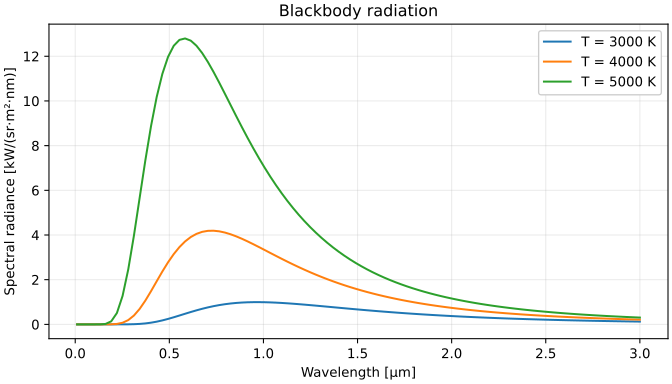
Run pip install 'unitx[matplotlib]' to try this example. NumPy broadcasts the
wavelength column against three temperatures in Planck's formula. The plot
uses the numerical values in the chosen display units.
import numpy as np
from matplotlib import pyplot as plt

from unitx.si import SI, si

wavelength = np.linspace(0.01, 3, 100)[:, None] * si.um
temperature = np.asarray([3000, 4000, 5000]) * si.K
exponent = SI.h * SI.c / (wavelength * SI.kB * temperature)
radiance = 2 * SI.h * SI.c**2 / (wavelength**5 * np.expm1(exponent))
radiance = radiance.to('kW/sr/m2/nm')

fig, ax = plt.subplots(figsize=(7, 4), layout='constrained')
ax.plot(wavelength.value, radiance.value)
ax.set(
    xlabel=f'Wavelength [{wavelength.unit}]',
    ylabel=f'Spectral radiance [{radiance.unit}]',
    title='Blackbody radiation',
)
ax.legend([f'T = {value}' for value in temperature], framealpha=1)
ax.grid(True, alpha=0.25)
plt.show()
For automatic axis conversion with ax.plot(t, q), see the
Matplotlib adapter.
Scalar results and comparisons
True division of two Python integers gives a float, as in the speed example.
When unit alignment requires a rational scale, integer magnitudes can yield
a Fraction. Use float magnitudes for floating-point calculations.
>>> from unitx import Quantity
>>> print(Quantity(1, 'm') + Quantity(50, 'cm'))
3/2 m
>>> print(Quantity(1.0, 'm') + Quantity(50, 'cm'))
1.5 m
>>> Quantity(1, 'm') == Quantity(100, 'cm')
True
>>> a, b = Quantity(0.1, 'm'), Quantity(10, 'cm')
>>> a == b
False
>>> a.isclose(b)
True
Exact scalar comparison uses the stored binary value of a float, so 0.1
metres differs from exactly one tenth of a metre. Use .isclose() when a
tolerance is appropriate. See scalar numerical behavior
for result types, Decimal arithmetic and tolerances.
Strings passed to Quantity and .to() use the default registry, where
MB means megabel. For megabytes, pass information.MB or
information.unit('MB') from the information catalogue.
Work with NumPy
Array support requires NumPy 2.1 or later. Install both packages with
pip install 'unitx[numpy]'. One Quantity wraps a whole array with one unit.
import numpy as np

from unitx import Quantity
from unitx.si import si

positions = Quantity(np.array([1.0, 2.0, 3.0]), si.m)
velocity = positions / (2 * si.s)
mean_velocity = np.mean(velocity)
assert mean_velocity == 1 * si.m / si.s
np.testing.assert_allclose(velocity.value_in(si.cm / si.s), [50, 100, 150])
NumPy handles broadcasting, dtypes and rounding. unitx checks and combines units, and comparisons return boolean masks. See the NumPy support matrix.
.value gives the magnitude in the stored unit, and .value_in(unit)
converts before returning the magnitude. Use either to pass plain numerical
values to another library. np.asarray(quantity) and np.array(quantity)
raise TypeError to prevent implicit unit removal.
Read more
Start at the documentation site, or go directly to a topic:
| Topic | Guide |
|---|---|
| Construction, arithmetic, conversion and unit expressions | Units and quantities |
| Ready-to-use units, constants and spelling conventions | Catalogue |
| Custom definitions and cross-process restoration | Custom units and serialization |
| Unit-aware math, statistics and clock readings | Standard-library enhancements |
| Notebook, text, LaTeX, HTML and siunitx output | Display and formatting |
| Magnitude types and NumPy inference | Typing |
| Fitting, wave packets and measurement uncertainty | Scientific examples |
| Responsibilities, dependencies and measured costs | Architecture and performance |
| Version changes | Migration and changelog |
This README describes the current source tree. Public APIs may change during the 0.x series; consult a release's matching tag for its documentation. Development and release checks are described in the contributing guide.
Licensed under the MIT License.
1 maintainer

Metadata
1 maintainer
Release files for unitx 0.19.0
For a detailed explanation of source distributions (sdists) and built distributions (wheels), please see the package formats documentation.
Source distribution (sdist)
| File | Size | Uploaded | Provenance | Actions |
|---|---|---|---|---|
| unitx-0.19.0.tar.gz | 687.7 kB | With provenance | Details for unitx-0.19.0.tar.gz |
Built distribution (wheel)
| File | Interpreter | ABI | Platform | Actions Reset |
|---|---|---|---|---|
| unitx-0.19.0-py3-none-any.whl | Python 3 | none | any | Details for unitx-0.19.0-py3-none-any.whl |
Total release size: 872.2 kB
Release files / unitx-0.19.0.tar.gz
| Download URL | unitx-0.19.0.tar.gz |
|---|---|
| Size | 687.7 kB |
| Tags | Source |
|
SHA-256 checksum How to use checksums |
23cd431b0ff7a3e7d382d8a7dcb61eb1b201ddf2e2aae10636980661f25a1670
|
|
BLAKE2b-256 checksum How to use checksums |
e21a73b45bb138f091b78ac80a53923555a52aefa4710a7cfc0a86c068772d0a
|
| Upload date | |
|
Uploaded using Trusted Publishing? What is trusted publishing? |
Yes |
| Uploaded via |
twine/7.0.0 CPython/3.13.16
|
Provenance
Provenance describes where a file came from. On PyPI, provenance is shared via attestations, which provide a verifiable record of the build or publishing details. View details, limitations and caveats.


PyPI Publish Attestation
PyPI verified that this artifact, at this checksum, originated from the publisher listed below.
Signed by GitHub Actions, verified by PyPI on Nov 17, 2026.
Transparency logRelease files / unitx-0.19.0-py3-none-any.whl
| Download URL | unitx-0.19.0-py3-none-any.whl |
|---|---|
| Size | 184.5 kB |
| Tags | Python 3 |
|
SHA-256 checksum How to use checksums |
b7ee3bff42d13418b0ff42c964d4cdf66dd54819ab4d76dd1aa984386dcb09ae
|
|
BLAKE2b-256 checksum How to use checksums |
8572d7153cb41076ff4046acb883d67f1560f7830510809f325826c92d177340
|
| Upload date | |
|
Uploaded using Trusted Publishing? What is trusted publishing? |
Yes |
| Uploaded via |
twine/7.0.0 CPython/3.13.16
|
Provenance
Provenance describes where a file came from. On PyPI, provenance is shared via attestations, which provide a verifiable record of the build or publishing details. View details, limitations and caveats.
PyPI Publish Attestation
PyPI verified that this artifact, at this checksum, originated from the publisher listed below.
Signed by GitHub Actions, verified by PyPI on Nov 17, 2026.
Transparency logSecurity for unitx 0.19.0
Provenance
Provenance describes where a file came from. On PyPI, provenance is shared via attestations, which provide a verifiable record of the build or publishing details. View details, limitations and caveats.
Full provenance
Both files in this release have been uploaded with provenance metadata.
Attestation for unitx-0.19.0.tar.gz
PyPI Publish Attestation
PyPI verified that this artifact, at this checksum, originated from the publisher listed below.
Signed by GitHub Actions, verified by PyPI on Nov 17, 2026.
Transparency logA note on package security
PyPI is a repository for distributing packages, not a service for auditing them. While third-party security researchers and our staff do their best to detect and remove malicious packages, PyPI cannot guarantee the quality, security or suitability of any given package.
To learn more about protecting yourself from malicious actors, visit our package security documentation.














