
validation_loop
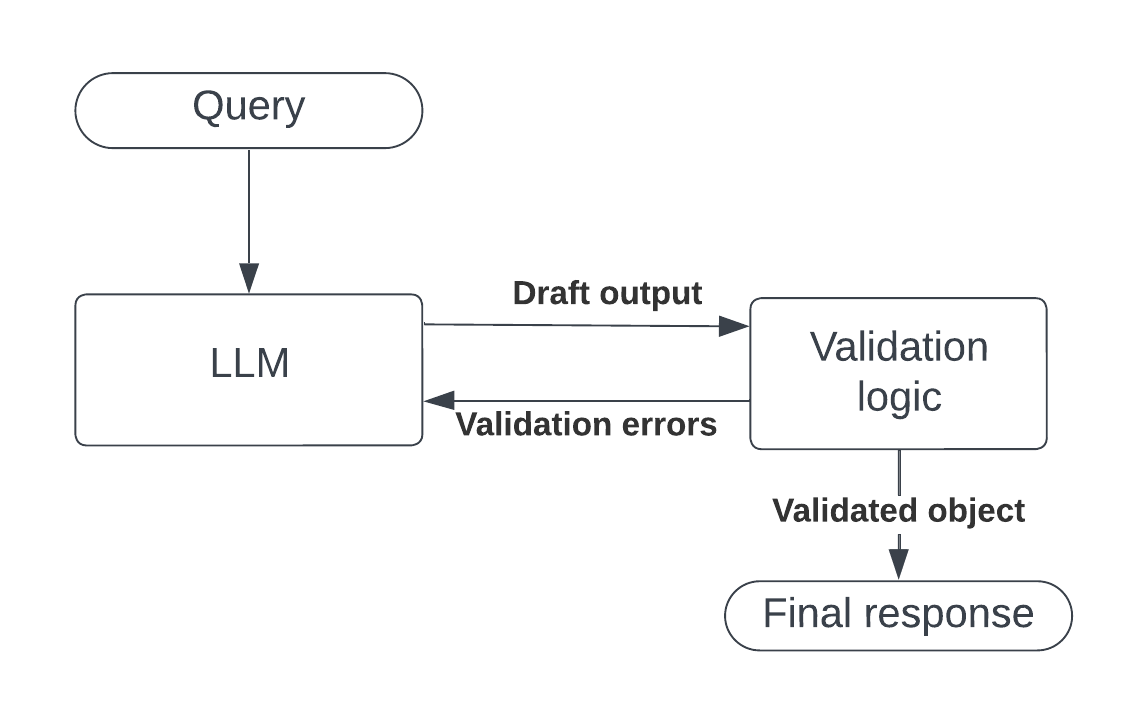
LLM structured output with automatic retry on validation failure.
validation_loop sends a prompt to any LLM, forces the response into a Pydantic model, runs your custom validation logic, and retries automatically if validation fails -- feeding the error back to the LLM so it can self-correct.
It uses Instructor for structured output extraction, LiteLLM for provider routing, and Tenacity for retry orchestration.
Installation
# Core (you still need a provider SDK installed for LiteLLM to route to)
pip install validation-loop

# With a specific provider
pip install validation-loop[openai]
pip install validation-loop[anthropic]
pip install validation-loop[mistral]
pip install validation-loop[google]
pip install validation-loop[cohere]

# All providers
pip install validation-loop[all]
Quick start
Function form
from pydantic import BaseModel, ValidationError
from validation_loop import validation_loop


class MovieReview(BaseModel):
    title: str
    rating: float
    summary: str


def validate_review(review: MovieReview) -> dict:
    """Business logic that runs after Pydantic validation.
    Raise an exception listed in retry_exceptions to trigger a retry."""
    if len(review.summary) < 20:
        raise ValueError("Summary is too short to be useful")
    return {
        "title": review.title.upper(),
        "rating": review.rating,
        "summary": review.summary,
    }


result = validation_loop(
    schema=MovieReview,
    prompt="Review the movie Inception in one short sentence.",
    validation_callable=validate_review,
    model="openai/gpt-4.1-mini",        # any LiteLLM model string
    max_attempts=3,
    retry_exceptions=(ValidationError, ValueError),
)
Decorator form
The val_loop decorator turns a validation function into a ready-to-call LLM pipeline. The Pydantic schema is extracted from the first parameter's type annotation:
from pydantic import BaseModel, ValidationError
from validation_loop import val_loop


class MovieReview(BaseModel):
    title: str
    rating: float
    summary: str


@val_loop(model="openai/gpt-4.1-mini", max_attempts=3, retry_exceptions=(ValidationError, ValueError))
def review_movie(review: MovieReview) -> dict:
    if len(review.summary) < 20:
        raise ValueError("Summary too short")
    return {"title": review.title.upper(), "rating": review.rating}


# Call it with a prompt:
result = review_movie(prompt="Review the movie Inception.")

# Override settings at call time:
result = review_movie(
    prompt="Review The Matrix.",
    model="anthropic/claude-sonnet-4-20250514",
    max_attempts=5,
)
The decorator also works without arguments, using defaults:
@val_loop
def review_movie(review: MovieReview) -> dict:
    return {"title": review.title}
Prompt formats
The prompt parameter accepts a plain string (shown above) or a list for more advanced use cases -- multi-turn conversations, images from local files, and image URLs. See PROMPT_FORMATS.md for details and examples.
How it works
- Your Pydantic schema is wrapped in a subclass that runs
validation_callableinsidemodel_post_init, so both Pydantic validation errors and your custom errors are visible to Instructor's retry loop. - Instructor calls the LLM via LiteLLM and parses the response into the schema.
- If validation fails, the error text is appended to the conversation and the LLM is called again.
- After
max_attemptsfailures, aRuntimeErroris raised with the last validation error as the cause.
API reference
validation_loop(schema, prompt, validation_callable, ...)
| Parameter | Type | Default | Description |
|---|---|---|---|
schema |
Type[BaseModel] |
required | Pydantic model defining the expected output |
prompt |
str | list |
required | See Prompt formats |
validation_callable |
Callable |
required | Called with the model instance; return value is returned on success |
model |
str |
"openai/gpt-4.1-mini" |
Any LiteLLM model string |
max_attempts |
int |
3 |
Max LLM calls before giving up |
retry_exceptions |
tuple[Type[Exception], ...] |
(ValidationError,) |
Exception types that trigger a retry |
@val_loop / @val_loop(...)
Decorator arguments: model, max_attempts, retry_exceptions (same defaults as above).
The decorated function accepts: prompt (required), plus optional keyword overrides for model, max_attempts, retry_exceptions.
ImageURL
from validation_loop import ImageURL
A simple wrapper marking a URL string as an image for use in prompt lists. See PROMPT_FORMATS.md.
License
MIT
1 maintainer

Metadata
1 maintainer
Release files for validation-loop 0.1.1
For a detailed explanation of source distributions (sdists) and built distributions (wheels), please see the package formats documentation.
Source distribution (sdist)
| File | Size | Uploaded | |
|---|---|---|---|
| validation_loop-0.1.1.tar.gz | 7.8 kB | Details |
Built distribution (wheel)
| File | Interpreter | ABI | Platform | Reset |
|---|---|---|---|---|
| validation_loop-0.1.1-py3-none-any.whl | Python 3 | none | any | Details |
Total release size: 16.5 kB
Release files / validation_loop-0.1.1.tar.gz
| Download URL | validation_loop-0.1.1.tar.gz |
|---|---|
| Size | 7.8 kB |
| Tags | Source |
|
SHA-256 checksum How to use checksums |
dfad56c2c9941162a47d914b3c2757424d81c93979e5a9bda721e15fe1ea7f92
|
|
BLAKE2b-256 checksum How to use checksums |
fe68a60ff88aab5217df7ca6a955da51ede8adb686b6d51ad9a2672da91f63d6
|
| Upload date | |
|
Uploaded using Trusted Publishing? What is trusted publishing? |
No |
| Uploaded via |
poetry/2.3.4 CPython/3.12.3 Linux/6.17.0-22-generic
|
Release files / validation_loop-0.1.1-py3-none-any.whl
| Download URL | validation_loop-0.1.1-py3-none-any.whl |
|---|---|
| Size | 8.7 kB |
| Tags | Python 3 |
|
SHA-256 checksum How to use checksums |
24bc5cb7e345b7886ed6ac8a374629c57e7fbeaf19e5ddd1e09fc287ba72b47b
|
|
BLAKE2b-256 checksum How to use checksums |
78b1c703e7748b752405dc4c2f32681c4ff8c4fb31c0114d62a14e9515a5caef
|
| Upload date | |
|
Uploaded using Trusted Publishing? What is trusted publishing? |
No |
| Uploaded via |
poetry/2.3.4 CPython/3.12.3 Linux/6.17.0-22-generic
|














