
veil
Reversible PII masking for LLM calls. Mask personal data before the prompt leaves your network, let the model reason over consistent surrogates, and restore the originals in the answer — streaming included.




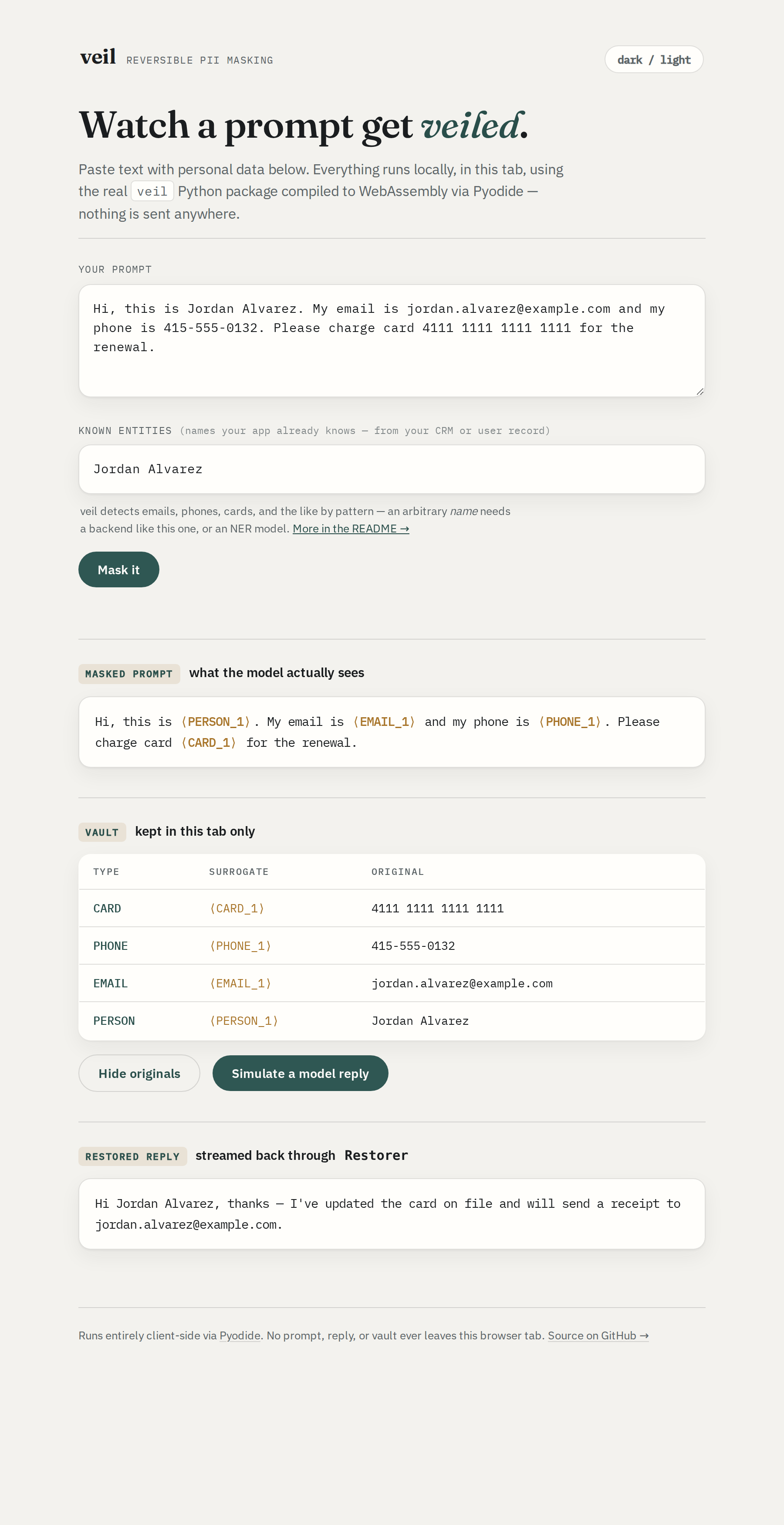
Try the live demo → — runs the
real Python package in your browser via Pyodide,
nothing leaves the page: its Content-Security-Policy lets it talk to its own
origin and to the CDN Pyodide is downloaded from, and to nothing else.
(web/; see Web demo below.)
On real text
veil's own benchmark is a corpus its generator wrote, and it scores 1.000 on it. A study in this repository ran it instead on text nobody wrote for it: phone numbers and email addresses as people typed them into OpenStreetMap in 46 cities, and 2.6 million words of system logs, CI logs and source code, where almost nothing should be masked.

- 0.4.4 masked 66% of 16,659 phone numbers written with a
+: 99% in the United States, 9% in France, 7% in Japan. It expected digits in groups of two to four. The detector now reads the calling code and checks the length that country uses: 99.9%, and 99.3% in 24 cities it was not changed against, where 0.4.4 found 53.9%. - In logs and code 0.4.4 masked eleven things per 1,000 words that were not
what it called them: 16,965 file paths and test names as secrets, 941
timestamps and block ids as card numbers,
::as an IPv6 address. Now 0.12 per 1,000, and 0.04 on a million words held out. - It caught 13% to 65% of random 20-character keys, because its entropy threshold was one a short key cannot reach and a file path can. Now 92% to 97%.
- Email addresses held up: 5,011 of 5,019. Numbers written without a
+outside North America are still missed.
These changes are in this repository and not yet in a release; pip install veil-pii gets 0.4.4.
Source update: mask the whole mailbox. first!last@example.org previously
became first!⟨EMAIL_1⟩, exposing part of the identity in outgoing SDK requests.
The source detector now covers full ASCII dot-atoms, supported international
and quoted local parts, and Unicode/punycode domains. A fresh recheck of the
retained contact corpus fully masks eight more email tags. Exact restoration,
actual SDK transport captures and syntax ambiguities are documented in the
mailbox study. The source and live browser
demo include this correction; the PyPI package remains unchanged.
The source also consumes all four IDNA domain separators:
an ideographic/fullwidth/halfwidth dot previously left a private domain suffix
visible or bypassed mailbox detection. Original spellings restore exactly.
The 2026-10-15 deployment record verifies all 27 served build files and actual offline workflows for IDNA mailboxes, temporary AWS key IDs and whole JWTs in both browser engines.
A literal example must not become someone's address. The source checkout
also corrects a masking collision: a prompt containing an email and the literal
token ⟨EMAIL_1⟩ previously used that token for both. Restoring the prompt
changed the example into the address. Allocation now reserves source literals,
and ambiguous reused mappings stop before output or an SDK request is sent.
Reproductions, actual SDK captures and browser downloads
show the correction and its limits. This change is not in the PyPI release.
Why this exists
Teams in healthcare, legal, finance, and support want to use hosted LLMs,
but their prompts contain customer names, emails, phone numbers, card
numbers, account IDs, and API keys. The usual answer is "redact it" —
replace the value with [REDACTED]. That breaks the response: the model
can't say "Dear [REDACTED], your order [REDACTED] ships tomorrow."
Veil replaces detected values with consistent surrogates and keeps their originals in a local vault. Its SDK adapters send the masked prompt and restore surrogates in the response, including those split across streamed chunks. Detection has limits: values it misses still reach the model. The linked studies measure those limits and retain examples of both misses and false positives.
How it works
flowchart LR
    A["Prompt\n(has real PII)"] -->|"Masker.mask()"| B["Masked prompt\n(surrogates only)"]
    B --> C["LLM"]
    C --> D["Response\n(surrogates only)"]
    D -->|"Masker.restore()\nor Restorer.feed()"| E["Restored response\n(real PII back)"]
    B -.->|"stores mapping"| V[("Vault")]
    E -.->|"looks up mapping"| V
- Detect. Regex-and-validation detectors (Luhn, mod-97, structural checks) find emails, phone numbers, cards, IBANs, SSNs, IPs, credential-bearing URLs, API keys, and dates of birth. A pluggable backend finds names/orgs/locations — see "Names, orgs, and locations" under Features below.
- Mask. Each detected value gets a surrogate — either a placeholder
token (
⟨EMAIL_1⟩) or a realistic fake (user1@example.com) — and the(original, surrogate)pair is recorded in aVault. The same original always maps to the same surrogate for the life of the vault. - Send. The masked text goes to the LLM. It never sees the real values.
- Restore. The response comes back full of surrogates.
restore_exact/restore_tolerantswap them back for a buffered response;Restorer.feed()does it token-by-token for a stream.
The streaming problem, concretely
Say the vault maps ⟨EMAIL_1⟩ to alice@example.com, and the model
streams its reply in small chunks:
chunk 1: "Sure, I'll email ⟨EM"
chunk 2: "AIL_1⟩ right away."
A restorer that looks at each chunk in isolation emits ⟨EM verbatim (the
placeholder leaks into what the user sees) and then has no memory of it
when AIL_1⟩ arrives in the next chunk. veil.restore.Restorer instead
recognizes that ⟨EM is a valid prefix of a known surrogate, holds back
only that trailing fragment, and completes the match once AIL_1⟩
arrives — emitting alice@example.com right away. with nothing leaked
and no extra latency beyond the one held-back fragment. It's built on a
trie over the vault's surrogate strings (see veil/restore.py), and
Hypothesis property tests prove that any way you split a given text
into chunks produces output identical to restoring it unsplit
(tests/test_restore_streaming.py).
Short credentials in ordinary URLs now follow the same explicit field policy:
client_secret, refresh_token, passwd and uppercase environment labels
protect the whole URL. Actual client requests and exact restoration
show the before/after behavior, including incorrect credentials.
Quickstart
pip install veil-pii
The registry version is 0.4.4. To use the unreleased corrections documented in this repository, install this tested source revision (requires Git):
python -m pip install --force-reinstall "veil-pii @ git+https://github.com/antonsoo/veil.git@ce74b2f1c84b124d703d0f2d9123517963732c27"
--force-reinstall also replaces an existing 0.4.4 installation: the source
revision still declares that version. The clean package and runtime receipt
compares all 40 runtime files with wheel, sdist and installed packages, plus
the 39 Python modules in the browser manifest. Native URL and restoration checks separate
the source correction from the unchanged registry package.
from veil import Masker

masker = Masker()
masked = masker.mask("Email alice@example.com about invoice #4471.")
print(masked)  # "Email ⟨EMAIL_1⟩ about invoice #4471."

# ... send `masked` to your LLM of choice, get `reply` back ...
reply = "Sure, I've noted it for ⟨EMAIL_1⟩."
print(masker.restore(reply))  # "Sure, I've noted it for alice@example.com."
With the Anthropic SDK
pip install "veil-pii[anthropic]"
from anthropic import Anthropic
from veil.integrations.anthropic import AnthropicVeil

client = AnthropicVeil(Anthropic())

response = client.create(
    model="claude-opus-5-5",
    max_tokens=1024,
    messages=[{"role": "user", "content": "Email alice@example.com about invoice #4471."}],
)
print(response.content[0].text)  # the real address, restored — Claude only ever saw a surrogate

# Streaming:
with client.stream(model="claude-opus-5-5", max_tokens=1024, messages=[...]) as stream:
    for text in stream.text_stream:  # already restored, split-token-safe
        print(text, end="", flush=True)
All three of the SDK's ways to stream come back restored: stream.text_stream,
iterating the stream's events (the API's deltas, and the SDK's own text and
input_json events and the snapshots on content_block_stop and
message_stop), and the raw event iterator of create(..., stream=True).
Tool-input JSON is restored as its fragments arrive. Text held back because it
might begin a surrogate is released before its block's content_block_stop.
AsyncAnthropicVeil is the same wrapper for AsyncAnthropic:
from anthropic import AsyncAnthropic
from veil.integrations.anthropic import AsyncAnthropicVeil

client = AsyncAnthropicVeil(AsyncAnthropic())
response = await client.create(model="claude-opus-5-5", max_tokens=1024, messages=[...])
async with client.stream(model="claude-opus-5-5", max_tokens=1024, messages=[...]) as stream:
    async for text in stream.text_stream:
        print(text, end="", flush=True)
Inline documents (source checkout, unreleased). Anthropic document title,
context, plain-text source.data and custom-content text now pass through
masking, including documents inside tool results. Previously all three example
contacts reached the SDK transport unchanged in each of the 36 retained requests.
Before/after SDK captures and supported forms.
PDF/image bytes and URL/file references remain opaque; sanitize them separately.
Returned citation quotes and locations stay exactly as the provider supplied
them and refer to the masked source, not character offsets in your original
document. Answer text is restored normally. The wrapper does not map citation
coordinates back to original text.
Retrieved search results (source checkout, unreleased). Anthropic
search_result source labels, titles and text blocks now pass through masking,
including results inside tool responses and content supplied as an iterator.
Previously all four recognized contacts reached transport unchanged in each of
36 SDK workflows. Citations retain the masked attribution and quotes; their
result/block indices and retained assistant replay stay intact.
Before/after captures and citation boundaries.
Tool-input serialization (source checkout, unreleased). Tuple values used
to bypass masking before the SDK turned them into JSON arrays. Custom model
objects and sensitive dictionary keys could also carry raw recognized
identifiers to transport. Fresh tool inputs now use plain JSON trees: tuple
entries are masked, detected sensitive keys reject, and opaque objects must be
serialized explicitly first, such as contact.model_dump(mode="json").
Numbers, booleans and null retain their types. The
44-workflow SDK replay captures 24 raw-value
request cases before and none after, across sync/async create and streaming
calls. Unchanged retained provider history still replays exactly; that history
is separate from fresh caller input.
With the OpenAI SDK
veil.integrations.openai.OpenAIVeil (the openai extra) wraps both of
OpenAI's APIs: create / stream for Chat Completions, and
create_response / stream_response for the Responses API. Passing
stream=True to create or create_response streams the same way, restored.
AsyncOpenAIVeil is the same wrapper for AsyncOpenAI (await each call,
async for over a stream).
from openai import OpenAI
from veil.integrations.openai import OpenAIVeil

client = OpenAIVeil(OpenAI())

response = client.create_response(
    model="gpt-6-sol",
    instructions="You draft customer emails.",
    input="Email alice@example.com about invoice #4471.",
)
print(response.output_text)  # restored; the model only saw ⟨EMAIL_1⟩

for event in client.stream_response(model="gpt-6-sol", input=[...]):
    if event.type == "response.output_text.delta":
        print(event.delta, end="", flush=True)  # restored, split-token-safe
For the Responses API, veil masks instructions and every message,
function_call, function_call_output and custom tool item in input. It
restores message text, refusals, tool-call arguments and reasoning summaries
in output, and response.output_text with them, since the SDK computes it
from output. Reasoning items pass through untouched. In a stream, text and
argument deltas are restored as they arrive, and any text held back because
it might begin a surrogate is released, as one more delta event, before the
matching .done event. With previous_response_id the server keeps the
masked history, so keep the same OpenAIVeil (and its vault) for the whole
conversation.
In a Chat Completions stream every choice has its own restorers (n > 1
choices arrive interleaved, and so do parallel tool calls), refusals are
restored like content, and held-back text is released in the chunk that
carries the choice's finish_reason, so nothing arrives after a choice has
finished or after the usage chunk.
The source checkout also masks Chat Completions refusal history (both the
refusal message field and refusal content parts), legacy
function_call.arguments, and custom-tool input. Complete replies restore
those fields too; retained unchanged replies still replay the exact provider
spelling. Previously, these history fields could pass raw contacts through
to the SDK request body. The correction is unreleased.
Actual SDK before/after captures cover
sync/async calls, both streaming entrypoints, complete replies and failed
request preparation. Streaming output restoration continues to cover text,
refusals and modern function-tool arguments.
Inline text arrays in the source checkout are visited before SDK serialization, including tuples and generators: Chat content parts, Responses input items, message/tool-output parts and reasoning summaries. Equivalent non-list arrays previously sent unmasked contacts. Lists and tuples are copied; a one-shot iterator is consumed during preparation and cannot be rewound if preparation fails. Vault changes still roll back before transport. Image/file references and encrypted reasoning remain opaque. Captured array-shape workflows retain the before/after evidence. This correction is unreleased.
How the wrappers are tested. There is no API key in this repository and
no live call. tests/test_sdk_anthropic.py and tests/test_sdk_openai.py
run the real SDKs (sync and async clients) over a mocked HTTP transport that
answers in the APIs' wire format, so the messages, chunks and events veil
restores there are the ones the SDK builds for an application; a property
test cuts a reply at arbitrary points and requires the same restored text.
The other integration tests use fakes shaped like the SDK types.
Multi-turn conversations and tool calls
Keep your history the normal way: append the assistant turn veil handed
you (real values restored, including in the tool_use input your code is
about to execute) and send the whole list on the next call. The wrapper
remembers the blocks the model produced and swaps retained, unchanged assistant
history back in before the request leaves. Keep the returned content/message
objects in history: they identify their original occurrence even when different
replies restore to the same text.
- Restored values are masked again or replayed as their surrogates. Tool-call arguments are the easy thing to leak: they are real by design, because your code has to act on them.
- Retained history keeps the provider's original content. Re-masking a restored turn only approximates the original (a support address the model wrote itself looks like PII and would get a fresh surrogate). Changing an earlier turn can interrupt prompt-cache reuse. Thinking blocks and their signatures are passed through unchanged.
Message boundaries and history identity (source checkout). Anthropic
text_stream and get_final_text() now restore each content block before
joining text. A placeholder split between two different blocks stays literal;
it cannot invent a contact from the vault. User messages always go through
masking, even when they repeat an assistant reply. Adding or removing a JSON
null in tool inputs counts as an edit.
Copied dictionaries and plain strings can be replayed only when their content
identifies one provider value and the cache has never evicted a content entry.
After an eviction, forgotten history could contain another original for the
same restored value, so content-only matches raise VaultError. Unchanged
retained objects (including blocks in a rebuilt content list) still identify
their own originals. If two different replies restore to identical
content, ambiguous reconstructed history raises VaultError before transport,
and request preparation rolls back its vault changes. Keep the returned
Anthropic response.content or Chat Completions response.choices[0].message
objects to distinguish those occurrences. The cache retains at most 10,000
content fingerprints and 10,000 object identities per wrapper. Edited or
unrecognized history is masked afresh; a known ambiguous match still fails.
Provider snapshots and outbound replay copies
are separate, so later mutations cannot rewrite saved history.
Synthetic SDK captures and reproduction
show the exact before/after behavior. These changes are not yet released to PyPI.
A turn veil didn't produce (or one you edited) is masked like any other
message. In the source checkout, OpenAI tool-call arguments are decoded before
masking: {"to":"alice\u0040example.org"} contains an email even though its raw
JSON spelling has no @. Only changed string values are rewritten; object
structure, numeric spelling, duplicate members and untouched escapes are kept.
Malformed JSON or a detected sensitive field name raises VaultError before
the request is sent, with the request's vault changes rolled back. Put sensitive
data in string values, not field names or numeric values. This fix is not yet in
the PyPI release; inspect the actual SDK captures.
OpenAI tool-call arguments arrive as a JSON string; veil decodes string values
before restoring, so a surrogate the model wrote with \u27e8-style
escapes is still found, and restored values are escaped so the arguments
stay valid JSON.
Complete replies now preserve unrelated JSON tokens too. Restoring an address
must not round an amount, discard repeated members or convert a large exponent
to Infinity. Captured complete replies
record these corrections; they are not yet in the PyPI release.
Streamed arguments use the same JSON string boundaries: mixed and uppercase
Unicode escapes restore correctly, while literal backslashes, object keys and
numbers remain unchanged. Feed Restorer(vault, json_string=True) from the
beginning of the JSON document. It transforms string values incrementally;
it does not validate or repair malformed JSON.
Ordinary assistant text restores literal values. For JSON returned through a
text channel, use the low-level Masker with Restorer(vault, json_string=True)
from the beginning of the document. SDK wrappers select this mode for tool
arguments; their ordinary assistant-text channel uses literal restoration.
This matters when an original value contains quotes or MIME line breaks.
Complete IPv6 literals (source checkout). Mixed addresses such as
2001:db8::192.0.2.33 and scoped addresses such as fe80::1%en0 now become
one surrogate. Previously, the mixed address left .0.2.33 visible and the
scoped address left %en0 visible. Exact restoration preserves the original
spelling. Recognition policy and before/after evidence
cover reserved-space exceptions, malformed-input controls and SDK transport.
Features
- Detectors (
veil.detectors): email, phone (NANP, or international with an explicit+, an assigned calling code and a length that country uses, in any grouping — no unprefixed generic fallback; see the module docstring for why), payment card (Luhn, plus an issuer's range or a card's printed grouping), IBAN (mod-97 + per-country length), US SSN (excluding never-issued ranges), IPv4/IPv6 (a dotted quad labelled as a version is left alone, and so are loopback, the unspecified address and most reserved space), credential-bearing URLs of any scheme (includingpostgres:///redis://-style connection strings), PEM private key blocks, API keys/secrets (AKIA…,ghp_…,github_pat_…,xox…,sk_live_…,sk-ant-…,sk-proj-…,sk-svcacct-…,sk-…, plus a heuristic for random tokens that leaves alone anything that reads as words), context-gated date-of-birth, and an opt-in US street-address heuristic. This checkout masks complete project/service-account-shaped token bodies; the released package is unchanged. Synthetic SDK replay and scope explain the recognition heuristic and its limits. The source also recognizes temporary AWSASIAkey IDs independently of entropy/word heuristics. Seeded coverage and actual SDK requests retain the previously missed cases; this correction is unreleased. The source also masks supported compact JWTs as whole credentials, covering encoded identity claims that fragment masking left visible. Native signature oracles and SDK captures document recognition boundaries; this change does not authenticate tokens. Explicit HTTP Basic/Bearer authorization values now become one secret even when short, repetitive or padded. Tool-input JSON retains the header key's context while masking its string value. Native headers, SDK requests and exact restoration retain the before/after evidence. This correction is in source and has not been released or deployed. Header names now travel separately as field context. A configured name backend could previously mask an invented header label and makeBearer abcrestore asabc. Original-value and actual SDK replay retains the correction, including streamed tool replies and vault provenance. ExplicitCookieandSet-Cookievalues are masked as whole secrets in source and the live demo, including short and hex-only sessions. HAR 1.2 header/cookie records retain that context in text and SDK tool data. Native HTTP exchange and native browser HARs, SDK transport and scope retain the evidence. These additions are not in the PyPI release. This source checkout also retains Basic/Bearer context for HARAuthorizationandProxy-Authorizationrecords. Previously, short credentials survived because their header names lived in sibling fields. Authenticated native HAR replay checks the CLI, SDK wire data and browser downloads. This correction is now verified in the live demo; the PyPI release remains unchanged. The source checkout also keeps credential context in HAR API-key headers, query records and form parameters. Credential-bearing serialized URLs and URL-encoded/multipart bodies stay opaque; public parameter records remain readable. Native browser/proxy captures and SDK replay reproduce the exposed copies and complete restoration. This addition is separate from the registry release. Explicit password, API-key, client-secret and OAuth-token assignments also protect short or word-like values, including immediate string fields in tool histories.masker.mask(value, field_name="password")retains a decoded field's context without serializing it. Credential-field replay and collateral review document the supported labels, syntax and source-code false positives; this addition is unreleased. Indented YAML literal/folded credential bodies are also protected in source and the live demo; masking a|marker alone no longer leaves its password visible. Native YAML and request reproduction records the supported block syntax and exact restoration boundaries. The source and live demo additionally protect complete quoted and plain YAML scalars, including native serializer wraps and doubled apostrophes that previously exposed password suffixes. This extension remains separate from PyPI 0.4.4. Its raw-text format ambiguities are documented alongside the native SDK and browser evidence. Recognized private-key blocks also own nested PII matches, so masking an email in an armor comment cannot leave the key's packet body visible. Truncated OpenPGP exports retain their metadata headers with the body. Native GnuPG recovery and signing evidence covers this separate source correction; it is unreleased. This checkout also recognizes signed AWS/GCS, Azure Storage SAS and CloudFront URLs, OAuth fragment tokens, and percent-encoded token parameter names. Credential-URL evidence and exact matching rules cover whole-URL masking, ordinary-link controls and restoration. - Names, orgs, and locations via a pluggable
NameBackend: a first-classKnownEntitiesBackend(you already know the customer's name from your own database — this is the most reliable option in practice) and an optionalSpacyBackend. - Surrogates: placeholder tokens or realistic format-preserving fakes
(fake names,
example.com/example.orgemails per RFC 2606,555-01xxNANP phone numbers, Luhn-valid test-range card numbers), consistent within a session. - Restore: exact (byte-for-byte) and tolerant (case changes,
possessives, a surrogate split across a line wrap) — see
veil/restore.pyfor exactly what "tolerant" does and doesn't cover. Fuzzy matches in this checkout keep combining accents attached to adjoining words, preventing a recased decomposed spelling such asavery castillófrom restoring the unaccentedAvery Castilloprefix. Native CLI, SDK and Unicode boundary controls retain the correction. Exact substring and streaming behavior are unchanged; this source correction remains separate from PyPI 0.4.4. - Streaming restore:
Restorer.feed(chunk) -> str/.flush() -> str, proven equal to non-streamed restore under arbitrary chunking. - Leak audit (
veil.audit): checks outgoing text for original values that should never reappear, and flags new PII the model introduced. In source, fragments inside known whole values are kept out of new-PII findings; outside and boundary-crossing candidates remain visible. An explicit empty detector list keeps only original-leak checks. Known-value boundaries and actual CLI evidence. The source checkout bounds candidate-prefix work for long vault values: a controlled 3,000-URL audit changed from 24.5 seconds to 15 ms with identical findings. Installed-wheel replay and limits. This correction is not yet in the PyPI release. - Vault: in-memory by default, JSON-serializable, optional Fernet
encryption at rest (
veil-pii[vault-crypto]) — see the threat model inveil/vault.py. - CLI:
veil mask,veil restore,veil audit. - SDK integrations: thin wrappers for the Anthropic Messages API and OpenAI's Chat Completions and Responses APIs, for sync and async clients, that mask every outgoing message (tool calls included), restore responses and every way of streaming them, and replay earlier assistant turns exactly as the model produced them.
- Zero runtime dependencies in the core. Everything above the detectors/surrogates/restore/vault/CLI layer is an optional extra.
CLI
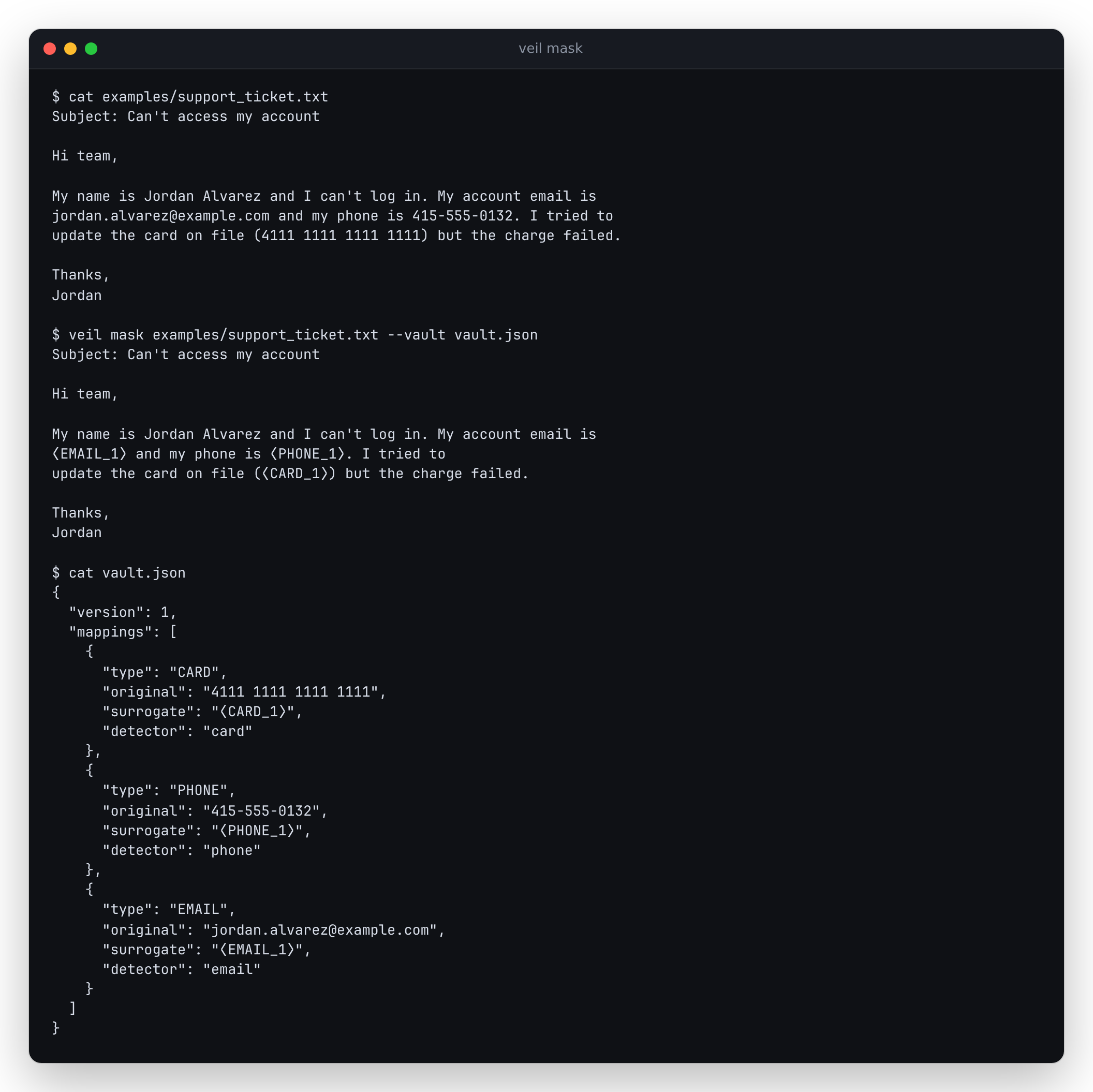
$ veil mask examples/support_ticket.txt --vault vault.json --name "Jordan Alvarez" --name Jordan
Subject: Can't access my account

Hi team,

My name is ⟨PERSON_1⟩ and I can't log in. My account email is
⟨EMAIL_1⟩ and my phone is ⟨PHONE_1⟩. I tried to
update the card on file (⟨CARD_1⟩) but the charge failed.

Thanks,
⟨PERSON_2⟩

$ veil restore masked_reply.txt --vault vault.json
$ veil audit outgoing_reply.txt --vault vault.json   # exit 1 if anything leaked
An email address or a card number has a shape; a name has none, so the names
are yours to give: --name, --org and --location (each repeatable), or
--names-file with one per line. Without them the ticket above keeps "Jordan
Alvarez" in it.
Each command reads stdin when no file is named and writes stdout, so they sit
on either side of a model call; -o FILE writes a file instead:
$ cat ticket.txt | veil mask --vault vault.json | your-llm-call | veil restore --vault vault.json
$ veil mask ticket.txt --vault vault.json -o masked.txt
The CLI saves the vault before emitting masked text. File writes replace a temporary sibling atomically and use owner-only permissions on POSIX. Input, output, names files and the vault must be distinct paths, including aliases. These protections do not encrypt a plaintext vault or coordinate concurrent writers. See session integrity for the exact contract.
Input and output are UTF-8 on every path, pipes included, whatever the
system's code page; line endings pass through unchanged. In Windows
PowerShell, prefer -o to >, which re-encodes what a program prints.
Literal tokens and related messages (source checkout)
Use mask_many when several raw texts will share one vault. Every source is
reserved before new replacements are chosen:
from veil import Masker

masker = Masker()
masked = masker.mask_many(["Contact alice@example.org", "Example: ⟨email_1⟩"])
assert masked == ["Contact ⟨EMAIL_2⟩", "Example: ⟨email_1⟩"]
assert [masker.restore(text) for text in masked] == [
    "Contact alice@example.org",
    "Example: ⟨email_1⟩",
]
mask checks one text; mask_many checks the supplied batch. Exact and tolerant
restoration must reproduce each source. A collision with an existing identity
raises VaultError and leaves the vault's mappings and counters unchanged.
The CLI returns exit 2 without replacing its output or vault file. Existing
identities are never silently renamed.
SDK wrappers validate all raw text they mask for one request before calling the SDK, including separate system/instruction and tool-argument fields. If a later field collides with a token already allocated during preparation, the whole preparation fails and rolls back. Choose a fresh vault and a placeholder template absent from the complete request when retrying; do not feed pre-masked strings back into a masking wrapper. The study explains what is and is not covered.
Web demo
antonsoo.github.io/veil runs the
actual veil Python package in the browser via
Pyodide (loaded from cdn.jsdelivr.net) — the
web/scripts/copy-veil-src.mjs build step bundles src/veil's real
source (zero runtime dependencies makes this possible with no wheel
build) so the demo is never a JS reimplementation drifting from the
library. Paste a prompt, optionally list names your app already knows
(wired to KnownEntitiesBackend), mask it, and watch a simulated reply
stream back through the real Restorer, one random-sized chunk at a
time — dark mode:
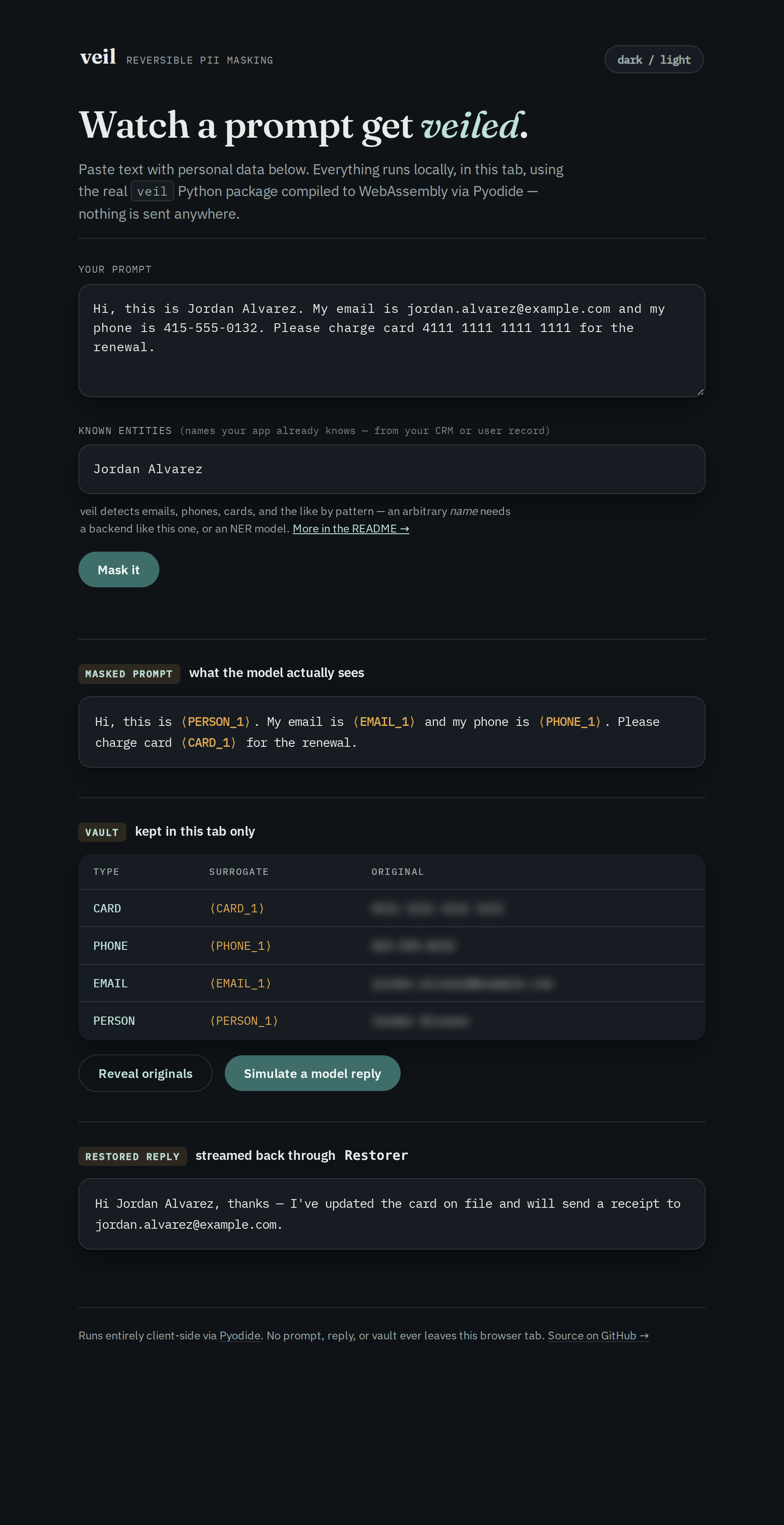
Everything — Pyodide, the package source, the whole interaction — stays
in that browser tab; nothing is sent anywhere, which the page itself
says. Built with Vite + TypeScript in web/; npm run dev there for
local development.
Measured results
On real text, see the study and the summary above. What follows is the synthetic corpus: a check that each validation is implemented correctly, not a measure of how veil does on what people actually write.
Measured on this machine (14 vCPU WSL2 Linux, 48 GB RAM) by running
scripts/evaluate.py against benchmarks/corpus.jsonl — a 240-document,
6-category synthetic corpus generated by scripts/generate_corpus.py
with a fixed seed (reproduce with
uv run python scripts/generate_corpus.py 40 > benchmarks/corpus.jsonl).
| Detector | Precision | Recall | F1 |
|---|---|---|---|
| Address (heuristic) | 1.000 | 1.000 | 1.000 |
| Card | 1.000 | 1.000 | 1.000 |
| DOB | 1.000 | 1.000 | 1.000 |
| 1.000 | 1.000 | 1.000 | |
| IBAN | 1.000 | 1.000 | 1.000 |
| IPv4 | 1.000 | 1.000 | 1.000 |
| Phone | 1.000 | 1.000 | 1.000 |
| Secret | 1.000 | 1.000 | 1.000 |
| SSN | 1.000 | 1.000 | 1.000 |
| Total | 1.000 | 1.000 | 1.000 |
Benign false positives: 0.00 per 1,000 words, measured over the
corpus's clean_negative and benign_numbers categories (80 documents,
4,155 words of ordinary business text with zero PII, deliberately
saturated with the numeric shapes that most look like phone numbers or
SSNs: ISO/DMY dates, times, #order-1234 and INV-/ticket IDs, ZIP+4,
carrier tracking numbers, prices, room numbers, and version/build
strings — the exact categories a naive digit-group detector over-masks).
0.00 here means specifically "no false positive on these known-tricky
shapes", not "no false positives on arbitrary text". On 1.6 million words of
real logs and source code the released 0.4.4 made 11.3 per 1,000 words, and
this checkout makes 0.12.
Masking throughput: ~1.6-2.1 MB/s (single-threaded, all nine
detectors run on every document; varies run to run — see elapsed_s in
the script's output). Time grows in step with the input: a 270 KB export
holding 16,000 values masks in 0.65 s and restores in 0.22 s, and
tests/test_scale.py keeps it that way. Those measurements concern one text.
The source checkout also speeds up batches of many short texts: a constructed
8,000-message batch drops from 9.87 s to 0.51 s, with identical masked text,
vault and round trips. A 4,000-block inline document through the actual SDK's
local mock transport drops from 2.78 s to 0.57 s. The
batch study records the host, all samples,
controls and limits. This improvement is not in the PyPI release.
Streaming-restore overhead: within roughly ±20% of non-streamed restore at a 24-character chunk size, on the same corpus — noise-level on this machine, not a meaningful cost.
Read the "1.000" row honestly — see Accuracy and
limitations. This corpus was built to
independently verify each detector's validated claims (a real Luhn
check, a real mod-97 check, real NANP/E.164 structure, real never-issued
SSN ranges — see How it works), so a clean score mostly
means those checks are implemented correctly, not that real-world text is
this easy. The corpus generator and the benign-numbers check both found
and fixed real precision bugs during development — most recently the
phone detector masking an ISO date and an order number as phone numbers
in ordinary support text, and the SSN detector matching a ZIP+4 code
(22156-7224 parses as area+group+serial if separators aren't required
to be consistent). See the git history for fix: detector false positives found via synthetic corpus evaluation and the phone/SSN
over-masking fix that followed it.
Accuracy and limitations
- Detection is never perfect. Every regex-and-validation detector here
has a documented failure mode in its own module docstring (e.g.
veil/detectors/phone.pyexplains exactly which phone formats it deliberately won't match, and why). Read those before relying on this for a compliance-sensitive workload. - Names need a backend. Out of the box, veil does not detect person,
organization, or location names — those require
KnownEntitiesBackend(recommended: you almost always already know the customer's identity) or an optional, unbenchmarked spaCy backend. Seeveil/backends/spacy_backend.pyfor why we don't claim an NER accuracy number we haven't measured. - The SDK wrappers cover the calls they name.
createandstream(Messages, Chat Completions) andcreate_response/stream_response(Responses), on sync and async clients. The SDKs' other entry points (client.chat.completions.stream(),client.responses.stream(),.parse(), batches,count_tokens) are not wrapped: called on the underlying client they send what you pass, unmasked. A model's thinking text is passed through as it was signed, so it shows surrogates, not the originals. - JSON argument masking covers string values. Numbers, booleans and null
retain their types and are not anonymized. Encode sensitive identifiers as
strings. JSON escape decoding applies to function-call
arguments, whose format is specified by the API; it does not recursively interpret ordinary message text or custom-tool input as JSON. Exact replay of provider-produced history retains the provider's original arguments, including malformed ones. Fresh Anthropic tool inputs require string-keyed dictionaries, lists/tuples and finite JSON scalars. Detected sensitive keys cannot safely be renamed; they reject the request. Convert custom model objects to plain JSON before passing them to the wrapper. Tuple text participates in the same request collision checks and rollback as ordinary list/string content. - US-centric. SSN and the address heuristic assume US formats. A phone
number is found in the North American format, or in any country's when it
is written with a
+. Written the local way anywhere else (03-1234-5678,080 2222 3333), it is missed: 4 of 467 such numbers were found in the study, and half the Indian numbers there are written that way. There's no general international address, national-ID, or VAT-number detector yet. - Realistic surrogates can leak structure. A format-preserving fake
IBAN still reveals the real one's country; a fake card still reveals
its network. See the trade-off discussion in
veil/surrogates.py. Finite name, organization and phone pools fall back to numbered placeholders. The source checkout avoids collisions with the raw texts submitted together and rejects ambiguous restoration. It does not retain earlier raw texts: include the whole raw conversation inmask_manywhen extending one. Provider-held history, signed/replayed blocks and future model-generated literals are outside that check. Restoration alone cannot tell an incidental model-generated occurrence from an intended reference. - The vault is the whole game. Anyone who reads the vault can
de-anonymize the masked text — see the threat model in
veil/vault.pybefore deciding where (or whether) to persist one. - Synthetic benchmarks overstate real-world performance. The corpus above is clean, well-formatted, English-language, and generated by the same kind of logic the detectors use to validate — it is a correctness check, not a claim about messy real-world text (typos, non-US formats, mixed languages, OCR noise). The study measured the gap for phone numbers, email addresses and technical text. It did not measure personal prose: letters, chats, tickets, medical notes. Nor recall for real card numbers and live credentials, for which there is no public corpus.
- Random is not the same as secret. The token heuristic masks lockfile hashes, ETags and other generated ids at low confidence, because nothing in the token says which it is. Explicit credential labels help with short values, but raw assignment syntax can also mask variable references in pasted source code. Unrecognized labels, malformed/multiline raw values and non-string tool fields remain outside that contextual rule. Detection does not authenticate a credential.
Development
git clone https://github.com/antonsoo/veil
cd veil
uv sync --group dev
uv run pytest          # including Hypothesis property tests
uv run ruff check .    # lint
uv run mypy            # typecheck (strict)
Correctness is checked against independent oracles where one exists: the
Luhn checksum for cards, ISO 7064 mod-97 for IBAN (verified against
published Wikipedia example IBANs for GB/DE/FR), and the stdlib
ipaddress module for IP parsing — see the module docstrings in
veil/detectors/ for details, and tests/ for the corresponding tests.
Contributing
See CONTRIBUTING.md.
License
MIT © 2026 Anthony Mercer
Part of Officina, a set of small open-source tools by Anthony Mercer.
1 maintainer

Metadata
1 maintainer
Release files for veil-pii 0.5.0
For a detailed explanation of source distributions (sdists) and built distributions (wheels), please see the package formats documentation.
Source distribution (sdist)
| File | Size | Uploaded | Provenance | Actions |
|---|---|---|---|---|
| veil_pii-0.5.0.tar.gz | 126.8 kB | Without provenance | Details for veil_pii-0.5.0.tar.gz |
Built distribution (wheel)
| File | Interpreter | ABI | Platform | Actions Reset |
|---|---|---|---|---|
| veil_pii-0.5.0-py3-none-any.whl | Python 3 | none | any | Details for veil_pii-0.5.0-py3-none-any.whl |
Total release size: 239.1 kB
Release files / veil_pii-0.5.0.tar.gz
| Download URL | veil_pii-0.5.0.tar.gz |
|---|---|
| Size | 126.8 kB |
| Tags | Source |
|
SHA-256 checksum How to use checksums |
67f91e1d35df05ac8005d25383adf91541e7be897de851627fede7836e5a4b37
|
|
BLAKE2b-256 checksum How to use checksums |
c505f7c7d26d2d78d8cfdeacba5e1084678e06e94c6e26cc96b4b872b4ec47b4
|
| Upload date | |
|
Uploaded using Trusted Publishing? What is trusted publishing? |
No |
| Uploaded via |
uv/0.13.10 {"installer":{"name":"uv","version":"0.13.10","subcommand":["publish"]},"python":null,"implementation":{"name":null,"version":null},"distro":{"name":"Ubuntu","version":"24.04","id":"noble","libc":null},"system":{"name":null,"release":null},"cpu":null,"openssl_version":null,"setuptools_version":null,"rustc_version":null,"ci":null}
|
Release files / veil_pii-0.5.0-py3-none-any.whl
| Download URL | veil_pii-0.5.0-py3-none-any.whl |
|---|---|
| Size | 112.3 kB |
| Tags | Python 3 |
|
SHA-256 checksum How to use checksums |
d267fdd55c21a1296f9ab82541825d11cdd912623d1ad29306becaed9b19fcc3
|
|
BLAKE2b-256 checksum How to use checksums |
02436896e75a8995b03c480e916499deb8a2ca41670bcde392d86650631a40f7
|
| Upload date | |
|
Uploaded using Trusted Publishing? What is trusted publishing? |
No |
| Uploaded via |
uv/0.13.10 {"installer":{"name":"uv","version":"0.13.10","subcommand":["publish"]},"python":null,"implementation":{"name":null,"version":null},"distro":{"name":"Ubuntu","version":"24.04","id":"noble","libc":null},"system":{"name":null,"release":null},"cpu":null,"openssl_version":null,"setuptools_version":null,"rustc_version":null,"ci":null}
|
Security for veil-pii 0.5.0
Provenance
Provenance describes where a file came from. On PyPI, provenance is shared via attestations, which provide a verifiable record of the build or publishing details. View details, limitations and caveats.
No provenance found
None of the files in this release were uploaded with provenance metadata.
A note on package security
PyPI is a repository for distributing packages, not a service for auditing them. While third-party security researchers and our staff do their best to detect and remove malicious packages, PyPI cannot guarantee the quality, security or suitability of any given package.
To learn more about protecting yourself from malicious actors, visit our package security documentation.














