
Agentic AI framework for autonomous data engineering, science, and storytelling

Project description

Agentic AI framework for autonomous data engineering, science, and storytelling.




Versifai provides specialized AI agents that automate the complete data lifecycle -from raw file discovery and schema design, through statistical analysis and modeling, to compelling narrative reports. Each agent operates autonomously using a ReAct (Reason-Act-Observe) loop, with human-in-the-loop oversight at every stage.
Built on LiteLLM for multi-provider LLM support (Anthropic, OpenAI, Azure, and 100+ more).
Table of Contents
- Features
- Agent Families
- Installation
- Quick Start
- Usage Examples
- Architecture
- Building Custom Agents
- Configuration
- Contributing
- License
Features
- Autonomous agent loop -ReAct-based agents that reason, act, and observe iteratively until a task is complete
- Multi-provider LLM -Swap between Claude, GPT-4, Azure, Gemini, or any LiteLLM-supported provider with a single parameter
- Modular tool system -Plug-and-play tools with a shared registry; add your own in minutes
- Smart resume -Agents persist state to disk and resume from where they left off after interruption
- Run isolation -Each run gets its own directory with metadata, progress logs, and artifacts
- Human-in-the-loop -Built-in
ask_humantool lets agents pause and request guidance - Databricks native -First-class support for Notebooks, Unity Catalog, Delta tables, and Volumes.
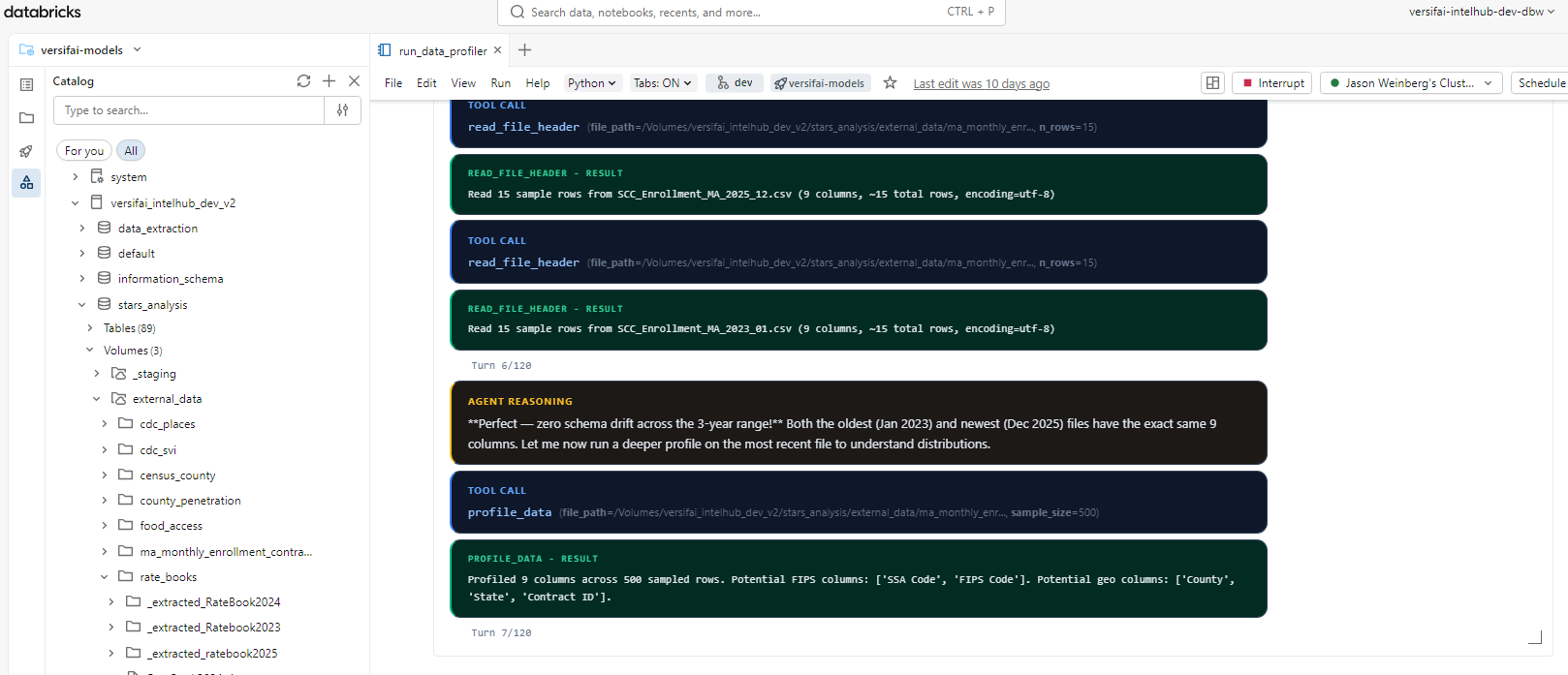
See It In Action
Read a full research report produced end-to-end by Versifai's agent pipeline -from raw CMS data ingestion through statistical analysis to narrative output:
CMS Stars Adjustment: An Autonomous Policy Research Report
Agent Families
| Family | Agents | What It Does |
|---|---|---|
versifai.data_agents |
DataEngineerAgent, DataAnalystAgent |
Discover raw files, profile data, design schemas, transform and load into structured tables. The analyst validates quality. |
versifai.science_agents |
DataScientistAgent |
Autonomous research -builds analytical datasets, runs hypothesis tests, fits models, produces charts and findings. |
versifai.story_agents |
StoryTellerAgent |
Transforms research findings into evidence-grounded narrative reports with citations, visual references, and editorial review. |
Installation
From PyPI
# Install with all runtime dependencies
pip install versifai

# With development tools (ruff, mypy, pytest, pre-commit)
pip install "versifai[dev]"
From Source (development)
git clone https://github.com/jweinberg-a2a/versifai-data-agents.git
cd versifai-data-agents
python -m venv .venv
source .venv/bin/activate
pip install -e ".[dev]"
Quick Start
1. Set your LLM API key
# Anthropic (default)
export ANTHROPIC_API_KEY="sk-ant-..."

# Or OpenAI
export OPENAI_API_KEY="sk-..."
2. Run a data engineering agent
from versifai.data_agents import DataEngineerAgent, ProjectConfig

cfg = ProjectConfig(
    name="Sales Pipeline",
    catalog="analytics",
    schema="sales",
    volume_path="/Volumes/analytics/sales/raw_data",
)

agent = DataEngineerAgent(cfg=cfg, dbutils=dbutils)
result = agent.run()
print(f"Processed {result['sources_completed']} sources")
3. Run a data science agent
from versifai.science_agents import DataScientistAgent, ResearchConfig

cfg = ResearchConfig(
    name="Customer Churn Analysis",
    catalog="analytics",
    schema="churn",
    results_path="/tmp/results/churn",
    themes=[...],  # Define research themes
)

agent = DataScientistAgent(cfg=cfg, dbutils=dbutils)
result = agent.run()
4. Generate a narrative report
from versifai.story_agents import StoryTellerAgent, StorytellerConfig

cfg = StorytellerConfig(
    name="Churn Analysis Report",
    thesis="Customer churn is driven primarily by...",
    research_results_path="/tmp/results/churn",
    narrative_output_path="/tmp/narrative/churn",
    narrative_sections=[...],  # Define report sections
)

agent = StoryTellerAgent(cfg=cfg, dbutils=dbutils)
result = agent.run()
print(f"Wrote {result['sections_written']} sections")
Usage Examples
Multi-Provider LLM Support
Versifai uses LiteLLM under the hood. Switch providers with a single parameter:
from versifai.core import LLMClient

# Anthropic Claude (default)
llm = LLMClient(model="claude-sonnet-4-6")

# OpenAI GPT-4o
llm = LLMClient(model="gpt-4o")

# Azure OpenAI
llm = LLMClient(
    model="azure/gpt-4o",
    api_base="https://my-endpoint.openai.azure.com",
)

# Google Gemini
llm = LLMClient(model="gemini/gemini-1.5-pro")

# Pass the LLM to any agent
agent = DataEngineerAgent(cfg=cfg, dbutils=dbutils)
agent._llm = llm  # Override the default
Smart Resume
All agents support resuming from interruption:
# First run -gets interrupted at source 3 of 10
agent = DataEngineerAgent(cfg=cfg, dbutils=dbutils)
agent.run()  # Ctrl+C after source 3

# Re-run -automatically picks up from source 4
agent = DataEngineerAgent(cfg=cfg, dbutils=dbutils)
agent.run()  # Skips sources 1-3, continues from 4
Running Specific Sections
Both science and story agents support targeted re-runs:
# Re-run only themes 0 and 3
scientist = DataScientistAgent(cfg=cfg, dbutils=dbutils)
scientist.run_themes(themes=[0, 3])

# Re-run only sections 1 and 2 of the narrative
storyteller = StoryTellerAgent(cfg=cfg, dbutils=dbutils)
storyteller.run_sections(sections=[1, 2])
Editorial Review (Human-in-the-Loop)
The storyteller agent has a dedicated editor mode:
agent = StoryTellerAgent(cfg=cfg, dbutils=dbutils)

# Guided review
agent.run_editor(
    instructions="Simplify the methodology section for a policymaker audience."
)

# Open-ended review
agent.run_editor()
Complete Workflow Example
See examples/ for full end-to-end configurations.
from versifai.data_agents import DataEngineerAgent
from versifai.science_agents import DataScientistAgent
from versifai.story_agents import StoryTellerAgent

# Step 1: Engineer ingests raw data
engineer = DataEngineerAgent(cfg=engineer_cfg, dbutils=dbutils)
engineer.run()

# Step 2: Scientist analyzes the data
scientist = DataScientistAgent(cfg=science_cfg, dbutils=dbutils)
scientist.run()

# Step 3: Storyteller writes the report
storyteller = StoryTellerAgent(cfg=story_cfg, dbutils=dbutils)
storyteller.run()
Architecture
src/versifai/
├── core/                  # Shared agentic framework
│   ├── agent.py           # BaseAgent -ReAct loop engine
│   ├── llm.py             # LLMClient -multi-provider via LiteLLM
│   ├── memory.py          # AgentMemory -conversation + carryover context
│   ├── display.py         # AgentDisplay -rich progress output
│   ├── config.py          # CatalogConfig, AgentSettings
│   ├── run_manager.py     # Run isolation + state persistence
│   └── tools/             # Shared tools (BaseTool, ToolRegistry, etc.)
│
├── data_agents/           # Data engineering & analysis
│   ├── engineer/          # DataEngineerAgent + planning + tools
│   ├── analyst/           # DataAnalystAgent (quality validation)
│   └── models/            # FileInfo, TargetSchema, AgentState
│
├── science_agents/        # Data science & research
│   └── scientist/         # DataScientistAgent + analysis tools
│
├── story_agents/          # Narrative & storytelling
│   └── storyteller/       # StoryTellerAgent + narrative tools
│
└── _utils/                # Internal utilities (naming, FIPS codes)
Key Design Patterns
- BaseAgent -All agents subclass
BaseAgent, which provides the ReAct loop, error recovery, and tool dispatch - ToolRegistry -Tools are registered at construction time; the agent's loop automatically matches LLM tool calls to registered tools
- BaseTool -Every tool implements
name,description,parameters_schema, andexecute(). Drop-in replaceable. - AgentMemory -Manages conversation history with automatic summarization for long-running tasks
Building Custom Agents
Create a Custom Tool
from versifai.core import BaseTool, ToolResult

class FetchWeatherTool(BaseTool):
    name = "fetch_weather"
    description = "Fetch current weather for a city"
    parameters_schema = {
        "type": "object",
        "properties": {
            "city": {"type": "string", "description": "City name"},
        },
        "required": ["city"],
    }

    def execute(self, city: str) -> ToolResult:
        # Your implementation here
        data = call_weather_api(city)
        return ToolResult(success=True, data=data)
Create a Custom Agent
from versifai.core import (
    BaseAgent, LLMClient, AgentMemory, AgentDisplay, ToolRegistry,
)

class WeatherAgent(BaseAgent):
    def __init__(self):
        registry = ToolRegistry()
        registry.register(FetchWeatherTool())

        super().__init__(
            display=AgentDisplay(),
            memory=AgentMemory(),
            llm=LLMClient(model="gpt-4o"),
            registry=registry,
        )
        self._system_prompt = "You are a helpful weather assistant."

    def ask(self, question: str) -> str:
        return self._run_phase(prompt=question, max_turns=10)

# Use it
agent = WeatherAgent()
answer = agent.ask("What's the weather in San Francisco?")
Where to Put Your Code
| What you're adding | Where it goes |
|---|---|
| A tool used by multiple agent families | src/versifai/core/tools/ |
| A tool specific to one agent | src/versifai/<family>/<agent>/tools/ |
| A new agent in an existing family | src/versifai/<family>/<new_agent>/ |
| A new agent family | src/versifai/<new_family>/ |
| Shared config or data models | src/versifai/core/config.py or src/versifai/<family>/models/ |
| Internal helpers | src/versifai/_utils/ |
Configuration
CatalogConfig (shared)
All agents that interact with Databricks Unity Catalog use CatalogConfig:
from versifai.core import CatalogConfig

catalog = CatalogConfig(
    catalog="my_catalog",
    schema="my_schema",
    volume_path="/Volumes/my_catalog/my_schema/data",
    staging_path="/Volumes/my_catalog/my_schema/staging",
)
AgentSettings (shared)
Tune agent behavior globally:
from versifai.core import AgentSettings

settings = AgentSettings(
    max_agent_turns=200,        # Max ReAct iterations per run
    max_turns_per_source=120,   # Max turns per data source
    max_acceptance_iterations=3, # Validation retry limit
    sample_rows=10,             # Rows shown in profiling previews
)
Environment Variables
| Variable | Purpose | Required |
|---|---|---|
ANTHROPIC_API_KEY |
Anthropic Claude API key | If using Claude |
OPENAI_API_KEY |
OpenAI API key | If using GPT models |
DATABRICKS_HOST |
Databricks workspace URL | For catalog operations |
DATABRICKS_TOKEN |
Databricks PAT | For catalog operations |
Contributing
We welcome contributions! See CONTRIBUTING.md for the full guide.
Quick Start for Contributors
git clone https://github.com/jweinberg-a2a/versifai-data-agents.git
cd versifai-data-agents
python -m venv .venv && source .venv/bin/activate
make install-dev   # installs with all deps + pre-commit hooks
make test          # run tests
make lint          # check code style
make format        # auto-format code
Where to Contribute
- New tools -The easiest way to contribute. Subclass
BaseTool, implementexecute(), and submit a PR. See Building Custom Agents for the pattern. - New agents -Add a new agent type to an existing family or propose a new family.
- LLM provider support -We use LiteLLM, so most providers work out of the box. If you find one that doesn't, help us fix it.
- Documentation and examples -Add example configs in
examples/for your domain. - Bug fixes and tests -Always appreciated.
License
Business Source License 1.1. Free to use, modify, and extend for non-commercial purposes. See LICENSE for full terms.
Release history Release notifications | RSS feed


Download files
Download the file for your platform. If you're not sure which to choose, learn more about installing packages.
Source Distribution
Built Distribution
Filter files by name, interpreter, ABI, and platform.
If you're not sure about the file name format, learn more about wheel file names.
Copy a direct link to the current filters
File details
Details for the file versifai-0.1.1.tar.gz.
File metadata
- Download URL: versifai-0.1.1.tar.gz
- Upload date:
- Size: 702.8 kB
- Tags: Source
- Uploaded using Trusted Publishing? No
- Uploaded via: twine/6.2.0 CPython/3.12.12
File hashes
| Algorithm | Hash digest | |
|---|---|---|
| SHA256 |
72df445ac2c704db38c38ecbe73af9e6764da739d424fce7b1ef2933306c2bd7
|
|
| MD5 |
cd544fb7942f3bedb23e10c91f05f267
|
|
| BLAKE2b-256 |
0fd2cb92263aab35a784c02728d219229f548e22dadd8a346fee54eb7a09eed2
|
File details
Details for the file versifai-0.1.1-py3-none-any.whl.
File metadata
- Download URL: versifai-0.1.1-py3-none-any.whl
- Upload date:
- Size: 290.3 kB
- Tags: Python 3
- Uploaded using Trusted Publishing? No
- Uploaded via: twine/6.2.0 CPython/3.12.12
File hashes
| Algorithm | Hash digest | |
|---|---|---|
| SHA256 |
49e0e72efec5182a4ea0e61a2155cd2ab5016944f09a19405f98c1ca6c56574c
|
|
| MD5 |
a638bd474d7927294284316f78ae9887
|
|
| BLAKE2b-256 |
3d0e916f1d1d131abbc94dc4284729ca4f5004d303a8eea752c67c9de299910d
|






