

Probe any vision backbone across high-, mid- and low-level computer vision tasks.




Status: v0.12.0. Three backbone families (DINOv2, CLIP, timm CNNs and ViTs) and sixteen probes run end-to-end across all three levels — high, mid and low — including eight trained dense probes and an anchor-free detection probe, from Python or from the
visbenchcommand line.v0.11 is where the corpus gets its controls. The record corpus is fifteen probes against twelve backbones, and MAE ViT-B/16 comes first on six of those boards and last on three — so "which backbone is best" is not a well-formed question against it. Three of the twelve share an architecture and a pretraining set and differ only in training objective, which is what lets a gap be attributed to anything at all. A fourth differs from one of them only in training recipe, and that is the one that supplies the denominator: quote an objective gap against the recipe gap on the same board, not against zero. On semantic segmentation the recipe gap is the larger of the two.
v0.10 separated the three levels —
TimmBackbonelearned to read a ViT's own structure, which added ConvNeXt-B, MAE and SigLIP-GAP in one change, and the documentation gallery moved to real photographs under a per-image licence check.v0.9 makes every probe visible.
visbench showdraws what a probe saw beside what it predicted, for all sixteen, and each renderer states the diagnostic its own history calls for as a figure rather than leaving it to the eye. It adds no probe and changes no measurement. v0.8 addedcorner, the first probe whose target VisBench computes rather than downloads; v0.7 made the project approachable (visbench demo, the documentation site, a contributor guide, a DOI); v0.6 is the leaderboard release — a committed record corpus, the comparability rules that decide what may be ranked together, generated tables, and probe heads you can save, publish and reload. v0.5 added 2D keypoint and occlusion-edge detection; v0.4 filled the low-level tier with edge detection; v0.3 added opt-in fine-tuning of the last N blocks — a different measurement from a frozen probe, kept apart in the record rather than averaged with it. See LEADERBOARD.md and the roadmap.
Try it in thirty seconds
No dataset, no configuration, no large download:
pip install visbench
visbench demo
drawing 20 images per class for 4 shapes...
loading resnet18 (torchvision, ~45 MB on first run)...
running the classification probe...

  top1         0.8125

  chance is 0.25 — the shapes differ in outline only.
That is a real probe, on a real pretrained backbone, through the same code path every other run uses. The images are generated: four shapes with colour, size, position and rotation randomised, so only geometry identifies a class and a backbone that has not learned shape scores about chance.
The number is deliberately not 1.0. Turn the difficulty up and watch it fall:
visbench demo --noise 90 # top1 ~0.31, against a chance of 0.25
--noise |
28 | 45 (default) | 60 | 75 | 90 |
|---|---|---|---|---|---|
| top1 | 0.975 | 0.812 | 0.550 | 0.438 | 0.312 |
A probe whose score does not move when you destroy the signal is not measuring the signal. That slide into chance is the demo's actual point.
Install
pip install visbench                    # core: DINOv2, every task, the CLI
pip install 'visbench[clip,timm]'       # + CLIP and timm backbones
pip install 'visbench[hub]'             # + push/pull probes to Hugging Face
clip and timm are optional extras. A backbone whose extra is missing stays
listed — visbench list backbones marks it — and constructing one tells you
which extra to install rather than pretending the name does not exist.
hub is needed only to transfer a probe. Saving one to a local file and
loading it back works in a core install.
Development:
git clone https://github.com/turhancan97/VisBench && cd VisBench
uv sync --all-extras            # exact locked versions — what the numbers below used
# or
pip install -e ".[dev,clip,timm]"
pytest              # fast tests, no weights downloaded
pytest -m slow      # also runs the real DINOv2 and CLIP checkpoints

# The three gating lint steps, exactly as CI runs them. Run them verbatim —
# mypy in particular reads [tool.mypy] from pyproject.toml, so invoking it
# with different flags checks something CI does not.
ruff check visbench/ tests/ conftest.py examples/
ruff format --check visbench/ tests/ conftest.py examples/
mypy visbench/ examples/ --ignore-missing-imports
What it is
VisBench answers one question with as little ceremony as possible: what does this vision backbone actually encode?
Working today — folder to scored, logged metrics, on any image folder laid out
as root/<class_name>/<image>:
import visbench
from visbench.data import ImageFolderDataset

result = visbench.run(
    "dinov2_vitb14",
    "retrieval",
    ImageFolderDataset("data/tiny", split="val"),
    results="results/visbench.jsonl",
)
result.metrics    # {"recall@1": 0.94, "recall@5": 0.99, "mAP": 0.87}
result.record     # the ResultRecord that says exactly how they were produced
run() resolves pooling, extracts through the cache, fits the probe if it
trains, evaluates, and appends the record. The pieces are public if you want
them separately:
from visbench.cache import FeatureCache

backbone = visbench.get_backbone("dinov2_vitb14")      # frozen, eval mode
probe    = visbench.get_probe("retrieval")             # zero-shot
features = FeatureCache().extract_dataset(
    backbone, dataset, pooling=probe.pooling, keep="pooled"
)                                                      # one forward pass per image
probe.evaluate(features, dataset.labels())
Re-running is cheap. On Imagenette (13,394 images, DINOv2 ViT-S, one V100):
| cold | cached | |
|---|---|---|
| wall time | 208 s | 26 s |
| on-disk cache | 107 MB | — |
| val top1 | 0.9939 | 0.9939 |
A cached image is resolved from its file identity and never decoded, and
keep="pooled" also stops dense features being written — storing them for a
task that never reads them cost 5 GB instead of 107 MB. Results go to JSONL
through visbench.results.ResultWriter, under one schema from the first
record.
Trained probes take the same call with a training split. A train/test split is just two datasets, so each half carries its own fingerprint:
result = visbench.run(
    "dinov2_vitb14", "classification", val_dataset, train_dataset=train_dataset
)
result.metrics             # {"top1": ..., "top5": ...}
result.probe.train_top1    # 0.99 — if this is low, the probe underfitted,
                           # not the backbone. Raise `lr` or `epochs`.
Passing train_dataset to a zero-shot task raises rather than being ignored:
silently dropping it would leave the caller's intent and the result
disagreeing.
The linear probe trains with AdamW on cached features, so its hyperparameters
are part of the reported number and travel with it in the record's
task_params.
Your own model
Any nn.Module works, without adding anything to this package:
from torchvision.models import convnext_tiny, ConvNeXt_Tiny_Weights

weights = ConvNeXt_Tiny_Weights.IMAGENET1K_V1
backbone = visbench.CustomBackbone(
    convnext_tiny(weights=weights).features,
    preprocess=weights.transforms(),
    name="convnext_tiny",
)
visbench.run(backbone, "retrieval", dataset)
The grid comes from the module's output shape, embed_dim from the first
forward pass, and the cache key from a hash of the weights — so a fine-tuned
checkpoint never reuses its parent's cached features. Where the output shape is
genuinely ambiguous VisBench raises rather than guesses; pass patch_size=,
has_cls_token= or a feature_fn= to say what it cannot infer.
To give a custom backbone a registry name, subclass BaseBackbone and apply
@visbench.register_backbone("my_model") — the same path the built-ins use.
examples/custom_backbone.py
runs all of this end to end and needs no dataset:
python examples/custom_backbone.py --finetune --register
Your own dataset
A folder layout needs no code (ImageFolderDataset, DenseFolderDataset,
DetectionFolderDataset), and anything else is a BaseDataset subclass with two
methods. When the data already lives in a torch.utils.data dataset or a
Hugging Face datasets.Dataset, there is a bridge:
from torchvision.datasets import CIFAR10
from visbench.data import TorchvisionDataset

raw = CIFAR10("./data", train=False, download=True)
visbench.run("dinov2_vits14", "classification", TorchvisionDataset(raw, split="test"),
             train_dataset=TorchvisionDataset(CIFAR10("./data", train=True, download=True)))
HuggingFaceDataset is the same shape and needs pip install visbench[datasets].
Both derive a real per-item cache_identity from the fact that the wrapped
dataset is immutable in index order, so a cached re-run still skips the
backbone. See examples/custom_dataset.py.
Sibling project to vismatch — same ergonomic philosophy, applied to representation probing instead of image matching.
The command line
Installing the package puts a visbench command on your path. It is a thin
wrapper over visbench.run() — same cache, same result records, same numbers.
visbench demo                       # a real probe on generated data, no setup
visbench list                       # backbones, probes and heads that exist
visbench run retrieval --data /path/to/imagenette2 --split val
visbench run classification --dataset torchvision:CIFAR10 --split test
visbench show depth --data /path/to/nyuv2 --out panels.png
visbench cache stats
Each probe is its own subcommand, because they do not take the same data.
visbench run depth --help shows the folder layout depth expects and only
depth's flags:
# mid-level geometry, zero-shot, no annotation needed
visbench run correspondence --data /path/to/images --split val --limit 200

# a dense probe: <data>/<split>/{images,masks}, paired by filename stem
visbench run generic_segmentation --data /path/to/data --epochs 40 --lr 5e-3

# an official split list instead of split directories — how real benchmarks
# express one. Passing --stems makes --data the dataset root itself.
visbench run semantic_segmentation --data VOCdevkit/VOC2012 \
    --image-dir JPEGImages --target-dir SegmentationClass \
    --stems ImageSets/Segmentation/val.txt \
    --train-stems ImageSets/Segmentation/train.txt \
    --num-classes 21 --backbone dinov2_vits14

# detection reads the same way, from ImageSets/Main
visbench run detection --data VOCdevkit/VOC2012 \
    --stems ImageSets/Main/val.txt \
    --train-stems ImageSets/Main/train.txt \
    --backbone dinov2_vits14
That last one reports miou 0.733 on VOC val, against the 0.732 the Python API
records for the same backbone — which is the check that matters for a wrapper.
Looking before you measure
visbench show writes a grid of image / target / prediction panels to a file.
It measures nothing — it exists because a dense target that has drifted from its
image fails silently: the probe trains, and the number merely comes out
mediocre, which reads as a hard task rather than a bug.
# no backbone, no cache, no GPU — just the data the probe would see
visbench show semantic_segmentation --data VOCdevkit/VOC2012 \
    --stems ImageSets/Segmentation/val.txt --num-classes 21 --out voc.png

# add a prediction column from a head you trained earlier
visbench run corner --data ./frames --save-probe heads/corner.pt
visbench show corner --data ./frames --predict-from heads/corner.pt --out corner.png
# correspondence draws both views and the matches between them
visbench show correspondence --data ./images --backbone dinov2_vits14 --out matches.png
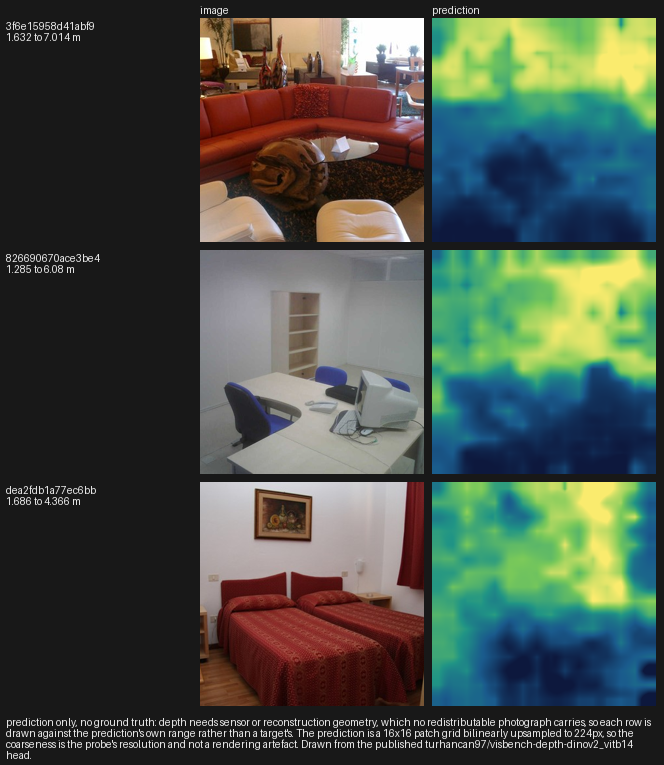
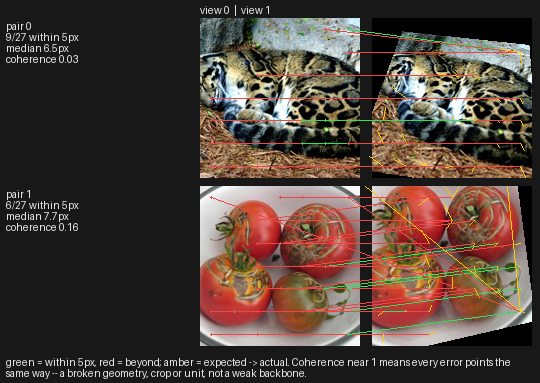
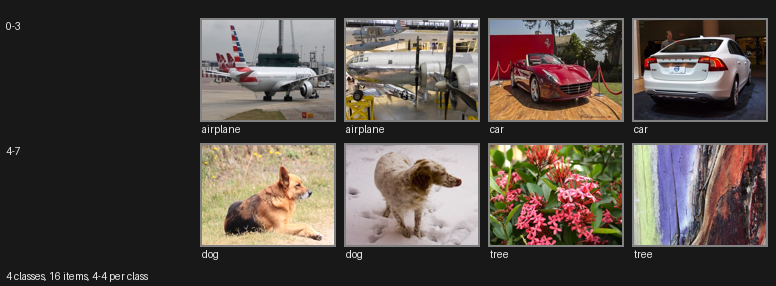
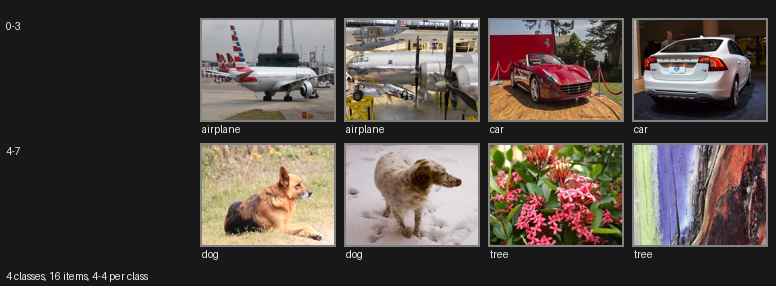
Every probe can be drawn — all sixteen, across four renderers, and a test
asserts show_probes() == list_probes() so a new one cannot ship undrawable.
Dense targets get an image | target | prediction grid, detection gets boxes,
correspondence gets match lines, and the probes with no spatial target
(classification, scene_classification, retrieval, similarity) get a view
of the decision they made — a contact sheet, a query and its neighbours, a
triplet with the human vote marked.
Each renderer states its own diagnostic as a figure rather than leaving it to the eye: invalid pixels in magenta per each probe's own convention (there are four, none visible in a tensor's shape); coherence, which separates a broken geometry from a weak backbone; class balance, which catches a split collapsed to one class scoring 1.0; and the vote balance that reveals a mis-read CSV column.
Every figure above is a real photograph run through the real command by
scripts/render_gallery.py.
The frames are CC BY 2.0 from Open Images,
licence-checked at fetch time and
credited;
the datasets the probes are actually scored on cannot be republished, which is
why they are not what you see. Boxes and masks are Open Images' own annotations;
the four probes needing sensor geometry show a prediction from a published
head instead of an invented target, and say so on the figure. See
all sixteen, or
the guide.
Two flags worth knowing. --batch-size is the extraction batch;
--train-batch-size is the head's, and they are separate because they are
different numbers with the same name. --limit shortens a split correctly for
whatever kind of split it is — per class on a labelled folder, by triplet for
similarity, by stem for a dense split — rather than taking a prefix, which on a
class-grouped folder would leave you evaluating one class and scoring 1.0.
Task levels
Following Chen, Marks & Cheng (arXiv:2411.17474):
| Level | Tasks | Status |
|---|---|---|
| High-level — semantic / category | classification, retrieval | v0.1 |
| semantic (multi-class) segmentation | v0.2 | |
| detection (anchor-free, single-scale) | v0.3 | |
| Mid-level — geometry & generic structure | geometric correspondence | v0.1 |
| depth, surface normals, generic (binary) segmentation, mid-level similarity | v0.2 | |
| occlusion-edge detection | v0.5 | |
| Low-level — signal properties | edge detection (dense magnitude regression) | v0.4 |
| 2D keypoint detection | v0.5 | |
| optical flow, texture, IQA | scope only |
Mid-level is where VisBench aims to be strongest relative to existing tooling. Note that mid-level image similarity and high-level retrieval are separate tasks — one judges perceptual/geometric resemblance, the other category membership.
Design in three points
One extraction method. backbone.extract_features(image, pooling=..., layers=...)
returns {"dense": (B, C, H, W), "pooled": (B, C), "grid_hw": (H, W)} — both
representations from one forward pass. ViTs and CNNs share the exact same
signature and return shape despite completely different internals.
Tasks choose pooling, backbones don't. A task passes pooling="cls" or
"mean" down into extraction. Backbones stay dumb and interchangeable; the
"what representation does this task need" decision lives in one place.
The cache is not optional. Disk-backed, keyed by
(image_hash, backbone_name, layer, pooling). Every task reads through it, so
the backbone forward pass runs at most once per image per backbone.
Pretrained probes — use one without training
Trained heads for the DINOv2 backbones are published on the Hugging Face Hub, so you can score your own images without fitting anything:
import visbench
from visbench.hub import load_probe_from_hub

backbone = visbench.get_backbone("dinov2_vits14")
probe = load_probe_from_hub("turhancan97/visbench-depth-dinov2_vits14", backbone=backbone)
scores = probe.evaluate(features, targets)
Browse the collection → — twenty heads, ten probes against DINOv2-S/14 and DINOv2-B/14, trained by the same commands that produced the record corpus.
One repository per (probe, backbone) pair, because a head fitted on one backbone is refused against any other — see below for why that refusal matters. The three zero-shot probes (retrieval, correspondence, similarity) are not published: they train nothing, so the backbone alone reproduces them.
Sharing a trained probe
A probe head is small — 17 KB for a linear classifier — so the cheapest way to let someone check your number is to hand them the probe rather than the recipe.
from visbench.hub import save_probe, load_probe

save_probe(probe, "checkpoints/voc.pt", backbone=backbone)
probe = load_probe("checkpoints/voc.pt", backbone=backbone)
With pip install 'visbench[hub]', the same thing over the network. Pushing
creates a private repository unless you ask otherwise, and writes a model
card alongside the weights:
from visbench.hub import push_probe, load_probe_from_hub

push_probe(probe, "you/dinov2-vits14-voc", backbone=backbone, metrics=scores)
probe = load_probe_from_hub("you/dinov2-vits14-voc", backbone=backbone)
A head only works with the backbone it was fitted on, and getting that wrong
is silent. Loading a head trained on DINOv2-S CLS tokens against mean-pooled
tokens from the same backbone gives the right shapes and a plausible number —
measured on Imagenette, 0.9540 against 0.9830. Nothing about the tensors
says anything is wrong, so load_probe checks the backbone weights, the
pooling, the feature mode and the layers, and refuses a mismatch. Pass
strict=False if you are deliberately testing transfer; it warns rather than
raising, and the number is then comparable with nothing.
Downloaded probes are read with torch.load(weights_only=True), so fetching one
from a stranger's repository cannot execute code.
The command line publishes what it just trained, so a run and its artifact cannot come from different settings:
visbench run depth --data ... --push-to you/visbench-depth-dinov2_vits14 --public
See examples/save_probe.py,
which demonstrates the mismatch on purpose,
examples/push_probe.py
for the Hub round trip, and the Hub guide
for the full reference.
Reproducibility
Sixteen probes against twelve backbones, as records:
LEADERBOARD.md.
Every board there — and every measured table below — is generated from
results/corpus/visbench.jsonl,
the committed corpus, by
scripts/render_tables.py.
A test in the fast suite fails if any of them drifts from the records, so a
published number and the run behind it cannot disagree.
Every run logs a structured JSON record — backbone, weights key, task, dataset,
pooling, feature mode, metrics, seed, timestamp — under one schema from v0.1,
so leaderboard tooling never needs a retrofit. A trained run also records how
its fit went (train_loss, and train_top1 where the probe has one), which
is what tells an underfitting probe apart from a weak representation — opposite
readings of the same low score. Dependencies are pinned in
uv.lock — exact versions and hashes for every platform, covering
the clip and dev extras too — and CI fails if it drifts from
pyproject.toml. The ranges in pyproject.toml carry upper bounds so that a
minor dependency release cannot quietly move reported numbers even when
installing without the lock:
uv sync --all-extras     # exact locked versions
pip install -e ".[dev,clip]"   # ranges, for day-to-day work
Backbone weights are pinned the same way. DINOv2 loads from a fixed upstream
commit rather than the default branch, and that ref is part of the cache key —
so bumping it invalidates every stale entry instead of silently serving
features from the old weights. Pass checkpoint= to load local weights; the
cache key then carries a hash of that file instead. CLIP's cache key carries
its pretrained tag, since openai and laion2b are different models behind
one name.
CLIP returns the pre-projection CLS token by default, not the 512-d
image-text embedding. The projection is trained to discard whatever does not
help match a caption, which is exactly what a mid-level probe measures, and
DINOv2 has no equivalent head to compare against. use_projection=True gets
the projected vector, under its own cache key.
Prior art
VisBench reuses established protocols rather than re-deriving them, and cites them at the point of use in the code:
- probe3d (El Banani et al., CVPR 2024) — evaluation protocols for depth, surface normal and correspondence.
- Probing the Mid-level Vision Capabilities of Self-Supervised Learning (Chen, Marks & Cheng) — the task categorization used throughout.
- vismatch (Berton) — API philosophy, and the matching logic mirrored in the correspondence task.
Where to go next
| The documentation site | https://turhancan97.github.io/VisBench/ |
| Every probe, its data layout and its measured numbers | docs/tasks.md |
| Looking at what a probe saw, and what it predicted | docs/show.md |
| Sixteen probes against twelve backbones, ranked | LEADERBOARD.md |
| How it was built, and what might come next | docs/roadmap.md |
| What changed in each release | CHANGELOG.md |
| Borrowed evaluation protocols and their licences | NOTICE |
| Setting up, the checks, and how to add a probe | CONTRIBUTING.md |
Questions and bug reports: open an issue.
Citing VisBench
If VisBench contributed to work you are publishing, please cite it. GitHub's Cite this repository button generates APA and BibTeX from CITATION.cff, or use:
@software{kargin_visbench,
  author  = {Kargın, Turhan Can},
  title   = {VisBench: probing vision backbones across high-, mid- and low-level tasks},
  doi     = {10.5281/zenodo.21822684},
  url     = {https://doi.org/10.5281/zenodo.21822684},
  license = {MIT},
  version = {0.12.0}
}
If you are reporting numbers, cite the version you ran. Every VisBench
result record carries the schema, the resolved pooling, the layers and the
protocol that produced it, so a number is reproducible — but only against the
release that produced it. visbench.__version__ is in every record.
The DOI above is the concept DOI: it always resolves to the newest release, which is what you want when citing the software itself. Zenodo also mints a version DOI per release, listed on the archive page under Versions — pin that one in a paper reporting measured numbers, for the same reason every record carries its schema and protocol.
License
MIT — see LICENSE.
VisBench borrows evaluation protocols from prior work, all permissively licensed and MIT-compatible; NOTICE records what came from where. Backbone weights are downloaded at runtime, never redistributed here, and carry their own upstream terms.
1 maintainer

Metadata
1 maintainer
Release files for visbench 0.15.0
For a detailed explanation of source distributions (sdists) and built distributions (wheels), please see the package formats documentation.
Source distribution (sdist)
| File | Size | Uploaded | |
|---|---|---|---|
| visbench-0.15.0.tar.gz | 1.1 MB | Details |
Built distribution (wheel)
| File | Interpreter | ABI | Platform | Reset |
|---|---|---|---|---|
| visbench-0.15.0-py3-none-any.whl | Python 3 | none | any | Details |
Total release size: 1.5 MB
Release files / visbench-0.15.0.tar.gz
| Download URL | visbench-0.15.0.tar.gz |
|---|---|
| Size | 1.1 MB |
| Tags | Source |
|
SHA-256 checksum How to use checksums |
021872a7cd1b9796231b35365bbd8936c961e1e47bd9307f760da536c01a98d8
|
|
BLAKE2b-256 checksum How to use checksums |
7d911755b5322c0e1e7c65f3a1e44beced922ceae66ab2f75568c56a9aa467e7
|
| Upload date | |
|
Uploaded using Trusted Publishing? What is trusted publishing? |
No |
| Uploaded via |
twine/7.0.0 CPython/3.12.8
|
Release files / visbench-0.15.0-py3-none-any.whl
| Download URL | visbench-0.15.0-py3-none-any.whl |
|---|---|
| Size | 369.0 kB |
| Tags | Python 3 |
|
SHA-256 checksum How to use checksums |
74e56ac95046b5fb43fcdc1d1140a8f88935554c11b42caad01e7bd41a704d31
|
|
BLAKE2b-256 checksum How to use checksums |
850b497be80af2245ef1c84733d73c62134df99234cd11d223764a49f635c1bf
|
| Upload date | |
|
Uploaded using Trusted Publishing? What is trusted publishing? |
No |
| Uploaded via |
twine/7.0.0 CPython/3.12.8
|














