


















Linux has always punched above its weight, except when it comes to voice typing. Vocalinux fixes that.
It's a free, AGPL-3.0-licensed desktop app that lets you dictate text into any application, on X11 or Wayland, using fully offline speech recognition. Pick from three engines (whisper.cpp, OpenAI Whisper, or VOSK), get automatic GPU acceleration via Vulkan, and control it all with customizable keyboard shortcuts: toggle or push-to-talk.
No internet required. No data leaves your machine. Just speak and type.
📚 What's New in v0.16.0
0.16.0 adds an in-app update checker with tray notifications, defaults new installs to hold Right Alt push-to-talk, makes the language list searchable, lets you delete unused downloaded models, and adds a family dictation tone picker. The project license is AGPL-3.0. The installer is hardened (Justfile, uv lockfiles, distro python3-gi). The app icon, tray states, and site favicons use the shared Voca family mic.
Highlights
| Feature | Description |
|---|---|
| Update checker | Settings → About checks stable/nightly channels; tray shows Update Available when GitHub has a newer release (#631, #645) |
| Right Alt PTT default | New installs default to hold Right Alt (push-to-talk); existing configs keep their shortcut (#648) |
| Searchable languages | Type to filter the Speech Model language list (#672) |
| Delete unused models | Remove leftover downloaded speech models from Settings (#671) |
| AGPL-3.0 | License aligned with other VocaHQ projects (#660) |
| Family mic icons | App icon, tray states, and site favicons use the shared Voca family mic (#704) |
| Tone picker | Settings → Audio: Lift, Flick, Ember, Step, Voca, Soft, Chirp, Scale, Drop, Glass, Off, plus Preview. New installs default to Voca. Catalog uses family preview WAVs (#707, #708) |
| Installer | Justfile, uv lockfiles, distro python3-gi required (no pip sdist of PyGObject). Epic #701 still open (#700, #705, #706) |
Also in this release
- IBus: safer scoped injection, engine restore after teardown, XKB layout restore on X11 (#623, #643, #665)
- Audio: filter unsafe virtual capture devices; open stereo mics at native channel count; catalog tones are the family preview WAVs, not the synthesized #707 files (#629, #673, #708)
- Clipboard: restore after ydotool paste; text-only reads and safer overlapping restore (#588, #646)
- GPU / AppImage: honor bundled GPU libs and skip software Vulkan; ship transitive GI typelibs (AppImage fix already hotfixed onto the v0.15.0 AppImages) (#674, #637)
- Settings / tray: separate Close from Test Dictation; reuse Settings/Logs windows; prefer Ayatana AppIndicator on KDE; optional missing-tray warning toggle (#670, #669, #621, #628)
- Test Dictation: no longer reports no speech when recognition never started (#702)
- Settings: About page groups this app, the VocaHQ family, and talk-to-us links (#718)
- Installer / downloads / tests: gate
util-linux-extrato Ubuntu 24.04+; report failed model downloads; stop tests from overwriting realconfig.json(#635, #690, #694) - Website: vocalinux.com restyled to the Voca family workbench; Discord and X links point at VocaHQ (#728, #729, #722, #717)
See docs/UPDATE.md and the full changelog.
Features
- 🎤 Toggle or Push-to-Talk activation modes
- ⚡ Real-time transcription with minimal latency
- 🌎 Universal compatibility across all Linux applications
- 🔒 100% Offline operation for privacy and reliability
- 🤖 whisper.cpp by default - High-performance C++ speech recognition
- 🎮 Universal GPU support - Vulkan acceleration for AMD, Intel, and NVIDIA
- 🎨 System tray integration with visual status indicators
- 🚀 Start on login support via XDG autostart (desktop-session startup)
- 🔊 Pleasant audio feedback - smooth gliding tones, headphone-friendly
- ⚙️ Graphical settings dialog for easy configuration
- 📦 3 engine choices - whisper.cpp (default), OpenAI Whisper, or VOSK
📸 Screenshots
Vocalinux in action. Settings gallery shots may lag the newest UI. Full gallery on the website screenshots page.
Product
 Real-time voice-to-text transcription |
 System tray with listening indicator |
 About & Updates in Settings |
 Log viewer for debugging |
Settings
 Speech Engine |
 Recognition |
 Audio |
 Performance |
 General |
 Advanced |
🚀 Quick Install
Interactive Install (Recommended)
Our new interactive installer guides you through setup with intelligent hardware detection:
curl -fsSL raw.githubusercontent.com/VocaHQ/vocalinux/main/install.sh -o /tmp/vl.sh && bash /tmp/vl.sh
Choose your engine:
- whisper.cpp ⭐ (Recommended) - Fast, works with any GPU via Vulkan
- Whisper (OpenAI) - PyTorch-based, NVIDIA GPU only
- VOSK - Lightweight, works on older systems
The installer will:
- Auto-detect your hardware (GPU, RAM, Vulkan support)
- Recommend the best engine for your system
- Download the appropriate model (~74MB for the default whisper.cpp tiny model)
- Install neural VAD support when ONNX Runtime is available
- Install in ~1-2 minutes (vs 5-10 min with old Whisper)
Note: Always installs the latest release. For a specific version, check GitHub Releases.
Installation Options
Default (whisper.cpp - recommended):
curl -fsSL raw.githubusercontent.com/VocaHQ/vocalinux/main/install.sh -o /tmp/vl.sh && bash /tmp/vl.sh
Fastest installation (~1-2 min), universal GPU support via Vulkan.
Whisper (OpenAI) - if you prefer PyTorch:
curl -fsSL raw.githubusercontent.com/VocaHQ/vocalinux/main/install.sh -o /tmp/vl.sh && bash /tmp/vl.sh --engine=whisper
NVIDIA GPU only (~5-10 min, downloads PyTorch + CUDA).
VOSK only - for low-RAM systems:
curl -fsSL raw.githubusercontent.com/VocaHQ/vocalinux/main/install.sh -o /tmp/vl.sh && bash /tmp/vl.sh --engine=vosk
Lightweight option (~40MB), works on systems with 4GB RAM.
Arch Linux (AUR)
yay -S vocalinux
See docs/AUR.md.
Flatpak (any distro)
For a sandboxed, distro-independent install (great for NixOS, Fedora Silverblue, Steam Deck, and anywhere else), build the Flatpak from the bundled manifest:
flatpak install flathub org.gnome.Platform//50 org.gnome.Sdk//50
flatpak-builder --user --install --force-clean build-dir \
  packaging/flatpak/com.vocalinux.Vocalinux.yml
flatpak run com.vocalinux.Vocalinux
The Flatpak ships the whisper.cpp engine with Vulkan GPU support and runs through
XWayland on Wayland sessions. See packaging/flatpak/README.md
for build details, permissions, and Flathub submission notes. Flathub publishing
is in progress.
Alternative: Install from Source
# Clone the repository
git clone https://github.com/VocaHQ/vocalinux.git
cd vocalinux

# Run the interactive installer (engine picker + GPU detection)
./install.sh

# Or pick the engine up front
./install.sh --engine=whisper_cpp   # whisper.cpp (default, GPU-accelerated)
./install.sh --engine=vosk          # lightweight VOSK
The installer handles everything: system dependencies, Python environment, speech models, and desktop integration.
🌙 Nightly Releases (Bleeding Edge)
For developers and early adopters who want to test the latest features, check out our GitHub Releases page which includes both beta and nightly builds.
⚠️ Warning: Nightly releases contain the absolute latest code and may be unstable. For production use, we recommend using the latest beta release.
Nightly builds are automatically generated from the main branch every day. They include all merged changes but haven't undergone the same testing as beta releases.
Release Channels:
- Beta (Recommended) - Tested pre-releases with known features
- Nightly - Untested bleeding edge with latest commits
After Installation
# If ~/.local/bin is in your PATH (recommended):
vocalinux

# Or activate the virtual environment first:
source ~/.local/bin/activate-vocalinux.sh
vocalinux

# Or run directly:
~/.local/share/vocalinux/venv/bin/vocalinux
Or launch it from your application menu!
📋 Requirements
- OS: Linux (tested on Ubuntu 22.04+, Debian 11+, Fedora 39+, Arch Linux, openSUSE Tumbleweed)
- Python: 3.9 or newer
- Display: X11 or Wayland
- Hardware: Microphone for voice input
Note: See Distribution Compatibility for distribution-specific information and experimental support for Gentoo, Alpine, Void, Solus, and more.
🎙️ Usage
Voice Dictation
- Push-to-talk (default): Hold Right Alt (Option on Mac-layout keyboards) and speak
- Speak clearly into your microphone
- Release the key to stop, or switch to Toggle mode in Settings (double-tap a key to start/stop)
Voice Commands
| Command | Action |
|---|---|
| "new line" | Inserts a line break |
| "period" / "full stop" | Types a period (.) |
| "comma" | Types a comma (,) |
| "question mark" | Types a question mark (?) |
| "exclamation mark" | Types an exclamation mark (!) |
| "delete that" | Deletes the last sentence |
| "capitalize" | Capitalizes the next word |
Command Line Options
vocalinux --help                  # Show all options
vocalinux --debug                 # Enable debug logging
vocalinux --engine whisper_cpp    # Use whisper.cpp engine (default)
vocalinux --engine whisper        # Use OpenAI Whisper engine
vocalinux --engine vosk           # Use VOSK engine
vocalinux --model medium          # Use medium-sized model
vocalinux --model medium.en-q5_0  # Use exact whisper.cpp model variant
vocalinux --model large-v3-turbo  # Use large-v3 Turbo with whisper.cpp
vocalinux --wayland               # Force Wayland mode
vocalinux --start-minimized       # Start without first-run modal prompts
Autostart on Login
Vocalinux uses the Linux desktop standard for autostart:
- Mechanism: XDG autostart desktop entry (
vocalinux.desktop) - Path:
$XDG_CONFIG_HOME/autostart/or~/.config/autostart/(fallback) - Launch mode: Starts as a regular user desktop app in your graphical session
- Not used: No
systemdunit/service is created by Vocalinux for autostart
How to enable/disable:
- First-run welcome dialog
- Tray menu: Start on Login
- Settings dialog: Start on Login
Compatibility notes:
- Works on mainstream desktop environments (GNOME, KDE, Xfce, Cinnamon, MATE, LXQt)
- On minimal/custom window-manager sessions, an autostart handler may be required
(for example DE-specific startup hooks or tools like
dex)
⚙️ Configuration
Configuration is stored in ~/.config/vocalinux/config.json:
{
  "speech_recognition": {
    "engine": "whisper_cpp",
    "model_size": "tiny",
    "vad_sensitivity": 3,
    "silence_timeout": 2.0
  }
}
For whisper.cpp, model_size may be a size such as tiny or an exact ggml model ID
such as medium.en-q5_0 or large-v3-turbo. You can also configure this through
the graphical Settings dialog, where whisper.cpp models are split into Model Size
and Specialization controls. Unused leftover downloads can be deleted from
Unused downloads on the Speech Model page (expand the section, then delete
one model at a time).
Neural Voice Activity Detection
Vocalinux ships with a Silero VAD model and uses it automatically when onnxruntime is available. The official installer attempts to install this support automatically. Without it, recording falls back to the simpler amplitude-threshold VAD.
For manual or PyPI installs, enable neural VAD with:
pip install "vocalinux[vad]"
Restart Vocalinux after install. The Recognition tab in Settings shows which backend is active. The same vad_sensitivity (1-5) works for both -- it's mapped to a Silero probability threshold internally (1 = 0.8, 5 = 0.3).
🔧 Development Setup
# Clone and install in dev mode
git clone https://github.com/VocaHQ/vocalinux.git
cd vocalinux
./install.sh --dev

# Activate environment
source venv/bin/activate

# Run tests
pytest

# Run from source with debug
python -m vocalinux.main --debug
📁 Project Structure
vocalinux/
├── src/vocalinux/                 # Main application code
│   ├── speech_recognition/        # Speech recognition engines (VOSK, Whisper, whisper.cpp)
│   │   └── recognition_manager.py # Unified engine interface
│   ├── text_injection/            # Text injection (X11/Wayland)
│   ├── ui/                        # GTK UI components
│   └── utils/                     # Utility functions
│       ├── whispercpp_model_info.py   # whisper.cpp model metadata & hardware detection
│       └── vosk_model_info.py         # VOSK model metadata
├── tests/                         # Test suite
├── scripts/                       # Development utilities
│   └── generate_sounds.py         # Sound generation script
├── resources/                     # Icons and sounds
├── docs/                          # Documentation
└── web/                           # Website source
📖 Documentation
- Installation Guide - Detailed installation instructions
- Update Guide - How to update Vocalinux
- User Guide - Complete user documentation
- Distribution Compatibility - Distro/session behavior and caveats
- Contributing - Development setup and contribution guidelines
Repository mirrors
GitHub is the primary forge for issues, pull requests, CI, and releases.
| Role | URL |
|---|---|
| Primary | https://github.com/VocaHQ/vocalinux |
| Read-only mirror (Codeberg) | https://codeberg.org/jatinkrmalik/vocalinux |
The Codeberg copy is a read-only source backup. Open issues and PRs on GitHub only.
🔊 Sound Customization
Vocalinux uses smooth, pleasant gliding tones for audio feedback:
- Start: Ascending F4→A4 (0.6s) - positive, uplifting
- Stop: Descending A4→F4 (0.6s) - resolves completion
- Error: Lower descending E4→C4 (0.7s) - gentle but noticeable
All sounds use pure sine waves with smoothstep interpolation for buttery smooth pitch transitions - perfect for headphone use!
Regenerate Sounds
To modify or regenerate the notification sounds:
python scripts/generate_sounds.py
This script generates all three sounds using the same smooth glide algorithm. You can edit the frequencies, durations, and amplitudes in the script to customize the sounds to your preference.
🗺️ Roadmap
-
Custom icon design✅ -
Graphical settings dialog✅ -
Whisper AI support✅ -
Multi-language support (FR, DE, RU)✅ -
whisper.cpp integration (default engine)✅ -
Vulkan GPU support✅ - In-app update mechanism ✅
-
Wayland support via IBus✅ -
Flatpak packaging✅ (Flathub submission in progress) - Application-specific commands
- Debian/Ubuntu package (.deb)
- Voice command customization
🌐 The Voca Ecosystem
Vocalinux is part of VocaHQ. Same privacy-first, offline voice dictation idea, one app per operating system.
| Platform | Project | Website | GitHub | Status |
|---|---|---|---|---|
| 🐧 Linux | VocaLinux | vocalinux.com | VocaHQ/vocalinux | ✅ Stable v0.16.0 |
| 🍎 macOS | VocaMac | vocamac.com | VocaHQ/vocamac | 🚀 Beta |
| 🪟 Windows | VocaWin | vocawin.com | VocaHQ/vocawin | 📋 Planned |
Each platform uses native technologies for the best possible integration, while sharing the same privacy-first philosophy and offline-only architecture.
🤝 Contributing
We welcome contributions! Whether it's bug reports, feature requests, or code contributions, please check out our Contributing Guide.
Contributors
Thanks to everyone who has contributed to Vocalinux! 🙌

Quick Links
⭐ Support
If you find Vocalinux useful, please consider:
- ⭐ Starring this repository
- 🐛 Reporting bugs you encounter
- 📖 Improving documentation
- 🔀 Contributing code
📜 License
This project is licensed under the GNU Affero General Public License v3.0 (AGPL-3.0), aligning with the other VocaHQ distribution projects (VocaMac, VocaPhone, VocaGateway).
You may use, study, modify, and redistribute the software under AGPL-3.0. If you run a modified version as a network service, AGPL also requires that you make the corresponding source available.
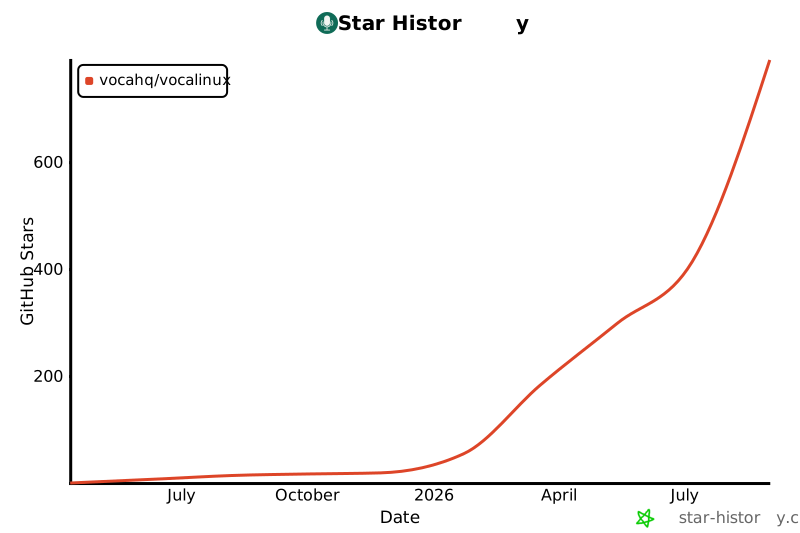
Star Chart
Made with ❤️ for the Linux community
1 maintainer

Download files
Download the file for your platform. If you're not sure which to choose, learn more about installing packages.
Source Distribution
Built Distribution
Filter files by name, interpreter, ABI, and platform.
If you're not sure about the file name format, learn more about wheel file names.
Copy a direct link to the current filters
File details
Details for the file vocalinux-0.16.0.tar.gz.
File metadata
- Download URL: vocalinux-0.16.0.tar.gz
- Upload date:
- Size: 3.5 MB
- Tags: Source
- Uploaded using Trusted Publishing? No
- Uploaded via:
twine/7.0.0 CPython/3.10.21
File hashes
| Algorithm | Hash digest | |
|---|---|---|
| SHA256 |
1d1fa09400cbe7dc8d1ceda84c4bc8507ff36b76e5227c193d75e6f1306d0d83
|
|
| MD5 |
afe77e917679ae429124d7ba7856a86f
|
|
| BLAKE2b-256 |
9e7e8f98b1b7150ae330d77438aa9046699ef0462ef443028d430515fc645819
|
File details
Details for the file vocalinux-0.16.0-py3-none-any.whl.
File metadata
- Download URL: vocalinux-0.16.0-py3-none-any.whl
- Upload date:
- Size: 2.8 MB
- Tags: Python 3
- Uploaded using Trusted Publishing? No
- Uploaded via:
twine/7.0.0 CPython/3.10.21
File hashes
| Algorithm | Hash digest | |
|---|---|---|
| SHA256 |
45c7027dc0d987cbacf2e3e8d9bf41270ce128d8175693bd23a467314a93e808
|
|
| MD5 |
ff182ce9b9feca8a788ddf8a2dd81a71
|
|
| BLAKE2b-256 |
9522da4fd2f4af0b6f871f2eff28a78771c3c491aef8360897458bef9d2469b8
|














