
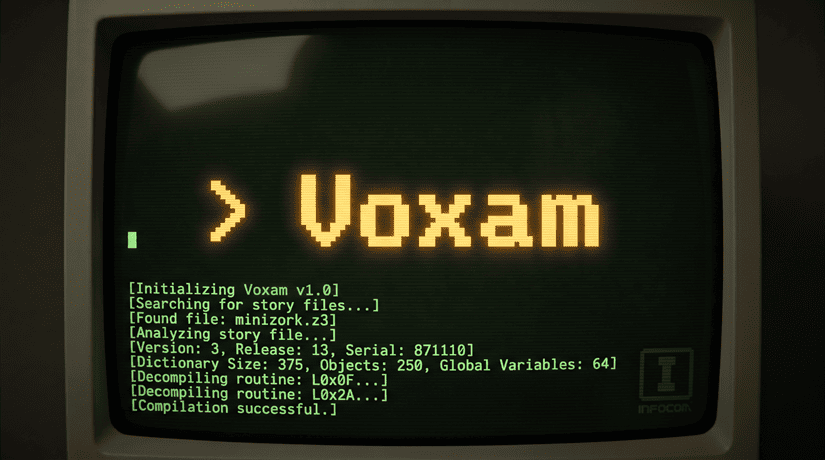
A Specification-Accurate Z-Machine Implementation
Early and Late Infocom + Modern Inform


Works On




An interpreter for the Z-Machine, written in Python, with Glulx to follow.
The Z-Machine is the virtual machine Infocom designed in 1979 to run its text adventures, and which the interactive fiction community has used ever since. Voxam reads a compiled story file and executes it, with two guiding commitments: fidelity to the Z-Machine Standard -- every rule the interpreter enforces cites the section it came from -- and reproducibility, so that a recorded play session replays identically, forever.
VΘXΔM is developed against real games. The Zork trilogy, Cutthroats, Deadline, Seastalker, Trinity, A Mind Forever Voyaging, The Hitchhiker's Guide to the Galaxy, and -- filed in triplicate, blood pressure rising -- Bureaucracy have all been played to winning conclusions under VΘXΔM, several across multiple releases and several to perfect scores, alongside modern classics from Colossal Cave to the IF Comp winner All Roads. The Version 6 era has opened: Arthur: The Quest for Excalibur plays to its ending -- the sword drawn from the stone at the rank of king, every chivalry point earned -- in what is as far as we know the first seeded, replayable Arthur session anywhere. The sound era is certified too: The Lurking Horror and Sherlock: The Riddle of the Crown Jewels both play to perfect scores -- recorded in the conforming quiet, and now heard aloud at a painted terminal with the sound extra installed -- and Beyond Zork's first act is on the record, its hero built point by point on the arrow-driven character screen, in what is as far as we know the first seeded, replayable Beyond Zork session anywhere. And the era plays illustrated now: Arthur, Shogun, and Zork Zero render their pictures, palettes, and window layouts in a real graphics window, held to the Standard's §8.8 screen model. The late formats have opened as well: version 8 is held to CZECH's exact tallies in continuous integration, Jigsaw -- Graham Nelson's epic of the twentieth century -- is recorded through its first two chapters, from the Sarajevo assassination to the Titanic's rescue summoned in real Morse code, and Emily Short's Bronze plays to its winning ending -- the King restored, his servants freed -- in a session adapted command by command from a surviving Release 12 transcript to the canonical Release 11 story file, its annotations recording every place the two releases disagree. Even version 7, the format Infocom never shipped, has a seeded recording, as far as we know the first anywhere. Ballyhoo joins the perfect scores -- 200 of 200, the circus saved, and three of its cruellest hidden state-gates excavated from Infocom's own source and annotated where every published walkthrough omits them. And Jon Ingold's The Mulldoon Legacy -- a game that teases players who act on knowledge their character hasn't earned ("Playing a restored game are we?") -- is recorded deep into its museum, the first of the fortune teller's visions complete: a verified route through a game built to resist secondhand play. Thirty-four recordings verify those sessions end-to-end with the acceptance harness described below, and their annotations double as an archaeology of where the games' published walkthroughs go wrong.
Status
Version 0.x: early, honest, and playable.
Works today: story file versions 1 through 8 -- Infocom's whole catalog, the modern Inform and PunyInform games built on versions 5 and 8, and the rarely-sighted version 7 besides -- including version 6, run against Infocom's own ZIPTEST checker and played through Arthur: the eight-window §8.8 ledger with its eighteen properties per window, user stacks, the formatted-text stream behind print_form, and the v6 cursor forms. At the pygame window the whole era renders illustrated -- the pictures, the palettes, and all eight windows for real -- while on a character glass a version 6 game still plays as flowing text, its graphical courtesies declared unavailable in the header and answered honestly when it asks anyway. Underneath all of it: the full parser and object machinery -- with code above the static-memory line decoded once and cached (§1.1), which is what lets an Inform 7 game spend three hundred thousand instructions on a single turn without the player noticing -- a seeded random number generator for reproducible sessions, the screen model (split windows, single-keystroke input), custom alphabet tables, the accented extra characters, and the Standard 1.1 Unicode extras -- custom translation tables and print_unicode -- so the interpreter declares revision 1.1 in every header it touches. SAVE, RESTORE, and RESTART speak the standard Quetzal format, auxiliary files cover the games that save fragments of themselves, UNDO is multi-level, and an acceptance-script harness records, replays, and probes whole playthroughs.
At a real terminal, VΘXΔM paints the screen: the blessed frontend (an optional extra, named for both its temperament and the blessed package behind it) renders the §8 screen model live -- a reverse-video status line that holds the top of the screen, split windows, character-input menus like Zork's InvisiClues browsed by single keypresses, bold, italic, and the §8.3.1 colours, forwarded to games that ask for them with the header declaring the offer honestly. Font 3 -- §16's character graphics -- paints as Unicode: box-drawing and blocks for Beyond Zork's on-screen map, its stat gauges as eighth-blocks, and the rune alphabet as genuine futhorc runes, each glyph derived from the Standard's own bitmaps. The painter owns the keyboard too: line input is read raw and echoed through the screen model, so nothing but the painter ever writes to the glass, and the cursor keys reach the games that listen for them (§3.8.4) -- which is how Beyond Zork's menus are driven. At a prompt those same keys are a full line editor: left and right move within the line, edits land at the cursor, and up and down walk the session's command history, shell-style -- at the terminal and the pygame window alike, with single-keystroke reads still passing the arrows through to the games that claim them. Timed input runs on the real wall clock there, so a game like Z-Tornado plays in genuine real time. The architecture keeps a strict split between a pure screen model -- a grid of attributed cells held to §8 by golden-grid tests -- and a thin painter that only repaints what changed, so the screen is as testable as the machine beneath it.
VΘXΔM reads Blorb
resource files as well: a .zblorb packaged story boots directly,
and a sidecar .blb found beside a story by name announces its
pictures and sounds at the banner. A cover picture -- Beyond
Zork ships one -- is shown before play at a painted terminal,
scaled into half-block cells on any colour terminal or drawn at
real resolution with --pixels, decoded by a pure-stdlib PNG
reader. The pixels path asks the terminal first: one that
declares sixel graphics also reports its cell size, so the art
magnifies to the glass as it actually measures, and one that
never learned sixel quietly gets the half-block painting instead
of escape garbage. Art is a courtesy, never a gate: a
cover VΘXΔM cannot draw earns a note and the story plays on. And
VΘXΔM can claim any classic machine identity (--interpreter amiga, or the legendary Tandy bit via --tandy), which some
early games answer with altered text and Beyond Zork answers
with its whole screen-model personality (§11.1.3, §16).
And at a pygame window -- the graphics extra, opened with
--graphics -- the Version 6 era plays illustrated. The §8.8
screen is real there: eight placeable windows on one pixel grid,
text at true pixel positions, margins that wrap prose around scene
art, and a [MORE] that pauses a screenful in the window's own
colours and cleans up after itself. Blorb pictures draw at the
sizes the Reso chunk scales them to, transparency lets the chrome
layer over the scenes, and the adaptive palettes recolour that
chrome as scenes change -- both the Standard's live APal dance and
Bocfel's pre-baked BPal replacements, which is how Zork Zero's
plaques keep their gold. Even §8.3.1's strangest colour is
honoured: colour -1 samples the pixel under the cursor, which is
how Zork Zero prints readable text over its parchment under the
Amiga identity. The window takes its share of the desktop --
--zoom, 85% by default -- by growing the grid rather than the
type: more rows and columns of the same modest cell, the way
Infocom's own interpreters used a big monitor, with --zoom 0
keeping the classic 80 by 24. It even wears its story's version as
its icon, z1 through z8. Arthur, Shogun, and Zork Zero all
play illustrated, and the modern Inform- and PunyInform-compiled
version 6 games render clean beside them. For the curious: point
the VOXAM_SNAPSHOT environment variable at a file path and every
presented frame is also saved there -- the diagnostic witness this
whole era was debugged with.
And the machine has a voice. With the sound extra installed, a
painted session plays the sampled sounds its Blorb carries, in the
background while play goes on (§9.4): volumes and repeat counts
decoded from the opcode, a Version 3 game's looping taken from the
Blorb's own Loop chunk -- which is how The Lurking Horror's rats
hum until the valve stops them -- and the end-of-sound routines
Sherlock leans on called when a sound truly finishes, never for
one stopped or replaced. Even the Standard's §9 war stories are
honoured: The Lurking Horror fires several sounds in one game
round, trusting the interpreter to be as slow as Infocom's Amiga
was, so a new sound waits for the current one to finish a cycle,
exactly as the Standard's remarks prescribe -- and its famously
bugged sound requests are pardoned by name. Sound is a courtesy on
the same terms as art: a missing package, a missing PortAudio
library, or a missing audio device each mean a quieter game, never
a broken one, with the header honestly saying so.
Input runs deeper than lines. A scripted line reaches single-keystroke reads one character at a time, which is how cursor-driven forms -- up to and including Bureaucracy's Software Licence Application -- fill in correctly from a recording. In recorded sessions timed input runs on a virtual clock instead: the "patient typist" lets one interrupt interval elapse before each input arrives, which keeps timed games replayable while recordings stay deterministic. Sampled sounds in recorded sessions likewise still pass in the conforming silence of an interpreter that declares none -- The Lurking Horror and Sherlock were both shipped to accept exactly that -- because a replay must land on the same bytes everywhere, speakers or no speakers.
VΘXΔM is verified against the community's interpreter test suites: CZECH (versions 3, 4, 5, and 8 -- the last certifying the modern Inform format, held to its exact tallies in continuous integration), Praxix -- its Standard 1.1 section included -- TerpEtude, and Strict Z Test all pass clean; Infocom's own ZIPTEST opened the version 6 era and named its frontiers one opcode at a time. Every remaining gap halts loudly with a citation instead of guessing.
Not yet: mouse input -- Zork Zero's mouse minigames want
real clicks, and a planned <click y x> recording token will keep
those sessions replayable when they come; Journey, the last of
the graphical four, not yet certified; the Blorb music formats,
MOD and OGG (the entire vendored Infocom sound catalog is sampled
AIFF and needs neither); and Glulx. For recorded sessions, seeds
substitute for saves: a script replays a whole game in moments.
Installation
VΘXΔM requires Python 3.12 or later.
pip install voxam
or, as an isolated tool:
pipx install voxam # or: uv tool install voxam
The painted screen frontend rides in the screen extra, the
pygame window in the graphics extra, and sampled-sound playback
in the sound extra beside them:
pip install "voxam[screen,graphics,sound]" # or: uv tool install "voxam[screen,graphics,sound]"
On Windows and macOS the sound extra is self-contained; on Linux,
PortAudio comes from the distribution (apt install libportaudio2
or the local equivalent). Without the extras, VΘXΔM plays as a
plain text stream -- every game still works; the status line
simply stays imaginary, and the sound games play in the conforming
silence they were shipped to accept.
VΘXΔM ships no story files. Bring your own: the IF Archive hosts thousands of freely available games, and story files you own from commercial collections work as-is.
Playing stories
Point VΘXΔM at a story file and play at the terminal:
voxam path/to/story.z3
At a terminal with the screen extra installed, the painted
frontend takes over automatically -- status line, windows, menus,
real-time input. Pass --plain to keep the classic stream
instead; pipes and scripted replays always use the stream, which
is what keeps recordings deterministic. And --graphics opens
the pygame window -- the home of the Version 6 games, and a fine
roomy home for the earlier ones too. --zoom sets how much of
the desktop it takes (0.85 by default; --zoom 0 keeps the
classic compact 80 by 24).
Add --seed to make the dice reproducible: the same seed and the
same commands produce the same session, every time.
voxam --seed 1137 path/to/story.z3
Blorb resources ride along automatically: a .zblorb story boots
from its package, and a like-named .blb beside a story file is
found on its own -- --resources names one explicitly. At a
painted terminal a packaged cover picture shows before play;
--pixels draws it in real pixels after asking whether the
terminal speaks sixel, falling back to half-blocks when it
does not. --interpreter claims any §11.1.3 platform by name or
number, and --tandy sets the bit that makes early Infocom games
mind their manners.
Typing save in a game writes a Quetzal file beside the story --
zork1.z3 saves to zork1.sav -- and restore reads it back.
Quetzal is the standard interchange format, so saves travel between
VΘXΔM and other interpreters.
Best played with
--interpreter is not a costume. Infocom's Version 6 games carry
genuine per-machine code paths, chosen at startup from the
header's interpreter number, and the flag picks which 1989 machine
VΘXΔM is pretending to be. Recommendations, earned from the games'
own source rather than folklore:
- Shogun: the default. Its own
DISPLAY-BORDERroutine draws the right decorative rail only on the IBM machine path; claiming--interpreter amigaover the IBM picture set gives a left-rail-only screen -- Infocom's authentic Amiga behaviour, whose matching art this Blorb does not carry. - Zork Zero: either, with character. The default plays the
classic look;
--interpreter amigaengages §8.3's shared colour pair and the under-cursor colour sampling for the grey-parchment look the Amiga release was famous for. Both render correctly -- the Amiga is arguably the prettier way in. - Beyond Zork: any -- the flag is a personality dial. The game reshapes its whole screen model per machine (§11.1.3, §16), so each identity is a different-feeling session.
- Early version 3 games:
--tandyfor the lore. The legendary bit that makes them mind their manners -- Zork I literally prints a different licence line.
None of these are bugs routed around: they are the games' own branches, preserved and selectable.
Acceptance scripts
A live session can be written down as it is played, and replayed later:
voxam --record my-session.accept path/to/story.z3
voxam --accept my-session.accept
--record captures every line typed and key pressed -- at the
plain stream or the painted terminal alike -- flushed input by
input, so even a session that ends in a death leaves a replayable
script up to its last keystroke. A recording needs a seed to
replay, so --record without --seed rolls one and writes it
down; the banner names it. An existing file is never overwritten,
and the rare input the script grammar cannot spell exactly draws a
warning rather than being silently mangled. A recorded session is
also the raw material for a curated one: scripts are just text, so
trim the wrong turns, add annotations, and keep the seed.
An acceptance script is a plain text file of typed commands plus a few directives:
! SEED=99
! GAME=path/to/story.z1

# Comments annotate the session; blank lines are ignored.

x me. x mailbox            # inline comments start at whitespace + #
> open mailbox             # the > prefix is optional transcript style
The rules, line by line:
! KEY=VALUEis a directive:GAMEnames the story file to run, andSEEDfixes the dice (a--seedargument overrides it). A relativeGAMEpath counts from the script's own directory, and forward slashes work on every platform.#at the start of a line is a comment.- An inline comment begins at whitespace followed by
#. - A leading
>is optional and stripped; it also escapes the rare command that genuinely begins with#or!. A>alone types an empty line: the enter key. <up>,<down>,<left>,<right>, and<escape>press special keys, one line per press -- how a recording drives Beyond Zork's menus and builds its characters. A token naming no known key fails loudly, and the> <up>prompt form stays a literal command for a game that really wants angle brackets.- A line starting with three backticks is a fence: everything until the next fence is skipped entirely, directives included. Text after the backticks labels the fence, and an unclosed fence skips the rest of the file -- handy while working out a section that a seed change will invalidate, or to replay only the start of a longer script.
- Anything else is typed into the game exactly as written.
- When the commands run out, the session ends as if the player had reached end of input.
While curating a longer session, --replay types the script and
then leaves you at the prompt instead of ending, so a
work-in-progress script catches you up to where you left off:
voxam --replay some-session.accept
And when a session has to stop -- or a wrong turn needs cutting --
--resume is that whole expedition loop as one flag:
voxam --resume my-session.accept
It replays the script to its last line, hands you the prompt, and appends everything you type to the same file. Trim the bad tail in an editor, resume, and press on: a recording grows append-only, under its own seed, across as many sittings as the game demands.
RegTest scripts
VΘXΔM also speaks RegTest, Andrew Plotkin's public-domain regression-test format for interactive fiction -- and speaks it twice over. A RegTest script of named tests, commands, and per-turn checks runs through the built-in in-process runner on any platform:
voxam --regtest my-suite.regtest
or through Plotkin's own reference implementation driving
voxam --plain over pipes on POSIX systems, same file, same
verdict. The in-process runner boots a fresh machine per test at
in-process speed, reports failures in the reference's own voice,
and reaches further than the reference's dumb-terminal mode can:
keystroke input works, because a sent line lands on the same
input seam a recording uses. The regtest/ directory holds
certified scripts that continuous integration runs under both
implementations and holds to the same verdict -- plus an Arthur
script only the built-in runner can follow, since v6's inline
keystroke prompts defeat pipe-based prompt framing. A seed on the
script's ** interpreter: line makes the whole suite
deterministic under both runners, which is not a thing most
interpreters can offer RegTest at all.
Refusal warnings
During a replay, VΘXΔM listens for the parser's refusal dialect -- responses like "You can't see any statuette here!" or "You should close it first" that mean a recorded command did not do what it said. Each one is reported with the script line that drew it:
voxam: line 31: 'lock door' looks refused: You should close it first.
Refusals scroll past a human reader without registering, and the missing side effect may not surface until dozens of turns later. The warning points at the moment it happened, which turns the most common recording bug from an archaeology expedition into a one-line fix.
Probing a recording
When a recording goes wrong -- a death that survives every retry, a
walkthrough command the game will not speak -- the fix is empirical,
and voxam.probe is the instrument. A seeded script is a
deterministic timeline, so a probe can replay the recorded prefix
exactly and then ask "what would happen if...?", as many times as it
takes:
from voxam.probe import Probe

probe = Probe.load("acceptance/advent.accept")
run = probe.attempt(["ne", "give eggs to troll", "ne"], drop_last=2)

for step in run.steps:
    line = step.response.strip().splitlines()[0] if step.response.strip() else ""
    flag = f"  <<< {step.refusal}" if step.refusal else ""
    print(f"[{step.command}] {line}{flag}")
Each step pairs a typed command with everything the story said
back, and flags any response spoken in the refusal dialect --
which turns a hundred-command stretch into a one-screen diagnosis.
attempt replays the script and tries a variant tail
(drop_last re-tries the ending without editing the file);
run takes the whole command list for surgery the prefix cannot
express, such as inserting turns mid-timeline; and the returned
machine is left standing for post-mortem reads of globals,
object parents, or the clock. Every run boots fresh from the seed,
so no experiment can contaminate another.
Probe scripts themselves are throwaways -- write one in a scratch
file, find the answer, record the fix in the .accept annotations,
and delete it. The harness is the part worth keeping.
Development
Working on VΘXΔM itself needs uv for dependency and environment management:
git clone https://github.com/jeffnyman/voxam.git
cd voxam
uv sync --all-groups
All commands below assume that environment.
| Task | Command |
|---|---|
| Run the test suite | uv run pytest |
| Run tests without coverage | uv run pytest --no-cov |
| Lint | uv run ruff check . |
| Lint and autofix | uv run ruff check --fix . |
| Format | uv run ruff format . |
| Check formatting only | uv run ruff format --check . |
| Type check | uv run mypy |
| Build distributions | uv build |
Project conventions
- Layout. Source lives under
src/voxam, tests undertests/. Thesrclayout ensures tests exercise the installed package rather than the working directory. - Typing.
mypyruns in strict mode over bothsrcandtests, and the package ships apy.typedmarker so downstream consumers get its types. - Coverage. The suite is gated at 100% branch coverage. This is deliberate
for a project of this size; adjust
fail_underinpyproject.tomlif it stops being useful. - Spec citations. The
§references in code, docstrings, and output follow the HTML rendering of the Z-Machine Standard 1.1 vendored atentharion/z-machine-standard/. Other renderings of the same Standard, including the PDF beside it, number some paragraphs differently. - Line endings. LF everywhere except Windows script files, enforced by both
.gitattributesand.editorconfig. - Recordings. Complete playthroughs live under
acceptance/in the repository (they are not part of the installed package). They reference games under the optionalentharionsubmodule, so they replay locally rather than in CI -- and they double as the project's archaeology notebook, annotating where the games' published walkthroughs go wrong.
Pre-commit hooks
Install the hooks once, after which lint, format, and type checks run on every commit, and commit messages are validated:
uv run pre-commit install
Every hook is a repo: local entry that runs its tool out of the project
environment via uv run, so pre-commit never clones hook repositories or
builds cached environments under ~/.cache/pre-commit. Tool versions have a
single source of truth: uv.lock.
To run every hook against the whole tree:
uv run pre-commit run --all-files
Commit messages
Commit messages follow Conventional Commits,
enforced at commit time by commitizen
through the commit-msg hook installed above:
feat: add object table parsing
fix(memory): reject story files shorter than the header
docs: explain the save file format
To check a message by hand, or to compose one interactively:
uv run cz check -m "feat: add object table parsing"
uv run cz commit
Because the history is machine-readable, commitizen derives the next version, tags it, and updates the changelog:
uv run cz bump
Reference Material (optional)
An entharion submodule holds the specifications and story files this
project is developed against. These are not required as part of building
and deploying VΘXΔM, but they help during development. VΘXΔM does not
depend on anything under entharion/. It is not needed to install the
project and CI does not fetch it. Git leaves submodules empty unless
asked, so a plain clone simply skips it.
If you want this reference material and if this is your first time checking out the repo, run this command:
git submodule update --init --recursive
That will fetch the primary repository as well as its submodules:
The latter is my own recomposed version of the Z-Machine Standard document, made a little easier for me to read and consume. You can see this deployed here:
To discard it again, freeing the disk space without affecting the project:
git submodule deinit --all
Dependabot tracks the pinned commit and opens a PR when upstream moves. To move the pin by hand instead:
git submodule update --remote entharion
git add entharion
git commit -m "chore(deps): update entharion submodule"
🪄 The Name


The name VΘXΔM draws from two sources of inspiration:
- From Latin, vox means "voice," evoking the idea of turning a player's command into action, like voice into magic.
- In Zork: Grand Inquisitor, voxam was a spell meaning "to separate the energies of different magics." That maps well to the process of parsing, breaking down a command into meaningful parts, isolating intent from raw text.
So whether seen as linguistic alchemy or parser sorcery, VΘXΔM stands at the intersection of command and consequence; of input and invocation.

In terms of a few more historical details, the VOXAM spell has a hilarious relevance in Zork: Grand Inquisitor: it's a complete joke and serves absolutely no functional purpose in the main game. When you first receive your spellbook from Y'Gael at the bottom of the well, VOXAM is one of the three starting spells written inside (alongside REZROV and IGRAM). According to the in-game lore, it belongs to the class of High Magic and, as stated earlier, is defined as a spell to "separate the energies of different magics."
Its actual relevance breaks down into two categories:
- In the Main Game: Pure Flavor & Trolling. While you use REZROV to open the very first locked door and IGRAM to turn purple things invisible later on, VOXAM can't be cast successfully on anything.
- The Developer Joke: The developers included it purely as world-building flavor to pad out your initial spellbook and to trick players into trying it on various magical anomalies throughout the Great Underground Empire.
Also worth mentioning is the "Booznik" System. Later in the game, you discover that the Grand Inquisitor has "Boozniked" (reversed) all magic. If you were theoretically able to reverse VOXAM, it would mean "conjoin the energies of different magics," but the spell remains entirely useless to your inventory.
So: a spell defined as separating the energies of different magics, that generations of players cast hopefully at every anomaly in the Great Underground Empire, and that never once worked on anything -- until now. Point this one at a story file and it separates raw Z-code into opcodes, operands, and intent, exactly as advertised.
Twenty-nine years later, the spell finally works on something.
Chris McDonald, in Techno History, wrote:
"Humans are ceaseless borrowers and copiers. Perhaps, contra Ecclesiastes, there is an occasional new thing under the sun, but certainly humans think no new thoughts ex nihilo. And yet we are also ceaseless inventors. We combine existing ideas in new ways or place them in new surroundings, and suddenly the old becomes new, in a wonderful alchemy of the mind."
A borrowed machine, a borrowed spell, a borrowed voice -- combined in new surroundings until the old became new. VΘXΔM is that alchemy, practiced on Z-code.
👨💻 Author
Made with 🤍 by Jeff Nyman



☦️ Doxazein (δοξάζειν)
חֶסֶד וֶאֱמֶת אַל־יַעַזְבֻךָ קָשְׁרֵם עַל־גַּרְגְּרֹתֶיךָ כָּתְבֵם עַל־לוּחַ לִבֶּךָ
"Let not mercy and truth forsake thee:
bind them about thy neck;
write them upon the table of thine heart."
Proverbs 3:3
🕹️ Acknowledgements
This project stands on the shoulders of the team at Infocom, the MIT-born company that invented the Z-Machine to let Zork, and everything that followed, run unmodified across nearly every computer of its era. Particular thanks go to Marc Blank and Joel Berez, who designed the Z-Machine's virtual architecture, and to Tim Anderson, Bruce Daniels, and Dave Lebling, whose work on Zork at MIT gave the format a reason to exist. Thanks also to Graham Nelson, whose Inform language and Z-Machine Standards Document kept the format alive and well-documented long after Infocom itself was gone, making implementations like this one possible.
⚖️ License
The code used in this project is licensed under the MIT license.
Note: This license applies only to the code in this repository. The original Z-Machine concept, design, and any original assets belong to their respective copyright holders.
✨ Long live the classics.
1 maintainer

Download files
Download the file for your platform. If you're not sure which to choose, learn more about installing packages.
Source Distribution
Built Distribution
Filter files by name, interpreter, ABI, and platform.
If you're not sure about the file name format, learn more about wheel file names.
Copy a direct link to the current filters
File details
Details for the file voxam-0.10.0.tar.gz.
File metadata
- Download URL: voxam-0.10.0.tar.gz
- Upload date:
- Size: 199.4 kB
- Tags: Source
- Uploaded using Trusted Publishing? Yes
- Uploaded via:
twine/7.0.0 CPython/3.13.14
File hashes
| Algorithm | Hash digest | |
|---|---|---|
| SHA256 |
dba407f91a375eb48dfef847eebd42111b4ef5de85bc81a85e7705fed9e90492
|
|
| MD5 |
951237b72884005cef2c8d0192a9fef7
|
|
| BLAKE2b-256 |
281cd6148c47ee3eb7233032c61cd112e9801adc4d4e82545f4ff609352c7b79
|
Provenance
The following attestation bundles were made for voxam-0.10.0.tar.gz:
Publisher:
release.yml on jeffnyman/voxam
-
Statement:
-
Statement type:
https://in-toto.io/Statement/v1 -
Predicate type:
https://docs.pypi.org/attestations/publish/v1 -
Subject name:
voxam-0.10.0.tar.gz -
Subject digest:
dba407f91a375eb48dfef847eebd42111b4ef5de85bc81a85e7705fed9e90492 - Sigstore transparency entry: 2515186898
- Sigstore integration time:
-
Permalink:
jeffnyman/voxam@0551efdd5997e7c41267fe32356df40d9b9f70d6 -
Branch / Tag:
refs/tags/v0.10.0 - Owner: https://github.com/jeffnyman
-
Access:
public
-
Token Issuer:
https://token.actions.githubusercontent.com -
Runner Environment:
github-hosted -
Publication workflow:
release.yml@0551efdd5997e7c41267fe32356df40d9b9f70d6 -
Trigger Event:
push
-
Statement type:
File details
Details for the file voxam-0.10.0-py3-none-any.whl.
File metadata
- Download URL: voxam-0.10.0-py3-none-any.whl
- Upload date:
- Size: 205.6 kB
- Tags: Python 3
- Uploaded using Trusted Publishing? Yes
- Uploaded via:
twine/7.0.0 CPython/3.13.14
File hashes
| Algorithm | Hash digest | |
|---|---|---|
| SHA256 |
dd28eaf7bb9f5bc0de5fe2fd68d28f9204ff2baf50cf180b6230e8dbc1e1ef45
|
|
| MD5 |
d51cdd90ba3bf1119ea7361268f974da
|
|
| BLAKE2b-256 |
b4409ec69cdd06d6bd6d49cde22a436252164b5345eab96e9b98ba9caef8691a
|
Provenance
The following attestation bundles were made for voxam-0.10.0-py3-none-any.whl:
Publisher:
release.yml on jeffnyman/voxam
-
Statement:
-
Statement type:
https://in-toto.io/Statement/v1 -
Predicate type:
https://docs.pypi.org/attestations/publish/v1 -
Subject name:
voxam-0.10.0-py3-none-any.whl -
Subject digest:
dd28eaf7bb9f5bc0de5fe2fd68d28f9204ff2baf50cf180b6230e8dbc1e1ef45 - Sigstore transparency entry: 2515187002
- Sigstore integration time:
-
Permalink:
jeffnyman/voxam@0551efdd5997e7c41267fe32356df40d9b9f70d6 -
Branch / Tag:
refs/tags/v0.10.0 - Owner: https://github.com/jeffnyman
-
Access:
public
-
Token Issuer:
https://token.actions.githubusercontent.com -
Runner Environment:
github-hosted -
Publication workflow:
release.yml@0551efdd5997e7c41267fe32356df40d9b9f70d6 -
Trigger Event:
push
-
Statement type:







