
warpax



JAX tools for curvature, energy conditions, and geodesics in prescribed
spacetimes. warpax uses automatic differentiation to evaluate the Einstein
tensor, then tests energy conditions across observer directions.
See the changelog for version 1.5.1.
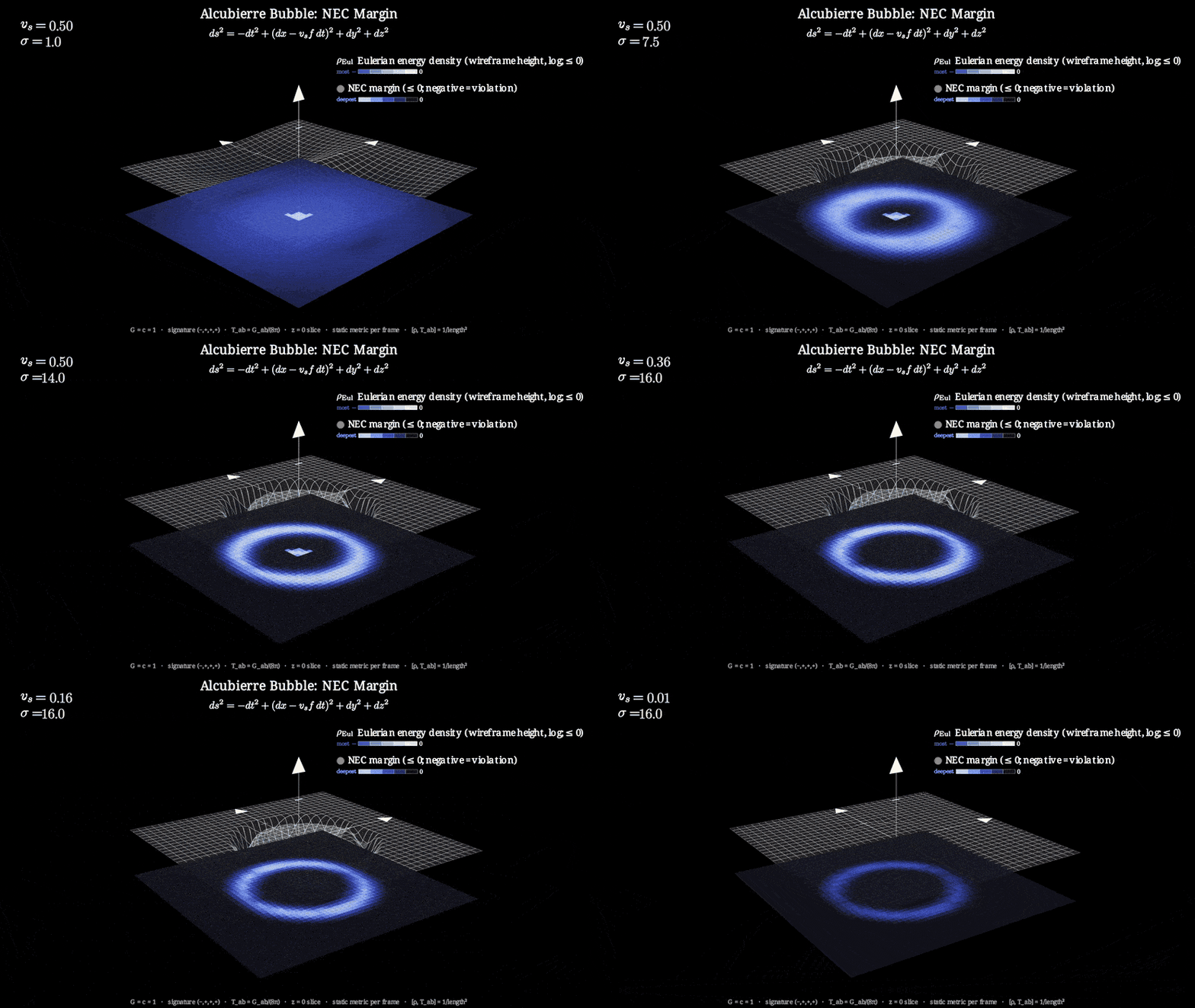
Alcubierre wall and speed sweep. Wireframe height shows Eulerian energy density; the lower plane shows the smallest normalized null contraction among 312 sampled directions. Both use signed logarithmic scales. Each frame is a separate constant-speed metric, and the height is a scalar plot, not a spatial embedding.
Install and run
Python 3.12 or newer:
pip install warpax
from warpax import certify
from warpax.metrics import RodalMetric

metric = RodalMetric(v_s=0.5, R=1.0, sigma=8.0)
result = certify(metric, shape=(16, 16, 16))
print(result.type_fractions)
print(result.invariant_nec_min)  # Minimum over sampled wall Type-I points.
The grid is a quick demonstration. Resolve the wall and vary the grid before
interpreting extrema or type fractions. Geometric units are G = c = 1, with
metric signature (-,+,+,+) and float64 enabled at import.
For a general GR starting point, the curvature tutorial checks Minkowski space and Schwarzschild vacuum against analytical results. The same curvature pipeline accepts custom metrics. The conventions specify index order, curvature sign and physical units.
For development and the examples:
git clone https://github.com/anindex/warpax.git
cd warpax
uv sync --locked --extra dev --extra viz --extra design --extra solver
uv run python examples/01_minkowski_sanity.py
| Extra | Use |
|---|---|
dev |
Tests and Ruff |
design, solver |
Interpolated metrics, shape design, and SciPy solvers |
viz, manim |
Plotting helpers and animations |
interop, einfields |
External metric files and model checkpoints |
docs, bench |
Documentation and performance benchmarks |
What it computes
- Curvature and stress-energy from callable metrics, including ADM fields.
- Hawking–Ellis classification, Type-I eigenvalue margins, and linear matrix inequality (LMI) tests that do not require an algebraic type assignment.
- Continuous observer searches, exact checks for supplied rational certificates, and interval bounds on supported metric domains.
- Timelike and null geodesics, finite-segment energy integrals, tidal effects, and quantum-inequality reference diagnostics.
- Constraint residuals, TOV equilibrium, ADM mass, junction conditions, legacy prescribed-source shell diagnostics, and metric optimization.
- WarpFactory, EinFields, and Cactus imports; Matplotlib and Manim visualization; Bondi flux and Newman–Penrose diagnostics.
Numerical classification and LMI searches use finite precision and tolerances.
An unsuccessful certificate search is inconclusive. The exact energy-condition
verdict is independent of the observer, but numerical margin magnitudes depend
on the tetrad and normalization. Observer optimization also depends on its
rapidity cap. The Eulerian normal remains timelike wherever the ADM lapse and
spatial metric are valid, including regions where the coordinate vector
∂t is spacelike.
The null integrals cover finite segments. They establish no complete-geodesic ANEC sign or ranking. Grid spreads and polished extrema are numerical diagnostics; only reported interval bounds support continuum claims. Vorticity alone does not determine algebraic type, and the exact pointwise quadratic speed law requires zero momentum and fixed profiles and domains.
Documentation
Start with the quickstart or
numbered examples. Each metric implements a callable
(4,) -> (4, 4) from spacetime coordinates to the covariant metric tensor.
| Task | Guide |
|---|---|
| Understand the calculations | Theory, architecture |
| Choose or implement a metric | Catalog, custom metric |
| Read results or load data | Energy-condition results, external metrics |
| Inspect the API or benchmark it | API, benchmarks |
| Reproduce the papers | Observer-robust energy conditions, shell calculations and limits |
Example 07 implements a Gaussian warp metric. Examples 08–10 cover shape design and shell diagnostics. Example 11 reproduces the revised elastic-shell equilibrium, frame dragging, cavity tides and central clock shifts. Its datasets and definitions live in this repository; see the shell guide for commands and approximation limits. Animation commands and system dependencies are in the animation instructions and render script.
Checks and reproduction
uv run python -m pytest
uv run ruff check src/ tests/ scripts/ benchmarks/ examples/
uv run ruff format --check src/ tests/ scripts/ benchmarks/ examples/
uv sync --locked --extra docs --extra design
uv run mkdocs build --strict
Tests run in parallel by default. Use -n 2 to limit workers, or select a module
such as tests/test_slemma.py.
The script guide lists reproduction commands and required
extras. reproduce_all.sh clears generated caches by default; --keep-cache
retains them, and --stage selects a stage. Interval enclosures are a separate,
expensive stage. The optional paper-number check requires the corresponding
manuscript sources and matching numerical inputs.
Citation
Use CITATION.cff for software metadata and cite the relevant paper:
- An T. Le, Observer-robust energy condition verification for warp drive spacetimes (2026).
- An T. Le, Relativistic elastic shells: material support and cavity geometry (2026).
The observer-robust paper received provisional acceptance by Classical and Quantum Gravity on September 21, 2026, pending the publisher's final checks. Example 11 supplies the elastic-shell numerical calculations. The legacy S-/T-shell constructors implement separate prescribed metrics; see the shell guide for their limitations.
Questions and contributions
For a numerical discrepancy, open an issue with the metric and parameters, evaluation point or grid, expected identity, tolerances and a minimal runnable example. Contributions of metrics should include their coordinate domain, conventions, source reference and an independent curvature or stress-energy check.
1 maintainer

Metadata
1 maintainer
Release files for warpax 1.5.1
For a detailed explanation of source distributions (sdists) and built distributions (wheels), please see the package formats documentation.
Source distribution (sdist)
| File | Size | Uploaded | |
|---|---|---|---|
| warpax-1.5.1.tar.gz | 696.8 kB | Details |
Built distribution (wheel)
| File | Interpreter | ABI | Platform | Reset |
|---|---|---|---|---|
| warpax-1.5.1-py3-none-any.whl | Python 3 | none | any | Details |
Total release size: 1.1 MB
Release files / warpax-1.5.1.tar.gz
| Download URL | warpax-1.5.1.tar.gz |
|---|---|
| Size | 696.8 kB |
| Tags | Source |
|
SHA-256 checksum How to use checksums |
aa3daa5f861e2717ad38e3a38e764c0c477302c446062bd43c32daefccfa7c61
|
|
BLAKE2b-256 checksum How to use checksums |
63d39c432f58a9b9308161d43071ac6f4e37eaee0989ac674393032d33c307d1
|
| Upload date | |
|
Uploaded using Trusted Publishing? What is trusted publishing? |
Yes |
| Uploaded via |
twine/7.0.0 CPython/3.13.14
|
Provenance
Provenance describes where a file came from. On PyPI, provenance is shared via attestations, which provide a verifiable record of the build or publishing details. View details, limitations and caveats.


PyPI Publish Attestation
PyPI verified that this artifact, at this checksum, originated from the publisher listed below.
Signed by GitHub Actions, verified by PyPI on Sep 24, 2026.
Transparency logRelease files / warpax-1.5.1-py3-none-any.whl
| Download URL | warpax-1.5.1-py3-none-any.whl |
|---|---|
| Size | 416.6 kB |
| Tags | Python 3 |
|
SHA-256 checksum How to use checksums |
7a32580e595e937a7f32d57048b126c570e85f5e07f008e1231b951542cafc26
|
|
BLAKE2b-256 checksum How to use checksums |
706f128706125c5c117786b9fa56b5445fb18eaeb5131f3fbc4da19c652426e3
|
| Upload date | |
|
Uploaded using Trusted Publishing? What is trusted publishing? |
Yes |
| Uploaded via |
twine/7.0.0 CPython/3.13.14
|
Provenance
Provenance describes where a file came from. On PyPI, provenance is shared via attestations, which provide a verifiable record of the build or publishing details. View details, limitations and caveats.
PyPI Publish Attestation
PyPI verified that this artifact, at this checksum, originated from the publisher listed below.
Signed by GitHub Actions, verified by PyPI on Sep 24, 2026.
Transparency log













