
weaklink
Streaming digital modem: bytes on stdin → audio → bytes on stdout. Works
with tail -f; no memory buffering, no wait-for-EOF.
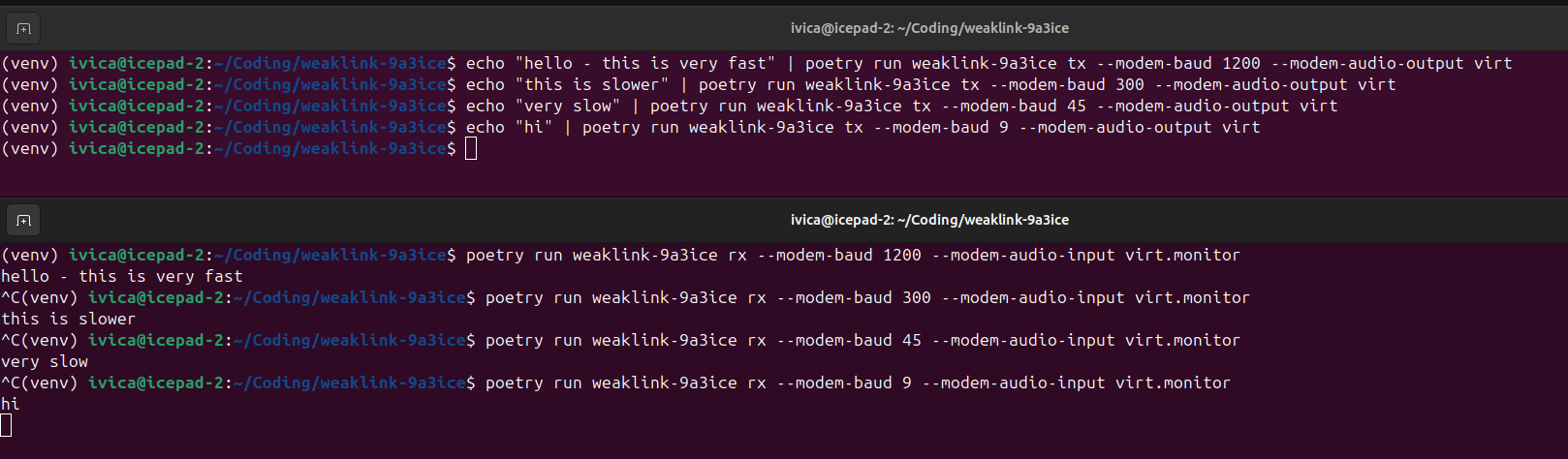
Distribution: weaklink-modem (PyPI + release binaries).
Install
Portable Linux binary:
sudo apt install libportaudio2 libsndfile1
curl -L -O https://github.com/ivica3730k/weaklink-9a3ice/releases/latest/download/weaklink-modem-linux-x86_64-latest
chmod +x weaklink-modem-linux-x86_64-latest
Debian / Ubuntu .deb:
curl -L -O https://github.com/ivica3730k/weaklink-9a3ice/releases/latest/download/weaklink-modem_amd64-latest.deb
sudo dpkg -i weaklink-modem_amd64-latest.deb
From source:
poetry install
poetry run weaklink-modem --version
PyPI:
pip install weaklink-modem
Quickstart
# WAV roundtrip
echo -n "hello weaklink" | weaklink-modem tx --modem-wav /tmp/hello.wav
weaklink-modem rx --modem-wav /tmp/hello.wav

# Live speaker → mic
weaklink-modem rx > out.txt &
echo -n "over the room" | weaklink-modem tx

# Long-lived stream
tail -f /var/log/syslog | weaklink-modem tx --modem-baud 300
Both sides must use the same --modem-baud (no handshake).
Presets
The three baud rates below are presets — starting points, not fixed configurations. Every preset carries 13 B of payload per RS block (RS(16,8) + CRC-32) by default, so message sizes and per-block air time in the table are what you get if you don't override anything.
Every knob shown is overridable on both sides via CLI flags
(--modem-num-tones, --modem-rs-data-bytes, --modem-rs-parity-bytes,
--modem-block-repeats, ...), or via ModemOptions in the Python
API. Changing them shifts the numbers in the table proportionally --
smaller RS blocks and lower repeat counts mean shorter minimum
payloads (and a worse cliff); the reverse is also true.
| Baud | CLI (both tx / rx) | 4-FSK tones (Hz) | Bandwidth | Default repeats | Measured best SNR | Min live tx (13 B payload) |
|---|---|---|---|---|---|---|
| 45 | --modem-baud 45 |
1200 / 1400 / 1600 / 1800 | 600 Hz | 4× | ≈ −14 dB | 28 s |
| 300 | --modem-baud 300 |
1050 / 1350 / 1650 / 1950 | 900 Hz | 2× | ≈ −5 dB | 2.4 s |
| 1200 | --modem-baud 1200 |
500 / 1700 / 2900 / 4100 | 3600 Hz | 2× | ≈ +2 dB | 1.0 s |
SNR is measured with AWGN normalised to a 3 kHz reference band — a cross-baud comparison convention, not a physical channel filter.
Doubling --modem-block-repeats buys ~2–3 dB via soft-LLR combining
at proportional air time. Full sweep of every combo we test is in
results.md.
Debugging live audio
weaklink-modem rx --modem-debug > out.txt writes diagnostics to
log.txt (stdout stays clean for piping). Watch for:
audio: peak +X dBFSbelow −40 dBFS → wrong mic or gain too low.RS corrected— outer code saved a block.N slot(s) failed CRC/RS— unrecoverable, data lost.- macOS mic AGC / voice-isolation destroys tones; disable in System Settings.
Full SNR sweep
Every baud × num_tones × RS × repeats combo is measured in
results.md. Re-run poetry run weaklink-modem-benchmark to
refresh.
Supported audio backends
| Backend | Linux | macOS | Windows | Notes |
|---|---|---|---|---|
| sounddevice / PortAudio | ✓ | ✓ | ✓* | Default. Index (5) or name substring (USB). WASAPI / CoreAudio / ALSA under the hood. |
| Pulse / PipeWire subprocess | ✓ | — | — | paplay / parec. Fires on pulse:<id>, pulse:<name>, a bare Pulse sink id resolvable by pactl, or a name PortAudio doesn't know (e.g. virt.monitor). |
| WAV via soundfile | ✓ | ✓ | ✓ | File I/O only, via --modem-wav. |
* Windows is untested — PortAudio supports it so it should work, but no CI on that platform yet.
CLI reference
| Flag | Default | Description |
|---|---|---|
--modem-baud N |
300 |
Symbol rate. Only 45, 300, 1200 supported. |
--modem-num-tones N |
4 |
N-FSK order: 2 / 4 / 8 / 16. Higher packs more bits per symbol at wider bandwidth and worse cliff. 2 halves throughput but fits narrow audio paths (e.g. FM voice via SignaLink). TX and RX must match. |
--modem-rs-data-bytes N |
preset | Reed-Solomon data bytes per block. |
--modem-rs-parity-bytes N |
preset | RS parity bytes. Corrects up to N/2 byte errors per block. |
--modem-no-rs-crc |
CRC on | Skip the CRC-32 inside each RS block. |
--modem-block-repeats N |
preset | N copies per block, each permuted differently; RX soft-combines LLRs. |
--modem-wav PATH |
live | WAV file instead of live audio. |
--modem-audio-output NAME |
OS default | tx audio target: sounddevice index, name substring, or Pulse sink. |
--modem-audio-input NAME |
OS default | rx audio source: same syntax; Pulse sources like virt.monitor supported. |
--modem-debug |
off | Verbose DEBUG chatter in the log file. |
--modem-log-file PATH |
./log.txt |
Diagnostics land here. |
How it works
TX signal chain
flowchart LR
    A[stdin bytes] --> B[Chunk<br/>rs_data − 3 B<br/>per block]
    B --> C[Frame<br/>len · idx · payload · pad]
    C --> D[RS + CRC-32]
    D --> E[Conv encode<br/>K=7, r=1/2]
    E --> F[Per-block<br/>interleaver<br/>32-cycle PN]
    F --> G[Bits → 4-FSK<br/>symbols]
    G --> H[CPFSK<br/>modulator]
    H --> I[+ preamble<br/>+ pilot]
    I --> J[audio out]
RX signal chain
flowchart LR
    A[audio in] --> B[Non-coherent<br/>4-FSK demod]
    B --> C[Coarse FFT<br/>LO offset]
    C --> D[Preamble<br/>correlator]
    D --> E[Peak detect<br/>+ non-max<br/>suppression]
    E --> F[Per-preamble<br/>fine offset]
    F --> G[Slot soft LLRs]
    G --> H[Deinterleave<br/>seed brute-force]
    H --> I[Soft Viterbi]
    I --> J{RS + CRC<br/>ok?}
    J -- yes --> K[Assemble<br/>by block_index]
    J -- no --> L[Buffer LLRs;<br/>combine across<br/>R copies]
    L --> I
    K --> M[Strip zero-pad<br/>via length]
    M --> N[stdout bytes]
Every slot is bracketed by a preamble, so any single slot decodes standalone. Spurious mid-stream peaks get dropped. Message boundaries between separate tx sessions are inferred from non-block-length spans between preambles — one rx pipe can watch many tx sessions in a row.
Wire format
One tx session (live audio):

  ┌────────┬─────┬────────┬─────┬────────┬─────┬─────┬────────┬─────┬────────┐
  │ pilot  │ pre │ slot 0 │ pre │ slot 1 │ pre │ ... │slot N-1│ pre │ pilot  │
  └────────┴─────┴────────┴─────┴────────┴─────┴─────┴────────┴─────┴────────┘

One RS block, data area (before conv + interleave + FSK):

  ┌── 1B ──┬── 2B ────┬──── rs_data − 3 B ────┬── 4B CRC ──┬── rs_parity B ──┐
  │ length │block_idx │ payload (zero-padded) │  CRC-32    │  RS parity      │
  └────────┴──────────┴───────────────────────┴────────────┴─────────────────┘
block_idx is 2 bytes → one tx session is bounded at 65 535 slots.
Testing
poetry run pytest -q # ~2 min, full suite
Every batch-decode test has an e2e-streaming companion that drives audio
through the same _StreamingRxPump the CLI uses.
Glossary
- N-FSK / CPFSK — N continuous-phase tones, log₂(N) bits per symbol. Default N=4.
- Preamble — Fixed 32-symbol PN sequence bracketing every slot; RX locks timing / frequency / amplitude from it.
- Slot — Preamble + one RS-encoded block.
- Block — RS-encoded chunk carrying header + payload.
- RS(n,k) — Reed-Solomon outer code. k data + parity → n wire bytes; corrects (n-k)/2 byte errors.
- CRC-32 — Catches errors past RS correction.
- Convolutional code (K=7, r=1/2) + soft Viterbi — Inner FEC and its decoder, driven by per-bit LLRs.
- LLR — Log-likelihood ratio; a soft (real-valued) confidence per bit instead of a hard 0/1.
- Interleaver — Bit shuffle so bursts become isolated errors. Ours changes every block (32-permutation cycle).
- Non-coherent demod — Tone detection by energy; ~3 dB behind coherent.
- LO offset — Radio frequency error; we correct up to ±500 Hz.
- Pilot — Short random N-FSK burst before / after every live TX.
- SNR (dB) — Signal-to-noise ratio. Negative = noise louder than signal.
- AWGN — Additive white Gaussian noise; the standard clean-channel noise model used by the benchmark.
- Shannon limit — Theoretical lowest SNR at which a given data rate can be decoded error-free. Every FEC decoder sits some dB above it — that gap is what "Gap" columns report.
- Best SNR / cliff — Lowest SNR at which decode still works for a given config. Below it, everything breaks.
- Nyquist theorem — A signal is only recoverable if sampled above twice its highest frequency. In practice: tones must sit below sample_rate/2, and N-FSK tone spacing must be at least
1/T_symbolfor non-coherent orthogonality.
Roadmap
- Coherent detection — Costas-loop demod, ~3 dB gain. Big DSP lift.
- LDPC — Closes ~2–4 dB of the Shannon gap. Needs a proper construction.
License
MIT. See LICENSE.
Reed-Solomon via reedsolo.
Convolutional code uses the standard NASA/CCSDS (171, 133) generator
polynomials. Audio via sounddevice
and soundfile.
1 maintainer

Metadata
1 maintainer
Release files for weaklink-modem 0.6.2
For a detailed explanation of source distributions (sdists) and built distributions (wheels), please see the package formats documentation.
Source distribution (sdist)
| File | Size | Uploaded | |
|---|---|---|---|
| weaklink_modem-0.6.2.tar.gz | 47.8 kB | Details |
Built distribution (wheel)
| File | Interpreter | ABI | Platform | Reset |
|---|---|---|---|---|
| weaklink_modem-0.6.2-py3-none-any.whl | Python 3 | none | any | Details |
Total release size: 97.6 kB
Release files / weaklink_modem-0.6.2.tar.gz
| Download URL | weaklink_modem-0.6.2.tar.gz |
|---|---|
| Size | 47.8 kB |
| Tags | Source |
|
SHA-256 checksum How to use checksums |
6a7e39e3731ffcaf4bcc37338efcb7e337f39a8eab97dabdbd9a107c8eff2588
|
|
BLAKE2b-256 checksum How to use checksums |
3daf4bfb25692f4576f4f37ce8d96d9c1fa29dde475a001890c09ae59e0da488
|
| Upload date | |
|
Uploaded using Trusted Publishing? What is trusted publishing? |
No |
| Uploaded via |
twine/6.1.0 CPython/3.13.14
|
Release files / weaklink_modem-0.6.2-py3-none-any.whl
| Download URL | weaklink_modem-0.6.2-py3-none-any.whl |
|---|---|
| Size | 49.8 kB |
| Tags | Python 3 |
|
SHA-256 checksum How to use checksums |
e9ceca9d9afdc018bff954bd2d6fcbd42c2331c8f91afbfc0d867bd629b9f8d8
|
|
BLAKE2b-256 checksum How to use checksums |
1eb96eff24ddfb4ec682bce6c30baca8a7be7118a5855fa8df468f5060d846f5
|
| Upload date | |
|
Uploaded using Trusted Publishing? What is trusted publishing? |
No |
| Uploaded via |
twine/6.1.0 CPython/3.13.14
|














