
weaklink
Streaming MFSK modem: bytes on stdin → audio → bytes on stdout.
Works with tail -f; no memory buffering, no wait-for-EOF. Reed-Solomon
- convolutional K=7 r=1/2 + soft Viterbi, per-block interleaver, soft-LLR combining across block repeats. Modes: OOK and 2/4/8/16-FSK at 45 / 300 / 1200 baud.
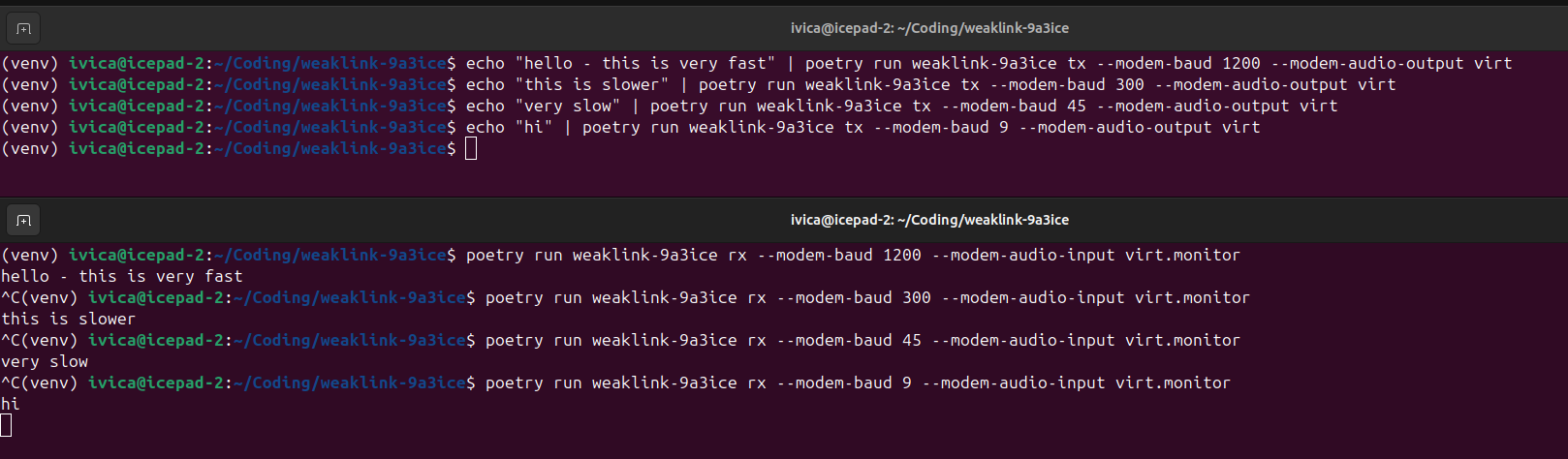
Distribution: weaklink-modem (PyPI + release binaries).
Install
Portable Linux binary (x86_64):
curl -L -O https://github.com/ivica3730k/weaklink-9a3ice/releases/latest/download/weaklink-modem-linux-x86_64-latest
chmod +x weaklink-modem-linux-x86_64-latest
Portable Linux binary (arm64 / Raspberry Pi):
curl -L -O https://github.com/ivica3730k/weaklink-9a3ice/releases/latest/download/weaklink-modem-linux-arm64-latest
chmod +x weaklink-modem-linux-arm64-latest
Debian / Ubuntu .deb (amd64):
curl -L -O https://github.com/ivica3730k/weaklink-9a3ice/releases/latest/download/weaklink-modem_amd64-latest.deb
sudo dpkg -i weaklink-modem_amd64-latest.deb
Debian / Raspberry Pi OS .deb (arm64):
curl -L -O https://github.com/ivica3730k/weaklink-9a3ice/releases/latest/download/weaklink-modem_arm64-latest.deb
sudo dpkg -i weaklink-modem_arm64-latest.deb
From source:
poetry install
poetry run weaklink-modem --version
PyPI:
pip install weaklink-modem
Quickstart
# WAV roundtrip
echo -n "hello weaklink" | weaklink-modem tx --modem-wav /tmp/hello.wav
weaklink-modem rx --modem-wav /tmp/hello.wav

# Live speaker → mic
weaklink-modem rx > out.txt &
echo -n "over the room" | weaklink-modem tx

# Long-lived stream
tail -f /var/log/syslog | weaklink-modem tx --modem-baud 300
Both sides must use the same --modem-baud (no handshake).
Presets
The three baud rates below are presets — starting points, not
fixed configurations. Every preset carries 13 B of payload per RS
block (RS(16,8) + CRC-32) by default; the table shows what you get
if you don't override anything. Every parameter is overridable on
both sides via CLI flags (--modem-num-tones, --modem-rs-data-bytes,
--modem-rs-parity-bytes, --modem-block-repeats, ...) or via
ModemOptions in the Python API.
Preset defaults use M=4 (4-FSK); the --modem-num-tones flag selects
any M ∈ {1, 2, 4, 8, 16}. M=1 is OOK; the sole carrier sits at the
center of the tone range shown below.
| Baud | CLI (both tx / rx) | Default tones (M=4, Hz) | Bandwidth | Default repeats | Measured best SNR | Min live tx (13 B payload) |
|---|---|---|---|---|---|---|
| 45 | --modem-baud 45 |
1200 / 1400 / 1600 / 1800 | 600 Hz | 4× | ≈ −14 dB | 28 s |
| 300 | --modem-baud 300 |
1050 / 1350 / 1650 / 1950 | 900 Hz | 2× | ≈ −5 dB | 2.4 s |
| 1200 | --modem-baud 1200 |
500 / 1700 / 2900 / 4100 | 3600 Hz | 2× | ≈ +2 dB | 1.0 s |
SNR is measured with AWGN normalised to a 3 kHz reference band — a cross-baud comparison convention, not a physical channel filter.
Doubling --modem-block-repeats buys ~2–3 dB via soft-LLR combining
at proportional air time. Full sweep of every combo we test is in
results.md.
OOK (M=1)
--modem-num-tones 1 selects on-off keying: single carrier at
center_hz, symbol 0 = silence, symbol 1 = tone. Narrowest possible
bandwidth of any mode — just the carrier and its modulation sidelobes,
no tone stack. Same 1 bit/symbol as 2-FSK but a few dB worse in AWGN
(silence half the time = less average energy). Cliff at 45 baud
with block_repeats=4: ≈ −14 dB, matching 4-FSK at the same
settings. See results.md for the per-baud numbers.
Constant envelope for any M
--modem-num-tones M means "M possible frequencies to pick from per
symbol", not "M frequencies playing simultaneously". The transmitter
emits exactly one sinusoid at any instant, hopping between frequencies
at the symbol clock. Constant envelope (PAPR = 3 dB, the peak-to-RMS
of a pure sine) regardless of M.
Consequences:
- All transmit power in one tone at a time — maximum per-symbol SNR, no
1/Mpower split. - Higher M buys log₂(M) bits/symbol with no PAPR cost. 16-FSK carries 4× the bits of 2-FSK at the same baud, same peak power.
On an SDR waterfall you'll see all M frequency slots "lit up" during a long transmission — that's the display integrating over time. Shrink the FFT window below one symbol duration (~3.3 ms at 300 baud) and you'll see the transmitter chasing one tone across the slots instead.
Debugging live audio
weaklink-modem rx --modem-debug > out.txt writes diagnostics to
log.txt (stdout stays clean for piping). Watch for:
audio: peak +X dBFSbelow −40 dBFS → wrong mic or gain too low.RS corrected— outer code saved a block.N slot(s) failed CRC/RS— unrecoverable, data lost.- macOS mic AGC / voice-isolation destroys tones; disable in System Settings.
Full SNR sweep
Every baud × num_tones × RS × repeats combo is measured in
results.md. Re-run poetry run weaklink-modem-benchmark to
refresh.
Supported audio backends
| Backend | Linux | macOS | Windows | Notes |
|---|---|---|---|---|
| sounddevice / PortAudio | ✓ | ✓ | ✓* | Default. Index (5) or name substring (USB). WASAPI / CoreAudio / ALSA under the hood. |
| Pulse / PipeWire subprocess | ✓ | — | — | paplay / parec. Fires on pulse:<id>, pulse:<name>, a bare Pulse sink id resolvable by pactl, or a name PortAudio doesn't know (e.g. virt.monitor). |
| WAV via soundfile | ✓ | ✓ | ✓ | File I/O only, via --modem-wav. |
* Windows is untested — PortAudio supports it so it should work, but no CI on that platform yet.
CLI reference
| Flag | Default | Description |
|---|---|---|
--modem-baud N |
300 |
Symbol rate. Only 45, 300, 1200 supported. |
--modem-num-tones M |
4 |
MFSK order: 1 (OOK) / 2 / 4 / 8 / 16. Higher M packs more bits per symbol (log₂ M) at wider bandwidth. 2 halves throughput vs 4 but fits narrow audio paths (e.g. FM voice via SignaLink). 1 (OOK) is narrowest and switching-amp friendly. TX and RX must match. |
--modem-rs-data-bytes N |
preset | Reed-Solomon data bytes per block. |
--modem-rs-parity-bytes N |
preset | RS parity bytes. Corrects up to N/2 byte errors per block. |
--modem-no-rs-crc |
CRC on | Skip the CRC-32 inside each RS block. |
--modem-block-repeats N |
preset | N copies per block, each permuted differently; RX soft-combines LLRs. |
--modem-wav PATH |
live | WAV file instead of live audio. |
--modem-audio-output NAME |
OS default | tx audio target: sounddevice index, name substring, or Pulse sink. |
--modem-audio-input NAME |
OS default | rx audio source: same syntax; Pulse sources like virt.monitor supported. |
--modem-debug |
off | Verbose DEBUG chatter in the log file. |
--modem-log-file PATH |
./log.txt |
Diagnostics land here. |
How it works
TX signal chain
flowchart LR
    A[stdin bytes] --> B[Chunk<br/>rs_data − 3 B<br/>per block]
    B --> C[Frame<br/>len · idx · payload · pad]
    C --> D[RS + CRC-32]
    D --> E[Conv encode<br/>K=7, r=1/2]
    E --> F[Per-block<br/>interleaver<br/>32-cycle PN]
    F --> G[Bits → MFSK<br/>symbols]
    G --> H[CPFSK<br/>modulator]
    H --> I[+ preamble<br/>+ pilot]
    I --> J[audio out]
RX signal chain
flowchart LR
    A[audio in] --> B[Non-coherent<br/>MFSK demod]
    B --> C[Coarse FFT<br/>frequency offset]
    C --> D[Preamble<br/>correlator]
    D --> E[Peak detect<br/>+ non-max<br/>suppression]
    E --> F[Per-preamble<br/>fine offset]
    F --> G[Slot soft LLRs]
    G --> H[Deinterleave<br/>seed brute-force]
    H --> I[Soft Viterbi]
    I --> J{RS + CRC<br/>ok?}
    J -- yes --> K[Assemble<br/>by block_index]
    J -- no --> L[Buffer LLRs;<br/>combine across<br/>R copies]
    L --> I
    K --> M[Strip zero-pad<br/>via length]
    M --> N[stdout bytes]
Every slot is bracketed by a preamble, so any single slot decodes standalone. Spurious mid-stream peaks get dropped. Message boundaries between separate tx sessions are inferred from non-block-length spans between preambles — one rx pipe can watch many tx sessions in a row.
Wire format
One tx session (live audio):

  ┌────────┬─────┬────────┬─────┬────────┬─────┬─────┬────────┬─────┬────────┐
  │ pilot  │ pre │ slot 0 │ pre │ slot 1 │ pre │ ... │slot N-1│ pre │ pilot  │
  └────────┴─────┴────────┴─────┴────────┴─────┴─────┴────────┴─────┴────────┘

One RS block, data area (before conv + interleave + MFSK):

  ┌── 1B ──┬── 2B ────┬──── rs_data − 3 B ────┬── 4B CRC ──┬── rs_parity B ──┐
  │ length │block_idx │ payload (zero-padded) │  CRC-32    │  RS parity      │
  └────────┴──────────┴───────────────────────┴────────────┴─────────────────┘
block_idx is 2 bytes → one tx session is bounded at 65 535 slots.
Testing
poetry run pytest -q # ~2 min, full suite
Every batch-decode test has an e2e-streaming companion that drives audio
through the same _StreamingRxPump the CLI uses.
Glossary
- MFSK — M-ary Frequency Shift Keying. M possible tone frequencies; each symbol picks one → log₂(M) bits/symbol. Exactly one tone on the air at any instant (never a stack). Default M=4.
- CPFSK — Continuous-Phase FSK. Frequency changes between symbols with no phase discontinuity, so the envelope stays clean at symbol boundaries. This modem's MFSK is CPFSK.
- OOK — On-off keying.
--modem-num-tones 1: single carrier, symbol 0 = silence, symbol 1 = tone. 1 bit/symbol like 2-FSK, narrower bandwidth, a few dB worse in AWGN. - PAPR — Peak-to-average power ratio. 3 dB for any single-tone signal (this modem); ~10·log₁₀(M) dB for M summed tones (OFDM-style, not this modem).
- Preamble — Fixed 32-symbol PN sequence bracketing every slot; RX locks timing / frequency / amplitude from it.
- Slot — One preamble + one RS-encoded block on the wire.
- Block — RS-encoded chunk carrying header + payload.
- RS(n,k) — Reed-Solomon outer code: k data → n wire bytes; corrects up to (n−k)/2 byte errors.
- Convolutional (K=7, r=1/2) + soft Viterbi — Inner FEC and its decoder, driven by per-bit LLRs.
- LLR — Log-likelihood ratio; a soft (real-valued) confidence per bit instead of a hard 0/1.
- Interleaver — Bit shuffle so bursts become isolated errors. Changes every block (32-permutation cycle).
- Pilot — Short random MFSK burst before / after every live TX (audio-level marker).
- SNR (dB) — Signal-to-noise ratio in the 3 kHz reference band. Negative = noise louder than signal.
- AWGN — Additive white Gaussian noise; the clean-channel noise model the benchmark uses.
- Best SNR / cliff — Lowest SNR at which decode still works for a given config. Below it, everything breaks.
- Shannon limit — Theoretical lowest SNR at which a given data rate can be decoded error-free. Reported gap-to-Shannon in
results.md.
Roadmap
- Coherent detection — Costas-loop demod, ~3 dB gain. Big DSP lift.
- LDPC — Closes ~2–4 dB of the Shannon gap. Needs a proper construction.
License
MIT. See LICENSE.
Reed-Solomon via reedsolo.
Convolutional code uses the standard NASA/CCSDS (171, 133) generator
polynomials. Audio via sounddevice
and soundfile.
1 maintainer

Metadata
1 maintainer
Release files for weaklink-modem 0.8.1
For a detailed explanation of source distributions (sdists) and built distributions (wheels), please see the package formats documentation.
Source distribution (sdist)
| File | Size | Uploaded | |
|---|---|---|---|
| weaklink_modem-0.8.1.tar.gz | 53.0 kB | Details |
Built distribution (wheel)
| File | Interpreter | ABI | Platform | Reset |
|---|---|---|---|---|
| weaklink_modem-0.8.1-py3-none-any.whl | Python 3 | none | any | Details |
Total release size: 107.2 kB
Release files / weaklink_modem-0.8.1.tar.gz
| Download URL | weaklink_modem-0.8.1.tar.gz |
|---|---|
| Size | 53.0 kB |
| Tags | Source |
|
SHA-256 checksum How to use checksums |
79137aef208a26e0f901b44d47f7fa3ff154f6c08515602a86627376d68e4c67
|
|
BLAKE2b-256 checksum How to use checksums |
16eeab6d592f33aebac3ef41f6ddd08118188ec7bf7ed9260588a33371a3f4d9
|
| Upload date | |
|
Uploaded using Trusted Publishing? What is trusted publishing? |
No |
| Uploaded via |
twine/7.0.0 CPython/3.13.14
|
Release files / weaklink_modem-0.8.1-py3-none-any.whl
| Download URL | weaklink_modem-0.8.1-py3-none-any.whl |
|---|---|
| Size | 54.3 kB |
| Tags | Python 3 |
|
SHA-256 checksum How to use checksums |
272886f9d5c65135d06df3dc77b27a2d6688be6d4abeba1c7d09ea8c7e4a533b
|
|
BLAKE2b-256 checksum How to use checksums |
4de32999082bb8940eaadcbdfa13458300d8435ff88ab7d65a5d4e1db8c2f87a
|
| Upload date | |
|
Uploaded using Trusted Publishing? What is trusted publishing? |
No |
| Uploaded via |
twine/7.0.0 CPython/3.13.14
|














