

WebSkrap
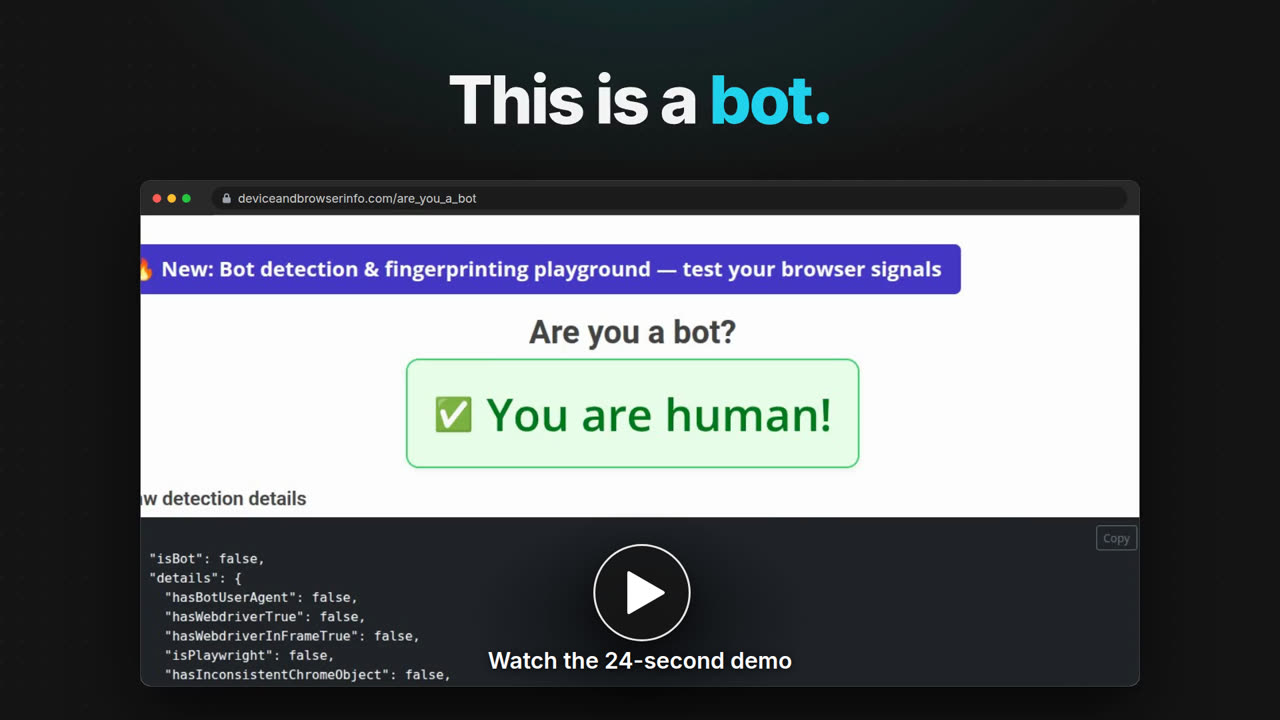
Async-first Python scraping on its own Chrome DevTools Protocol client, with persistent sessions, resource routing, stealth defaults, web search, a CLI, and an MCP server for agents.



Install
pip install webskrap
webskrap install
webskrap install downloads Chrome for Testing. WebSkrap drives it through its
own CDP client, with no Playwright. Upgrading from 2.x? Read the
migration guide.
Quickstart
import asyncio

from webskrap import WebSkrapClient


async def main() -> None:
    async with WebSkrapClient() as client:
        result = await client.fetch("https://example.com")
        print(result.status, result.title)
        print(result.text[:200])


asyncio.run(main())
For deferred content, pass ready_selector="#content" to a Python fetch or
--ready-selector '#content' to CLI fetch. Both MCP fetch tools accept
ready_selector too. The selector must become visible after consent dismissal.
Known challenge pages (DataDome, Cloudflare, HUMAN, Akamai, AWS WAF, and reCAPTCHA or hCaptcha on a 403, 429 or 503 page) and provider block
pages (DataDome, Cloudflare, Akamai) raise blocked. WebSkrap waits for device
checks that reload the page. It does not retry refusals. With
solve_cloudflare=True (CLI --solve-cloudflare), it clicks Cloudflare's
Turnstile checkbox; see Cloudflare Turnstile. With
solve_datadome=True (CLI --solve-datadome), it drags DataDome's slider; see
DataDome slider. With solve_perimeterx=True (CLI
--solve-perimeterx), it holds HUMAN's Press & Hold button; see
HUMAN Press & Hold. With solve_recaptcha=True (CLI
--solve-recaptcha), it clicks a reCAPTCHA v2 or hCaptcha checkbox on a
blocking page; see reCAPTCHA and hCaptcha checkbox.
Ordinary HTTP errors still return ok=False.
For an empty HTTP error body, Chromium can show its own error page. The returned
text or HTML is that rendered page. The status, headers, and final_url still
come from the HTTP response.
For any other CAPTCHA, complete it by hand: open a persistent browser with
webskrap browser open --headed --session manual --proxy http://localhost:8888 URL.
Complete the check in that browser. Keep the same session, profile, and proxy
for later commands. On a remote host, use a desktop connection to its display.
virtual_display=True alone does not provide a remote desktop.
Keep profile_mode="native" for the browser's own identity. On Linux with Xvfb,
virtual_display=True runs a headed browser without a visible desktop window.
Full profile emulation is useful for device tests, but cannot replace every
worker or iframe value. See the identity limits.
Python batches
Use client.fetch_many(urls) to fetch a finite batch in order with one browser:
async with WebSkrapClient() as client:
    results = await client.fetch_many(
        ["https://example.com", "https://example.org"], text_only=True
    )
Each batch shares cookies and storage, then closes its browser. Separate batches
and client.fetch() calls use fresh sessions. An explicit user_data_dir can
still share state on disk. Empty batches do not launch a browser. The first page
error stops the batch and raises; no partial list is returned. Ordinary HTTP
errors remain results with ok=False. screenshot=True uses a separate generated
PNG filename for each page.
For large inputs, per-page options, or state across batches, create a session
with session = await client.session("crawl"). Call await session.fetch(url)
for each URL. Close it with await client.close_session("crawl"), or let the
client context close it. Session names belong to one client. Use separate
sessions for unrelated callers.
Select elements
Query fetched HTML with CSS selectors. Use parse_html(html) for HTML from
other sources.
async with WebSkrapClient() as client:
    result = await client.fetch("https://example.com")
    print(result.css_first("h1").text)
    print([a.attrs["href"] for a in result.css("a[href]")])
Search
A search loads the engine's results page in the same stealth browser and
returns the organic hits. Click-tracking redirects are unwrapped, so each
url is the destination itself. Bing is the default; use engine="ddg" for
DuckDuckGo's HTML endpoint. Google is not offered.
async with WebSkrapClient() as client:
    result = await client.search("example domain", max_results=5)
    for hit in result.hits:
        print(hit.title, hit.url)
webskrap search "example domain" --engine ddg --max-results 10 --format json
When an engine distrusts the exit address it serves a bot challenge. That
comes back as a blocked error, not as zero hits. Switch engine, reuse a
persistent profile, or change the exit IP. WebSkrap does not retry.
Cloudflare Turnstile
solve_cloudflare=True (CLI --solve-cloudflare) handles Cloudflare's "Just
a moment" page, like Scrapling's option of the same name. It is off by default;
without it a Cloudflare challenge fails fast with blocked. With it, WebSkrap
waits on the challenge page. When Cloudflare draws its Turnstile checkbox, the
cursor wanders for 1.5 to 3 seconds, follows a curved path to the checkbox and
clicks with a mouse-like button hold. The checkbox position is read from the
widget's own DOM before each click. If the page has not cleared 20 seconds
later, WebSkrap clicks again, at most three times. The checkbox gets up to 60
seconds from when it first appears, on top of timeout_ms. Success is reported
only after the real page loads and no challenge is detected on it; otherwise
the call fails with blocked.
It works in headless, headed and virtual_display modes. A click only answers
the widget: Cloudflare still scores the browser and the exit IP, so a headless
browser or a flagged IP can still be refused. No token is read, copied or
injected, and no outside solving service is used. Other CAPTCHAs, such as
image and audio puzzles, are reported as blocked and never touched.
DataDome slider
solve_datadome=True (CLI --solve-datadome) handles DataDome's slider
CAPTCHA. It is off by default; without it a DataDome CAPTCHA fails fast with
blocked. With it, WebSkrap waits on the CAPTCHA page. When DataDome draws
its slider, the cursor wanders for 3 to 5 seconds, moves to the handle, grabs
it and drags it onto the slot in 35 small moves: slow, then faster, then slow
again, with a little jitter. The handle and slot positions are read from the
CAPTCHA frame's DOM before each drag. If the page has not cleared 10 seconds
later, WebSkrap drags again, at most three times. The slider gets up to 60
seconds from when it first appears, on top of timeout_ms. Success is reported
only after the real page loads and no challenge is detected on it; otherwise
the call fails with blocked.
A drag only answers the slider: DataDome still scores the browser, the exit IP
and the gesture. A hard block has no slider and stays blocked. Headed and
virtual_display browsers passed in live runs; a headless browser can get the
hard block instead. No cookie or token is read, copied or injected, no outside
solving service is used, and DataDome's audio and image puzzles are never
touched.
HUMAN Press & Hold
solve_perimeterx=True (CLI --solve-perimeterx) handles the Press & Hold
challenge of HUMAN Security (formerly PerimeterX). It is off by default;
without it the challenge page fails fast with blocked. With it, WebSkrap
waits on the challenge page. When HUMAN draws its button, the cursor follows a
curved path to it, presses, and holds with a small hand tremor until the
button's progress fill is complete, then lets go. The button is read from the
challenge frame's DOM before each hold. If the page has not cleared 8 seconds
later, WebSkrap holds again, at most three times. The button gets up to 60
seconds from when it first appears, on top of timeout_ms. Success is
reported only after the real page loads and no challenge is detected on it;
otherwise the call fails with blocked.
A hold only answers the widget: HUMAN still scores the browser and the exit IP. In live runs it refused every completed hold from a flagged IP, in every browser mode, and accepted the first hold from a cleaner exit. No cookie or token is read, copied or injected, and no outside solving service is used.
reCAPTCHA and hCaptcha checkbox
solve_recaptcha=True (CLI --solve-recaptcha) clicks the "I'm not a robot"
checkbox of reCAPTCHA v2 or hCaptcha on a page that blocks the site: a 403,
429 or 503 response that carries the widget. It is off by default; without it
such a page fails fast with blocked. With it, WebSkrap waits for the widget,
moves the cursor like a person and clicks the checkbox. When the provider
trusts the browser, the box ticks and the page's own callback continues to the
real page. If the page has not cleared 15 seconds later, WebSkrap clicks again,
at most twice within 60 seconds. When the provider opens an image challenge
instead, WebSkrap leaves it alone and the call fails with blocked at once.
For a checkbox inside a form, fill the form, then call browser_solve_captcha
(CLI webskrap browser solve-captcha) before you submit it. Its
captcha.state is checked, challenge, gone, timeout or not_found.
The click only answers the checkbox: the provider still scores the browser and the exit IP, and a datacenter IP usually gets the image challenge. reCAPTCHA v3 and invisible widgets have no checkbox and are not handled. No token is read, copied or injected, and no outside solving service is used.
Use them responsibly: only on sites whose terms and applicable law allow automated access, and at a polite rate. Passing a challenge does not grant permission to collect data you may not collect.
webskrap fetch https://example.com --virtual-display --solve-cloudflare
webskrap fetch https://example.com --virtual-display --solve-datadome
webskrap fetch https://example.com --virtual-display --solve-perimeterx
webskrap fetch https://example.com --virtual-display --solve-recaptcha
webskrap browser solve-captcha
Visual browser interaction
Agents can see the rendered viewport and interact by coordinates, including
canvas and controls missing from the accessibility tree. MCP browser_view
returns a PNG image directly; browser_mouse clicks, moves, scrolls, or drags.
browser_insert_text inserts literal text into the focused control.
webskrap browser open https://example.com
webskrap browser view viewport.png --format json
# Open the returned PNG with your agent's image viewer, then choose coordinates.
webskrap browser mouse click 120 80
webskrap browser insert-text "hello"
webskrap browser press Enter
webskrap browser view viewport.png --format json
webskrap browser close
Coordinates are CSS pixels from the original image's top-left. Take a fresh view after scrolling or page changes. Headless Chromium needs no Xvfb for this; the agent's client and model must support image input.
Load only what the task needs
The default resource policy is auto. Text-only fetches skip images, fonts
and media. HTML fetches, screenshots and interactive pages load all resources.
Set resource_policy="all", "lite", or "documents" to override this choice.
Use documents only when removing CSS preserves the required result.
Fetches use domcontentloaded; set ready_selector for deferred content.
Use browser_find(text="Save") to locate a known control with ancestor context.
Use browser_snapshot(target="e15", depth=2) for one subtree; add boxes=true
only when geometry matters. Reuse returned refs with browser_interact.
Use networkidle, screenshots and full snapshots only when the task needs them.
CLI and MCP reject cookies by default. Disable this only for known pages where
it is unnecessary. In Python, enable rejection with SessionConfig(decline_cookies=True).
Documentation
The agent skill is available at .agents/skills/webskrap/SKILL.md,
.claude/skills/webskrap/SKILL.md, and .codex/skills/webskrap/SKILL.md.
The file lives in .agents/skills/webskrap/. The .claude and .codex
folders link to it, and every folder links to the root references/.
The checkout must support symbolic links. On Windows, enable Developer Mode
and Git's core.symlinks before cloning.
Security
Persistent browser sessions keep Chromium's OS sandbox, store their profiles
0700, and confine MCP screenshot output to ./webskrap-output. See
SECURITY.md for the security model and how to report a
vulnerability, and CHANGELOG.md for what changed.
Contributing
See CONTRIBUTING.md for setup, checks, and pull request expectations.
1 maintainer

Metadata
1 maintainer
Release files for webskrap 4.0.0
For a detailed explanation of source distributions (sdists) and built distributions (wheels), please see the package formats documentation.
Source distribution (sdist)
| File | Size | Uploaded | Provenance | Actions |
|---|---|---|---|---|
| webskrap-4.0.0.tar.gz | 457.0 kB | With provenance | Details for webskrap-4.0.0.tar.gz |
Built distribution (wheel)
| File | Interpreter | ABI | Platform | Actions Reset |
|---|---|---|---|---|
| webskrap-4.0.0-py3-none-any.whl | Python 3 | none | any | Details for webskrap-4.0.0-py3-none-any.whl |
Total release size: 686.6 kB
Release files / webskrap-4.0.0.tar.gz
| Download URL | webskrap-4.0.0.tar.gz |
|---|---|
| Size | 457.0 kB |
| Tags | Source |
|
SHA-256 checksum How to use checksums |
7835c7677989767ba6e6450266ea8c0c2be4fec7f1dedfc0b6ad3e6d9260405e
|
|
BLAKE2b-256 checksum How to use checksums |
44c7fb67e17d41a59df8b7b56ba43fd75e3cc993dce48b01054805d92b85bb0c
|
| Upload date | |
|
Uploaded using Trusted Publishing? What is trusted publishing? |
Yes |
| Uploaded via |
twine/7.0.0 CPython/3.13.16
|
Provenance
Provenance describes where a file came from. On PyPI, provenance is shared via attestations, which provide a verifiable record of the build or publishing details. View details, limitations and caveats.


PyPI Publish Attestation
PyPI verified that this artifact, at this checksum, originated from the publisher listed below.
Signed by GitHub Actions, verified by PyPI on Nov 20, 2026.
Transparency logRelease files / webskrap-4.0.0-py3-none-any.whl
| Download URL | webskrap-4.0.0-py3-none-any.whl |
|---|---|
| Size | 229.6 kB |
| Tags | Python 3 |
|
SHA-256 checksum How to use checksums |
b0c4e8e361dbb9cecd5913d824595b257cd3408974ded314eefb4e52b82573bf
|
|
BLAKE2b-256 checksum How to use checksums |
130c3a51803c6f77448fcc269c11577b08add9057af7d717c1038e7420f2817f
|
| Upload date | |
|
Uploaded using Trusted Publishing? What is trusted publishing? |
Yes |
| Uploaded via |
twine/7.0.0 CPython/3.13.16
|
Provenance
Provenance describes where a file came from. On PyPI, provenance is shared via attestations, which provide a verifiable record of the build or publishing details. View details, limitations and caveats.
PyPI Publish Attestation
PyPI verified that this artifact, at this checksum, originated from the publisher listed below.
Signed by GitHub Actions, verified by PyPI on Nov 20, 2026.
Transparency logSecurity for webskrap 4.0.0
Provenance
Provenance describes where a file came from. On PyPI, provenance is shared via attestations, which provide a verifiable record of the build or publishing details. View details, limitations and caveats.
Full provenance
Both files in this release have been uploaded with provenance metadata.
Attestation for webskrap-4.0.0.tar.gz
PyPI Publish Attestation
PyPI verified that this artifact, at this checksum, originated from the publisher listed below.
Signed by GitHub Actions, verified by PyPI on Nov 20, 2026.
Transparency logA note on package security
PyPI is a repository for distributing packages, not a service for auditing them. While third-party security researchers and our staff do their best to detect and remove malicious packages, PyPI cannot guarantee the quality, security or suitability of any given package.
To learn more about protecting yourself from malicious actors, visit our package security documentation.














