
Python SDK for recording agent flows into the WizardFlow / AgentTrace file format.

Project description
WizardFlow Python SDK
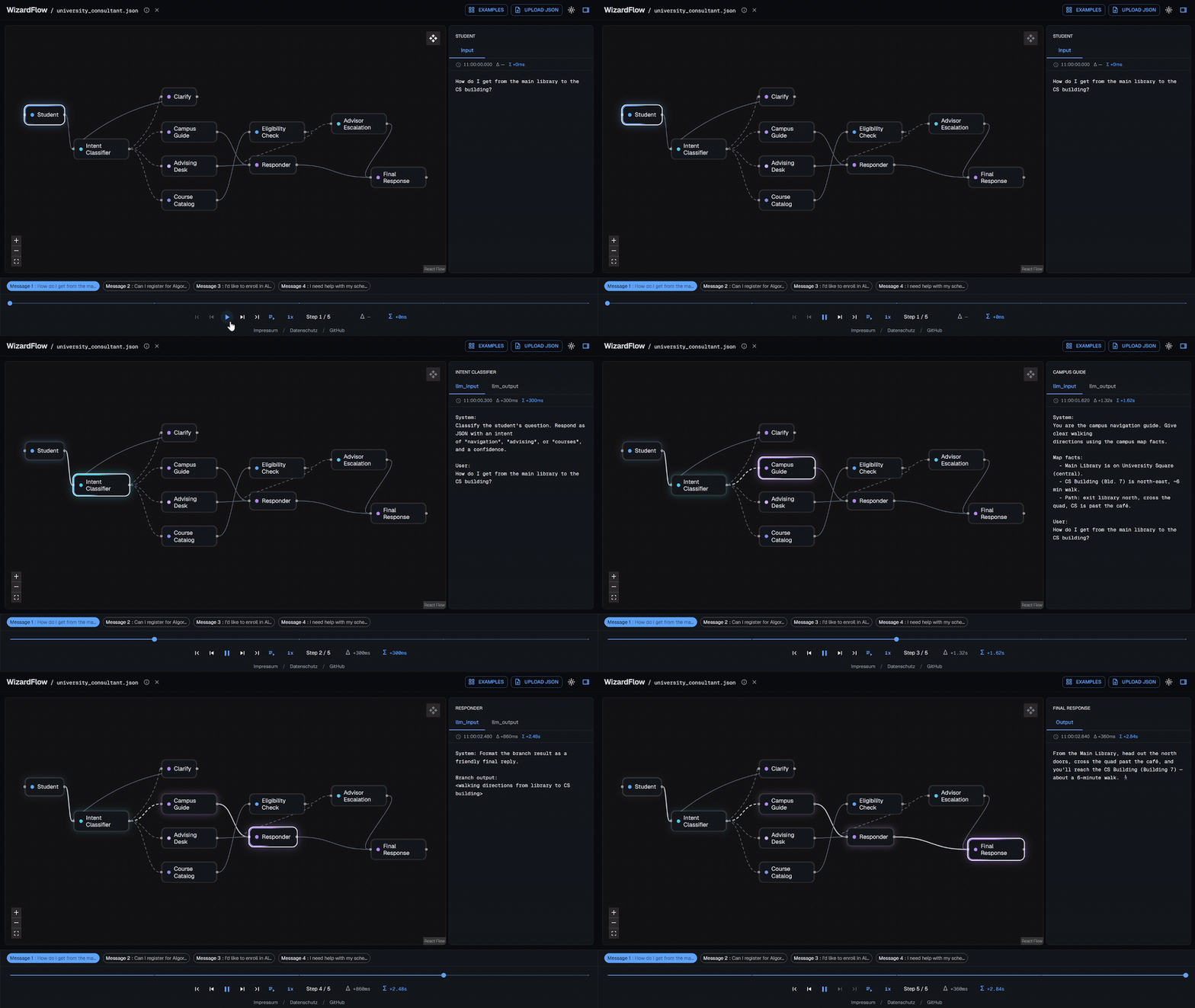
A lightweight tracer for Python agents. Drop three calls into your code —
init, log, end_message — and turn a messy multi-agent run into a portable
trace you can replay as an interactive graph or export to Markdown/HTML. Because
the trace is just a JSONL file, anyone can replay it: hand it to a teammate or PM
and they drop it into getwizardflow.com in the
browser — no Python, no install. Lightweight by design: pure Python, zero
runtime dependencies, no daemon, no setup.
The file it produces is JSON Lines with a small, documented schema: line 1 is a
header record carrying the graph { nodes, edges }, then one message
record per line (steps[] → payloads[] { label, value }). Every line is plain
JSON — head -1 run.jsonl | jq .graph just works.
Why WizardFlow?
Most agent tracing means an observability platform (LangSmith, Langfuse, …): a server or SaaS account, an ingestion pipeline, auto-instrumentation, dashboards behind a login. WizardFlow takes the opposite bet:
- The trace is a file. No server, no account, no daemon — your run becomes
a
.jsonlyou can commit, diff, grep, or attach to a bug report. - Anyone can replay it. Hand the file to a teammate or PM and they drop it into getwizardflow.com — no Python, no install, and nothing is uploaded (the viewer is fully client-side).
- Three calls, zero dependencies. The whole API is
init,log,end_message— pure Python that pulls nothing into your environment, and no framework required (LangGraph support just callsapp.get_graph()on whatever you pass — langgraph itself is never imported). - Explicit by design. You place every
log()call yourself, so a trace contains exactly what you logged — nothing else. No auto-instrumentation capturing things behind your back, no surprise PII in the payloads, no guessing why a span exists.
If you need fleet-wide monitoring, token-cost dashboards, or eval pipelines, use an observability platform. WizardFlow is for understanding one run — and being able to hand that run to anybody.
Install
pip install wizardflow
No runtime dependencies. Developing the SDK itself? See CONTRIBUTING.md.
Quickstart
import wizardflow

wizardflow.init(
    output_dir="traces",                # where trace files are written
    file_prefix="run",                  # optional; defaults to "wizardflow"
    description="A small router-based agent run.",
    nodes=["user_input", "router", "planner", "tool_node", "final_response"],
    edges=[("user_input", "router"), ("router", "planner")],
)

# Every log names its message in the first argument:
# log(message_id, node, payload_label, payload_value)
wizardflow.log("msg-1", "router", "llm_input", prompt)    # same node, two payloads ->
wizardflow.log("msg-1", "router", "llm_output", output)   #   folded into one step
wizardflow.log("msg-1", "tool_node")                       # visited, no payloads
wizardflow.end_message("msg-1")                            # -> writes the trace
There is no save() and no autosave: log() only accumulates in memory,
and end_message(id) is the one call that writes the trace. Writes happen at
message boundaries — one append per finished message, however many log()
calls it contains, so a write costs the same no matter how large the trace has
grown. init() returns a client and also stashes it as the module default, so
the bare wizardflow.log(...) form above works.
Concurrency-safe. Multi-agent setups end messages from many threads/tasks at
once; an internal lock serializes the appends so the shared part file is never
corrupted and no message is lost or duplicated. Every ended message is durable
on disk the moment end_message returns — a crash can at worst tear the line
being appended, and readers drop a torn final line and load everything before
it.
Targeting a message
The first argument to log is the message id, so overlapping messages never
collide — interleave them freely (as concurrent agents do) and each step routes
to the right message:
# log(message_id, node, payload_label, payload_value)
wizardflow.log("msg-1", "classifier", "input", text_a)
wizardflow.log("msg-2", "classifier", "input", text_b)   # a different message
wizardflow.log("msg-1", "generator", "output", answer_a)
wizardflow.end_message("msg-1")          # writes msg-1
wizardflow.end_message("msg-2")          # writes msg-2
Pass the string id, never a handle object — safe to hand to a callback or
across threads. A message is created on first reference and finalized by
end_message; end_message(id, title="...") optionally gives it a human title.
LangGraph: automatic topology
Instead of listing nodes/edges by hand, read them straight from a compiled
LangGraph app:
app = workflow.compile(checkpointer=memory)

wizardflow.init_from_langgraph(app, output_dir="traces", file_prefix="trace")

wizardflow.log("msg-1", "planner", "Input", state)   # runtime logging unchanged
wizardflow.end_message("msg-1")
You can keep the extracted LangGraph topology and still choose node accent colors for important nodes:
wizardflow.init_from_langgraph(
    app,
    output_dir="traces",
    file_prefix="trace",
    node_colors={
        "router": "#A78BFA",
        "retriever": "#22D3EE",
        "generator": "#60A5FA",
    },
)
By default, a color key that does not match an extracted node id raises a
WizardFlowError so typos fail fast. With silent=True, unknown color keys are
ignored.
It extracts node ids (keeping __start__ / __end__) and directed edges, and
marks runtime branches with "conditional": true (deterministic and parallel
fan-out edges stay plain):
{
  "edges": [
    { "source": "__start__", "target": "router" },
    { "source": "router", "target": "planner", "conditional": true },
    { "source": "planner", "target": "final_response" }
  ]
}
LangGraph is not a dependency — extraction is duck-typed on app.get_graph().
A non-LangGraph object raises LangGraphExtractionError; missing conditional
metadata never fails extraction (the edge is just emitted plain). Call it
after compile(), when the topology actually exists.
API (v0.2)
Breaking change in 0.2: traces are now JSON Lines (
.jsonl), written by appending — the old single-document.jsonformat is gone from the SDK (writer and CLI readers). The web UI at getwizardflow.com still opens old.jsontraces.
init(output_dir=, file_prefix="wizardflow", name=, description=, nodes=, edges=, meta=, silent=False, max_bytes=16_000_000, max_messages=2_000) -> Clientdescriptionlands inmeta.description(matches the schema field).nodes=enables fast-fail:log()to an undeclared node raisesUnknownNodeErrorimmediately (unless silenced).output_diris optional; omitted, traces are written in cwd.file_prefixis optional; omitted, filenames start withwizardflow.max_bytes/max_messagescap each part file before rotation (see below).
init_from_langgraph(app, output_dir=, file_prefix="wizardflow", name=, description=, meta=, node_colors=, silent=False, max_bytes=..., max_messages=...) -> Client- same as
init, butnodes/edgescome fromapp.get_graph(). node_colorsmaps extracted node ids to CSS colors such as"#A78BFA".
- same as
log(id, node, label=None, content=None)— the first positional is the message id, the second is the node. Withlabel/contentit records a payload; barelog(id, "node")records a visit with no payloads. The message is created on first reference; this only accumulates in memory.end_message(id, title=None)— finalize a message and append it to the trace; returns the current trace path. The only call that touches disk. Optionaltitlesets the message's human title. Idempotent.Client.current_path— the trace file currently being written.to_dict()/to_json()— inspect the active part (completed messages), assembled into oneAgentTraceFileobject.
The file format
A trace part is JSON Lines: one JSON object per line, each with a type:
{"type":"header","version":"0.2","name":"run","meta":{...},"graph":{"nodes":[...],"edges":[...]}}
{"type":"message","id":"msg-1","label":"First question","steps":[...]}
{"type":"message","id":"msg-2","steps":[...]}
{"type":"seal","nextPart":"run__...__part2.jsonl"}
header(always line 1) — everything about the run except the messages.message— one completed message, appended byend_message.seal— only on a part that rotated away; its presence means "this part is complete, continue atnextPart". The active part has no seal.
Readers skip records with an unknown type (forward compat) and drop an
unparseable final line (a crash mid-append leaves a torn tail; everything
before it is intact). Only completed messages are written; an in-progress
message lives in memory until it ends.
How saving works
end_message appends one line to the active part — O(1) no matter how
large the part already is, and the moment it returns, that message is durable
on disk. Nothing is ever rewritten.
Rotation (no single huge file)
There's no natural "end" to a chatbot trace, so the SDK caps part size instead. The cap exists for the reader: a part is what you drop into the viewer, and an oversized file makes the browser tab sluggish. Each run writes a timestamped entry file whose name carries the run-start time:
wizardflow__2026-06-08T16-29-09-123Z.jsonl
The name's wizardflow is the file_prefix; the timestamp is captured when
init() creates the client. If the next message would push the active part past
max_bytes (16 MB by default) — or past max_messages (2,000 by default; many
tiny messages strain the viewer before many bytes do) — the part is sealed and
the message starts a fresh one:
wizardflow__2026-06-08T16-29-09-123Z.jsonl
wizardflow__2026-06-08T16-29-09-123Z__part2.jsonl
wizardflow__2026-06-08T16-29-09-123Z__part3.jsonl
Rotation only ever happens at a message boundary, never mid-message (a lone
message larger than the cap gets its own oversized part). max_bytes is
clamped to a hard ceiling (64 MB) — past that, parsed-object inflation makes
the viewer slow on ordinary hardware. Each part is self-contained (full
graph in its header + its slice of messages), chained backward via the header's
meta.prevPart and forward via the seal record's nextPart.
A single-part trace stays clean (no part metadata, no seal). There's no
partCount — the total is genuinely unknown while a continuous run is still
logging; follow the seal records to walk to the end. Since names are
timestamped, read the real file back from the client's current_path (also the
path end_message returns).
Logging
Rotation emits an INFO notice on the wizardflow logger. Following library
convention, the SDK attaches a NullHandler and configures nothing — you see
nothing unless you opt in:
import logging
logging.getLogger("wizardflow").setLevel(logging.INFO)
This is separate from silent= (which governs raise-vs-swallow for errors).
Step folding
Consecutive log() calls to the same node within a message fold into a
single step with multiple payloads (e.g. a router step carrying both
llm_input and llm_output). A log() to a different node starts a new step.
Examples
Fuller runnable examples live in
examples/:
quickstart.py— a small linear agent; two messages, the second finalized with anend_message(..., title=...)title.multibranch.py—routerfans out into a planner/tool path and a retriever path that rejoin atgenerator. Two messages take different branches, so each logs only the nodes it actually visited.
CLI
The wizardflow command has four subcommands: ui, md, html, and json.
Every one takes the trace file as a positional argument or via --path
(pass one, not both):
wizardflow ui   run.jsonl
wizardflow md   run.jsonl
wizardflow html run.jsonl
wizardflow json run.jsonl
# --path is equivalent everywhere:
wizardflow ui --path run.jsonl
The SDK only ever writes JSONL, but these commands read either framing —
a .jsonl part or a single-document .json (what wizardflow json emits) — so
they stay at parity with the web viewer, which also accepts both.
wizardflow ui — local viewer
wizardflow ui run.jsonl [--host 127.0.0.1] [--port 0] [--no-open]
Binds a stdlib HTTP server, serves the static WizardFlow UI bundled in the SDK package, and opens the selected trace in your browser (the JSONL is assembled server-side and served to the UI as one JSON document, re-read on refresh — so you can watch a still-running trace grow).
| flag | default | meaning |
|---|---|---|
--host |
127.0.0.1 |
interface to bind |
--port |
0 |
port to bind; 0 asks the OS for a free port |
--no-open |
off | print the local URL instead of launching a browser |
wizardflow md — export to Markdown
wizardflow md run.jsonl                 # -> stdout
wizardflow md run.jsonl -o run.md       # -> file
wizardflow md run.jsonl --no-mermaid    # omit the graph diagram
Renders the full trace as Markdown: a metadata table, a Mermaid flowchart of
the graph, then each message's steps and payloads (scalars inline; multi-line
strings and dict/list values in fenced code blocks; conditional edges drawn
dashed).
| flag | default | meaning |
|---|---|---|
-o, --output |
— | write to this file instead of stdout |
--mermaid |
on | include the Mermaid graph diagram |
--no-mermaid |
— | omit the Mermaid graph diagram |
wizardflow html — export to HTML
wizardflow html run.jsonl               # -> stdout
wizardflow html run.jsonl -o run.html   # -> file
Emits a single self-contained document — inline CSS, no JavaScript, no
external assets — that opens offline in any browser and follows your OS
light/dark mode. Messages-only by design: no graph/Mermaid (use md for that).
| flag | default | meaning |
|---|---|---|
-o, --output |
— | write to this file instead of stdout |
wizardflow json — assemble to one pretty-printed JSON document
wizardflow json run.jsonl               # -> stdout
wizardflow json run.jsonl -o run.json   # -> file
The inverse of how the SDK writes. JSONL is built for appending, so the raw
file is one long line per record and not much fun to read. This assembles the
part — header plus all its message records, with the seal's nextPart folded
into meta — into the indented, single-document AgentTraceFile shape, for
eyeballing, diffing in review, or handing someone a canonical JSON. (The web UI
reads that single-document form too.)
| flag | default | meaning |
|---|---|---|
-o, --output |
— | write to this file instead of stdout |
Already have jq? You don't need this for a quick look — jq . run.jsonl
pretty-prints every record, and jq 'select(.type=="message")' run.jsonl just
the messages. wizardflow json differs in that it assembles the part into one
document (and walks no external tool).
Rendered samples (*.md, *.html) live in the repo's
examples/.
Status / not yet
- Timestamps are wall-clock at log time — fine for slow/live runs, wrong if steps fire faster than ms resolution or you import after the fact. (Open design item: explicit per-step timestamps.)
Release history Release notifications | RSS feed


Download files
Download the file for your platform. If you're not sure which to choose, learn more about installing packages.
Source Distribution
Built Distribution
Filter files by name, interpreter, ABI, and platform.
If you're not sure about the file name format, learn more about wheel file names.
Copy a direct link to the current filters
File details
Details for the file wizardflow-0.2.0.tar.gz.
File metadata
- Download URL: wizardflow-0.2.0.tar.gz
- Upload date:
- Size: 1.2 MB
- Tags: Source
- Uploaded using Trusted Publishing? Yes
- Uploaded via: twine/6.1.0 CPython/3.13.12
File hashes
| Algorithm | Hash digest | |
|---|---|---|
| SHA256 |
690c80ae1d5922eb87f87270e022521a27b9d9a902a5f5fe070b900a5782c8e2
|
|
| MD5 |
79a62b0533d6b48049f0ff1f1e575caf
|
|
| BLAKE2b-256 |
d834ccc4df6796e1eb7d772161ec11d730fdc7e58c85042aced1c53362afde91
|
Provenance
The following attestation bundles were made for wizardflow-0.2.0.tar.gz:
Publisher:
publish.yml on lkleonk/wizardflow
-
Statement:
-
Statement type:
https://in-toto.io/Statement/v1 -
Predicate type:
https://docs.pypi.org/attestations/publish/v1 -
Subject name:
wizardflow-0.2.0.tar.gz -
Subject digest:
690c80ae1d5922eb87f87270e022521a27b9d9a902a5f5fe070b900a5782c8e2 - Sigstore transparency entry: 1817895452
- Sigstore integration time:
-
Permalink:
lkleonk/wizardflow@ec5e1a8333fa1f47b12af45ebb5c5670a5cc3e9c -
Branch / Tag:
refs/tags/v0.2.0 - Owner: https://github.com/lkleonk
-
Access:
public
-
Token Issuer:
https://token.actions.githubusercontent.com -
Runner Environment:
github-hosted -
Publication workflow:
publish.yml@ec5e1a8333fa1f47b12af45ebb5c5670a5cc3e9c -
Trigger Event:
push
-
Statement type:
File details
Details for the file wizardflow-0.2.0-py3-none-any.whl.
File metadata
- Download URL: wizardflow-0.2.0-py3-none-any.whl
- Upload date:
- Size: 654.2 kB
- Tags: Python 3
- Uploaded using Trusted Publishing? Yes
- Uploaded via: twine/6.1.0 CPython/3.13.12
File hashes
| Algorithm | Hash digest | |
|---|---|---|
| SHA256 |
0a3b0db2f31c52421d1a3f1b766e488c7105a2397a3f85fbce65e41353278ccf
|
|
| MD5 |
0d02e59bed41d8cb442ca3e7d1cef0a8
|
|
| BLAKE2b-256 |
940855c5a708f97a6831dfe103ff61a6f61695d379fdf4a226f8532f29f17aa5
|
Provenance
The following attestation bundles were made for wizardflow-0.2.0-py3-none-any.whl:
Publisher:
publish.yml on lkleonk/wizardflow
-
Statement:
-
Statement type:
https://in-toto.io/Statement/v1 -
Predicate type:
https://docs.pypi.org/attestations/publish/v1 -
Subject name:
wizardflow-0.2.0-py3-none-any.whl -
Subject digest:
0a3b0db2f31c52421d1a3f1b766e488c7105a2397a3f85fbce65e41353278ccf - Sigstore transparency entry: 1817895745
- Sigstore integration time:
-
Permalink:
lkleonk/wizardflow@ec5e1a8333fa1f47b12af45ebb5c5670a5cc3e9c -
Branch / Tag:
refs/tags/v0.2.0 - Owner: https://github.com/lkleonk
-
Access:
public
-
Token Issuer:
https://token.actions.githubusercontent.com -
Runner Environment:
github-hosted -
Publication workflow:
publish.yml@ec5e1a8333fa1f47b12af45ebb5c5670a5cc3e9c -
Trigger Event:
push
-
Statement type:






