
Your Turn
Your agents are fast. You're the queue.


Why Your Turn · Quick start · Handoff skill · Your inbox · Privacy · Docs
Your Turn shows your coding-agent chats in one local inbox, with a handoff skill that ends every agent answer with an Outcome and a Next step. You can also use just the skill directly in chat, with no server.
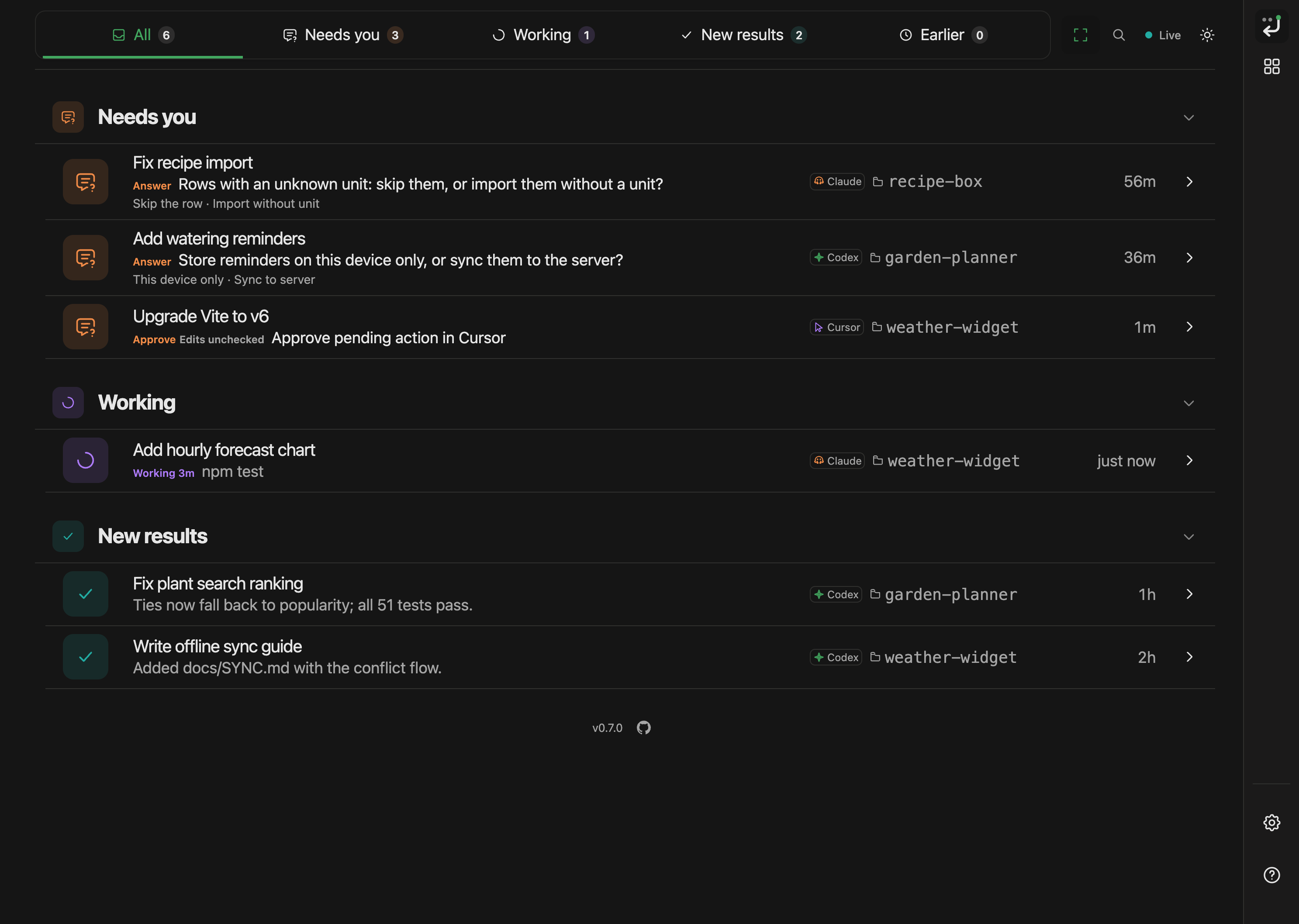
The optional inbox, with made-up demo chats from make screenshots.
Why Your Turn instead of another agent framework?
Why I built this
I built this after realizing I had three apps open at once: Claude Code for the code, Codex for images, and Gemini for writing the instructions. One of them had been sitting idle for 20 minutes waiting on a single y/n approval while I was reviewing another diff. Worse, I kept copying a plan from one agent, pasting it into another for a second opinion, and losing track of which window finished what. I'm also not a fan of fully autonomous development. I'd rather settle on a plan first, then build it in small pieces I can check. I wanted one quiet place to see who actually needs me, and a simple contract so one agent can hand work to another without me playing human clipboard.
How it compares
Most agent frameworks run their own autonomous loop on API keys, and multiplexers usually wrap your terminal. Your Turn and Your Turn Loop work with the agents and logins you already use:
| Agent frameworks | Wrapper and multiplexer UIs | Your Turn + Loop | |
|---|---|---|---|
| Billing and auth | Separate API keys and pay-per-token billing | Varies; often a custom runner config | No API keys. Uses the CLI logins and subscriptions you already have |
| Runtime footprint | Orchestrator daemons and SDK lock-in | Wraps or takes over your terminal sessions | A read-only local inbox and portable SKILL.md files |
| Control model | Autonomous loops you can't see into | Manual tab-switching across sessions | You make the calls. Each result ends with Outcome and Next step, which names what needs you or says none |
| Cross-agent work | Custom Python or TypeScript graphs | Separate panes and manual copy-paste | One orchestrator chat delegates through the agent CLIs (ask for second opinions, relay for builds in their own git worktree) and reads the results back |
How it works day to day
- Your agents are fast. You're the queue. With Codex, Claude Code, and Cursor running in parallel, the slow part is noticing which chat is waiting on you.
- Your terminal and apps stay as they are. Keep using Ghostty, iTerm, VS Code, or each agent's own app. Your Turn reads the logs and local chat database your agents already write, and sends nothing to the cloud.
- You talk to one orchestrator. It delegates to the other agents and reviews what they return. Every agent ends with the same
OutcomeandNext step, so nobody has to retell the chat. - You only get pulled in for decisions. The orchestrator reviews each delegated diff. The inbox shows the results that need your call, and you carry one into the next brief with what-to-ask.
Quick start
Choose Full setup for the inbox and handoff skill, or install just the skill from your-turn-loop for handoffs in your existing chats.
Full setup
You need uv and Codex, Claude Code, or Cursor. uv downloads Python 3.11 or newer if you do not have it. Without uv, install it first with brew install uv or uv's installer.
uvx your-turn@latest install
install adds the Your Turn handoff instructions to the agent apps it finds, then starts the inbox. Restart those agent apps, then open http://localhost:8787.
To start the inbox on later visits, or if you already have the skill, run:
uvx your-turn@latest serve
Keep the terminal open while using the inbox. Stop it with Ctrl+C.
Start the inbox with Codex (optional, macOS/Linux)
Use a persistent installation, then opt in to a user-level Codex hook:
uv tool install your-turn@latest
your-turn autostart enable
Review the hook in /hooks in the Codex CLI or Settings → Hooks in the desktop app. Enabling autostart does not grant hook trust or verify that Codex loaded it. On SessionStart, the hook starts or reuses one background inbox without opening a browser.
The handoff stays instruction-only. Disable the hook with your-turn autostart disable; the shared inbox keeps running until you stop it with your-turn stop. See autostart setup and diagnostics, including what to do if the installed Python environment changes.
Use a phone or uninstall
The server binds to loopback only (127.0.0.1). To remove the handoff, run uvx your-turn@latest uninstall.
To open the inbox on your phone, run uvx your-turn@latest serve --phone (in a clone: make phone) and scan the QR code it prints. The phone needs to be on the same Wi-Fi or Tailscale network, and the link carries a token; delete ~/.your-turn/phone-token to lock out paired phones.
Check where a release comes from, or pin one
uvx your-turn@latest runs the newest PyPI release, which GitHub Actions builds from a Git tag and PyPI shows with its attestation. Without @latest, uv keeps reusing the release it downloaded first. To pin a version, use uvx your-turn@0.9.2, or install straight from its tag with uvx --from git+https://github.com/martin-gomola/your-turn@v0.9.2 your-turn.
Run with Nix instead
The repository is a flake, with dependencies pinned in flake.lock. This starts the inbox without changing any agent app:
nix run github:martin-gomola/your-turn
Only install and uninstall change agent app folders. To see what install would touch, run nix run github:martin-gomola/your-turn -- doctor first. To skip it, add the handoff by hand from docs/agents-snippet.md, or print the Cursor rule with nix run github:martin-gomola/your-turn -- cursor-rule. nix profile install github:martin-gomola/your-turn puts your-turn on your PATH. To pin a release, use github:martin-gomola/your-turn/v0.9.2.
Skill only (no server)
Install your-turn-handoff with the your-turn-loop installer. See docs/handoff.md for requirements, first use, and adding the inbox later.
Handoff skill
The handoff asks the agent to end each answer with an Outcome line and a Next step line that names what needs you, or none. See docs/handoff.md for an example.
Your inbox
The inbox shows which Codex, Claude Code, and Cursor chats need you. It is not an orchestrator or IDE wrapper: execution, answers, and approvals stay in each agent's app.
See the inbox beside a chat
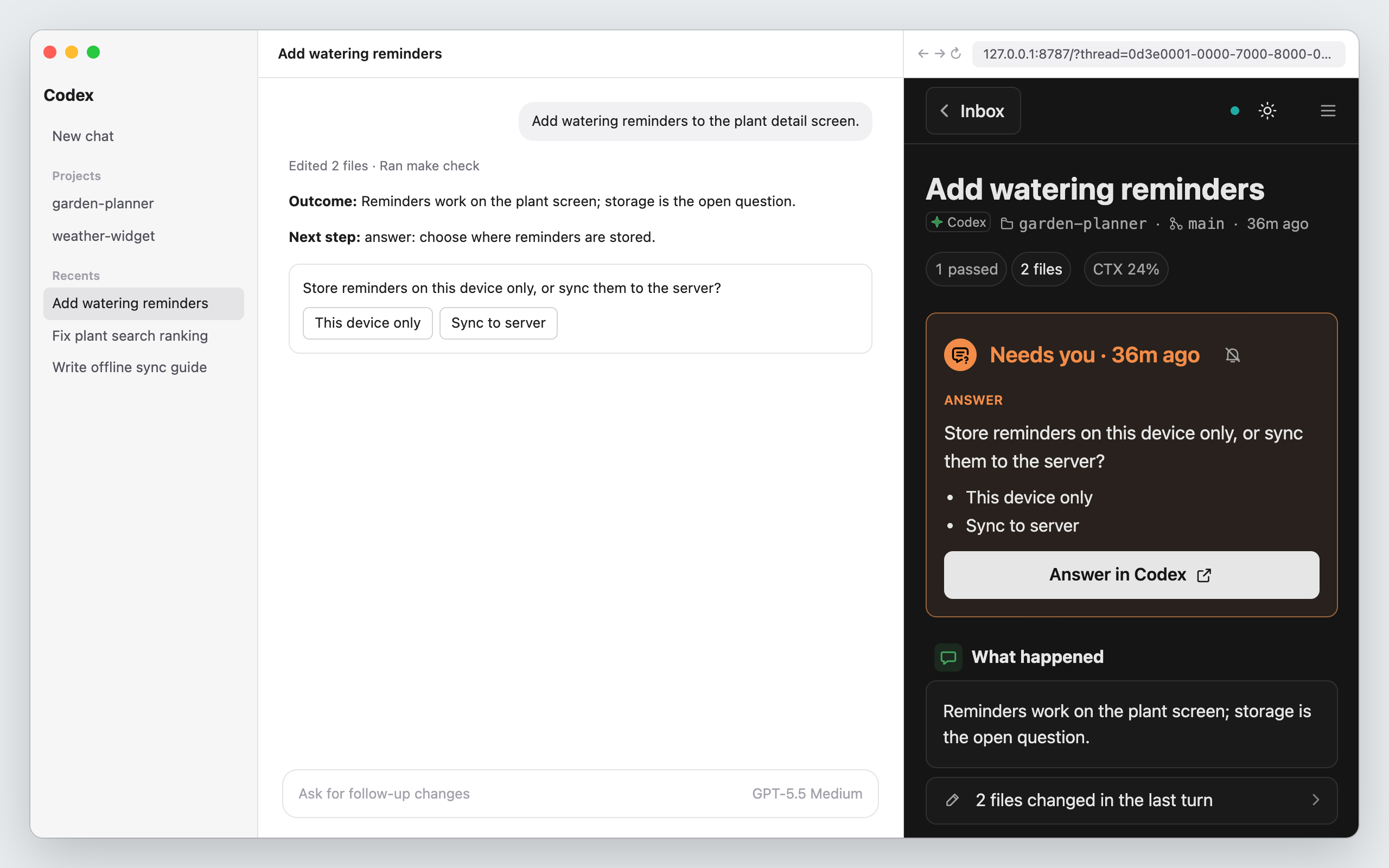
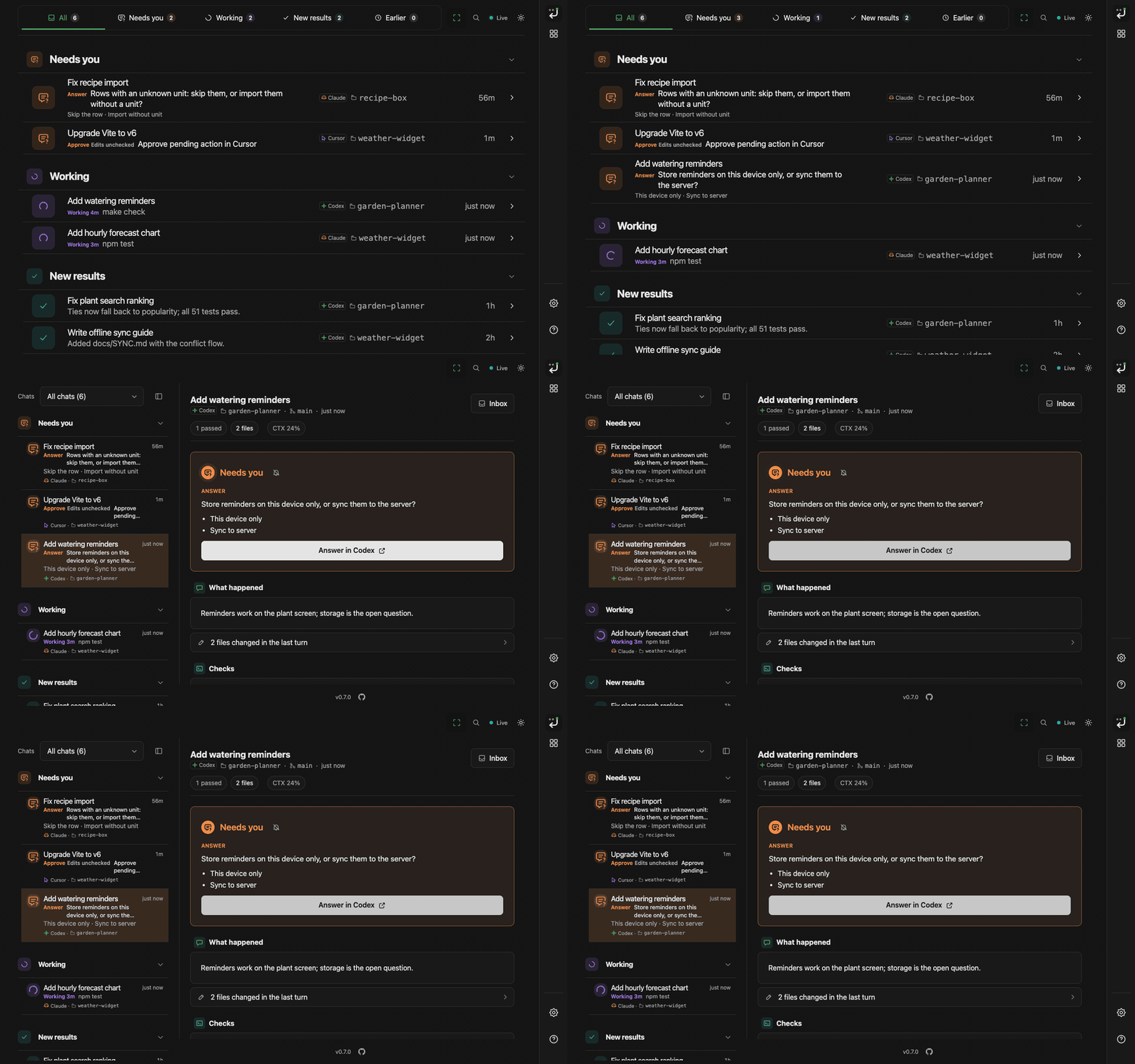
Watch a chat move into Needs you
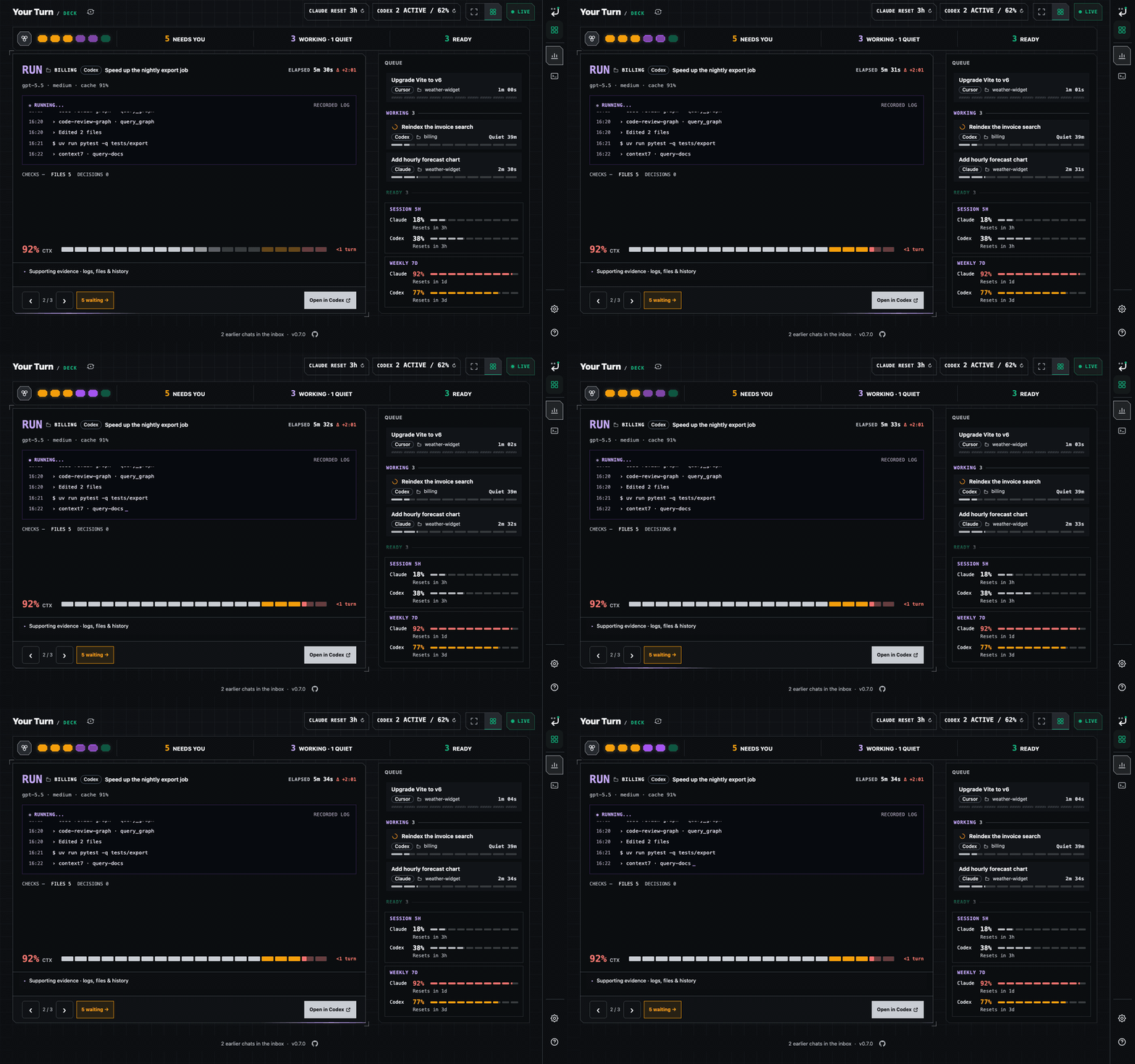
See the Deck on a second screen or tablet
The inbox runs on localhost:8787 and reads the JSONL logs your agents already write and the local Cursor chat database. For each chat it shows:
- Questions, pending approvals, and unreviewed results, ordered by how long they have waited.
Check failedandEdits uncheckedbadges tied to the latest code edit.- The next step in one line, with one click to open or resume the chat in its app.
From a phone or tablet, "Open in Codex" and "Open in Cursor" ask your Mac to open that chat's link.
Privacy
- Local only. The server binds to
127.0.0.1. It does not send session data anywhere. - Read-only session access. Your Turn reads agent logs and Cursor's local chat database. It never edits them, starts or answers chats, or approves actions.
- Small local state file.
~/.your-turn/state.jsonstores seen results and dismissed reminders so they stay in sync across browsers. The browser keeps a local backup. - No account or setup file. Your Turn finds existing chats and leaves out sub-agents, headless runs, and abandoned chats.
Docs
| Guide | What it covers |
|---|---|
| docs/harnesses.md | Data sources by OS, supported apps, inbox states, checks, and limits |
| docs/handoff.md | What the handoff looks like, and installing only the skill |
| docs/configuration.md | CLI commands and flags, app setup, handoff format, and development |
| DESIGN.md | UI design contract and references |
| docs/agents-snippet.md | Handoff format to add to agent instructions by hand |
| docs/handoff-source.md | Canonical handoff source, pinned snapshot and package checks |
Run from a clone
git clone https://github.com/martin-gomola/your-turn.git
cd your-turn
make install
make install sets up the handoff from this checkout, adds the Your Turn Loop skills to every agent it finds (including Antigravity and the Gemini app; needs Node.js), and starts the inbox. Open http://localhost:8787. Later, from the same folder:
make up        # start the inbox in the background
make down      # stop it
make phone     # restart it reachable from your phone: scan the printed QR code
make doctor    # check the handoff without changing it
make test      # run the test suite
make demo      # made-up chats in every Deck state at http://127.0.0.1:8790/deck, for design QA
make site      # the install page at http://127.0.0.1:8791
See docs/configuration.md for all make targets and API routes.
License
MIT. Third-party icons and artwork are listed in THIRD_PARTY_NOTICES.md.
1 maintainer

Metadata
1 maintainer
Release files for your-turn 0.9.2
For a detailed explanation of source distributions (sdists) and built distributions (wheels), please see the package formats documentation.
Source distribution (sdist)
| File | Size | Uploaded | Provenance | Actions |
|---|---|---|---|---|
| your_turn-0.9.2.tar.gz | 662.1 kB | With provenance | Details for your_turn-0.9.2.tar.gz |
Built distribution (wheel)
| File | Interpreter | ABI | Platform | Actions Reset |
|---|---|---|---|---|
| your_turn-0.9.2-py3-none-any.whl | Python 3 | none | any | Details for your_turn-0.9.2-py3-none-any.whl |
Total release size: 1.2 MB
Release files / your_turn-0.9.2.tar.gz
| Download URL | your_turn-0.9.2.tar.gz |
|---|---|
| Size | 662.1 kB |
| Tags | Source |
|
SHA-256 checksum How to use checksums |
f2f8ae588485c4d21c3e96d08cd70947d5301ba8af4bdecdcd273e175da27b1b
|
|
BLAKE2b-256 checksum How to use checksums |
d748c72da20837ebefd29e800d9489d6a3f4de1d554eef65caf843a5e5da0abb
|
| Upload date | |
|
Uploaded using Trusted Publishing? What is trusted publishing? |
Yes |
| Uploaded via |
twine/7.0.0 CPython/3.13.16
|
Provenance
Provenance describes where a file came from. On PyPI, provenance is shared via attestations, which provide a verifiable record of the build or publishing details. View details, limitations and caveats.


PyPI Publish Attestation
PyPI verified that this artifact, at this checksum, originated from the publisher listed below.
Signed by GitHub Actions, verified by PyPI on Nov 23, 2026.
Transparency logRelease files / your_turn-0.9.2-py3-none-any.whl
| Download URL | your_turn-0.9.2-py3-none-any.whl |
|---|---|
| Size | 542.8 kB |
| Tags | Python 3 |
|
SHA-256 checksum How to use checksums |
477f62603647847b35e32418215d5f693547f5471163364af01803e091d86aa3
|
|
BLAKE2b-256 checksum How to use checksums |
573bf0a44860c8333919c1981f0237e8257737558d7e70f6ecbb4b340c31bb8b
|
| Upload date | |
|
Uploaded using Trusted Publishing? What is trusted publishing? |
Yes |
| Uploaded via |
twine/7.0.0 CPython/3.13.16
|
Provenance
Provenance describes where a file came from. On PyPI, provenance is shared via attestations, which provide a verifiable record of the build or publishing details. View details, limitations and caveats.
PyPI Publish Attestation
PyPI verified that this artifact, at this checksum, originated from the publisher listed below.
Signed by GitHub Actions, verified by PyPI on Nov 23, 2026.
Transparency logSecurity for your-turn 0.9.2
Provenance
Provenance describes where a file came from. On PyPI, provenance is shared via attestations, which provide a verifiable record of the build or publishing details. View details, limitations and caveats.
Full provenance
Both files in this release have been uploaded with provenance metadata.
Attestation for your_turn-0.9.2.tar.gz
PyPI Publish Attestation
PyPI verified that this artifact, at this checksum, originated from the publisher listed below.
Signed by GitHub Actions, verified by PyPI on Nov 23, 2026.
Transparency logA note on package security
PyPI is a repository for distributing packages, not a service for auditing them. While third-party security researchers and our staff do their best to detect and remove malicious packages, PyPI cannot guarantee the quality, security or suitability of any given package.
To learn more about protecting yourself from malicious actors, visit our package security documentation.














