
DACLhound
DACLhound collects and analyzes Active Directory permissions over LDAP or native ADWS. Explore the results in the interactive graph viewer or run analyze for a quick terminal overview.
DACLhound is built for Hack The Box (HTB) and similar hands-on labs. It works best with small and medium-sized domains; performance in very large enterprise environments has not been evaluated.
Unlike BloodHound CE's modeled graph edges, DACLhound preserves the collected DACL details and exposes individual Write-Property rights by attribute (for example, WriteLogonHours or WriteUserAccountControl, etc.). This helps inspect the specific property and ACE behind a relationship.
Development status
DACLhound is still under active development. I plan to update it daily as I continue testing it, fixing bugs, and improving the results. You may encounter issues, and feedback or bug reports are welcome.
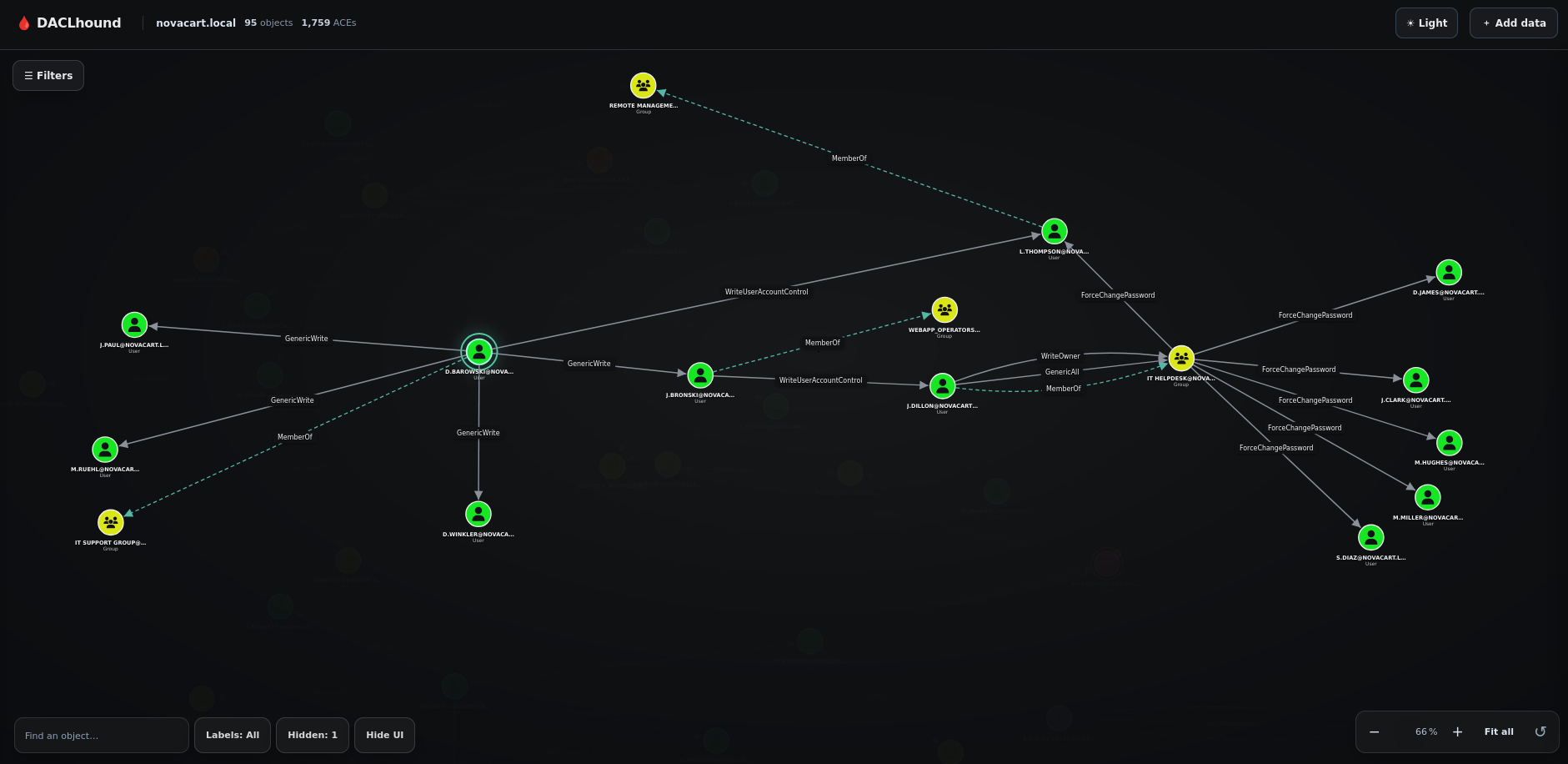
Demo
https://github.com/user-attachments/assets/62a531d9-c3f0-47d3-aab0-d7fef8db28d1
The demo walks through collecting a domain and opening the graph viewer. It also shows selecting an object to focus on its permission paths, hiding objects, and setting start and end nodes to reveal a path.
Install
Python 3.10 or newer is required.
pipx install DACLhound
Upgrade later with:
pipx upgrade DACLhound
Collect a graph
daclhound collect --host DC01.lab.local -d lab.local -u 'user' -p 'password' --dc-ip 192.168.2.1
--host accepts the domain controller's FQDN or IP address. Use the FQDN when authenticating with Kerberos.
By default, the graph is saved using the domain name in the current directory: the first collection creates lab.local.json, and later collections use the next available name, such as lab.local_1.json. Use --output custom-name.json only when you want to choose a custom path; existing files get the same numeric suffix. Pass --overwrite only when you want to replace the selected output file.
The collector is read-only. By default it collects users, groups, computers, OUs, containers, GPOs, the domain, trusts, Sites from the Configuration partition, Foreign Security Principals, and ADCS data. Use --types to limit directory object types:
daclhound collect --host DC01.lab.local -d lab.local -u 'user' -p 'password' --types users,groups
Use --no-adcs to skip ADCS collection. The graph uses the domain-based default filename described above. Add --raw-output to keep the collector's raw entries as well.
By default, collect tries LDAP, then falls back to native ADWS if LDAP cannot connect. Choose a transport explicitly with --transport ldap or --transport adws. ADWS uses TCP port 9389 and supports NTLM and Kerberos; --secure applies to LDAP only. DACLhound resolves schema GUIDs so attribute-level Write-Property rights remain visible.
LDAP visibility depends on the account used for collection. If you have multiple accounts with different directory permissions, collect the domain with each one; their results may reveal additional objects or ACLs. Load the resulting JSON files together in the graph viewer, or pass them together to analyze to combine their data.
Analyze saved graphs
Run a quick console triage of saved graphs without opening the web viewer. analyze reports domain context, Domain Admins, effective permission paths, Kerberos roasting, delegations, ADCS findings, trusts, and other useful relationships. You can analyze several domains together; duplicate objects and relationships are combined:
daclhound analyze lab.local.json
daclhound analyze lab.local.json megacorp.local.json
daclhound analyze lab.local.json --from-user 'alice@lab.local'
By default, analyze traces effective permission paths from collected users, resolves trustees by SID across all supplied JSON files, and groups paths that share a trustee group. It also reports direct rights, domain membership, delegation, roasting, ADCS, and GPO link findings in prioritized sections. Use --from-user to focus the paths on one account. Output is colorized by default; use --color never to disable colors. This is a quick way to review findings from the terminal when you do not need the web viewer.
Authentication
NTLM password
daclhound collect --host DC01.lab.local -d lab.local -u 'user' -p 'password' --dc-ip 192.168.2.1
NTLM pass-the-hash
Pass the NT hash directly, or use LMHASH:NTHASH when you have both hashes:
daclhound collect --host DC01.lab.local -d lab.local -u 'user' -hashes '613a519b5b0ef57c07bc6395aa1aff14' --dc-ip 192.168.2.1
Kerberos
Kerberos supports a password, pass-the-hash, or an existing ccache. When using a
ccache, -u is optional; the identity is taken from the ticket. -no-pass is
an explicit flag for ccache authentication.
Password:
daclhound collect --host DC01.lab.local -d lab.local -u 'user' -p 'password' -k --dc-ip 192.168.2.1
Pass-the-hash (NT hash used as the Kerberos RC4 key):
daclhound collect --host DC01.lab.local -d lab.local -u 'user' -hashes '613a519b5b0ef57c07bc6395aa1aff14' -k --dc-ip 192.168.2.1
If both hashes are available, use -hashes '<LMHASH>:<NTHASH>'.
Existing ccache:
# Use the current KRB5CCNAME
daclhound collect --host DC01.lab.local -d lab.local -k -no-pass --dc-ip 192.168.2.1

# Or provide a ccache file directly
daclhound collect --host DC01.lab.local -d lab.local -k user.ccache -no-pass --dc-ip 192.168.2.1
An AES key enables Kerberos automatically: use -aesKey '<AESKEY>' (with -u). Add -s to use LDAPS.
Open the graph
Run the viewer in the foreground and stop it with Ctrl+C:
daclhound graph --input lab.local.json
Or manage the viewer as a background service:
- Start the viewer without preloading a graph:
daclhound graph start. - Start the viewer and load a graph immediately:
daclhound graph start --input lab.local.json. - Check whether the background viewer is running:
daclhound graph status. - Stop the background viewer:
daclhound graph stop.
The server listens on 127.0.0.1:8765 by default. Uploaded JSON files stay in memory while the server is running and are discarded when it stops. Use --bind and --port to change the listener. Run daclhound collect --help or daclhound graph --help for all options.
License
MIT. See LICENSE.
1 maintainer

Metadata
1 maintainer
Release files for DACLhound 0.1.29
For a detailed explanation of source distributions (sdists) and built distributions (wheels), please see the package formats documentation.
Source distribution (sdist)
| File | Size | Uploaded | Provenance | Actions |
|---|---|---|---|---|
| daclhound-0.1.29.tar.gz | 154.1 kB | Without provenance | Details for daclhound-0.1.29.tar.gz |
Built distribution (wheel)
| File | Interpreter | ABI | Platform | Actions Reset |
|---|---|---|---|---|
| daclhound-0.1.29-py3-none-any.whl | Python 3 | none | any | Details for daclhound-0.1.29-py3-none-any.whl |
Total release size: 319.4 kB
Release files / daclhound-0.1.29.tar.gz
| Download URL | daclhound-0.1.29.tar.gz |
|---|---|
| Size | 154.1 kB |
| Tags | Source |
|
SHA-256 checksum How to use checksums |
e272c72584041c626d1367b60784d16710b6d1f7b05b22e25133769c637f56a6
|
|
BLAKE2b-256 checksum How to use checksums |
4a6b48fb9e37dc30444af78603a121b708c2db3508f5fb0e03c4eb5f004917ad
|
| Upload date | |
|
Uploaded using Trusted Publishing? What is trusted publishing? |
No |
| Uploaded via |
twine/7.0.0 CPython/3.14.7
|
Release files / daclhound-0.1.29-py3-none-any.whl
| Download URL | daclhound-0.1.29-py3-none-any.whl |
|---|---|
| Size | 165.3 kB |
| Tags | Python 3 |
|
SHA-256 checksum How to use checksums |
43491d8d13328687e5a8a8bc38df2eead9ee4691480551ba21b0fdef8918ca04
|
|
BLAKE2b-256 checksum How to use checksums |
2f6bc112ddc60540c118ef731f700cab1e401d4bc97d918dfecd49dc94dfa6bb
|
| Upload date | |
|
Uploaded using Trusted Publishing? What is trusted publishing? |
No |
| Uploaded via |
twine/7.0.0 CPython/3.14.7
|
Security for DACLhound 0.1.29
Provenance
Provenance describes where a file came from. On PyPI, provenance is shared via attestations, which provide a verifiable record of the build or publishing details. View details, limitations and caveats.
No provenance found
None of the files in this release were uploaded with provenance metadata.
A note on package security
PyPI is a repository for distributing packages, not a service for auditing them. While third-party security researchers and our staff do their best to detect and remove malicious packages, PyPI cannot guarantee the quality, security or suitability of any given package.
To learn more about protecting yourself from malicious actors, visit our package security documentation.














