
Graphinate. Data to Graphs.

| Package |


|
| Code |


|
| Tools |


|
| CI/CD |





|
| Scans |


|
| Mentions |


|
| Badge |

|
Table of Contents
Introduction
Meet Graphinate
Graphinate turns your data into Graphs. Effortlessly.
It is a Python library designed to streamline the pipeline from raw data to structured Graph representations. With Graphinate, you can easily map complex data hierarchies and payloads directly to nodes and edges, creating an efficient retrieval system.
Whether you need to visualize relationships, analyze structure, or serve data via an API, Graphinate provides the tools to bring your graph to life.
Graphinate uses and builds upon the excellent NetworkX.
Library at a Glance
📐 The Architect (graphinate.modeling)
Define the blueprint of your graph by decorating simple functions (sync or async) that yield your data as nodes and edges, and compose models via + or GraphModel.merge().
⚙️ The Engine (graphinate.engine)
Traverses models and coordinates lifecycle events (on_start, on_node, on_edge, on_finish) across observers via synchronous (run()) or asynchronous (arun()) execution.
🏗️ The Construction Crew (graphinate.builders)
Takes your graph blueprint and constructs various outputs—a queryable NetworkX graph, a D3 dictionary, a Mermaid diagram, or an executable GraphQL schema (supporting both dynamic and static schema modes).
🎨 The Artists (graphinate.renderers)
A suite of tools to visualize your graphs, from matplotlib plots to interactive Mermaid diagrams.
📡 The Broadcaster (graphinate.server)
Instantly serve your graph data as an interactive GraphQL API with an embedded, 100% offline 3D WebGL graph viewer requiring zero external CDNs.
⌨️ The Command Center (graphinate.cli)
A handy command-line tool to manage and interact with your graph definitions without writing boilerplate code.
Links
- Website (including documentation): https://erivlis.github.io/graphinate
- Source: https://github.com/erivlis/graphinate
- Package: https://pypi.org/project/graphinate
Quick Start
Install
Graphinate is available on PyPI:
pip install graphinate
or
uv add graphinate
To install with high-performance vectorized operations (NumPy progressive enhancement):
pip install "graphinate[perf]"
To install with server and offline 3D WebGL viewer support:
pip install "graphinate[server]"
or combine them:
pip install "graphinate[perf,server]"
Graphinate officially supports Python >= 3.11.
Example
import graphinate

N: int = 8

# First define a GraphModel instance to hold graph definitions
graph_model: graphinate.GraphModel = graphinate.model(name="Octagonal Graph")


# Register in the Graph Model the edges' supplier generator function
@graph_model.edge()
def edge():
    for i in range(N):
        yield {'source': i, 'target': i + 1}
    yield {'source': N, 'target': 0}


# Use the NetworkX Builder
builder = graphinate.builders.NetworkxBuilder(graph_model)

# Build the NetworkX GraphRepresentation (an nx.Graph instance)
graph = builder.build()

# Display the graph with matplotlib
graphinate.matplotlib.plot(graph, with_edge_labels=True)

# Or create a Mermaid diagram
mermaid_builder = graphinate.builders.MermaidBuilder(graph_model)
diagram: str = mermaid_builder.build()
mermaid_markdown: str = graphinate.mermaid.markdown(diagram)

# Or create a Strawberry GraphQL schema and serve it
gql_builder = graphinate.builders.GraphQLBuilder(graph_model)
schema = gql_builder.build()
graphinate.graphql.server(schema)
Asynchronous Pipelines (abuild)
Graphinate natively supports asynchronous generator functions (async def ... yield) and coroutines (async def ... return [...]):
import asyncio
import graphinate
from graphinate.builders import NetworkxBuilder

m = graphinate.model(name="Async Mesh")

@m.node(type_="service")
async def services():
    yield "auth-service"
    yield "payment-service"

async def main():
    # Asynchronously build across any builder
    nx_graph = await graphinate.abuild(NetworkxBuilder, m)
    print(nx_graph)

asyncio.run(main())
CLI
For detailed information on the command-line interface, please see the CLI Usage Guide in the official documentation.
Gallery
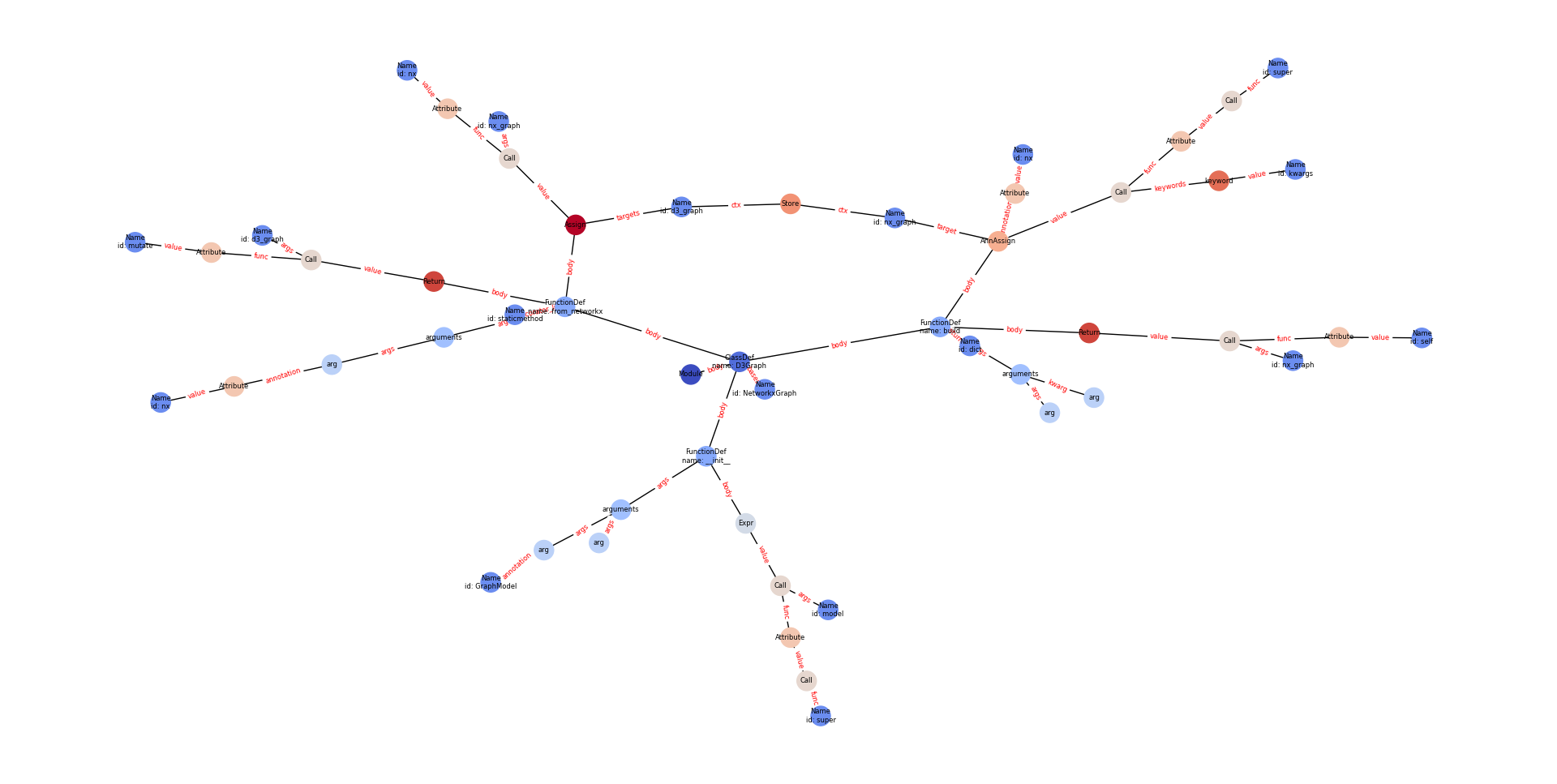
Python Class AST
matplotlib
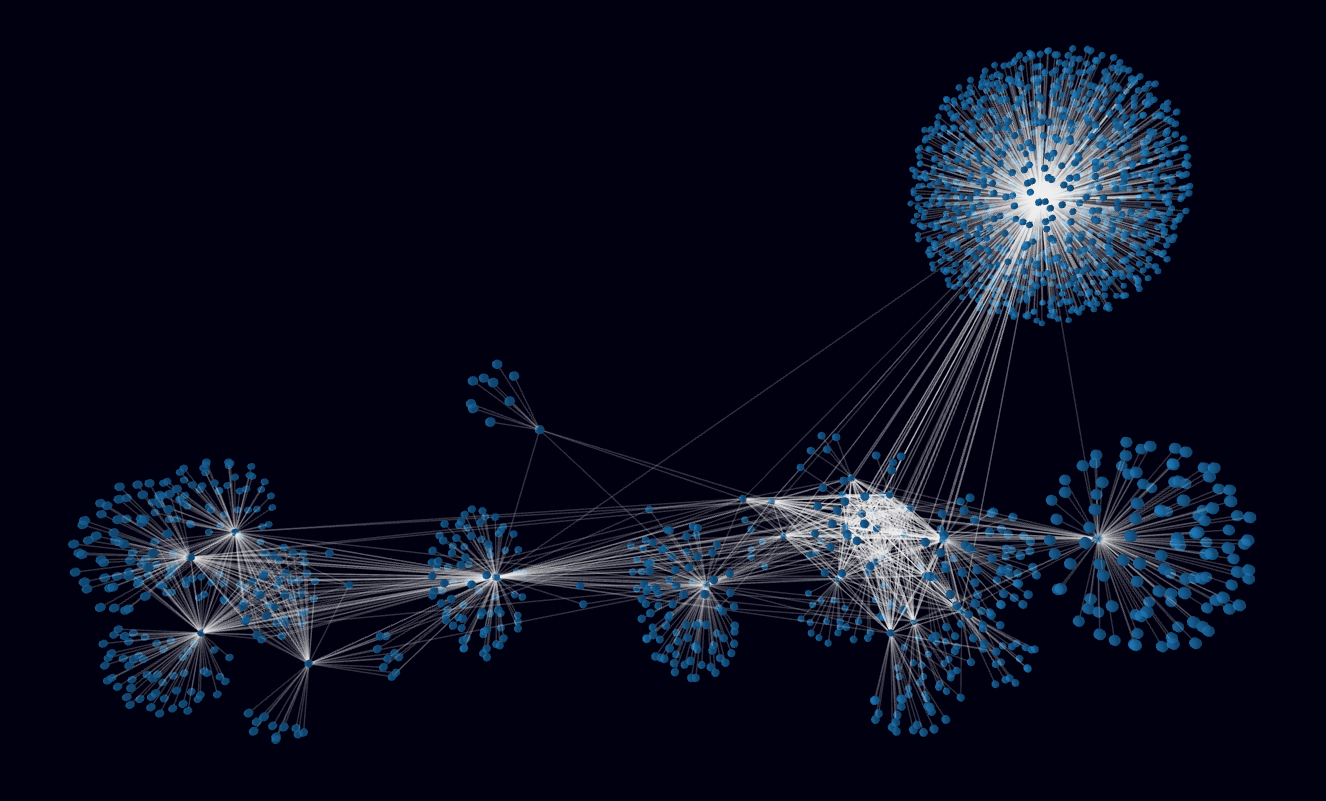
3D Force-Directed Animation
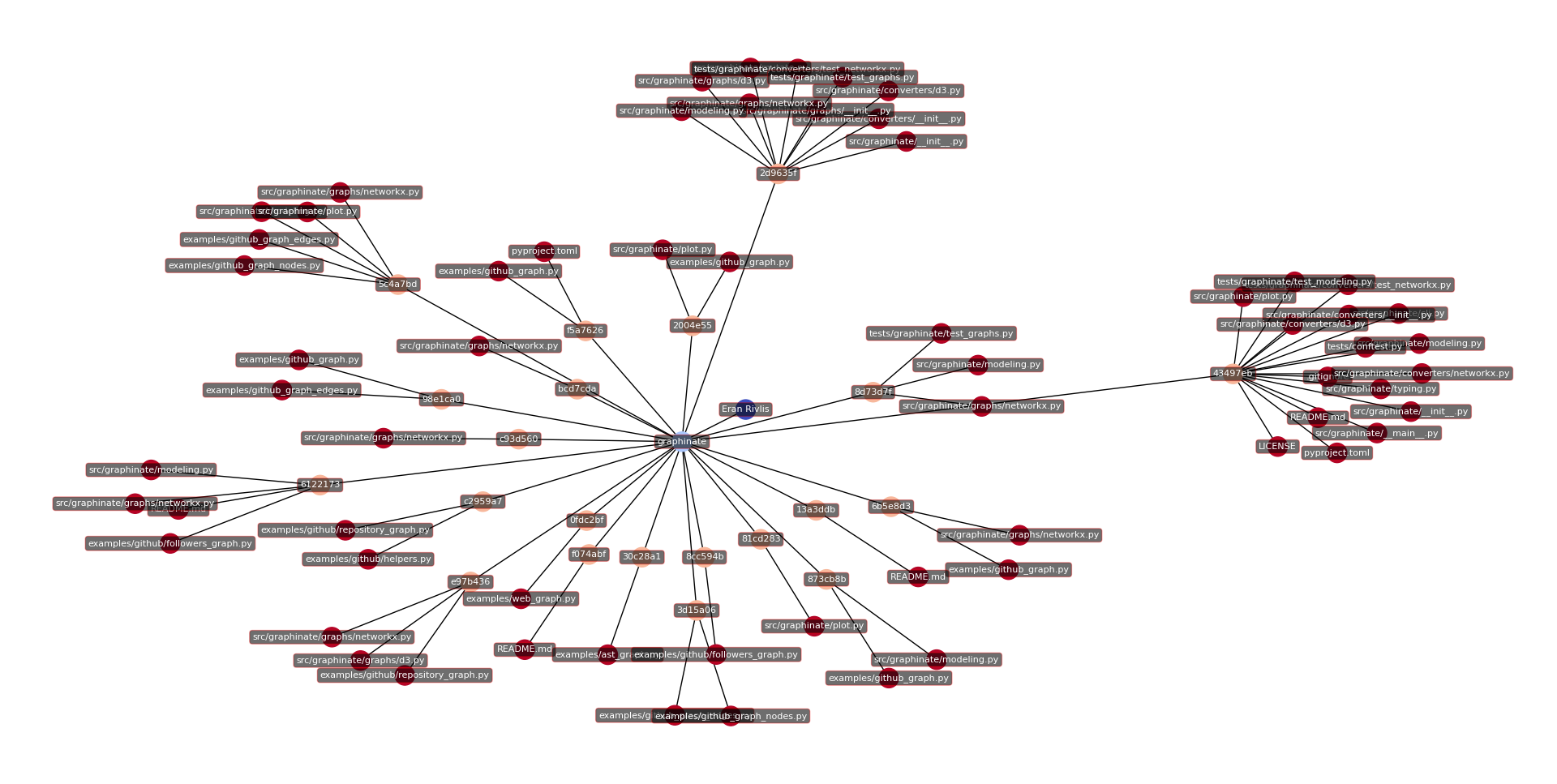
GitHub Repository
Web Links
Development
For instructions on how to set up your development environment, run tests, and contribute to the project, please see the Development Guide in the official documentation.
Acknowledgements
For a list of the dependencies and tools that make Graphinate possible, please see the Acknowledgements page in the official documentation.


Copyright © 2023-2026 Eran Rivlis
1 maintainer

Metadata
1 maintainer
Release files for Graphinate 0.18.0
For a detailed explanation of source distributions (sdists) and built distributions (wheels), please see the package formats documentation.
Source distribution (sdist)
| File | Size | Uploaded | Provenance | Actions |
|---|---|---|---|---|
| graphinate-0.18.0.tar.gz | 3.5 MB | Without provenance | Details for graphinate-0.18.0.tar.gz |
Built distribution (wheel)
| File | Interpreter | ABI | Platform | Actions Reset |
|---|---|---|---|---|
| graphinate-0.18.0-py3-none-any.whl | Python 3 | none | any | Details for graphinate-0.18.0-py3-none-any.whl |
Total release size: 4.3 MB
Release files / graphinate-0.18.0.tar.gz
| Download URL | graphinate-0.18.0.tar.gz |
|---|---|
| Size | 3.5 MB |
| Tags | Source |
|
SHA-256 checksum How to use checksums |
a08a3ae9c7b3de0a49c0d12aaa4e9de7b4565daa2dda57fdda6cff2049a0977b
|
|
BLAKE2b-256 checksum How to use checksums |
8ea37a5af8a9a24124b71a915b9f099a4da8ee3f610a0ed332cf0dbdbf79e82d
|
| Upload date | |
|
Uploaded using Trusted Publishing? What is trusted publishing? |
Yes |
| Uploaded via |
uv/0.13.6 {"installer":{"name":"uv","version":"0.13.6","subcommand":["publish"]},"python":null,"implementation":{"name":null,"version":null},"distro":{"name":"Ubuntu","version":"24.04","id":"noble","libc":null},"system":{"name":null,"release":null},"cpu":null,"openssl_version":null,"setuptools_version":null,"rustc_version":null,"ci":true}
|
Release files / graphinate-0.18.0-py3-none-any.whl
| Download URL | graphinate-0.18.0-py3-none-any.whl |
|---|---|
| Size | 783.5 kB |
| Tags | Python 3 |
|
SHA-256 checksum How to use checksums |
e4a5859b08a27d227b82c70fdc99e74cb775865da50a142508e2be995a15aa4d
|
|
BLAKE2b-256 checksum How to use checksums |
4553f48003cc3be074da9e10228208056febc8041dfd29d1bacc03b7fefa288a
|
| Upload date | |
|
Uploaded using Trusted Publishing? What is trusted publishing? |
Yes |
| Uploaded via |
uv/0.13.6 {"installer":{"name":"uv","version":"0.13.6","subcommand":["publish"]},"python":null,"implementation":{"name":null,"version":null},"distro":{"name":"Ubuntu","version":"24.04","id":"noble","libc":null},"system":{"name":null,"release":null},"cpu":null,"openssl_version":null,"setuptools_version":null,"rustc_version":null,"ci":true}
|
Security for Graphinate 0.18.0
Provenance
Provenance describes where a file came from. On PyPI, provenance is shared via attestations, which provide a verifiable record of the build or publishing details. View details, limitations and caveats.
No provenance found
None of the files in this release were uploaded with provenance metadata.
A note on package security
PyPI is a repository for distributing packages, not a service for auditing them. While third-party security researchers and our staff do their best to detect and remove malicious packages, PyPI cannot guarantee the quality, security or suitability of any given package.
To learn more about protecting yourself from malicious actors, visit our package security documentation.














