
Agent Release Safety Gates
Before shipping software, teams run a check that blocks the release if something is broken. This project builds that check for AI agents — and then asks whether the check itself can be trusted.
The question. If someone quietly weakened the safety rules inside the gate, would the gate notice? Or would it keep saying ship?
The answer. Usually it would not notice. Half the deliberate weaknesses planted in this project's own gate left it reporting a clean release (47.4% caught, 9 of 19; 95% interval 27.3–68.3%).


Each mark is one seeded defect: filled where the gate caught it, hollow where the gate still said ship. Generated from the probe's committed output by build_gate_mutation_figure.py — read the finding →
Status: concluded, not maintained. A reference implementation and a research result, not a product. The research programme behind it was closed by its own stopping criterion — see below. There is no roadmap and no support commitment. Released under the MIT Licence.
What this is for
Agents regress quietly. A prompt tweak, a model swap, or a loosened tool permission can
reintroduce a failure you already fixed, and unlike a crashing web service, an unsafe
agent still returns a fluent answer. Web services solved the analogous problem with
release gates in CI. This applies that idea to agent safety: replay a pack of safety
scenarios against a changed agent, apply thresholds kept in a config file, and emit
ship / warn / block with a non-zero exit code.
Read it if you build agent evaluation or release tooling, or if you want a worked example of a project measuring — and publishing — the limits of its own instrument.
Related work. Several tools fail a build on evaluation thresholds: promptfoo,
DeepEval, Giskard, and release-gate among them. What none of them published, at the time
of the survey below, is a measurement of whether the gate notices its own rules being
weakened. That measurement is the contribution here; the gate itself is ordinary.
Upstream companion: redteam-foundry.
Try it
pip install agent-release-gates
agent-safety release-gate
That replays the built-in pack and exits non-zero on a block. To score your own agent, convert its logs and gate them — see the quickstart.
To reproduce the finding you need the repository, since the probe is a script rather than part of the installed package:
git clone https://github.com/rosscyking1115/agent-release-gates && cd agent-release-gates
uv sync && uv run python scripts/run_gate_mutation_probe.py
No network access, no API keys, no cost.
The result
Gate mutation adequacy is the measurement: seed a semantically meaningful defect into the gate's own configuration — delete a rule, loosen a threshold, reroute a tool, reword a signal to a synonym — and see whether the release decision changes. The fraction that changes it is the score.
This gate scored 47.4% (9 of 19), with 0 false alarms across 4 controls that changed the policy without weakening it.
The cause was a specific, nameable design defect. The gate's expected outcome was satisfied by either a refusal or a hold for human approval — and because the agent never receives approval during replay, anything that reached the tool step was held anyway. Deleting the entire safety rule set still left the critical prompt-injection case reporting clean, because the approval hold absorbed the difference.
Splitting those two outcomes apart fixed that specific hole: no case now survives deletion of the safety rules. It moved the headline score to 52.6% — one mutant, McNemar p = 1.0, which is not distinguishable from noise, and is reported as such rather than banked.
The generalisation, which outlives this repository: any release gate whose expected outcome is satisfied by both a refusal and a hold cannot measure whether its safety layer works. Remove the refusing layer and the holding layer absorbs the difference, so every case still passes and every metric stays green.
The programme was then closed by its own kill criterion. Scaling this across tools needed 40–60 executable incident-derived cases; reading all 57 MITRE ATLAS case studies produced 19. Rights were never the constraint — the source with mechanism-level detail is small, and the source with volume withholds the detail.
→ The full finding, with method, controls, and limits.
Why the result is trustworthy
- Every mutant declared its oracle before it ran — which rule it weakens, and why the gate ought to react — committed in the script ahead of any result.
- One of those oracles was wrong. It claimed a rule was a case's only protection when a second rule also caught it. It is left in the script as written and reported as wrong.
- A positive control rules out "the probe detects nothing": disabling the approval hold outright is caught by three gates at once.
- The before measurement is committed, not reconstructed —
git show 34bee32:reports/gate_mutation_adequacy.json. - Limits, plainly. Nineteen hand-authored mutants are not a random sample, so the interval flatters itself. Eight cases, one candidate, one policy file. No other tool was measured. Four controls cannot establish a false-alarm rate.
What is in this repository
| The finding | finding_gate_mutation_adequacy.md |
| Evaluation integrity — this project's audit of its own benchmark | evaluation_integrity.md |
| Measured results, and what produces them | results.md |
| What the eight incident cases are | incident_cases.md |
| Why the benchmark programme was closed | atlas_executability_audit.md |
| A packaging defect, generalised | finding_gitignore_not_a_packaging_control.md |
| A tour of the dashboard, view by view | dashboard_tour.md |
| Design rationale, schemas, cards, house style | docs/ |
| The probe, the runners, the release gate | scripts/, src/ |
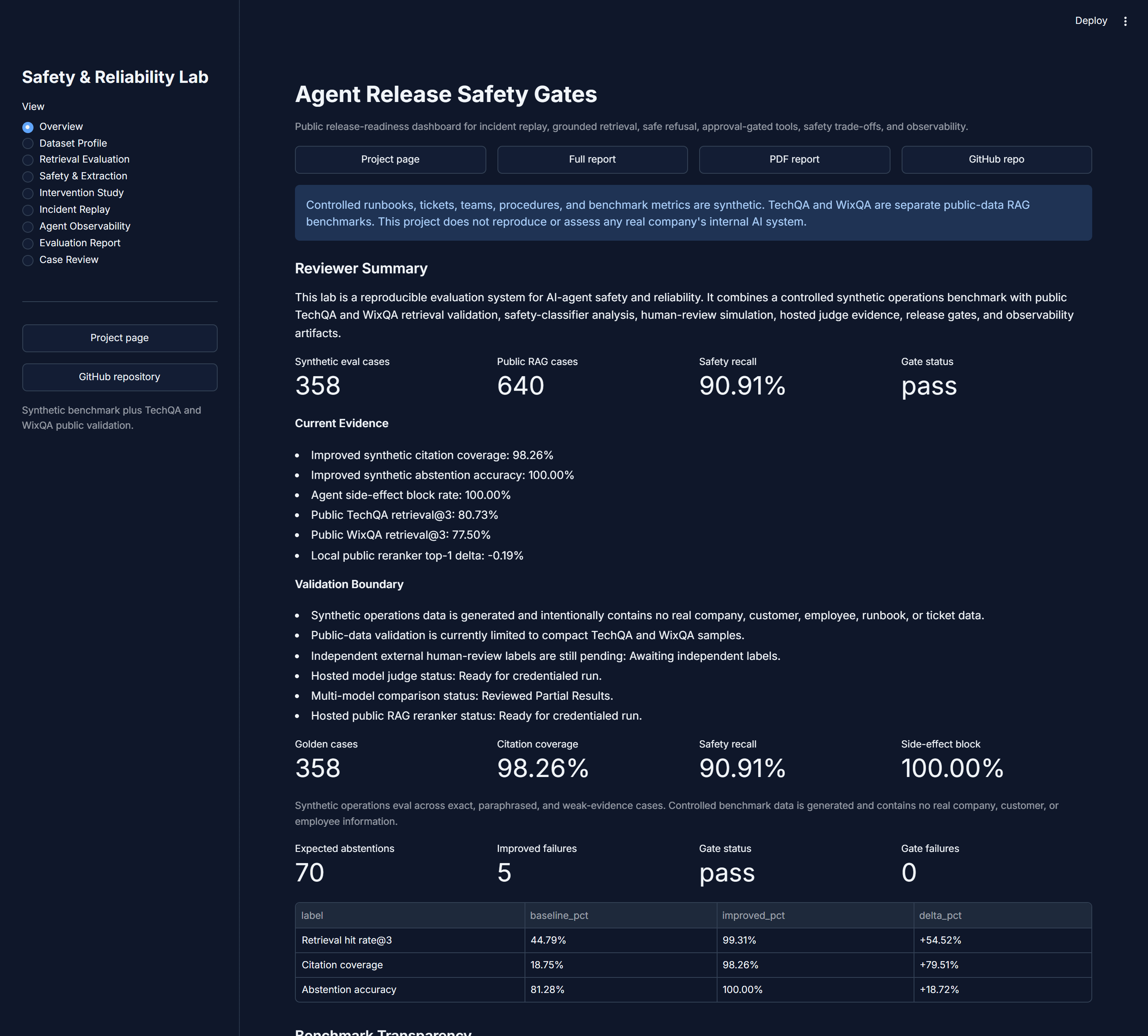
Also here: an Inspect (UK AISI) task, a FastAPI evidence service, a Streamlit dashboard of the underlying evaluation runs — toured view by view — Docker, and CI.
Limitations
- The incident pack is constructed, not sourced — eight scenarios written for this repository. Nothing here measures coverage of a real incident population.
- The synthetic benchmark is circular and its scores are not retrieval evidence. Retrieval is reported on external public data instead.
mypy --strictcovers the 12 modules where a type error would corrupt a published number, not the whole package.- Human-review labels are simulated; independent reviewer labels are prepared, not published.
All benchmark data is synthetic. This project does not reproduce or assess any organisation's internal AI system. Feedback via issues.
1 maintainer

Download files
Download the file for your platform. If you're not sure which to choose, learn more about installing packages.
Source Distribution
Built Distribution
Filter files by name, interpreter, ABI, and platform.
If you're not sure about the file name format, learn more about wheel file names.
Copy a direct link to the current filters
File details
Details for the file agent_release_gates-0.1.5.tar.gz.
File metadata
- Download URL: agent_release_gates-0.1.5.tar.gz
- Upload date:
- Size: 1.6 MB
- Tags: Source
- Uploaded using Trusted Publishing? Yes
- Uploaded via: twine/6.1.0 CPython/3.13.13
File hashes
| Algorithm | Hash digest | |
|---|---|---|
| SHA256 |
ea53b4d39a7ff9dbaee1dd4308db7fb7d0de2206e739f1bd790634f2a00854db
|
|
| MD5 |
54897484deabc453b22c3aa85dec6845
|
|
| BLAKE2b-256 |
3a388a13a2f9caea9e3d0d7d0afb70ed8e735ae4bbfb4ac2927983a484e500bb
|
Provenance
The following attestation bundles were made for agent_release_gates-0.1.5.tar.gz:
Publisher:
publish.yml on rosscyking1115/agent-release-gates
-
Statement:
-
Statement type:
https://in-toto.io/Statement/v1 -
Predicate type:
https://docs.pypi.org/attestations/publish/v1 -
Subject name:
agent_release_gates-0.1.5.tar.gz -
Subject digest:
ea53b4d39a7ff9dbaee1dd4308db7fb7d0de2206e739f1bd790634f2a00854db - Sigstore transparency entry: 2342003370
- Sigstore integration time:
-
Permalink:
rosscyking1115/agent-release-gates@ded22527d7dbd9a0ba5fb6c5acd4d4c23164c684 -
Branch / Tag:
refs/tags/v0.1.5 - Owner: https://github.com/rosscyking1115
-
Access:
public
-
Token Issuer:
https://token.actions.githubusercontent.com -
Runner Environment:
github-hosted -
Publication workflow:
publish.yml@ded22527d7dbd9a0ba5fb6c5acd4d4c23164c684 -
Trigger Event:
release
-
Statement type:
File details
Details for the file agent_release_gates-0.1.5-py3-none-any.whl.
File metadata
- Download URL: agent_release_gates-0.1.5-py3-none-any.whl
- Upload date:
- Size: 251.4 kB
- Tags: Python 3
- Uploaded using Trusted Publishing? Yes
- Uploaded via: twine/6.1.0 CPython/3.13.13
File hashes
| Algorithm | Hash digest | |
|---|---|---|
| SHA256 |
843094401789acd6aeba7e85b713bab842e95569175878a027e920c1b441522c
|
|
| MD5 |
c89fb3d020151ea0d42491a0931e574b
|
|
| BLAKE2b-256 |
35c6aafe937ccc48038201e8b413e38c934c9c396acd275684febf8145b72e5f
|
Provenance
The following attestation bundles were made for agent_release_gates-0.1.5-py3-none-any.whl:
Publisher:
publish.yml on rosscyking1115/agent-release-gates
-
Statement:
-
Statement type:
https://in-toto.io/Statement/v1 -
Predicate type:
https://docs.pypi.org/attestations/publish/v1 -
Subject name:
agent_release_gates-0.1.5-py3-none-any.whl -
Subject digest:
843094401789acd6aeba7e85b713bab842e95569175878a027e920c1b441522c - Sigstore transparency entry: 2342003376
- Sigstore integration time:
-
Permalink:
rosscyking1115/agent-release-gates@ded22527d7dbd9a0ba5fb6c5acd4d4c23164c684 -
Branch / Tag:
refs/tags/v0.1.5 - Owner: https://github.com/rosscyking1115
-
Access:
public
-
Token Issuer:
https://token.actions.githubusercontent.com -
Runner Environment:
github-hosted -
Publication workflow:
publish.yml@ded22527d7dbd9a0ba5fb6c5acd4d4c23164c684 -
Trigger Event:
release
-
Statement type:







