
Decision stability and coverage checks for AI agent tests
Verified details
These details have been verified by PyPIProject links
GitHub Statistics
Maintainers

Project description
AgentVerity
Decision stability and coverage checks for AI agent tests.





AgentVerity qualifies tests for model-backed components that choose from a
finite, reviewed set of decisions. Examples include routers, approval or
policy gates, and supervisors that select the next agent or tool. It compares
the named decision, exposed as verdict, rather than harmless changes in
explanation text.
Use another evaluator for open-ended chat with no reviewed decision or ordered tool-path contract. AgentVerity is alpha, with documented pre-1.0 guarantees.
Read the design story: Introducing AgentVerity: What Does a Green Agent Test Prove?
Is it a fit?
AgentVerity fits when all three conditions hold:
- each run exposes a named decision or a reviewed tool or handoff path
- repeated trials can start from equivalent state in isolated sessions
- you can supply deliberately varied test inputs that should reach different valid decisions
Good targets include support and payment routers, fraud triage, approval and policy gates, incident routing, multi-agent supervisors, and bounded tool selectors. In a larger agent, test the step that owns the decision or the final pipeline decision. Test both when each is a release contract.
It is not an end-to-end quality evaluator for chat, RAG answers, generated content, coding agents, or research agents. If one of those systems also emits a reviewed route, approval, escalation, or tool path, AgentVerity can qualify that decision layer, not the open-ended work around it.
See the applicability checklist and exact limits.
Try it
pip install agentverity
from agentverity import from_callable, run

def route(ticket: str) -> dict[str, str]:
    # Deliberate defect: every ticket takes the same route.
    return {"text": "route: general", "verdict": "general"}

agent = from_callable(route)
result = run(agent, inputs=[
    "my card was charged twice",
    "the app crashes on login",
    "where is my refund",
    "the checkout button is the wrong colour",
])

print(result.headline)
NOT TRUSTWORTHY - the agent answered 'general' on 100% of the probes,
so a pass says more about the probe set than about the agent.
Those deliberately varied test inputs form the probe set. AgentVerity asks:
- Decision stability: does one case reach the same decision across isolated reruns?
- Decision coverage: do the cases reach more than one decision?
- Declared coverage: when you supply a decision contract, did the suite include every required decision, did the agent return them, and did it emit an unknown decision?
A green quality score answers a different question: whether the selected answers were right. AgentVerity checks how much evidence that score rests on. It complements DeepEval, promptfoo, AgentCore Evaluations, and ordinary assertions rather than replacing them.
Together, the checks guard against two failure modes:
- Vacuous green: every supplied assertion passes, but the test inputs reach only one decision.
- Regression trap: that narrow run becomes the baseline, so later changes to untested decisions remain invisible.
AgentVerity qualifies the evidence from this run. It does not certify the agent as correct, safe, or fully covered.
Why rerun counts are harder than they look
Three or five reruns chosen by convention can support the wrong conclusion. In one deterministic example, 36 non-overlapping rerun comparisons produced no decision changes. That was still too little evidence to certify a change rate below 5%. The honest result was undecided, not unstable. Certifying that threshold with no observed changes needed 73 comparisons.
The decision rule is:
- pair reruns without reusing an output
- calculate a 95% Wilson interval around the observed decision-change rate
- report
deterministicwhen the upper bound is below the tolerated rate - report
stochasticwhen the lower bound is above the tolerated rate - report
undecidedwhen the interval spans that tolerance
Wilson intervals are established statistics. AgentVerity's design choice is to use one as a three-outcome release rule rather than force an underpowered run into stable or unstable. Non-overlapping pairs avoid making the sample look larger than the target calls justify, while the requested tolerance determines the call budget before execution.
The default balanced precision calculates that budget automatically.
See the executable helper, arithmetic, and exact API mapping.
The evidence gate
A baseline is a reviewed set of expected decisions for later versions. AgentVerity refuses to save one until calls complete, decisions are stable enough, the probe set crosses a decision boundary, and a person approves the reference outputs.
The bundled payment-dispute example runs two test sets:
python examples/payment_dispute_gate.py
| Probe set | Exact-match | Verdict stability | Declared coverage | Baseline |
|---|---|---|---|---|
| Narrow, 6 duplicate-charge cases | ✅ 6/6 | ✅ verdict-deterministic | ❌ 1/6 required routes | ❌ REFUSED |
| Repaired, 6 dispute categories | ✅ 6/6 | ✅ verdict-deterministic | ✅ 6/6 required routes | ✅ ADMITTED |
Both score 6/6. The narrow set correctly tests one route, but it covers only one of the six routes declared as required. The repaired set reaches all six and can be saved as a versioned snapshot.
Declare that test contract in Python:
from agentverity import DecisionCase, DecisionContract, DecisionSuite, run

suite = DecisionSuite(
    contract=DecisionContract(
        allowed={"duplicate_charge", "refund_delay", "card_security"},
        critical={"card_security"},
    ),
    cases=(
        DecisionCase("I was charged twice", "duplicate_charge"),
        DecisionCase("My refund is late", "refund_delay"),
        DecisionCase("I do not recognise this card payment", "card_security"),
    ),
)

result = run(agent, suite=suite)
expected records the route each case is intended to exercise. AgentVerity
checks intended and observed route coverage separately. Your assertions or
quality evaluator still decide whether each returned route was correct.
Create one through the CLI:
agentverity snapshot \
  --agent examples/payment_dispute_gate.py:build_agent \
  --suite examples/payment_decisions.json \
  --output baseline.json \
  --accept-reference
The same checks run before agentverity check reports differences as
regressions. Snapshot files retain SHA-256 input fingerprints rather than raw
prompts.
Where it fits
AgentVerity is an evaluation runner, not serving-path middleware. It makes controlled calls with reviewed test inputs:
reviewed cases ---> agent ---> quality evaluator: "Was it right?"
             +---> agent ---> AgentVerity: "Can I trust this test?"
                                      |
                           snapshot or release decision
Use it while developing, on a pull request, before release, or as a scheduled synthetic canary. Do not repeat live customer requests. Results can leave as text, JSON, JUnit XML, or one privacy-minimised OpenTelemetry span.
See CI, telemetry, lifecycle, and multi-agent integration.
Measured AgentCore canary
The optional production example combines a Strands payment router on Amazon Bedrock, DeepEval route-quality checks, AgentVerity, AgentCore Runtime, and CloudWatch.
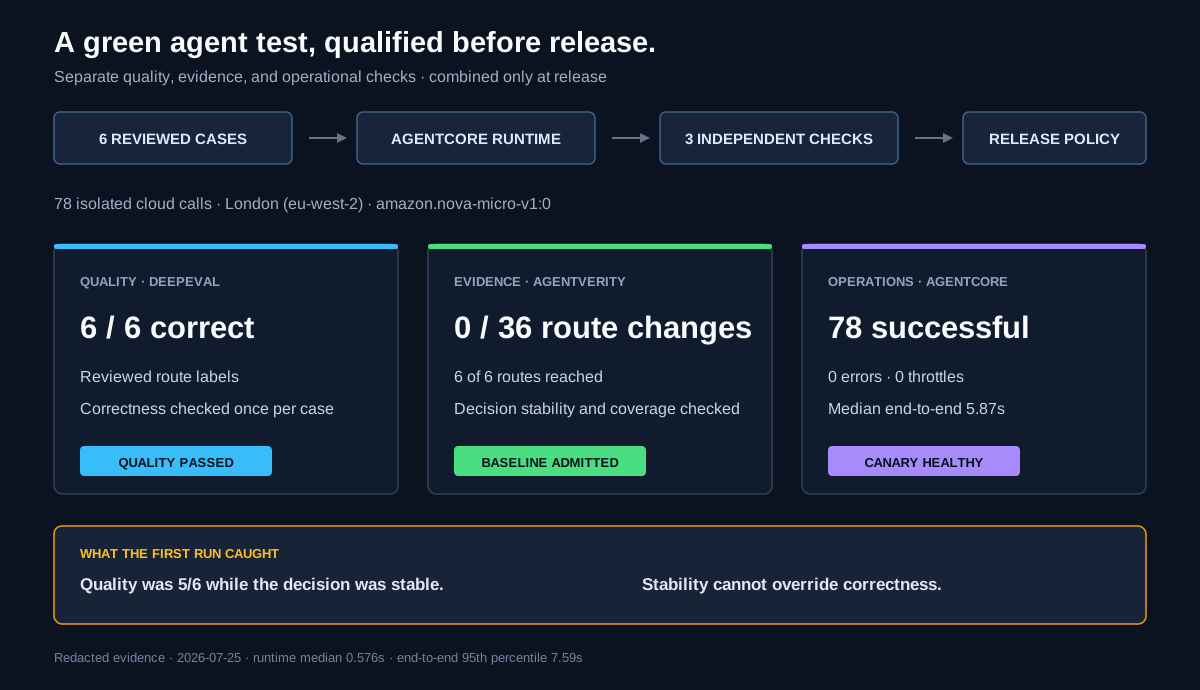
The London canary recorded 6/6 correct routes, no changes across 36 repeat pairs, all six routes reached, and 78 successful cloud calls with no errors or throttles. Its first run was stable but only 5/6 correct, so the example now requires both quality and evidence before snapshot admission.
The v0.9 contract path was then rerun directly through Bedrock after the old runtime was removed. It again scored 6/6 with 0/36 route changes, and reported all six required routes intended and observed with no unknown decision.
This is deployment proof, not an AWS requirement. The zero-dependency callable works with any stack.
Run the production example · Read the measured result
Scope
A trustworthy AgentVerity result means that, for the supplied probe set, optional decision contract, and chosen tolerance:
- repeated isolated calls provided enough evidence about decision stability
- observed decisions did not collapse onto one highly dominant route
- every required decision was intended and observed when a contract was given
- no observed decision fell outside that contract
- execution completed and any requested relation checks were meaningful
That is a minimum dynamic adequacy check, not exhaustive branch coverage. Without a decision contract, AgentVerity only checks observed diversity. With one, it reports required, intended, observed, missing, and unknown decisions. It still does not establish that every boundary was tested or that critical routes meet their own stability target. Keep labelled correctness cases and run critical groups separately when their risk warrants a tighter tolerance.
It also does not judge answer correctness, prove safety, store traces, host a dashboard, or monitor production traffic. Static tools remain useful for declared branches, route schemas, and expected labels. AgentVerity measures the decisions a model-backed or black-box target actually returns.
Documentation
- Which agents fit, and what the result does not prove
- Why arbitrary rerun counts fail
- Integrations and AgentCore validation
- API guide
- Design decisions
- ADR: compare named decisions, not generated text
- API stability and path to 1.0
- Security and data handling
- Contributing
- Release process
Development
pip install -e ".[dev]"
python -m pytest -q
ruff check .
CI covers Python 3.10 through 3.14, lint, package construction, and the
generated README evidence. A coverage job enforces at least 90% statement
coverage, and the branch-protection CI gate requires that job to pass.
Status and licence
Alpha. Pin a minor series for production use, for example
agentverity~=0.9.0. Patch releases preserve the public API.
Apache-2.0. Contributions are welcome through the pull-request workflow.
Project details
Verified details
These details have been verified by PyPIProject links
GitHub Statistics
Maintainers
Release history Release notifications | RSS feed


Download files
Download the file for your platform. If you're not sure which to choose, learn more about installing packages.
Source Distribution
Built Distribution
Filter files by name, interpreter, ABI, and platform.
If you're not sure about the file name format, learn more about wheel file names.
Copy a direct link to the current filters
File details
Details for the file agentverity-0.9.0.tar.gz.
File metadata
- Download URL: agentverity-0.9.0.tar.gz
- Upload date:
- Size: 612.0 kB
- Tags: Source
- Uploaded using Trusted Publishing? Yes
- Uploaded via: twine/6.1.0 CPython/3.13.14
File hashes
| Algorithm | Hash digest | |
|---|---|---|
| SHA256 |
b824218309f3dd802029082c19075aaaeb481747f47b6dae7b670867d753663a
|
|
| MD5 |
7c823e6c292b3585bc6b472d876fbf0e
|
|
| BLAKE2b-256 |
b0fa3c826ebad2959b136001fa40c26f0c4f31b29ec1f109e9221871f3842830
|
Provenance
The following attestation bundles were made for agentverity-0.9.0.tar.gz:
Publisher:
release.yml on mrwersa/agentverity
-
Statement:
-
Statement type:
https://in-toto.io/Statement/v1 -
Predicate type:
https://docs.pypi.org/attestations/publish/v1 -
Subject name:
agentverity-0.9.0.tar.gz -
Subject digest:
b824218309f3dd802029082c19075aaaeb481747f47b6dae7b670867d753663a - Sigstore transparency entry: 2264335248
- Sigstore integration time:
-
Permalink:
mrwersa/agentverity@95a619df727e4241b764db521746ee60c0adb93d -
Branch / Tag:
refs/tags/v0.9.0 - Owner: https://github.com/mrwersa
-
Access:
public
-
Token Issuer:
https://token.actions.githubusercontent.com -
Runner Environment:
github-hosted -
Publication workflow:
release.yml@95a619df727e4241b764db521746ee60c0adb93d -
Trigger Event:
release
-
Statement type:
File details
Details for the file agentverity-0.9.0-py3-none-any.whl.
File metadata
- Download URL: agentverity-0.9.0-py3-none-any.whl
- Upload date:
- Size: 53.9 kB
- Tags: Python 3
- Uploaded using Trusted Publishing? Yes
- Uploaded via: twine/6.1.0 CPython/3.13.14
File hashes
| Algorithm | Hash digest | |
|---|---|---|
| SHA256 |
f8b483b0d6f41034a41a7350ab221f27c965b37e218a3452caf4ff9757e46666
|
|
| MD5 |
937d81523fd7ff70f9fc06b9e1fa03b7
|
|
| BLAKE2b-256 |
ecef0dee6110df357f1b3ee3347e556b23aae1fc4618c1c31beb4e2051a24207
|
Provenance
The following attestation bundles were made for agentverity-0.9.0-py3-none-any.whl:
Publisher:
release.yml on mrwersa/agentverity
-
Statement:
-
Statement type:
https://in-toto.io/Statement/v1 -
Predicate type:
https://docs.pypi.org/attestations/publish/v1 -
Subject name:
agentverity-0.9.0-py3-none-any.whl -
Subject digest:
f8b483b0d6f41034a41a7350ab221f27c965b37e218a3452caf4ff9757e46666 - Sigstore transparency entry: 2264335710
- Sigstore integration time:
-
Permalink:
mrwersa/agentverity@95a619df727e4241b764db521746ee60c0adb93d -
Branch / Tag:
refs/tags/v0.9.0 - Owner: https://github.com/mrwersa
-
Access:
public
-
Token Issuer:
https://token.actions.githubusercontent.com -
Runner Environment:
github-hosted -
Publication workflow:
release.yml@95a619df727e4241b764db521746ee60c0adb93d -
Trigger Event:
release
-
Statement type:






