
ai-profile
Show the evidence behind your AI collaboration.
ai-profile turns explicit Git provenance across your local repositories into
privacy-safe GitHub Profile cards and a provider-filterable dashboard with a
provider ledger—without uploading source code or guessing
attribution.
Explore the live dashboard → · Generate yours in four commands




- Explicit evidence: attribution comes from
AI-*trailers and verified AI co-author identities—not source-code style. - Local-first privacy: CLI scanning, aggregation, refresh, and rendering happen on your machine; repository identities stay out of public assets.
- Profile-ready: one render produces theme-aware SVG cards, a self-contained dashboard, and a machine-readable public summary.
ai-profile is not an AI code detector. Commits with no explicit evidence
stay unknown (shown as Unattributed in the UI); they are never silently
counted as human or assigned to a provider. Add AI-* trailers to future
commits when you want their AI participation recorded.
A real GitHub Profile example
This card contains the maintainer's real public aggregate data. Select it to open the provider-filterable dashboard; the card shows explicit provider participation and evidence totals when the Git history declares AI activity.
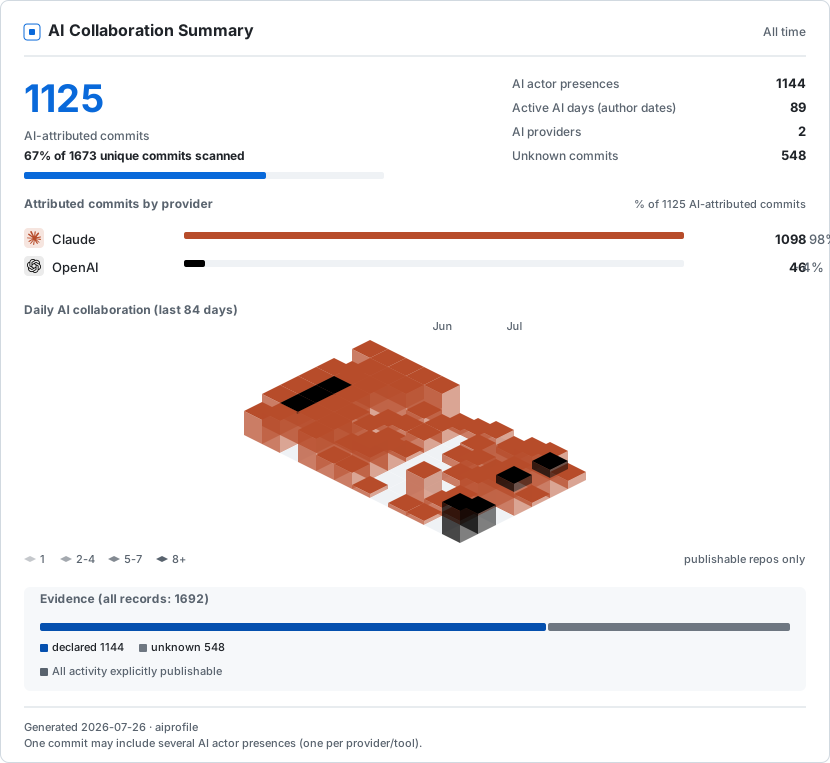
The card shows sustained AI collaboration (active AI days and an 84-day voxel collaboration mine — continuous 28-day landscape terraces with linear dual pillars for AI-attributed and Other commits, publishable dates only), breadth across AI providers, and the explicit evidence totals behind every number. It is a record of declared Git evidence, not a skill score.
Why ai-profile?
- Generic GitHub statistics answer how active a developer is.
- Line-level attribution tools answer which lines a tool changed.
ai-profileanswers how AI participated and what evidence supports that claim across repositories, while keeping the analysis local.
It complements those tools; it does not replace them or infer historical AI use when Git evidence is absent.
Install
Requires Python 3.11 or newer and Git 2.17 or newer. The wheel-onboarding workflow tests Ubuntu, Windows, and macOS on Python 3.12; the full suite also tests Python 3.11–3.14 on Ubuntu. Repositories must use Git's SHA-1 object format.
python -m pip install --upgrade ai-profile-cli
aiprofile --version
The package name is ai-profile-cli; the installed command is aiprofile.
If your shell has not refreshed its script path, use:
python -m aiprofile --version
Quickstart
Run these commands from the root of one of your repositories:
aiprofile init
aiprofile scan .
aiprofile aggregate
aiprofile render
Use python -m aiprofile in place of aiprofile for any command if needed.
initcreates the local configuration and seeds your identity fromgit config user.email.scanreads commits reachable from the repository's currentHEADand records commits authored by your configured identities.aggregateprints the exact privacy-safe statistics eligible for publication.renderwrites exactly eight files todist/:
badge-dark.svg       heatmap-light.svg   summary-dark.svg
badge-light.svg      profile.json        summary-light.svg
dashboard.html       heatmap-dark.svg
Existing commits without explicit AI evidence will appear as unknown.
Large unknown counts are an honest result, not a failed scan. Add trailers to
future commits when you want their AI participation credited.
Configure identities and repository privacy
The configuration file is:
- macOS/Linux:
~/.aiprofile/config.json - Windows:
%USERPROFILE%\.aiprofile\config.json($HOME\.aiprofile\config.jsonin PowerShell) - custom automation:
$AIPROFILE_HOME/config.json
Only commits authored by an address in identities count. After init,
close other aiprofile processes, open the file as UTF-8 JSON, and add every
address you use—including GitHub noreply addresses:
{
  "identities": [
    "you@example.com",
    "12345678+username@users.noreply.github.com"
  ],
  "repositories": [],
  "salt": "keep-the-existing-generated-value"
}
Keep the generated salt unchanged. After a scan, each repository entry also
contains path, repository_uid, and publication_level. Change only
publication_level when adjusting privacy:
On Windows, save with an editor's UTF-8 (no BOM) option. Windows
PowerShell 5.1's Set-Content -Encoding utf8 adds a BOM that strict JSON
readers, including this Public Beta, reject. VS Code's default UTF-8
encoding is suitable; confirm the file still parses before replacing your
backup.
{
  "path": "/local/path/created-by-scan",
  "repository_uid": "keep-the-existing-generated-value",
  "publication_level": "aggregate_only"
}
The allowed values are:
aggregate_only— default; include totals but withhold repository identity and daily dates.full— include identity-redacted daily aggregate activity in date views.excluded— omit that repository entirely.
aiprofile scan --full /path/to/repository is the supported opt-in from
aggregate_only to full. It does not mean the repository is public on
GitHub, and a later scan without --full does not downgrade it. To reduce
publication, edit only the existing entry's publication_level, save valid
UTF-8 JSON, then run:
aiprofile aggregate
aiprofile render
If configuration parsing fails, restore the previous valid JSON; do not
delete or regenerate the salt, path, or repository_uid. Always review
aggregate before publishing.
Automate daily updates
Choose one path. Keep private and aggregate_only repositories on your own
machine; use GitHub Actions only when every source repository is already
public.
# Refresh every configured, non-excluded repository now.
aiprofile refresh --out dist
aiprofile refresh --out dist --dry-run

# Or install one daily local job (05:37 in the machine's local time).
aiprofile schedule install --profile-repo /path/to/USERNAME --time 05:37
aiprofile schedule status
aiprofile schedule remove
Refresh every configured repository
refresh rescans each configured path once, then aggregates and writes the
same eight files. Aliases do not cause duplicate scans, and excluded
repositories remain excluded. A scan, configuration, privacy, or rendering
failure publishes no new generation. --dry-run lists which of the eight
files would change without changing configuration, publication policy,
recorded database/WAL content, or output assets. It may create or use the
advisory lock, and SQLite may update transient -shm coordination bytes while
reading committed WAL content; neither is published data.
If two configuration entries resolve to the same path but carry different
repository_uid values, refresh refuses the whole run before scanning or
reading cached aggregates. Keep the UID created by scan; do not copy a UID
between entries or invent a replacement.
Only one refresh can use an AIPROFILE_HOME at a time. On the rare filesystem
failure where output rollback is incomplete, the CLI says that partial assets
or recovery backups may remain; inspect the output before committing it.
Private or local repositories: native scheduler
schedule install creates an OS-native user job: Task Scheduler on Windows,
launchd on macOS, or a systemd user timer on Linux. It refreshes
<profile-repo>/dist daily and, by default, stages only the eight generated
paths, commits only byte changes, and pushes through the repository's existing
Git authentication only while the remote still equals the captured parent.
Push mode requires one fetch destination and the same single push destination;
multiple or different push URLs fail closed before refresh. The captured
destination is bound to a fixed alias inside a private, isolated Git context;
push and verification never put the URL in argv and cannot be redirected by
later repository, global, insteadOf, or pushInsteadOf changes. Supported
destinations are credential-free HTTPS, SSH/SCP, Git, file URLs, or local
paths without query strings or fragments. Local paths are resolved from the
Profile repository before the isolated context is created. Shallow and partial
clones are rejected before refresh because scheduled publication requires a
complete local Git history. Use a credential manager, askpass,
or SSH agent; embedded passwords and authorization headers are intentionally
unsupported, and ambient proxy variables are not forwarded. The tool does not persist or log credentials. Add
--no-push to create and advance the local exact-eight commit without pushing
it to the remote; use --dry-run to preview installation without changing
scheduler state.
The user scheduler and machine must be available. Windows and systemd can recover missed runs according to their native settings; launchd does not replay a run missed while the machine was powered off. Detached branches, changed branch state, protected branches, and rejected pushes fail closed. Scheduler commits are mechanical and intentionally do not run user commit hooks or signing.
Before a push-capable run, a clean local checkout is safely fast-forwarded when
the recorded remote branch is ahead and is a verified descendant of local
HEAD; the fetch uses the same isolated destination transport as publication.
Deliberate local commits, dirty checkouts, rewinds, deletions, and diverged or
unstable remote tips still fail closed for manual synchronization. A failed
push is retried from the same private pending commit only after an interrupted
branch update and the exact-eight index are safely recovered, and while its
branch, parent, tree, and remote remain unchanged. The actual push uses an
exact-old lease tied to that parent and verifies the remote at the immutable
commit before reporting success or clearing retry state. The private retry
record binds a SHA-256 commitment of the destination, never the URL itself.
Different homes targeting one Profile are
serialized by that Profile's Git metadata lock, and generated bytes are
verified against the completed refresh before the commit is created.
Install the scheduler from a Python environment that will remain in place.
If you move, remove, or upgrade that interpreter or virtual environment, run
schedule install again and confirm schedule status.
Public repositories: GitHub Actions
For a Profile sourced entirely from public repositories:
- Copy
docs/templates/profile-refresh-caller.ymlto.github/workflows/profile-refresh.ymlin the Profile repository. - Edit the explicit public
owner/repolist. Add the identity-email payload as the repository secretAIPROFILE_IDENTITIES; never put it inwith:. If you have individually confirmed old commits, optionally sync the complete private ledger asAIPROFILE_ATTESTATIONS. - In Settings → Pages, choose GitHub Actions as the source, then run the workflow once with Actions → Daily ai-profile refresh → Run workflow.
The template runs daily at 05:37 UTC and also supports manual dispatch. It
pins the reusable workflow to commit
62284cc9ffb6b1a05af677e8f20c73d33e4bc4c6, installs exactly
ai-profile-cli==0.10.0, rejects non-public sources before scanning, and
deploys Pages from the exact published-sha produced in that run. It uses
only GITHUB_TOKEN; no PAT fallback is provided. GitHub-hosted automation is
not local-first processing: it clones only the public repositories you list
and treats them as full. Use the local scheduler if any source is private or
aggregate_only.
Branch protection can reject the direct asset commit. Scheduled workflows in
public repositories can be disabled after 60 days without repository
activity, forks require Actions to be enabled, and organization Actions
allowlists must permit the pinned actions and reusable workflow. A commit made
with GITHUB_TOKEN does not trigger ordinary push workflows or a Pages build,
so the caller performs an explicit, same-run Pages deployment. Use one caller,
not a matrix of overlapping refresh jobs.
After personally confirming older commits, aiprofile reconcile sync-github --profile-repo OWNER/PROFILE --confirm-sync sends the complete private
ledger to the optional AIPROFILE_ATTESTATIONS Actions secret through gh
standard input. Sync again after every add/remove; missing or invalid secrets
never make the workflow infer AI. The cloud caller must explicitly pass that
secret to the reusable workflow. aiprofile sources suggest OWNER/REPO is a
read-only comparison against configured sources; it never enrolls a repo.
Publish to your GitHub Profile
Run aiprofile render --out dist inside your USERNAME/USERNAME Profile
repository, commit dist/, and place this clickable card in its README:
<a href="https://USERNAME.github.io/USERNAME/dist/dashboard.html">
  <picture>
    <source media="(prefers-color-scheme: dark)" srcset="dist/summary-dark.svg">
    <img alt="Open my interactive AI collaboration dashboard"
         src="dist/summary-light.svg">
  </picture>
</a>
Add the heatmap with the same <picture> pattern using
heatmap-{light,dark}.svg. GitHub READMEs do not execute JavaScript, so the
SVG remains the Profile view and the link opens dashboard.html.
For manual publication, host the dashboard with GitHub Pages as follows. If you use the daily Action above, keep GitHub Actions as the Pages source and skip these branch-source steps.
- Push
README.mdanddist/to the Profile repository'smainbranch. - Open Settings → Pages.
- Under Build and deployment, choose Deploy from a branch.
- Select main, / (root), then Save.
- Open
https://USERNAME.github.io/USERNAME/dist/dashboard.html.
A new Pages deployment can return 404 for a few minutes. Wait for the Pages
workflow to finish, then reload the exact case-sensitive URL. If it still
returns 404, confirm that Pages uses main and / (root) and that
dist/dashboard.html exists in the pushed commit.
What gets generated
The synthetic previews below demonstrate the complete output family:
The summary and dashboard form an original voxel collaboration mine: thick orthographic terrain, blue AI-attributed pillars beside stone Other-record pillars, cubic explorers, provider workstations and an evidence archive. Pillar fronts use a shared linear scale; decoration never changes counts. Horizontal date bands remain separate from terrain and moving characters. The generation date is always a snapshot, never a real-time claim.
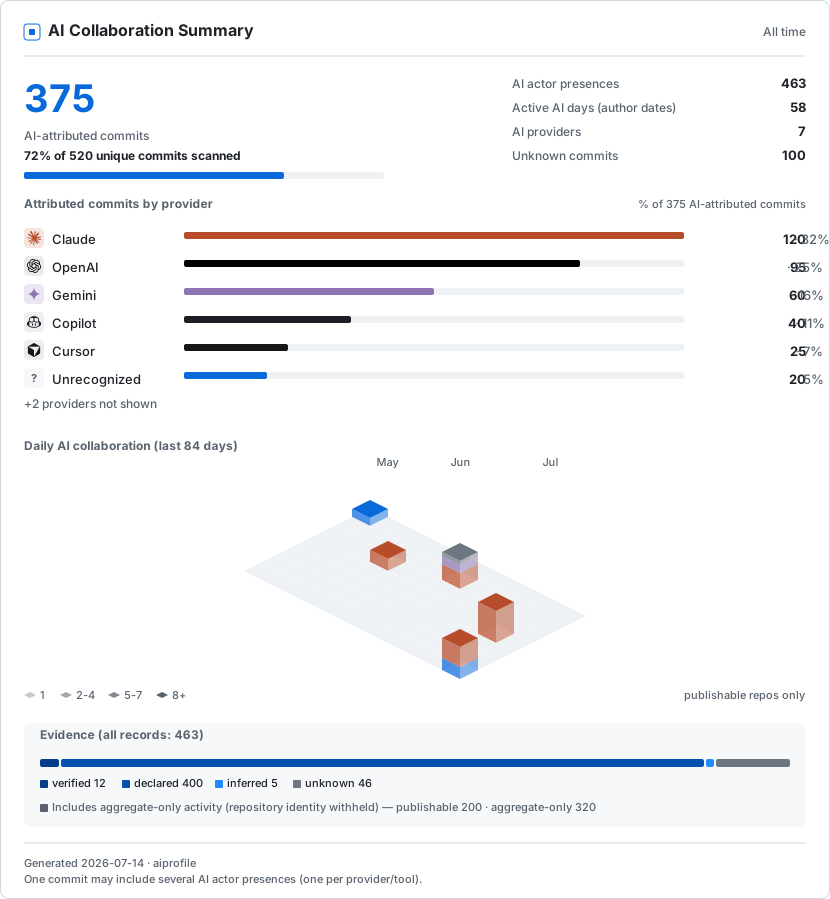
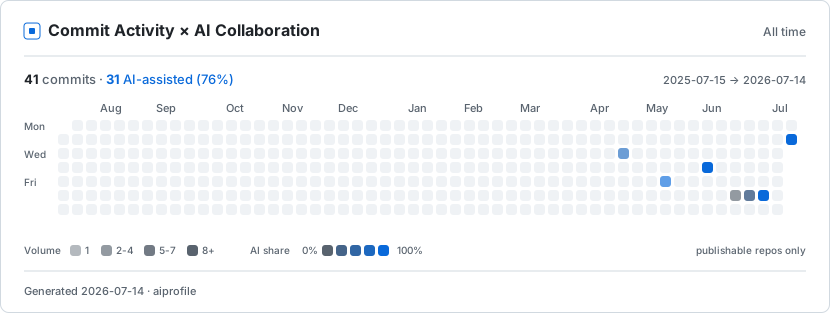

The two summary SVGs include continuously looping original characters; heatmap
and badge SVGs stay static. Reduced motion and print stop the animation.
dashboard.html is a self-contained provider-filterable view with all dates
in the selected range, pause/play, and light, dark, and system themes. It loads no
external script, font, tracker, or API. profile.json contains the same
validated public aggregate contract used by every renderer.
Declare AI participation
Known AI co-author identities are recognized automatically. For other tools,
or richer attribution, add one contiguous AI-* trailer block after a blank
line in the commit message:
feat: add aggregation service

AI-Provider: Anthropic
AI-Model: Claude-Sonnet
AI-Tool: Claude-Code
AI-Role: implementation, documentation
AI-Mode: AI-Assisted
AI-Reviewed-By: Human
Repeat AI-Provider: without a blank line between actor groups to declare
another AI actor in the same commit. One commit can therefore equal one
unique AI-attributed commit and multiple actor presences. Use
AI-Mode: Human-Only only for an explicitly human-only commit.
Provider declarations are normalized to a canonical provider identity
(typically company-oriented). The dashboard may show the more recognizable
product display name instead: AI-Provider: Anthropic is shown as Claude.
This is a label-only mapping; it does not change aggregation or counts.
When AI-Model is present, its canonical value is mapped to a small
schema-owned family vocabulary (for example, Claude-Sonnet → Claude) and
retained as validated, machine-readable evidence in profile.json. Family
commit counts remain intentionally non-exclusive, while actor presences and
active days remain separate measures. Missing model declarations stay
Unknown; raw model strings never enter public assets.
v0.10 also accepts Assisted-By: LLM (Claude Code) and
Generated-By: Codex CLI when they explicitly identify AI or a registered
AI tool; a bare organization name is insufficient. Ambiguous values remain
Unattributed. For a single staged
commit, opt in with aiprofile provenance mark --provider OpenAI --tool "Codex CLI" --confirm-ai, then install optional, non-overwriting hooks with
aiprofile provenance hook install. A mark is bound to the current HEAD and
staged tree, is consumed only when the final commit retains the confirmed AI
trailers, and can be removed with
aiprofile provenance clear. aiprofile provenance doctor reports hook,
pending-mark, and recent explicit-evidence status. Existing hooks require
manual integration; opening an AI tool never creates a mark.
If existing AI trailers cannot be kept in distinct actor groups, the hook
stops the commit and leaves the mark for manual message correction.
For an older, individually confirmed reachable commit, use aiprofile reconcile add --repo PATH --sha FULL_SHA --provider OpenAI --confirm-ai, then
aiprofile refresh. reconcile list and reconcile remove --repo PATH --sha FULL_SHA --confirm-remove manage the private ledger without rewriting Git
history. Do not backfill a commit you have not personally verified. A
proposed squash message can be checked with aiprofile provenance pr-check --base BASE --head HEAD --message-file MESSAGE; GitHub may replace source
messages during squash, so confirm the final reachable commit as well.
Optional PR check and
squash-message templates are provided;
neither automatically merges or asserts that AI participated.
Privacy
- Scanning, aggregation, refresh, and rendering make no network calls and
send no telemetry. The optional local scheduler may run
git pushthrough a credential manager, askpass, or SSH agent;ai-profiledoes not persist or log credentials. - The optional public Action runs on a GitHub-hosted runner and clones only
explicit public repositories. Identity emails are passed as a secret and
are not written to public assets or default workflow logs. An optional
attestationssecret holds the complete private reconciliation ledger; malformed, out-of-allowlist, or over-48 KB values are rejected. - Public assets contain the UTC generation date. They may also contain
aggregate counts, public provider names, and evidence totals; repository
activity dates appear only for
fullrepositories. - Public assets never contain repository names or paths, organization names, branches, commit SHAs or messages, raw trailers, prompts, or email addresses.
aggregateis the publication preview. Review it before committing any generated asset.- Aggregate-only output is identity redaction, not anonymity. Repeated publication can reveal when totals changed.
- Never publish or sync
.aiprofile; it contains private paths, identities, repository identifiers, and a local salt.
Read the complete privacy model.
Metrics and current limitations
- AI-attributed commits are unique commits with at least one explicit AI actor presence.
- Actor presences count distinct provider/tool participation inside a commit. Provider totals can exceed unique commit totals.
- Model-family rows in
profile.jsoncount explicit canonicalAI-Modelevidence. A commit can contribute to more than one family row; this does not inflate the unique AI-attributed commit headline. - Unknown remains separate from human.
- Evidence quality is
verified > declared > imported > inferred > unknown. - Scans cover commits reachable from the current
HEAD, not every branch. - Git repositories using SHA-256 object format are not supported yet.
- Bot-authored commits are outside the author-identity scan unless the bot address is deliberately configured; some bot-plus-human co-author histories may therefore be absent.
- Historical AI use without explicit Git evidence stays unknown. Source-code style is never used to reconstruct attribution.
Help, contributing, and license
Run aiprofile --help or aiprofile COMMAND --help. Use
GitHub Issues for bugs and
feature requests; report vulnerabilities through the
security policy.
Contributions are welcome; see CONTRIBUTING.md. Licensed under the MIT License; vendored icon notices are in THIRD_PARTY_NOTICES.md.
1 maintainer

Metadata
1 maintainer
Release files for ai-profile-cli 0.10.0
For a detailed explanation of source distributions (sdists) and built distributions (wheels), please see the package formats documentation.
Source distribution (sdist)
| File | Size | Uploaded | |
|---|---|---|---|
| ai_profile_cli-0.10.0.tar.gz | 1.8 MB | Details |
Built distribution (wheel)
| File | Interpreter | ABI | Platform | Reset |
|---|---|---|---|---|
| ai_profile_cli-0.10.0-py3-none-any.whl | Python 3 | none | any | Details |
Total release size: 2.0 MB
Release files / ai_profile_cli-0.10.0.tar.gz
| Download URL | ai_profile_cli-0.10.0.tar.gz |
|---|---|
| Size | 1.8 MB |
| Tags | Source |
|
SHA-256 checksum How to use checksums |
4c27b7d15fe81850a566b5e5f335cf9e52c8873122599169490cfb9bc32f5548
|
|
BLAKE2b-256 checksum How to use checksums |
32d029d87e0c72e346ade5adcf5ea505b13cf289a403cb92d471a586379e0033
|
| Upload date | |
|
Uploaded using Trusted Publishing? What is trusted publishing? |
Yes |
| Uploaded via |
twine/6.1.0 CPython/3.13.14
|
Provenance
Provenance describes where a file came from. On PyPI, provenance is shared via attestations, which provide a verifiable record of the build or publishing details. View details, limitations and caveats.


PyPI Publish Attestation
PyPI verified that this artifact, at this checksum, originated from the publisher listed below.
Signed by GitHub Actions, verified by PyPI on Sep 24, 2026.
Transparency logRelease files / ai_profile_cli-0.10.0-py3-none-any.whl
| Download URL | ai_profile_cli-0.10.0-py3-none-any.whl |
|---|---|
| Size | 191.3 kB |
| Tags | Python 3 |
|
SHA-256 checksum How to use checksums |
f928f3cea716f80b005b1e126af8b774bbc63b6f9886b54cdb2748454ef4da4e
|
|
BLAKE2b-256 checksum How to use checksums |
3dc61f59cd5306de43326175eaea712418f5634a879d7ef9f6c0bb5c17a581a4
|
| Upload date | |
|
Uploaded using Trusted Publishing? What is trusted publishing? |
Yes |
| Uploaded via |
twine/6.1.0 CPython/3.13.14
|
Provenance
Provenance describes where a file came from. On PyPI, provenance is shared via attestations, which provide a verifiable record of the build or publishing details. View details, limitations and caveats.
PyPI Publish Attestation
PyPI verified that this artifact, at this checksum, originated from the publisher listed below.
Signed by GitHub Actions, verified by PyPI on Sep 24, 2026.
Transparency log













