
AI-SLOP Detector
Ship Code. Not Slop.
Find warning signs of unfinished code in Python, JavaScript/TypeScript, Go, and Rust.
No API key. No network calls. Your code never leaves your machine.












Quick Start · What You Get · VS Code · CI/CD · AI Agents · Security · Full Guide
What Is AI-SLOP Detector?
Code can look finished and still hide a stub, a swallowed error, an input
nothing reads, or a todo!() that panics when it is reached. Linters pass it
because it is well-formed, and AI assistants produce a lot of it.
AI-SLOP Detector is a static analyzer for that gap. It reads your code without running it, reports each spot with the file, the line, the rule and a fix, and gives every file a 0-100 score (higher = more warning signs). It does not tell whether a person or an AI wrote the code; it reports what is in the code.
- 55 rules across Python (37), JavaScript/TypeScript (8), Go (6) and Rust (4)
- Deterministic: the same input gives byte-identical JSON
- Local only: no API key, no model download, no network call during a scan
- Everywhere you work: terminal, VS Code, CI gates, pre-commit, AI agents (MCP)
Quick Start
60-second first run (more in the guide):
pip install ai-slop-detector
slop-detector --project .
No configuration is needed. Then:
| Next | Command |
|---|---|
| One file | slop-detector path/to/file.py |
| Every report in one folder (Markdown, HTML, PDF with an installed Chrome or Edge, AI report and work order, JSON) | slop-detector --project . --report-dir slop-report |
| JSON for scripts (UTF-8, safe on Windows PowerShell) | slop-detector --project . --json --output slop.json |
| Fail a CI build | slop-detector --project . --ci-mode hard --ci-report |
| No install | uvx ai-slop-detector --project . or npx ai-slop-detector --project . |
Every command and option: docs/GUIDE.md.
What You Get
The terminal screen (slop-detector --project examples/demo_project):
the score and its band, the findings by severity, the first findings with the
rule and the reason, and what to do next.
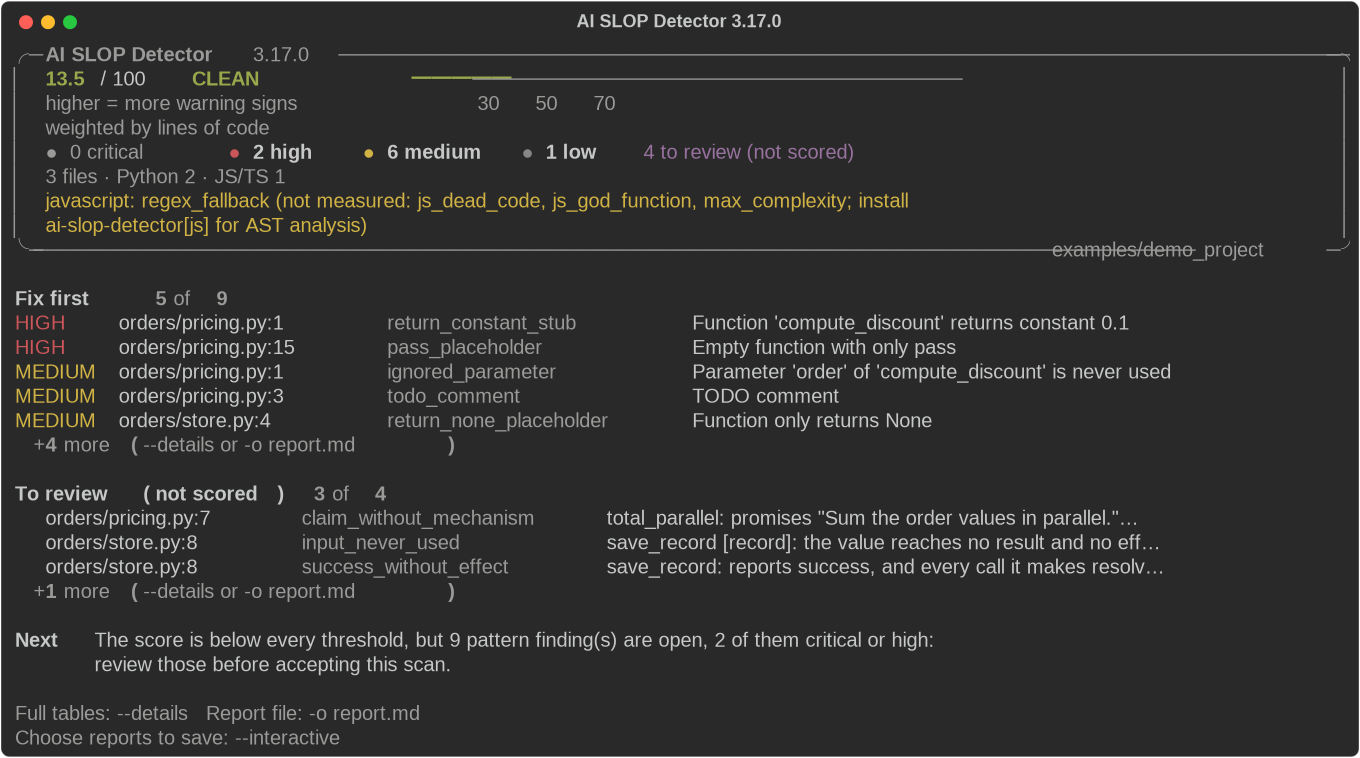
--details prints the full metric tables, --quiet one line.
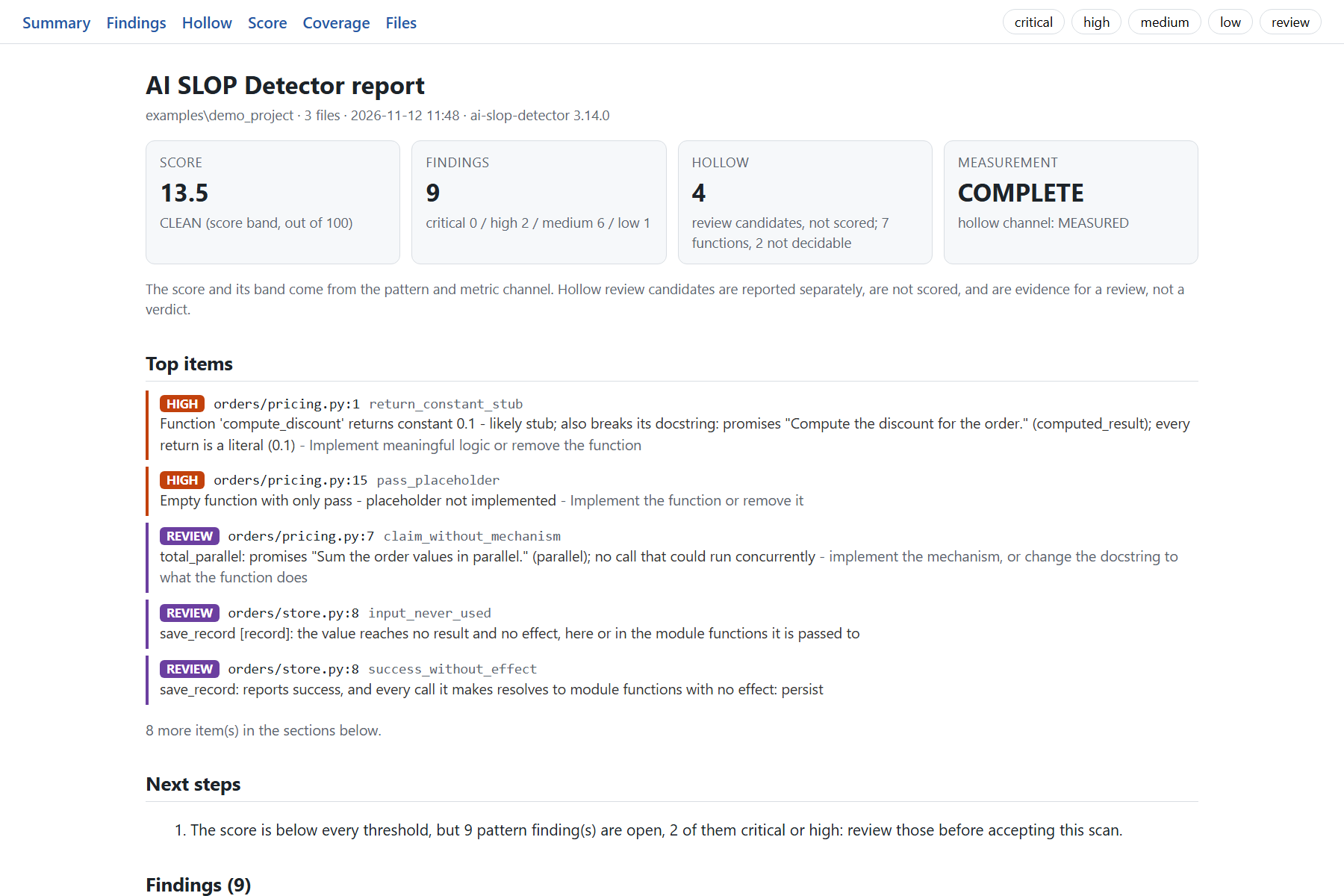
The HTML report (-o report.html; -o report.pdf prints the same page):
every finding with its fix and evidence, and the review candidates apart from
the score.
Outputs for AI agents, made to be acted on, not read:
| Output | What it is |
|---|---|
--format ai-md (AI work order) |
Markdown for an agent: the rules it must follow, a VERIFY question per rule, every file bound to the SHA-256 of the bytes scanned, one block per item. It is read back before it is written and refuses when an item is missing or doubled. |
--format ai (AI report) |
One JSON object per line: each finding with its location, rule, fix and evidence. |
--json |
The full result, including scan_coverage (what was measured and how) and next_steps. |
Details: docs/REPORTS.md · docs/AI_WORK_ORDER.md · what you get, in the guide.
Languages
| Language | Files | Read by (base install) | Optional extra (Python 3.10+) | Rules |
|---|---|---|---|---|
| Python | .py |
Python AST | - | 37 |
| JavaScript / TypeScript | .js .jsx .ts .tsx |
regex reader (god functions, dead code and complexity are not measured) | [js]: tree-sitter, measures all 8 |
8 |
| Go | .go |
regex reader, measures every Go rule | [go] installs tree-sitter-go; the analyzer does not use it yet |
6 |
| Rust | .rs |
token scanner, measures every Rust rule | [rust]: tree-sitter, same findings |
4 |
pip install "ai-slop-detector[js]" # or [rust]; on Python 3.8/3.9 the base install reads these files
Rule counts come from the pattern registry in docs/PATTERNS.md
(55 rules), which a test keeps in line with the analyzers. A scan says which
reader ran for each language (scan_coverage.analysis_modes).
What It Detects
| Language | Example | Rules (sample) |
|---|---|---|
| Python | a function that returns a constant where its docstring promises a computed result; a handler that turns a failure into success; a parameter nothing reads; an import of a package that does not exist | return_constant_stub, failure_as_success, ignored_parameter, phantom_import |
| JavaScript / TypeScript | any types, empty arrow functions, ==, leftover console.log |
js_any_type, js_empty_arrow, js_double_equals, js_console_log |
| Go | ignored errors, panic() as error handling, empty functions |
go_ignored_error, go_panic, go_empty_func |
| Rust | todo!() and unimplemented!() outside test code, leftover dbg!() |
rust_todo_macro, rust_unimplemented_macro, rust_dbg_macro |
Python files also get hollow review candidates: functions that report success with no effect, inputs that reach nothing, docstring promises the body cannot keep. They are listed for review and never change the score.
All 55 rules: docs/PATTERNS.md.
How It Works
flowchart TD
    A["Project or file"] --> B{"Language by file extension"}
    B -->|.py| P["Python<br/>AST, 37 rules<br/>LDR, ICR, DDC, Purity"]
    B -->|.js .jsx .ts .tsx| J["JavaScript / TypeScript<br/>tree-sitter or regex, 8 rules"]
    B -->|.go| G["Go<br/>regex reader, 6 rules"]
    B -->|.rs| R["Rust<br/>tree-sitter or token scanner, 4 rules"]
    P --> F["File score 0-100<br/>higher = more warning signs"]
    J --> F
    G --> F
    R --> F
    P --> H["Hollow review candidates<br/>Python only, not scored"]
    F --> S["Project score<br/>weighted by lines of code"]
    S --> O["Terminal, Markdown, HTML/PDF,<br/>JSON, AI work order"]
    H --> O
    S --> C["CI gate: soft, hard, quarantine"]
    F --> V["VS Code: line marks, hover, Problems"]
The same input gives the same output: scoring is deterministic and needs no model or network. Details: docs/HOW_IT_WORKS.md.
Scoring Model
| Score | Status |
|---|---|
| < 30 | CLEAN |
| 30 - 50 | SUSPICIOUS |
| 50 - 70 | INFLATED_SIGNAL |
| >= 70 | CRITICAL_DEFICIT |
- Higher score = more warning signs. Each file gets a deficit score from 0 to 100; the project score weights files by their lines of code.
CLEANis a score band, not "no findings". A clean project can still have open findings; its next steps then say how many, and how many are critical or high.- Nothing measured is not clean. When no file could be analyzed, reports
read
NOT EVALUATED, and--fail-thresholdfails. - Findings are leads, not verdicts. The tool reads code statically: it does not run it.
How the score is computed: the scoring model in the guide and docs/MATH_MODELS.md.
VS Code Extension
Findings where you write code, for all four languages: a tint and a severity bar on the line, the message at the end of it, a hover with the Fix and a link that copies a work order for an AI agent, the Problems panel, a sidebar of files by score, and the file score in the status bar. It runs the same local backend; nothing is sent anywhere.
Install from the Marketplace · extension guide
CI/CD Integration
# GitHub Actions
- name: AI-SLOP Gate
  run: |
    pip install ai-slop-detector
    slop-detector --project . --ci-mode hard --ci-report
| Mode | What it does |
|---|---|
--ci-mode soft |
Reports only, never fails the build |
--ci-mode hard |
Fails on a deficit score >= 70, 3 or more critical patterns, inflation >= 1.5 or DDC < 0.5 (inflation and DDC are Python metrics) |
--ci-mode quarantine |
Escalates a file after 3 violations |
The gate judges every analyzed file: Python, JS/TS, Go and Rust. pre-commit
hooks (slop-detector, slop-detector-warn, slop-detector-patterns) and
more: CI/CD in the guide ·
docs/CI_CD.md.
AI Agents
| Surface | How |
|---|---|
| MCP server | slop-detector mcp (or npx ai-slop-detector mcp) for Claude Code and other MCP clients |
| Claude Code skill | cp -r claude-skills/slop-detector ~/.claude/skills/: a review loop of review, pulse, sweep with JSON output |
| AI work order | --format ai-md, bound to the SHA-256 of each scanned file (see What You Get) |
| REST | A local FastAPI server ([api] extra) that binds 127.0.0.1 |
| Node | npx ai-slop-detector runs the same Python backend; typed results at ai-slop-detector/types |
Details: Claude Code integration · docs/CLAUDE_CODE_SKILL.md · docs/API.md.
Local Calibration
Every scan is recorded locally (~/.slop-detector/history.db) with what
measured it. slop-detector . --self-calibrate reports how the weights would
change from the comparable runs of one project. It is advisory: it never
writes weights; you change them in .slopconfig.yaml if you agree.
slop-detector --init detects the project's domain and sets that domain's
pattern thresholds, printing every change.
Local calibration in the guide ·
docs/SELF_CALIBRATION.md.
Security Considerations
- No network during a scan. A test runs a full project scan with every socket connection refused and requires that none was attempted.
--read-onlywrites nothing to the project or the home directory.history.dblives in your home directory, outside every repository..slopconfig.yamllists which functions are exempt from complexity rules, so it maps the weak spots of a codebase;--initadds it to.gitignore(remove that line to share it with your team).- Reports describe your code. Every report names file paths, function names and docstring text, and the AI work order (auditor mode) quotes code lines: share them as you would the code.
More: security considerations in the guide · SECURITY.md.
Why Not Just Use a Linter?
Ruff, pylint, ESLint, and SonarQube primarily check syntax, style, and general static-quality rules. They'll happily pass code that follows every rule and still does nothing — which is exactly what AI assistants tend to produce. This tool checks the other half: does the code contain structural evidence for what it and its docs claim? Structural evidence is not proof that a claim is true; the tool does not run your code.
| Can it catch... | ruff / pylint / SonarQube | AI-SLOP Detector |
|---|---|---|
| Style, formatting, syntax | Yes | No (not its job) |
| An empty function with a real-looking body or fake return | No | Yes |
| A module imported but never actually used downstream | Partial (unused-import) | Yes (usage ratio) |
| A handler or pipeline that's defined but never wired in | No | Yes |
| Docs or comments that oversell what the code does | No | Yes |
| Copy-pasted duplicate functions across files | Partial | Partial (exact duplicates) |
| Runs offline, no API key, deterministic core score | Yes | Yes |
Use a linter for correctness-of-form. Use this for "is this code real, or just plausible-looking." The two are complementary — run both.
When NOT to Use This
- You want style or formatting enforcement — use ruff / black / ESLint. This tool ignores style on purpose.
- You need a runtime correctness guarantee — a low score means cleaner structure, not that the code works. Keep your tests.
- Your code isn't Python, JS/TS, Go or Rust — other languages aren't analyzed yet.
- You expect thresholds tuned to your repository — weights are the defaults or the values in your
.slopconfig.yaml; nothing tunes them automatically. Treat findings as leads, not verdicts.
How Results Are Checked
| Deterministic | The same input gives byte-identical JSON across cache, hash seed, Rust helper and working directory; --read-only writes nothing to the project or the home directory. |
| Says when it measured nothing | Every project result carries measurement_state (COMPLETE, PARTIAL, NO_MEASUREMENT) and score_valid. When nothing was measured, human reports read NOT EVALUATED instead of a clean verdict, and a scan whose files all failed to analyze fails --fail-threshold. |
| Its own tests are tested | More than 1,900 tests run in CI on Python 3.8 to 3.12. Behavior changes are checked against deliberately broken copies of the code (mutation testing): in v3.14.0, 133 of 133 breakages of the item identity, binding, work-order and docstring-promise rules were caught; in v3.15.0, 24 of 24 breakages of the work-order families, file table, read-back check and budget (v3.12.0: 21 of 21). |
| Rules state their reasons | Each rule ships with tests that name the code shape it reports and the shapes it leaves alone; the CHANGELOG records every behavior change. |
Release Highlights
v3.16.1: Rust files are analyzed (todo!(), unimplemented!(), dbg!(),
TODO comments) and judged by the CI gate like the other languages; Go and
JS/TS regex readers no longer report text inside strings or comments; the CI
report states its verdict and lists files it could not analyze. Every
release: docs/RELEASE_NOTES.md ·
CHANGELOG.md.
Document Map
The full guide holds everything this page leaves out: docs/GUIDE.md.
| Topic | Where |
|---|---|
| Every command, the npm wrapper | All commands · CLI usage |
| Reports | Reports · AI work order |
| Rules and analyzers | Patterns · What it detects · Adding a language |
| Scoring and metrics | How it works · Math models · Validation |
| Configuration | Configuration guide · Examples · History tracking |
| Architecture | Architecture · Governance · Agent workflow |
| Releases | Release notes · Changelog · Roadmap |
More sections of the guide (old links to this page land here):
- Verification path: how to check a result yourself
- Scope and boundaries: what it does not measure
- Key features:
--init, JS/TS, structural coherence, source held in memory - Claude Code integration: the review, pulse and sweep loop
- Configuration:
.slopconfig.yaml, domains, ignores - Inline suppression: mute a rule on a line or a block; it stays in the suppression ledger
- Repeated-run cache: an unchanged Python file reuses its earlier result
- Priority hotspots: which Python files to fix first (score, git churn, coverage)
- Agent surface: the REST routes for agents
Development
git clone https://github.com/flamehaven01/AI-SLOP-Detector.git
cd AI-SLOP-Detector
pip install -e ".[dev]"
pytest tests/
Development guide · Contributing · development in the guide.
Download Stats
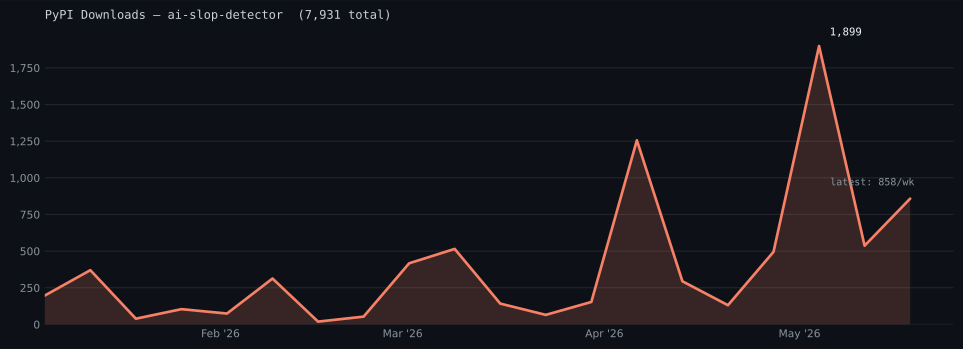
Chart updated weekly via GitHub Actions. Monthly installs: pypistats.org (mirrors excluded). Total: pepy.tech (incl. mirrors)
License
MIT — see LICENSE.
Flamehaven Labs • Issues • Discussions • Docs
1 maintainer

Metadata
1 maintainer
Release files for ai-slop-detector 3.16.1
For a detailed explanation of source distributions (sdists) and built distributions (wheels), please see the package formats documentation.
Source distribution (sdist)
| File | Size | Uploaded | Provenance | Actions |
|---|---|---|---|---|
| ai_slop_detector-3.16.1.tar.gz | 501.7 kB | With provenance | Details for ai_slop_detector-3.16.1.tar.gz |
Built distribution (wheel)
| File | Interpreter | ABI | Platform | Actions Reset |
|---|---|---|---|---|
| ai_slop_detector-3.16.1-py3-none-any.whl | Python 3 | none | any | Details for ai_slop_detector-3.16.1-py3-none-any.whl |
Total release size: 977.2 kB
Release files / ai_slop_detector-3.16.1.tar.gz
| Download URL | ai_slop_detector-3.16.1.tar.gz |
|---|---|
| Size | 501.7 kB |
| Tags | Source |
|
SHA-256 checksum How to use checksums |
1a0ba8748103424a5e57fea7b0992768cc2261016089d880b732e0b181fd591e
|
|
BLAKE2b-256 checksum How to use checksums |
7acc04ecbf2f2fd9f5d83764a0d9f16d66a00618a465d82c4e9a0b9893c19809
|
| Upload date | |
|
Uploaded using Trusted Publishing? What is trusted publishing? |
Yes |
| Uploaded via |
twine/7.0.0 CPython/3.13.16
|
Provenance
Provenance describes where a file came from. On PyPI, provenance is shared via attestations, which provide a verifiable record of the build or publishing details. View details, limitations and caveats.


PyPI Publish Attestation
PyPI verified that this artifact, at this checksum, originated from the publisher listed below.
Signed by GitHub Actions, verified by PyPI on Nov 17, 2026.
Transparency logRelease files / ai_slop_detector-3.16.1-py3-none-any.whl
| Download URL | ai_slop_detector-3.16.1-py3-none-any.whl |
|---|---|
| Size | 475.6 kB |
| Tags | Python 3 |
|
SHA-256 checksum How to use checksums |
8236dd1848b94fa2dda45ab4404a512cd20df8001f1ff8c6bfd0de543770327c
|
|
BLAKE2b-256 checksum How to use checksums |
edccbb4947f606ed9737588bc2cdfad24b25ed482b172aede63d04cfacda470b
|
| Upload date | |
|
Uploaded using Trusted Publishing? What is trusted publishing? |
Yes |
| Uploaded via |
twine/7.0.0 CPython/3.13.16
|
Provenance
Provenance describes where a file came from. On PyPI, provenance is shared via attestations, which provide a verifiable record of the build or publishing details. View details, limitations and caveats.
PyPI Publish Attestation
PyPI verified that this artifact, at this checksum, originated from the publisher listed below.
Signed by GitHub Actions, verified by PyPI on Nov 17, 2026.
Transparency logSecurity for ai-slop-detector 3.16.1
Provenance
Provenance describes where a file came from. On PyPI, provenance is shared via attestations, which provide a verifiable record of the build or publishing details. View details, limitations and caveats.
Full provenance
Both files in this release have been uploaded with provenance metadata.
Attestation for ai_slop_detector-3.16.1.tar.gz
PyPI Publish Attestation
PyPI verified that this artifact, at this checksum, originated from the publisher listed below.
Signed by GitHub Actions, verified by PyPI on Nov 17, 2026.
Transparency logA note on package security
PyPI is a repository for distributing packages, not a service for auditing them. While third-party security researchers and our staff do their best to detect and remove malicious packages, PyPI cannot guarantee the quality, security or suitability of any given package.
To learn more about protecting yourself from malicious actors, visit our package security documentation.














