
aind-dynamic-foraging-models


AIND library of models for dynamic foraging tasks: generative agents fitted per session by maximum likelihood, logistic regression on choice history, hierarchical Bayesian fits across sessions and subjects, and GLM-HMMs with discrete latent states.
User documentation available on readthedocs.
| Model family | Subpackage | Fitting | Extra |
|---|---|---|---|
| Generative agents (RL and others) | generative_model |
MLE per session (differential evolution) | [rl] |
| Logistic regression | logistic_regression |
scikit-learn, with bootstrap | none |
| Hierarchical Bayesian | hierarchical_bayes |
NUTS in NumPyro, population → subject → session | [bayes] |
| GLM-HMM | glm_hmm |
EM in dynamax, global fit then per-subject MAP refits | [glmhmm] |
Installation
pip install aind-dynamic-foraging-models            # logistic regression only
pip install aind-dynamic-foraging-models[rl]        # + generative agents
pip install aind-dynamic-foraging-models[bayes]     # + hierarchical Bayesian fitting
pip install aind-dynamic-foraging-models[glmhmm]    # + GLM-HMM
[bayes]needs Python 3.12+: everyarviz1.x wheel requires it, andpipon 3.10 or 3.11 fails with "No matching distribution found for arviz".pyproject.tomlexplains the pin.[bayes]and[glmhmm]boundjaxbelow 0.7, to match the disRNN wrapper'sjaxpin. CI tests both extras on Python 3.12, and the core package on 3.10 and 3.11.
To develop the code, clone the repo to your local machine, and run
pip install -e .[dev]
Reinforcement Learning (RL) models with Maximum Likelihood Estimation (MLE) fitting
Overview
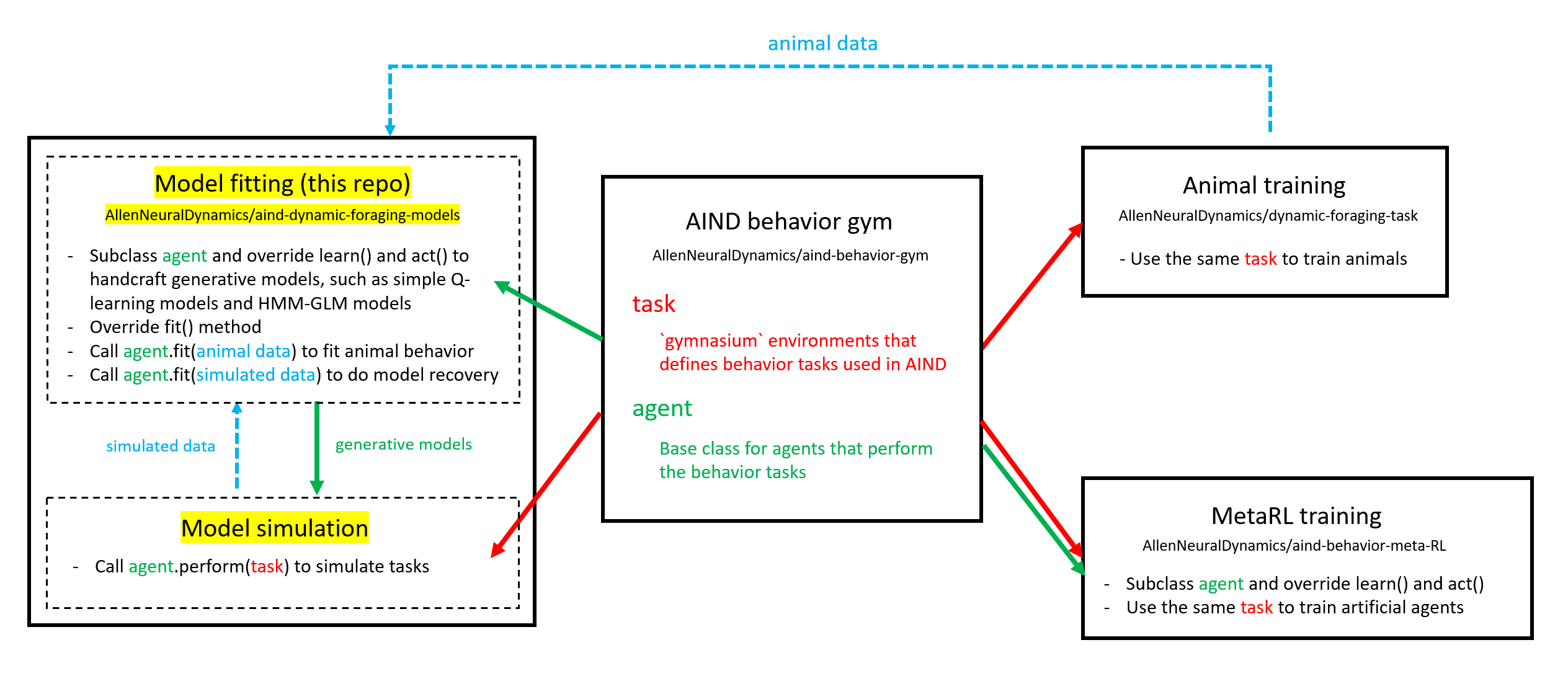
RL agents that can perform any dynamic foraging task in aind-behavior-gym and can fit behavior using MLE.
Code structure

- To add more generative models, please subclass
DynamicForagingAgentMLEBase.
Implemented foragers
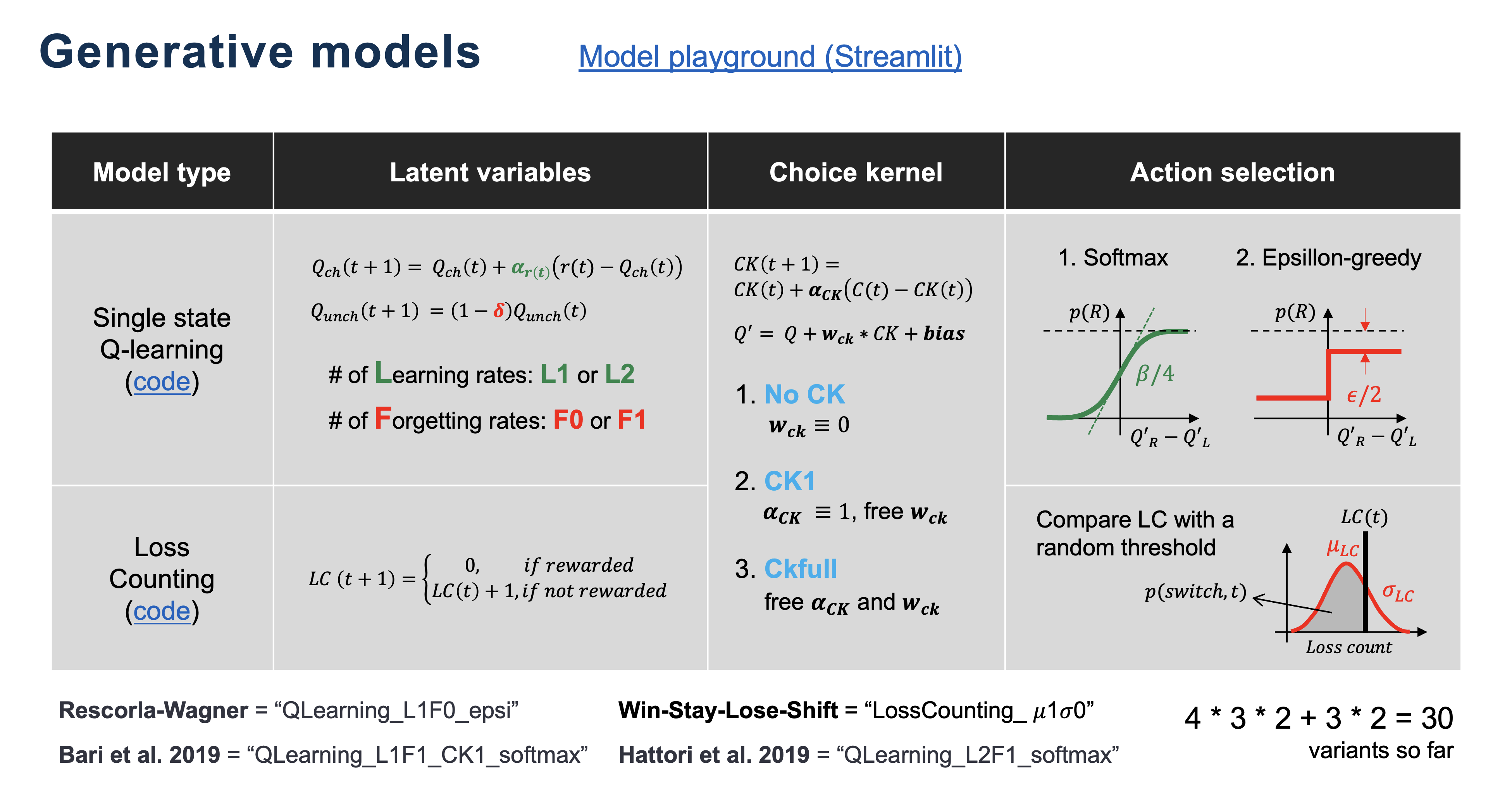
ForagerQLearning: Simple Q-learning agents that incrementally update Q-values.- Available
agent_kwargs:number_of_learning_rate: Literal[1, 2] = 2, number_of_forget_rate: Literal[0, 1] = 1, choice_kernel: Literal["none", "one_step", "full"] = "none", action_selection: Literal["softmax", "epsilon-greedy"] = "softmax",
- Available
ForagerLossCounting: Loss counting agents with probabilisticloss_count_threshold.- Available
agent_kwargs:win_stay_lose_switch: Literal[False, True] = False, choice_kernel: Literal["none", "one_step", "full"] = "none",
- Available
ForagerActorCritic: Actor-critic agents. A softmax actor holds a preference per side; a single state-value critic gives the reward baseline.- Available
agent_kwargs:choice_kernel: Literal["none", "one_step", "full"] = "none",
- Available
ForagerCompareThreshold: Compare-to-threshold (CTT) agents. One value is compared with a threshold through a sigmoid: above it the agent is more likely to stay, below it more likely to switch.- Available
agent_kwargs:number_of_learning_rate: Literal[1, 2] = 1, choice_kernel: Literal["none", "one_step", "full"] = "none", reset_to_threshold: Literal[True, False] = True,
- Available
- Action selections (readthedoc)
Published-model reproductions
forager_published_bandits.py
re-implements published two-armed-bandit models as MLE agents with fixed structure (no
agent_kwargs). docs/published_bandit_reproductions.md
records each model's equation source, the author code it was checked against, and every
deliberate departure from it.
| Class | Model |
|---|---|
ForagerFeedbackDependentRL |
Costa: feedback-dependent Rescorla-Wagner |
ForagerFeedbackDependentRLBias |
Costa RL plus a fixed choice bias |
ForagerFeedbackDependentRLBiasCK1 |
Costa dual-rate RL plus bias and Bari's one-step choice kernel |
ForagerAlsioRL |
Alsiö et al.: dual-rate RL with one-step spatial stickiness |
ForagerLopezDoubleTrace |
López-Yépez et al.: reward value plus fast and slow choice traces |
ForagerRLCK |
Chen and Zid: four-parameter RL plus choice kernel |
ForagerZidHistoryKernel |
Zid et al.: history-kernel-2 compare-to-threshold foraging RL |
ForagerGrossmanMetaLearning |
Grossman et al.: uncertainty-dependent asymmetric meta-learning |
ForagerLebedevaPR |
Lebedeva et al.: perseveration / reward-learning (PR) |
ForagerBeronRFLR |
Beron et al.: recursively formulated logistic regression (RFLR) |
ForagerMillerRHG |
Miller et al.: reward-seeking / habit / gambler's fallacy (RHG) |
ForagerEcksteinRL |
Eckstein et al.: asymmetric, counterfactual RL with perseveration |
ForagerEcksteinBI |
Eckstein et al.: hidden-state Bayesian inference |
The Findling et al. Weber-imprecision Bayesian-inference model
(findling_weber.py) is
not an MLE agent: its likelihood averages over a stochastic belief state with a particle
filter. Fit it with fit_findling_weber_map over the 1,000-candidate grid from
findling_weber_parameter_grid.
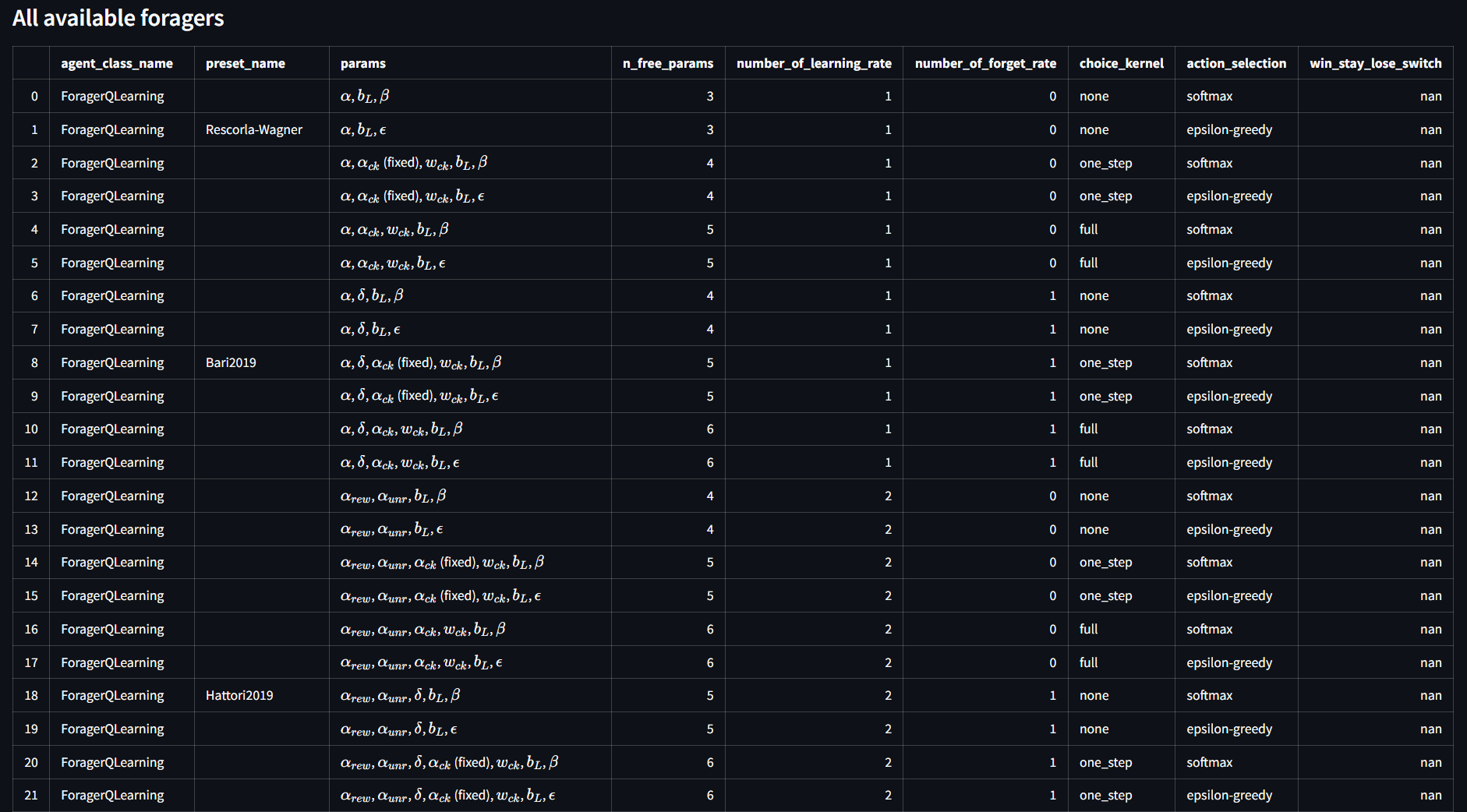
Here is the list of foragers in the RL model playground. ForagerCollection().get_all_foragers() lists every forager and preset in the installed version.

Usage
- Jupyter notebook
- See also these unittest functions.
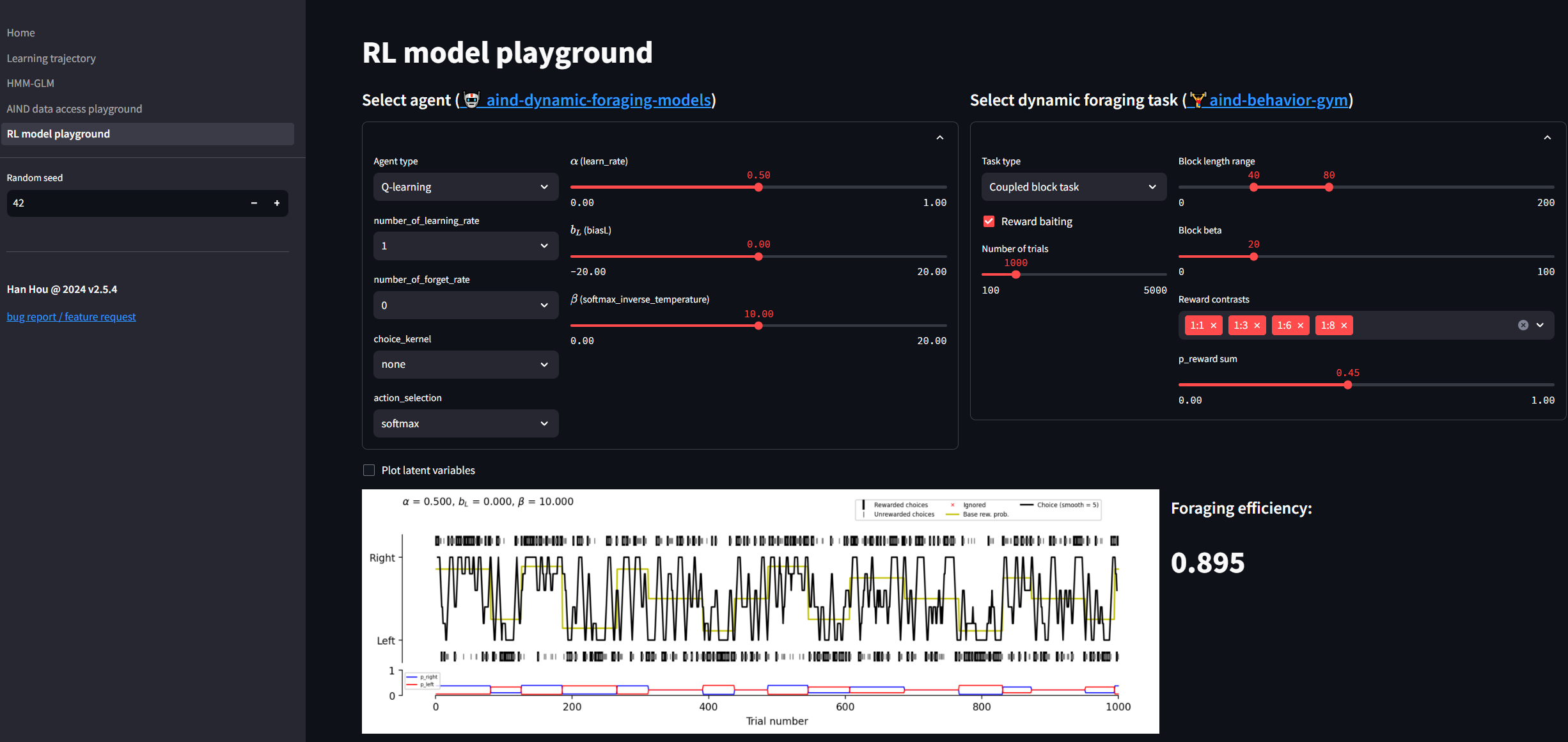
RL model playground
Play with the generative models here.
Logistic regression
Choosing logistic regression models
Su 2022
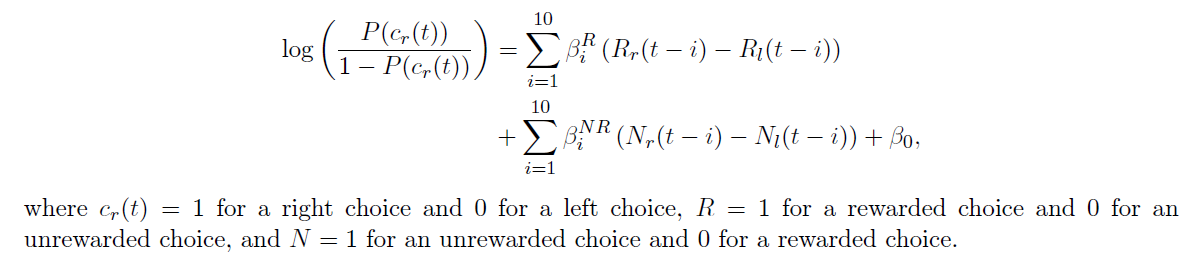
$$ logit(p(c_r)) \sim RewardedChoice+UnrewardedChoice $$
Bari 2019


$$ logit(p(c_r)) \sim RewardedChoice+Choice $$
Hattori 2019

$$ logit(p(c_r)) \sim RewardedChoice+UnrewardedChoice+Choice $$
Miller 2021

$$ logit(p(c_r)) \sim Choice + Reward+ Choice*Reward $$
Encodings
- Ignored trials are removed
| choice | reward | Choice | Reward | RewardedChoice | UnrewardedChoice | Choice * Reward |
|---|---|---|---|---|---|---|
| L | yes | -1 | 1 | -1 | 0 | -1 |
| L | no | -1 | -1 | 0 | -1 | 1 |
| R | yes | 1 | 1 | 1 | 0 | 1 |
| L | yes | -1 | 1 | -1 | 0 | -1 |
| R | no | 1 | -1 | 0 | 1 | -1 |
| R | yes | 1 | 1 | 1 | 0 | 1 |
| L | no | -1 | -1 | 0 | -1 | 1 |
Some observations:
- $RewardedChoice$ and $UnrewardedChoice$ are orthogonal
- $Choice = RewardedChoice + UnrewardedChoice$
- $Choice * Reward = RewardedChoice - UnrewardedChoice$
Comparison
| Su 2022 | Bari 2019 | Hattori 2019 | Miller 2021 | |
|---|---|---|---|---|
| Equivalent to | RewC + UnrC | RewC + (RewC + UnrC) | RewC + UnrC + (RewC + UnrC) | (RewC + UnrC) + (RewC - UnrC) + Rew |
| Severity of multicollinearity | Not at all | Medium | Severe | Slight |
| Interpretation | Like a RL model with different learning rates on reward and unrewarded trials. | Like a RL model that only updates on rewarded trials, plus a choice kernel (tendency to repeat previous choices). | Like a RL model that has different learning rates on reward and unrewarded trials, plus a choice kernel (the full RL model from the same paper). | Like a RL model that has symmetric learning rates for rewarded and unrewarded trials, plus a choice kernel. However, the $Reward $ term seems to be a strawman assumption, as it means “if I get reward on any side, I’ll choose the right side more”, which doesn’t make much sense. |
| Conclusion | Probably the best | Okay | Not good due to the severe multicollinearity | Good |
Regularization and optimization
The choice of optimizer depends on the penality term, as listed here.
lbfgs- [l2, None]liblinear- [l1,l2]newton-cg- [l2, None]newton-cholesky- [l2, None]sag- [l2, None]saga- [elasticnet,l1,l2, None]
Hierarchical Bayesian fitting
aind_dynamic_foraging_models.hierarchical_bayes fits the foragers as hierarchical Bayesian
models (population → subject → session) with NumPyro, as a partially-pooled counterpart to
the per-session MLE fitting in generative_model.
pip install aind-dynamic-foraging-models[bayes]
- Two forager likelihoods, chosen by
model=(hierarchical_bayes.model.MODELS):"hattori2019"(the default) and"ctt"(compare-to-threshold). heldout.pyscores a held-out subject: it adapts the subject to its context sessions with the population frozen, then scores the subject's test sessions.- Start here: a worked end-to-end example on synthetic data with known ground truth --
simulate a cohort, fit it both ways, and check that the parameters come back:
notebook/demo_hierarchical_bayes.ipynb - Design decisions and their rationale:
src/aind_dynamic_foraging_models/hierarchical_bayes/docs/design-decisions.md - Validation against the reference Stan implementation, and performance measurements:
src/aind_dynamic_foraging_models/hierarchical_bayes/benchmarks/RESULTS.md
GLM-HMM
aind_dynamic_foraging_models.glm_hmm fits an input-driven HMM with GLM emissions (Ashwood et
al. 2022, Nat Neurosci 25:201) over left / right / ignore choices, on
dynamax.
pip install aind-dynamic-foraging-models[glmhmm]
- Two emissions, both exactly normalised over the three outcomes:
hurdle(per state, an engagement GLM on unsigned history and a side GLM on signed history) andreference(per state, one multinomial GLM with ignore as the zero-logit class, as in Faeze'sssmfits). How they differ, and which to use:glm_hmm/README.md. - Regressors (
design.py): RewC and UnrC lags (signed), Ignored and Rewarded lags (unsigned), and a bias; trial 0 of every session sees the bias alone. - Fitting (
model.py): EM over many variable-length sessions, bucketed by length with exact masking. The emission M-step is exact Newton with a Gaussian prior; pi and A use a Dirichlet MAP. Priors are arguments, so one model serves a near-flat global fit (GLOBAL_PRIOR) and per-subject MAP refits started from it (SUBJECT_PRIOR).Prior.meancentres the weight prior, for example on the global fit's weights for a subject refit; the defaultNoneis zero. fit_with_restarts(..., max_workers=N)runs EM restarts at once and shares their row compression; the GLM-HMM README gives the speed-up on a CPU.- Scoring:
predictive_log_probsis the forward filter's one-step-ahead log p(y_t | y_<t) per class. It is the held-out quantity, and it never uses later trials.state_posteriorsgives filtered and smoothed posteriors and Viterbi paths. tfp-nightlyis pinned to one build in the extra: dynamax leaves it unpinned, and only some nightlies work with jax 0.6.1 and numpy 2.4.- Device: float64 on the CPU by default;
AIND_GLMHMM_DEVICE=gpumoves the fits to a GPU. GPU linear solves need the CUDA solver libraries pinned, asmodel._computeexplains. A GPU is faster for a large pooled fit, but not for one mouse's refit. - Benchmark:
glm_hmm/benchmarks/RESULTS.mdtimes CPU against V100, A100 and L40S on study 14's 4.9M-trial cohort, with the scripts to rerun it. The GPU decision is tracked in AllenNeuralDynamics/aind-dynamic-foraging-bfm-wrapper#111. - Validation:
glm_hmm/recovery/simulates from known parameters and refits them, and cross-checks the likelihood againstssm(RESULTS.md). The study version, including a factorial of designed strategies, is AllenNeuralDynamics/aind-dynamic-foraging-bfm-studies#50.
See also
- Foraging model simulation, model recovery, etc.: https://github.com/hanhou/Dynamic-Foraging
Contributing
Linters and testing
There are several libraries used to run linters, check documentation, and run tests.
- Please test your changes using the coverage library, which will run the tests and log a coverage report:
coverage run -m unittest discover && coverage report
- Use interrogate to check that modules, methods, etc. have been documented thoroughly:
interrogate .
- Use flake8 to check that code is up to standards (no unused imports, etc.):
flake8 .
- Use black to automatically format the code into PEP standards:
black .
- Use isort to automatically sort import statements:
isort .
Pull requests
For internal members, please create a branch. For external members, please fork the repository and open a pull request from the fork. We'll primarily use Angular style for commit messages. Roughly, they should follow the pattern:
<type>(<scope>): <short summary>
where scope (optional) describes the packages affected by the code changes and type (mandatory) is one of:
- build: Changes that affect build tools or external dependencies (example scopes: pyproject.toml, setup.py)
- ci: Changes to our CI configuration files and scripts (examples: .github/workflows/ci.yml)
- docs: Documentation only changes
- feat: A new feature
- fix: A bugfix
- perf: A code change that improves performance
- refactor: A code change that neither fixes a bug nor adds a feature
- test: Adding missing tests or correcting existing tests
Semantic Release
The table below, from semantic release, shows which commit message gets you which release type when semantic-release runs (using the default configuration):
| Commit message | Release type |
|---|---|
fix(pencil): stop graphite breaking when too much pressure applied |
|
feat(pencil): add 'graphiteWidth' option |
|
perf(pencil): remove graphiteWidth optionBREAKING CHANGE: The graphiteWidth option has been removed.The default graphite width of 10mm is always used for performance reasons. |
(Note that the BREAKING CHANGE: token must be in the footer of the commit) |
Documentation
To generate the rst files source files for documentation, run
sphinx-apidoc -o docs/source/ src
Then to create the documentation HTML files, run
sphinx-build -b html docs/source/ docs/build/html
More info on sphinx installation can be found here.
1 maintainer

Metadata
1 maintainer
Release files for aind-dynamic-foraging-models 0.27.1
For a detailed explanation of source distributions (sdists) and built distributions (wheels), please see the package formats documentation.
Source distribution (sdist)
| File | Size | Uploaded | Provenance | Actions |
|---|---|---|---|---|
| aind_dynamic_foraging_models-0.27.1.tar.gz | 7.0 MB | Without provenance | Details for aind_dynamic_foraging_models-0.27.1.tar.gz |
Built distribution (wheel)
| File | Interpreter | ABI | Platform | Actions Reset |
|---|---|---|---|---|
| aind_dynamic_foraging_models-0.27.1-py3-none-any.whl | Python 3 | none | any | Details for aind_dynamic_foraging_models-0.27.1-py3-none-any.whl |
Total release size: 7.3 MB
Release files / aind_dynamic_foraging_models-0.27.1.tar.gz
| Download URL | aind_dynamic_foraging_models-0.27.1.tar.gz |
|---|---|
| Size | 7.0 MB |
| Tags | Source |
|
SHA-256 checksum How to use checksums |
32a4b499cae71546d65a2296645543e35e9f7330e2373518be2ce23182e1cedb
|
|
BLAKE2b-256 checksum How to use checksums |
6b4a712d06feb1fa72c1a5bbdb45947a44889bfcddb618cfe41794d11c649a37
|
| Upload date | |
|
Uploaded using Trusted Publishing? What is trusted publishing? |
No |
| Uploaded via |
twine/7.0.0 CPython/3.13.16
|
Release files / aind_dynamic_foraging_models-0.27.1-py3-none-any.whl
| Download URL | aind_dynamic_foraging_models-0.27.1-py3-none-any.whl |
|---|---|
| Size | 265.9 kB |
| Tags | Python 3 |
|
SHA-256 checksum How to use checksums |
2323c3974e8da7371752c8e921ba151f80b83db690cdbd17456432f8e0b704b6
|
|
BLAKE2b-256 checksum How to use checksums |
b4145b3f5434ff1914bee5cdbf8a5ac0193d4b1944dc0c8c6ac3711f14228772
|
| Upload date | |
|
Uploaded using Trusted Publishing? What is trusted publishing? |
No |
| Uploaded via |
twine/7.0.0 CPython/3.13.16
|
Security for aind-dynamic-foraging-models 0.27.1
Provenance
Provenance describes where a file came from. On PyPI, provenance is shared via attestations, which provide a verifiable record of the build or publishing details. View details, limitations and caveats.
No provenance found
None of the files in this release were uploaded with provenance metadata.
A note on package security
PyPI is a repository for distributing packages, not a service for auditing them. While third-party security researchers and our staff do their best to detect and remove malicious packages, PyPI cannot guarantee the quality, security or suitability of any given package.
To learn more about protecting yourself from malicious actors, visit our package security documentation.














