
View airflow-pytest-operator results in the Airflow 3 web UI.
Verified details
These details have been verified by PyPIProject links
GitHub Statistics
Maintainers

Project description
airflow-pytest-plugin
View airflow-pytest-operator
results in the Airflow 3 web UI.
Package
| Badge | What it tells you |
|---|---|
 |
Latest release on PyPI — pip install airflow-pytest-plugin |
 |
Supported Python versions (3.10+) |
 |
Targets Airflow 3.x (FastAPI plugin UI) |
 |
Distributed under the Apache-2.0 licence |
Quality & build
| Badge | What it tells you |
|---|---|
 |
Build & test suite (lint, types, unit, integration) on main |
 |
Test coverage of the package |
 |
Fully type-checked with mypy --strict |
 |
Linted & formatted with Ruff |
 |
OpenSSF supply-chain security score |
The operator runs a pytest suite as an Airflow task and parses the JUnit
report into a structured result. This plugin archives each of those reports —
keyed by dag_id / run_id / task_id / try — and serves a small web UI to browse
them: pass/fail counts per run, durations, and the per-test breakdown (with
failure messages) for any run.
It has two halves that share one on-disk layout:
| Side | Where it runs | What it is |
|---|---|---|
| Producer | the worker | ArchivingResultParser, a drop-in parser= for PytestOperator |
| Reader | the API server | a FastAPI app + single-page viewer, registered as an Airflow plugin |
Contents
- Screenshots
- Install
- Quickstart
- Do I need
cleanup="never"? - How it works
- HTTP API
- Access control (RBAC)
- Configuration
- Architecture (SOLID)
- Development
- License
Screenshots
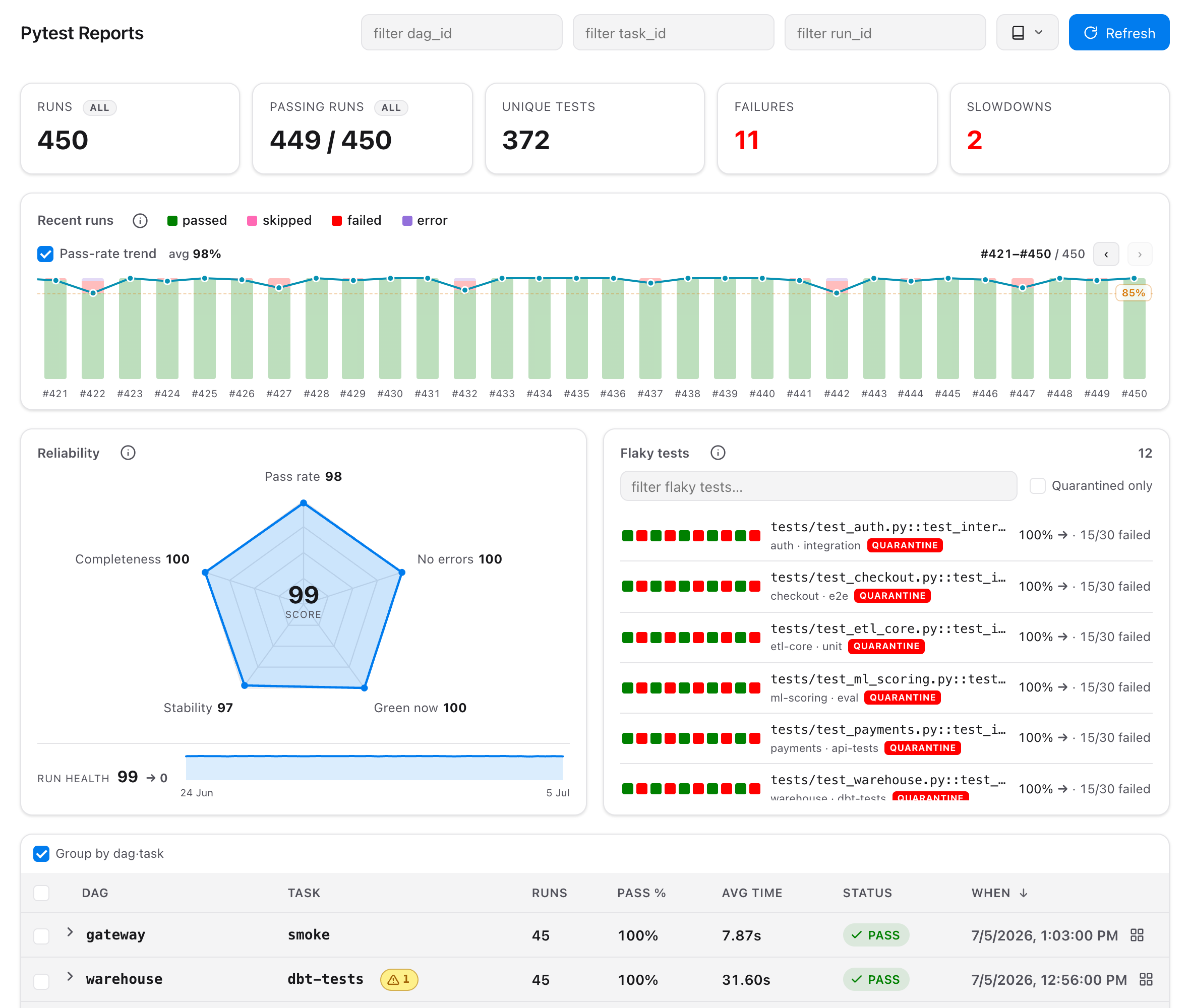
Overview — the run list with the historical chart (per-status legend toggles, run numbers, and a carousel beyond 30 runs), KPI cards, and Airflow- matched colours and font:
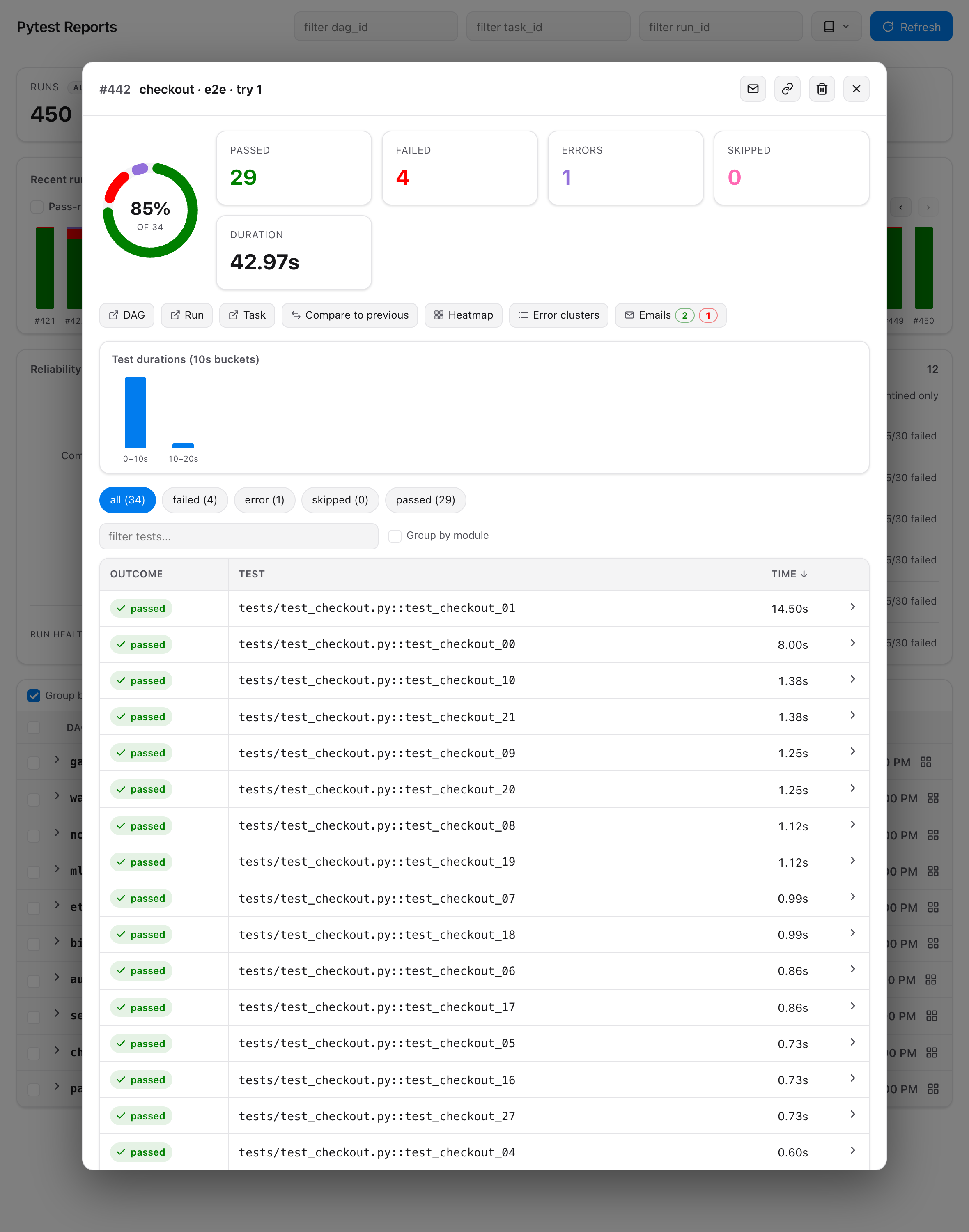
A single run — a clickable success donut (pass-rate in the centre; click a slice to filter by status), the counts, and every test's captured output on expand:
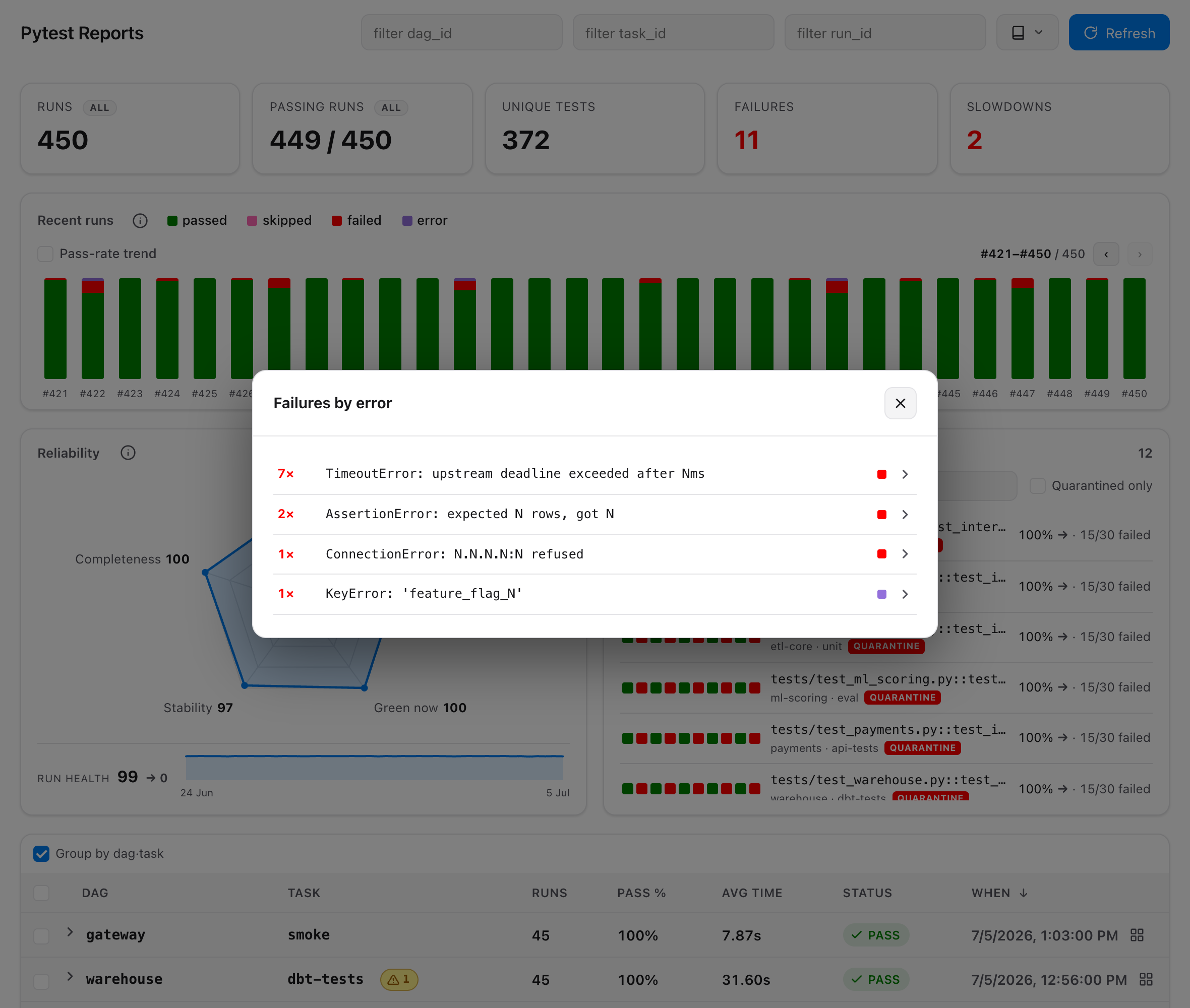
Failed tests — clicking the Failures KPI lists every failed/errored case across the visible runs (paginated); a row jumps to that run:
Install
pip install airflow-pytest-plugin          # producer side (workers)
pip install 'airflow-pytest-plugin[web]'   # reader side (API server)
On Airflow 3 the API server already provides FastAPI, so the bare install is
enough there too; the [web] extra only adds the standalone dev server.
Quickstart
1. Point your operator at the archiving parser — the only DAG change:
from airflow_pytest_operator import PytestOperator
from airflow_pytest_plugin import ArchivingResultParser

PytestOperator(
    task_id="run_tests",
    test_path="tests/",
    parser=ArchivingResultParser(),   # was JUnitResultParser()
)
2. Tell both sides where reports live (one place, read by producer and reader alike):
export AIRFLOW_PYTEST_REPORTS_ROOT=/opt/airflow/pytest-reports
or in airflow.cfg:
[pytest_reports]
reports_root = /opt/airflow/pytest-reports
In a distributed deployment this should be a shared volume that both the workers (writing) and the API server (reading) can see.
3. Open the UI. The plugin registers itself via the airflow.plugins entry
point — no config. The app mounts on the API server at /pytest-reports, with a
Pytest Reports entry under Browse in the nav.
Preview locally, without Airflow
python -m airflow_pytest_plugin.web --root ./pytest-reports --port 8000
# open http://127.0.0.1:8000/
Do I need cleanup="never"?
No. In the operator, the parser owns the report location, and a
parser-supplied directory is never deleted by the runner under any cleanup
policy. ArchivingResultParser supplies its own directory, so reports
always survive regardless of the runner's cleanup setting. cleanup="never"
only matters when you let the runner use throwaway temp dirs — which is exactly
the fragile path (random names, no dag/run/task association, not visible to
other workers) this plugin replaces.
How it works
worker                              shared volume                 API server
──────                              ─────────────                 ──────────
PytestOperator                      {root}/{dag}/{run}/           FastAPI app
  └─ ArchivingResultParser ──▶   {task}/t{try}/        ◀──── FileSystemReportSource
       report_request() → path          ├─ junit.xml              └─ lists meta.json,
       parse()          → meta.json     └─ meta.json                 parses junit.xml
report_request()reads the live Airflow context (get_current_context(), available because the parser runs inside the task'sexecute()), computes the archive directory, and hands it to the operator's JUnit parser.parse()reuses the operator's JUnit parsing, then drops ameta.jsonsidecar carrying the Airflow coordinates + the summary. That sidecar makes each report self-describing, so the reader needs no database access.- The reader lists by scanning
meta.jsonfiles (fast) and parsesjunit.xmlon demand for the per-case detail.
The directory is a human-friendly container; the authoritative identity always
lives in meta.json (and the API's opaque, reversible report token), so awkward
run_id characters like : are sanitised in the path without losing anything.
HTTP API
The app is mountable under any prefix; the viewer derives its API base at runtime. Endpoints (relative to the mount):
| Method & path | Returns |
|---|---|
GET / |
the single-page viewer (HTML) |
GET /api/reports?dag_id=&run_id= |
summaries, newest first |
GET /api/reports/{report_id} |
one report with per-case rows |
GET /api/failures?dag_id=&run_id=&task_id= |
failed/errored cases across the visible runs |
DELETE /api/reports/{report_id} |
delete a report (RBAC-gated) |
GET /api/reports/{report_id}/allure.zip |
raw Allure results as a zip (if any) |
GET /api/health |
{"status": "ok"} |
GET /api/docs |
OpenAPI docs |
The reads (GET) and the delete are gated by Airflow RBAC — see below.
Access control (RBAC)
Access is enforced the way Airflow 3 enforces it: every check goes through
Airflow's auth manager (is_authorized_dag(...)) — the same call Airflow's
own DAG-run endpoints make — keyed by the report's dag_id and the
authenticated user. Two permissions are checked:
| Action | Airflow 3.x check | Airflow 2.x (FAB) equivalent |
|---|---|---|
| See / open a report | is_authorized_dag(method="GET", access_entity=RUN) |
can_read on the DAG |
| Delete a report | is_authorized_dag(method="POST", access_entity=RUN) (may trigger the DAG) |
trigger / can_create on the DAG |
The report list is filtered to the DAGs you may read, opening a report you can't
read returns 403, and deleting one requires permission to trigger its DAG.
Every check fails closed: if the auth manager can't be consulted, access is
denied.
Airflow 2 → 3 mapping. Airflow 2's FAB used (action, resource) pairs —
can_read / can_edit / can_delete / can_create on a resource such as
DAG:<id>. Airflow 3 replaced these with the auth manager's method: GET ↔
read, POST ↔ create, PUT ↔ edit, DELETE ↔ delete, MENU ↔ menu access.
This plugin maps read → GET and delete → POST (trigger), so it
inherits your existing per-DAG roles with no extra configuration.
Plugin visibility. The nav entry is an Airflow external_views item, which
has no per-permission gate, so the menu link is visible to every signed-in user;
access is enforced on the content (a user who may read no DAG sees an empty
list and 403 on direct links). The standalone dev server (no Airflow auth)
allows everything.
Allure / TestOps export
Opt in per task and install allure-pytest
on the worker:
parser=ArchivingResultParser(allure=True)
The parser then adds --alluredir (pytest errors with unrecognized arguments
if allure-pytest is missing), so the raw Allure results are archived next to
the report, with an executor.json linking the launch back to the Airflow run.
Download them from a report's detail view, or GET /api/reports/{id}/allure.zip — then upload to Allure TestOps
(allurectl upload …). The JUnit viewer is unaffected; both artifacts coexist.
Configuration
| Setting | Default | Purpose |
|---|---|---|
AIRFLOW_PYTEST_REPORTS_ROOT (env) |
— | report root (highest precedence) |
[pytest_reports] reports_root (cfg) |
— | report root |
| built-in default | /opt/airflow/pytest-reports |
fallback |
Architecture (SOLID)
Mirrors the operator's layering — each piece has one reason to change:
| Module | Responsibility |
|---|---|
layout.ReportLayout |
the single ReportRef → directory mapping, shared by both sides |
producer.ArchivingResultParser |
write JUnit XML + meta.json (extends the operator's parser) |
sources.ReportSource / FileSystemReportSource |
read/index reports behind an interface (Dependency Inversion) |
web.create_app |
map HTTP onto a ReportSource — knows nothing about the filesystem |
plugin.PytestReportsPlugin |
register the app with Airflow |
compat |
the only module that imports Airflow; version differences resolved once |
models |
JSON-serializable view types; the web layer never sees operator types |
Adding a different backing store (e.g. an XComReportSource reading the
metadata DB) is a new ReportSource, not an edit of the web app (Open/Closed).
Development
pip install -e '.[dev,web]'
pytest -q
ruff check src tests && ruff format --check src tests
mypy src
License
Apache-2.0. See LICENSE.
Project details
Verified details
These details have been verified by PyPIProject links
GitHub Statistics
Maintainers
Release history Release notifications | RSS feed


Download files
Download the file for your platform. If you're not sure which to choose, learn more about installing packages.
Source Distribution
Built Distribution
Filter files by name, interpreter, ABI, and platform.
If you're not sure about the file name format, learn more about wheel file names.
Copy a direct link to the current filters
File details
Details for the file airflow_pytest_plugin-0.2.1.tar.gz.
File metadata
- Download URL: airflow_pytest_plugin-0.2.1.tar.gz
- Upload date:
- Size: 61.9 kB
- Tags: Source
- Uploaded using Trusted Publishing? Yes
- Uploaded via: twine/6.1.0 CPython/3.13.13
File hashes
| Algorithm | Hash digest | |
|---|---|---|
| SHA256 |
f009da6cb438c2cd1acd82cd8dbb7e51e1657f66231513f1760da8868245b221
|
|
| MD5 |
f2e75bbd1f9eee50a7ec267e3e943a40
|
|
| BLAKE2b-256 |
7bc5521c28005ae72a0e8138d2e63656054d8ddccd3581468d3548bcace9d747
|
Provenance
The following attestation bundles were made for airflow_pytest_plugin-0.2.1.tar.gz:
Publisher:
release.yml on IKrysanov/airflow-pytest-plugin
-
Statement:
-
Statement type:
https://in-toto.io/Statement/v1 -
Predicate type:
https://docs.pypi.org/attestations/publish/v1 -
Subject name:
airflow_pytest_plugin-0.2.1.tar.gz -
Subject digest:
f009da6cb438c2cd1acd82cd8dbb7e51e1657f66231513f1760da8868245b221 - Sigstore transparency entry: 1930544104
- Sigstore integration time:
-
Permalink:
IKrysanov/airflow-pytest-plugin@87c947b7582d09c1904c66cb1060ae8b01603378 -
Branch / Tag:
refs/tags/v0.2.1 - Owner: https://github.com/IKrysanov
-
Access:
public
-
Token Issuer:
https://token.actions.githubusercontent.com -
Runner Environment:
github-hosted -
Publication workflow:
release.yml@87c947b7582d09c1904c66cb1060ae8b01603378 -
Trigger Event:
release
-
Statement type:
File details
Details for the file airflow_pytest_plugin-0.2.1-py3-none-any.whl.
File metadata
- Download URL: airflow_pytest_plugin-0.2.1-py3-none-any.whl
- Upload date:
- Size: 59.3 kB
- Tags: Python 3
- Uploaded using Trusted Publishing? Yes
- Uploaded via: twine/6.1.0 CPython/3.13.13
File hashes
| Algorithm | Hash digest | |
|---|---|---|
| SHA256 |
b88578ea5a7df2f8b7fdbdb87e814d46fe19718d357823265e4c5129b9aa73c6
|
|
| MD5 |
b94b3d0548db3b74774339e7150ade96
|
|
| BLAKE2b-256 |
21a294116d5dd38651144910c5241e1651fc37fb175e9796ea84a6861cba8aeb
|
Provenance
The following attestation bundles were made for airflow_pytest_plugin-0.2.1-py3-none-any.whl:
Publisher:
release.yml on IKrysanov/airflow-pytest-plugin
-
Statement:
-
Statement type:
https://in-toto.io/Statement/v1 -
Predicate type:
https://docs.pypi.org/attestations/publish/v1 -
Subject name:
airflow_pytest_plugin-0.2.1-py3-none-any.whl -
Subject digest:
b88578ea5a7df2f8b7fdbdb87e814d46fe19718d357823265e4c5129b9aa73c6 - Sigstore transparency entry: 1930544179
- Sigstore integration time:
-
Permalink:
IKrysanov/airflow-pytest-plugin@87c947b7582d09c1904c66cb1060ae8b01603378 -
Branch / Tag:
refs/tags/v0.2.1 - Owner: https://github.com/IKrysanov
-
Access:
public
-
Token Issuer:
https://token.actions.githubusercontent.com -
Runner Environment:
github-hosted -
Publication workflow:
release.yml@87c947b7582d09c1904c66cb1060ae8b01603378 -
Trigger Event:
release
-
Statement type:






