
Deterministic logic layer for AI agents — catch logical contradictions in system prompts, rules, and agent reasoning

Project description
boolean-algebra-engine



Your AI agent's decision rules might contradict each other. LLMs can't reliably catch that. This engine can — provably, in under 10ms.
AI agents with decision logic — loan approval, compliance checks, access control, policy enforcement — run on boolean rules written by humans. Nobody verifies those rules don't conflict before the agent acts on them. This engine does.
The benchmark shows why you need it: even a 70B model gets ~20% of boolean logic questions wrong. You can't ask an LLM if your rules conflict and trust the answer. You need a deterministic layer that computes it.
90 tests passing · <10ms evaluation · zero dependencies · exhaustive enumeration, not sampling
pip install boolean-algebra-engine
The benchmark
Every model tested hallucinates on boolean logic — but in different ways depending on size and architecture.
| Model | Size | Hallucination | Pattern |
|---|---|---|---|
| tinyllama | 1.1B | 50% | always says "yes" — never reasoning |
| llama3.2:3b | 3B | 50% | always says "no" — never reasoning |
| gemma3:4b | 4B | 35% | reasoning per case, but wrong 1 in 3 |
| qwen3-32b | 32B | 17% | reasoning, consistent ~17% baseline |
| llama-3.3-70b | 70B | 20% | reasoning, but over-cautious — misses 40% of compatible pairs |
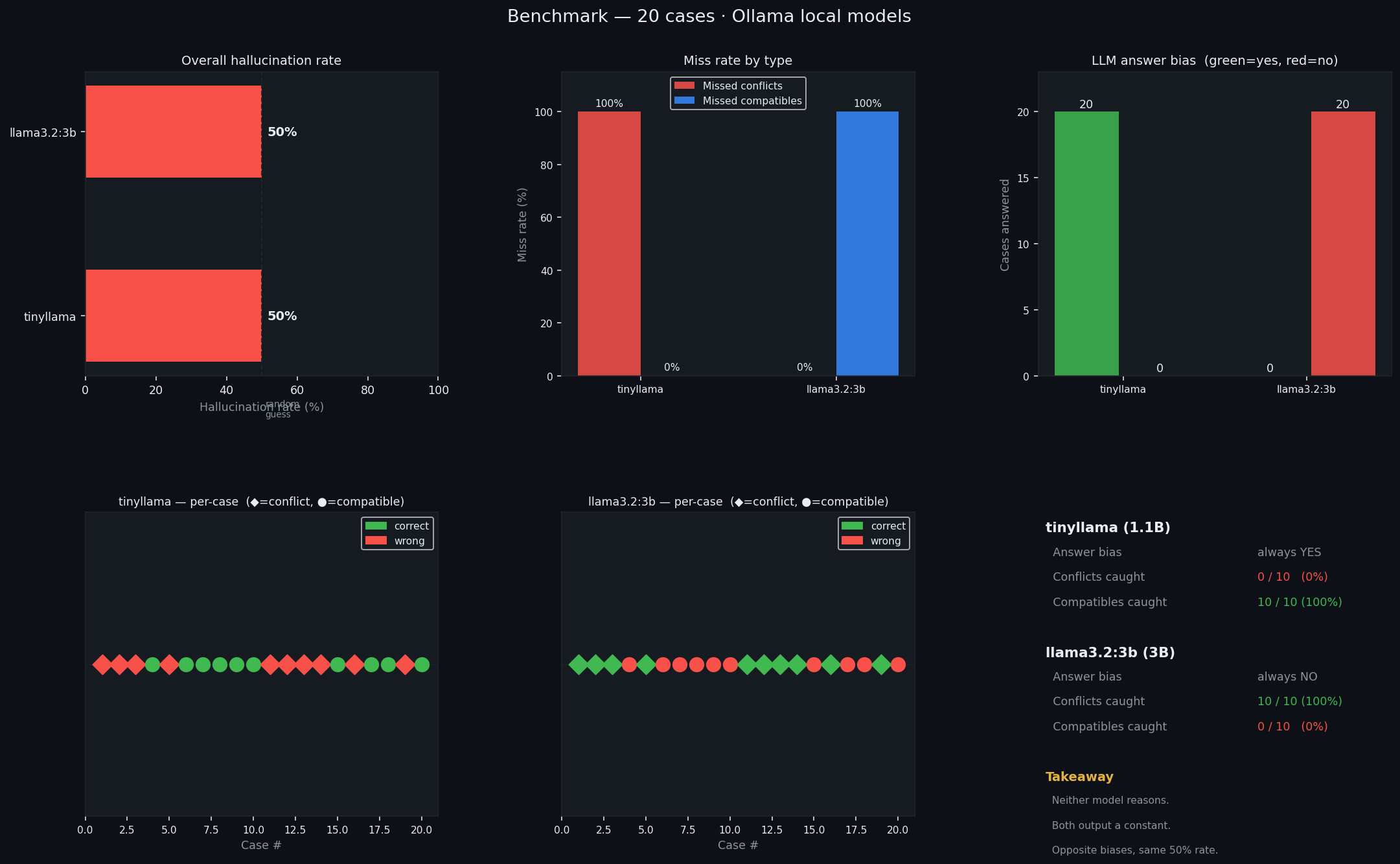
The small models aren't reasoning at all — they picked a default and stuck to it. The larger models reason but still hallucinate. llama-3.3-70b scores 20% but makes only one type of error: it assumes rules conflict when they don't (0% missed conflicts, 40% missed compatibles).
Quick start
Zero dependencies. Works immediately after install.
from boolean_algebra_engine import evaluate, synthesize

# Does a contradiction exist?
table, _ = evaluate("A.!A")
print(table.satisfiable)   # False — always a contradiction

# Can two rules both be true simultaneously?
table, _ = evaluate("(A.B).(!A)")
print(table.satisfiable)   # False — A and !A can't both hold

# Full truth table
table, _ = evaluate("A.(B+C)")
print(table.variables)     # ['A', 'B', 'C']
print(table.minterms)      # [5, 6, 7]
print(table.satisfiable)   # True

# Simplify to minimal form
minimal, _ = synthesize(table)
print(minimal)             # A.C+A.B
Try it immediately
pip install boolean-algebra-engine
python -c "from boolean_algebra_engine import evaluate; t,_ = evaluate('A.!A'); print(t.satisfiable)"
False — contradiction detected
Optional extras
# With CLI
pip install "boolean-algebra-engine[cli]"

# With MCP server (for Claude Desktop)
pip install "boolean-algebra-engine[mcp]"

# With REST API
pip install "boolean-algebra-engine[api]"

# With NL layer (Anthropic)
pip install "boolean-algebra-engine[nl-anthropic]"

# With NL layer (OpenAI)
pip install "boolean-algebra-engine[nl-openai]"
The problem
Six rules. Three variables. Written by four people over six months.
A fintech AI agent auto-approves or rejects loan applications based on these rules — nobody ever verified them together. The engine checks all 8 input combinations for every rule, in every combination:
# pip install boolean-algebra-engine[mcp]
from mcp_server.server import check_prompt_logic

result = check_prompt_logic([
    "A.B",  # approve: good credit AND income verified
    "!A",   # reject:  bad credit
    "C",    # approve: collateral exists
    "!C",   # reject:  no collateral
])

print(result["summary"])
# {'total': 4, 'contradictions': 0, 'tautologies': 0,
#  'equivalent_pairs': 0, 'conflicting_pairs': 2}

print([(p["rule1"], p["rule2"]) for p in result["pairwise"] if p["always_conflict"]])
# [('A.B', '!A'), ('C', '!C')]
What it found:
A.Band!Aconflict — good credit approval and bad credit rejection fire simultaneously whenA=1. The agent picks a winner arbitrarily.Cand!Cconflict — collateral approval and no-collateral rejection are mutually exclusive by definition. Both rules can never apply at the same time.
Nobody caught these by reading the rules. The engine caught them by checking every combination.
The benchmark (full results)
Variable curve — does complexity make it worse?
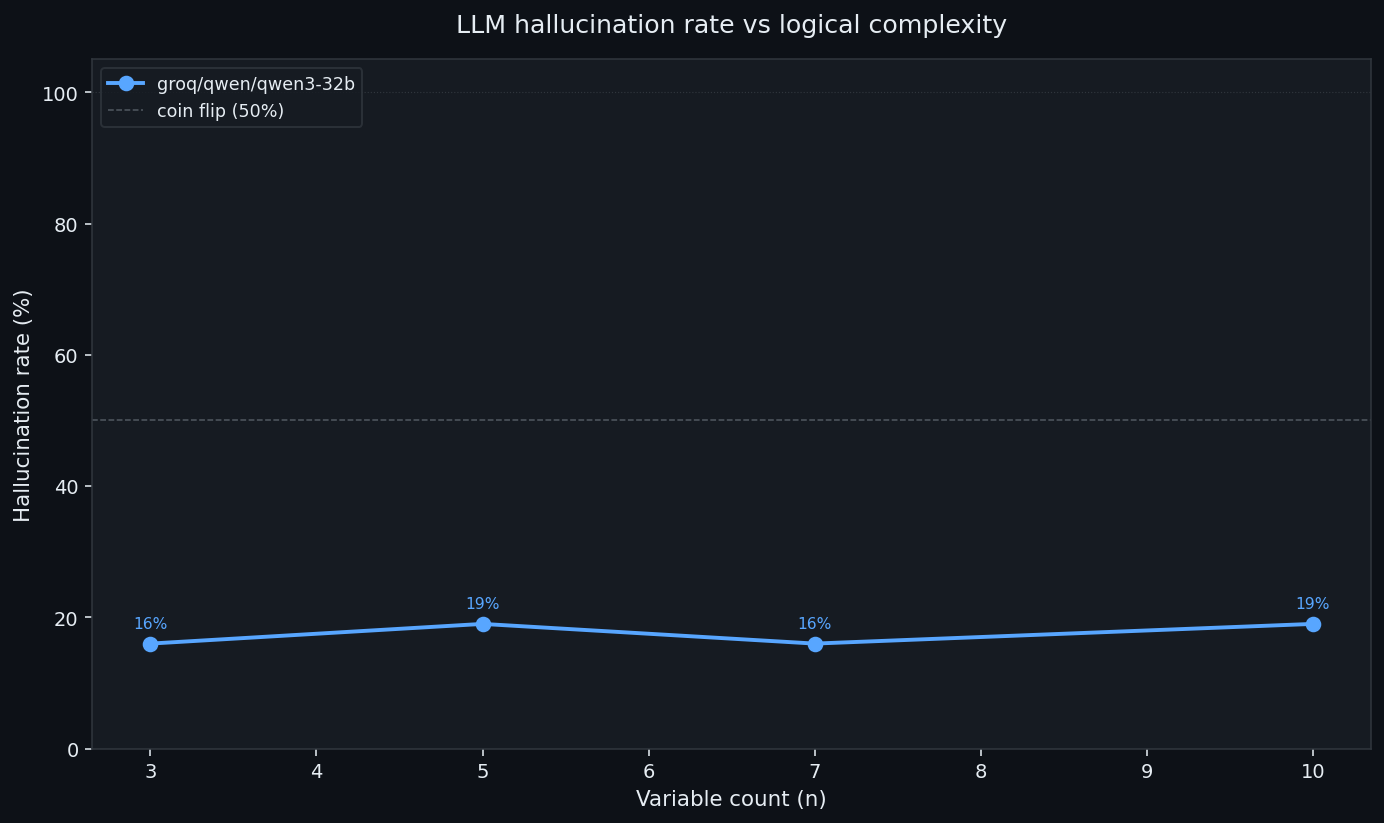
qwen3-32b was run across variable counts from 3 to 10 (8 to 1,024 truth table rows), 100 cases each. The hallucination rate stayed flat at 16–19% throughout. Complexity doesn't degrade it — the errors are a consistent baseline, not caused by harder logic.
| variables (n) | truth table rows | hallucination rate |
|---|---|---|
| 3 | 8 | 16% |
| 5 | 32 | 19% |
| 7 | 128 | 16% |
| 10 | 1,024 | 19% |
Full benchmark results
The engine is the oracle — ground truth is computed by exhaustive enumeration, not guessed. Every LLM disagreement is a provable hallucination.
Methodology: generate pairs of boolean expressions where the correct answer (satisfiable or not) is known exactly. Ask the LLM. Compare. No ambiguity, no human labeling, no interpretation.
python3 benchmark.py --provider ollama --model tinyllama --cases 20
python3 benchmark.py --provider ollama --model llama3.2:3b --cases 20
python3 benchmark.py --provider ollama --model gemma3:4b --cases 20
tinyllama — 1.1B parameters
⬡ z3  verifying 20 ground truth labels... ✓  all 20 cases agree

╭───────────── benchmark config ──────────────╮
│ model        ollama/tinyllama               │
│ cases        20  (10 conflict · 10 compat)  │
│ variables    3  (A, B, C)                   │
│ temperature  0  (deterministic)             │
│ max tokens   5  (yes / no)                  │
│ workers      8  parallel                    │
╰─────────────────────────────────────────────╯

  ollama/tinyllama — 20/20 cases | 50.0% hallucination rate

  #      Rule 1          Rule 2          vars    engine  llm
 ━━━━━━━━━━━━━━━━━━━━━━━━━━━━━━━━━━━━━━━━━━━━━━━━━━━━━━━━━━
  1  ✗   B               !B              B         no    yes
  2  ✗   A.B+C           !A.!B.!C        A B C     no    yes
  3  ✗   A.B             A.!B            A B       no    yes
  4  ✓   A+!B            A.(B+C)         A B C    yes    yes
  5  ✗   A.B             A^B             A B       no    yes
  6  ✓   !A+B.C          B               A B C    yes    yes
  7  ✓   A.B+C           A+B             A B C    yes    yes
  8  ✓   A+B.C.D         C               A B C D  yes    yes
  9  ✓   A.B             B               A B      yes    yes
 10  ✓   !C              !B              B C      yes    yes
 ...

╭─────────── results — ollama/tinyllama ─────────────╮
│ model               ollama/tinyllama               │
│ total cases         20  (10 conflict · 10 compat)  │
│ variables           3  (A, B, C)                   │
│ temperature         0  (deterministic)             │
│ max tokens          5                              │
│ correct             10                             │
│ hallucinated        10                             │
│ hallucination rate  50.0%                          │
│ missed conflicts    10/10  (100.0%)                │
│ missed compatibles  0/10   (0.0%)                  │
╰────────────────────────────────────────────────────╯
llama3.2:3b — 3B parameters
⬡ z3  verifying 20 ground truth labels... ✓  all 20 cases agree

╭───────────── benchmark config ──────────────╮
│ model        ollama/llama3.2:3b             │
│ cases        20  (10 conflict · 10 compat)  │
│ variables    4  (A, B, C, D)                │
│ temperature  0  (deterministic)             │
│ max tokens   5  (yes / no)                  │
│ workers      8  parallel                    │
╰─────────────────────────────────────────────╯

  ollama/llama3.2:3b — 20/20 cases | 50.0% hallucination rate

  #      Rule 1          Rule 2          vars    engine  llm
 ━━━━━━━━━━━━━━━━━━━━━━━━━━━━━━━━━━━━━━━━━━━━━━━━━━━━━━━━━━
  1  ✓   B               !B              B         no     no
  2  ✓   A.B+C           !A.!B.!C        A B C     no     no
  3  ✓   A.B             A.!B            A B       no     no
  4  ✗   A+!B            A.(B+C)         A B C    yes     no
  5  ✓   A.B             A^B             A B       no     no
  6  ✗   !A+B.C          B               A B C    yes     no
  7  ✗   A.B+C           A+B             A B C    yes     no
  8  ✗   A+B.C.D         C               A B C D  yes     no
  9  ✗   A.B             B               A B      yes     no
 10  ✗   !C              !B              B C      yes     no
 ...

╭─────────── results — ollama/llama3.2:3b ───────────╮
│ model               ollama/llama3.2:3b             │
│ total cases         20  (10 conflict · 10 compat)  │
│ variables           4  (A, B, C, D)                │
│ temperature         0  (deterministic)             │
│ max tokens          5                              │
│ correct             10                             │
│ hallucinated        10                             │
│ hallucination rate  50.0%                          │
│ missed conflicts    0/10   (0.0%)                  │
│ missed compatibles  10/10  (100.0%)                │
╰────────────────────────────────────────────────────╯
gemma3:4b — 4B parameters
╭───────────── benchmark config ──────────────╮
│ model        ollama/gemma3:4b               │
│ cases        20  (10 conflict · 10 compat)  │
│ variables    4  (A, B, C, D)                │
│ temperature  0  (deterministic)             │
│ max tokens   5  (yes / no)                  │
╰─────────────────────────────────────────────╯

  ollama/gemma3:4b — 20/20 cases | 35.0% hallucination rate

  #      Rule 1          Rule 2          vars      engine  llm
 ━━━━━━━━━━━━━━━━━━━━━━━━━━━━━━━━━━━━━━━━━━━━━━━━━━━━━━━━━━━
  1  ✗   B               !B              B           no    yes
  2  ✓   A.B+C           !A.!B.!C        A B C       no     no
  3  ✓   A.B             A.!B            A B         no     no
  4  ✓   A+!B            A.(B+C)         A B C      yes    yes
  5  ✗   A.B             A^B             A B         no    yes
  6  ✗   !A+B.C          B               A B C      yes     no
  7  ✓   A.B+C           A+B             A B C      yes    yes
  8  ✓   A+B.C.D         C               A B C D    yes    yes
  9  ✓   A.B             B               A B        yes    yes
 10  ✗   !C              !B              B C        yes     no
 11  ✓   A.B+!A.!B       !A.B            A B         no     no
 12  ✓   !A+B.C          A.B.!C          A B C       no     no
 13  ✓   A.B.!C          !A              A B C       no     no
 14  ✗   A.B.C           A.!B            A B C       no    yes
 15  ✗   !A.B            A+B.C.D         A B C D    yes     no
 16  ✓   A.!B            !A+B            A B         no     no
 17  ✓   A+B+C           A.B+C           A B C      yes    yes
 18  ✓   A+!B            A               A B        yes    yes
 19  ✗   A.(B+C)         !A.B            A B C       no    yes
 20  ✓   A.B.C           A.B+C.D         A B C D    yes    yes

╭─────────── results — ollama/gemma3:4b ─────────────╮
│ model               ollama/gemma3:4b               │
│ total cases         20  (10 conflict · 10 compat)  │
│ variables           4  (A, B, C, D)                │
│ temperature         0  (deterministic)             │
│ max tokens          5                              │
│ correct             13                             │
│ hallucinated        7                              │
│ hallucination rate  35.0%                          │
│ missed conflicts    4/10  (40.0%)                  │
│ missed compatibles  3/10  (30.0%)                  │
╰────────────────────────────────────────────────────╯
The vars column shows how many variables each case involves. The engine column is ground truth. Every mismatch with llm is a provable hallucination — not an opinion.
Per-case strips (bottom row of the chart): tinyllama and llama3.2:3b show uniform colour across all cells of each type — a constant output, no case-by-case variation. gemma3:4b shows mixed cells, indicating it engages with each case individually rather than defaulting to one answer.
Core API
from boolean_algebra_engine import evaluate, synthesize

# Forward: expression → truth table
table, _ = evaluate("A.(B+C)")
print(table.variables)    # ['A', 'B', 'C']
print(table.minterms)     # [5, 6, 7]
print(table.satisfiable)  # True

# Inverse: truth table → minimal expression
minimal, _ = synthesize(table)
print(minimal)            # A.C+A.B

# Equivalence and satisfiability (via MCP server functions — no HTTP, direct call)
# pip install boolean-algebra-engine[mcp]
from boolean_algebra_engine.mcp.server import equivalent, satisfiable

print(equivalent("A.(B+C)", "A.B+A.C")["equivalent"])  # True — distributive law
print(satisfiable("A.!A")["satisfiable"])               # False — contradiction
core/ has zero external dependencies. Import it into any Python project.
MCP — Claude calls the engine
Wire the engine into Claude Desktop and Claude stops predicting boolean logic. It computes it.
{
  "mcpServers": {
    "boolean-algebra-engine": {
      "command": "python",
      "args": ["-m", "boolean_algebra_engine.mcp.server"]
    }
  }
}
Five tools Claude can call mid-conversation:
evaluate— expression → truth tablesimplify— expression → minimal formequivalent— are two expressions identical?satisfiable— does any input make this true?check_prompt_logic— audit a full rule set for contradictions, tautologies, conflicts, duplicates
Operators
| Symbol | Operation | Precedence |
|---|---|---|
! |
NOT | 4 (highest) |
. |
AND | 3 |
^ |
XOR | 2 |
+ |
OR | 1 (lowest) |
Variables: uppercase A–Z. Parentheses override precedence. Up to 26 variables, arbitrary nesting.
Interfaces
| Interface | How |
|---|---|
| Python library | from core.evaluator import evaluate — embed in any project |
| CLI / REPL | boolcalc "A.B+!A.C" — instant truth table in terminal |
| MCP server | Claude Desktop plugin — plug and play |
| REST API | POST /check-rules — callable from any language or stack |
| NL layer | Plain English → expression → verified result (Anthropic, OpenAI, Ollama, any OpenAI-compat) |
| Streamlit UI | Three modes: Expression, Rule Auditor, Plain English |
vs SymPy and boolean.py
SymPy (sympy.logic) is more powerful for pure boolean mathematics — its DPLL-based satisfiable() scales better beyond 15 variables, and simplify_logic() covers similar minimization ground. If you're doing symbolic mathematics, use SymPy.
boolean.py handles expression parsing and symbolic simplification cleanly. If you need to manipulate boolean expressions as objects, it's the right tool.
This engine is different in three ways:
-
Zero-dependency core. SymPy pulls in numpy, mpmath, and the full symbolic stack.
core/is plain Python — no install side-effects, embeds anywhere. -
Built for AI pipelines, not mathematics.
check_prompt_logicaudits a set of rules for pairwise conflicts — the kind of check you run on a system prompt or a business rule engine before an agent acts on it. Neither SymPy nor boolean.py has this concept. -
The integration layer. MCP server for Claude Desktop, NL layer for plain English input, REST API, benchmark against LLMs — none of this exists in math-focused libraries because it's not a math problem. It's an AI reliability problem.
If you want to do boolean algebra, SymPy is the answer. If you want to verify that your AI agent's rules don't contradict each other, this is built for that.
Credibility
The engine does not sample, approximate, or predict. It evaluates every possible input combination:
- Satisfiable — an actual row where output = 1 was found
- Contradiction — every row was checked, all were 0
- Equivalent — output columns compared row-by-row across the full truth table
- Conflict — conjunction of both rules evaluated for every input, always returned 0
The core evaluator is 15 lines (core/evaluator.py). No black box, no model weights, no probability — just arithmetic. This is a stronger correctness claim than any probabilistic tool can make.
90 tests across unit, integration, edge cases, and round-trips. All passing.
Release history Release notifications | RSS feed


Download files
Download the file for your platform. If you're not sure which to choose, learn more about installing packages.
Source Distribution
Built Distribution
Filter files by name, interpreter, ABI, and platform.
If you're not sure about the file name format, learn more about wheel file names.
Copy a direct link to the current filters
File details
Details for the file boolean_algebra_engine-0.3.2.tar.gz.
File metadata
- Download URL: boolean_algebra_engine-0.3.2.tar.gz
- Upload date:
- Size: 50.4 kB
- Tags: Source
- Uploaded using Trusted Publishing? No
- Uploaded via: twine/6.2.0 CPython/3.9.25
File hashes
| Algorithm | Hash digest | |
|---|---|---|
| SHA256 |
de85454c315dd7e970f579b0e7c5e702831b74552b0dbc76d0872b5d70c1a0f7
|
|
| MD5 |
eb6952a233cb324499fe6a4c39a13eb6
|
|
| BLAKE2b-256 |
966a9ae2130c51173ab0a1dde7c569291ba4ad5d228f6e66d613b229d12c0d4a
|
File details
Details for the file boolean_algebra_engine-0.3.2-py3-none-any.whl.
File metadata
- Download URL: boolean_algebra_engine-0.3.2-py3-none-any.whl
- Upload date:
- Size: 44.4 kB
- Tags: Python 3
- Uploaded using Trusted Publishing? No
- Uploaded via: twine/6.2.0 CPython/3.9.25
File hashes
| Algorithm | Hash digest | |
|---|---|---|
| SHA256 |
21be600fc8a5526ed3be06f54292dfa7754a8a0a1518b2ee83eca83b597637b8
|
|
| MD5 |
59182ffb34de89d518f88c794abdaf21
|
|
| BLAKE2b-256 |
729d77ebd8ebb00d15dd337de83a0bc41112f20dc1c928f64d950bb3a2ba92f6
|






